“Help–My Daughter Just Attempted Suicide”

My 19-year-old daughter has been hospitalized because she has tried to commit suicide. This has not only created a moment of crisis with in our immediate family but a very big puzzling question. Why would a person who professes to believe in Christ attempt to commit suicide? What should I say to her? How can I tell her that Christ is bigger than any of her problems may be?

Please know that I will be praying for your daughter and your family in this difficult time.

Teenagers are universally having a difficult time sorting out their lives in this new millennium. There are so many competing pressures and influences that they easily get overwhelmed. While suicide is indeed a drastic measure, it is more common today among our youth than ever before.

If your daughter is a believer, as you suggest, she might be wondering where is God in her life and circumstances. She may have a false expectation that knowing God should make everything better. While Proverbs makes clear that we are better off living with wisdom and insight, there are no guarantees against trouble. In fact Jesus warned that we would have tribulation in our lives. We can often see the ungodly and wicked succeeding in life and wonder why we should bother doing things right. Asaph wondered the same thing in Psalm 73. Check out my article on Where Was God on 9/11? for an exposition of this important Psalm.

She may also rationalize that heaven will be a far better place than earth and why not get there sooner if her life seems impossible for whatever reason. This logic is hard to refute especially since we believe in the eternal security of the believer. Suicide does not forfeit your place in heaven if you are a true child of the King.

If she is not truly a believer then she needs the hope only He can bring. Images of the Good Shepherd from Psalm 23 and John 10 (especially verses 9, 11, 14, 15, 27, 28, and 29) can be very helpful to someone struggling to make their way in this messy world. The entire Gospel of John may be a good project for the two of you to read together.

So what do you say? First, you assure her of your love and commitment to her no matter what she has done. As her father, you carry the major load in communicating your love and acceptance of her no matter her failures or perceived inadequacies. You must depend on the Lord to allow you to see her through Jesus’ eyes.

Second, she needs to understand that God is sovereign and has planned out her life. In our relationship with Him we need to seek His wisdom and guidance not our own. Things may look bad now but she can’t see her life ahead as the Lord does. There is a reason for everything even when it doesn’t make sense to us. She may not be ready to trust God with her life yet but she needs to know you trust God with her life.

Third, there is undoubtedly some deep seated need or hurt in her life that causes her to disrespect herself so much. She will likely need counseling to uncover this. But she will need your support through the entire process. You may need to face a failure on your own part in her life that you are unaware of. You have to be willing to face whatever it takes to bring her back to wholeness. For awhile you will need to supply the courage she needs to face every day. You can’t do this in your own strength. Remember Isaiah 40:31:

But those who hope in (or wait upon) the LORD
will renew their strength.
They will soar on wings like eagles;
they will run and not grow weary
they will walk and not be faint.

Take courage, for your Savior has overcome the world and there is nothing impossible to Him.

Respectfully,

Dr. Ray Bohlin

©2005 Probe Ministries


The Continuing Controversy over Stem Cells: A Christian View

Dr. Ray Bohlin brings a biblical worldview to this intersection of ethics and science.  From a Christian perspective, is it right to harvest and destroy embryonic stem cells for the hope of possible finding a treatment for some diseases?

Different Kinds of Stem Cells

Stem cell research grew into a major issue in the 2004 election and will continue to be discussed and argued for years to come as research continues to make progress. Unfortunately, most people continue to be misinformed about the real issues in the discussion.

Most articles in the media fail to distinguish between the different kinds of stem cells and the different ethical questions each of them presents. Several states either already have or are working to get around federal restrictions on embryonic stem cell research in order to keep the research dollars at their state research universities.

So the controversy has far from abated. In order to think our way through this we will need some basic information. First, we need to understand some things about stem cells in general and the types of stem cells available for research.

What are stem cells? Stem cells are specialized cells that can produce several different kinds of cells in your body. Just like the stem of a plant will produce branches, leaves, and flowers, so stem cells can usually produce many different kinds of cells within a particular tissue.

There are over one trillion cells in your body. Most will only divide a few times. For instance, when you were born you basically already had all the brain and neural cells you would need. As you grew, those cells simply got bigger. However, other tissues need a constant renewing of cells. The lining of your intestines, stomach, skin, and lungs constantly slough old cells and need replacements. Your blood cells constantly need replacing. In these kinds of tissues, specialized stem cells continually produce new cells.

BlastocystThere are skin, bone marrow, liver, muscle, and other types of stem cells in your body. These are referred to as adult stem cells. Other common types of stem cells are those found in umbilical cord blood. Even though these are fetal tissues, they are referred to as adult stem cells because they are already differentiated to a large degree. There are no ethical difficulties in using these stem cells for research and therapy.

Now, what are embryonic stem cells? Embryonic stem cells exist only in the earliest embryo just a few days after fertilization. This is referred to as the blastocyst. The blastocyst contains a small cluster of identical cells called the inner cell mass. These cells eventually form the baby and therefore can produce all the cells of the body. These are embryonic stem cells (ESC). In order to retrieve them, the embryo is destroyed.

Here then is the problem. While adult stem cells offer no ethical difficulties–but are not likely to be as versatile as embryonic stem cells–embryonic stem cells can only be obtained by destroying the embryo.

The Promise of Adult Stem Cells

What is the overall hope for stem cells? Why are they so sought after?

Essentially, it is hoped that stem cells can be used to treat and even cure diseases like diabetes, Parkinson’s, Alzheimer’s, and brain and spinal injuries. These are primarily degenerative diseases where certain cells no longer function as designed due to genetic defects or injuries. Generally it has been believed that embryonic stem cells offer the most hope since we know they can become any cell in the body.

But embryonic stem cells require the destruction of the embryo where adult stem cells can be harvested from the individual that needs to be treated. First, this involves only informed consent and is ethically non-controversial. Second, since the person’s own cells are used, there is no chance of rejection of the cells by the patient’s immune system.

In the last few years important discoveries have been made concerning certain types of adult stem cells. Essentially, we have learned that adult stem cells can switch tissues. Bone marrow stem cells seem to be the most versatile. They have been coaxed to generate new muscle, neural, lung and other tissues.

Additionally, we have learned that adult stem cells migrate throughout the body in the blood. It appears that adult stem cells are somehow informed of injury in the cell and can migrate from their source to the injury and begin at least modest repairs.

In January 2002, a group from the University of Minnesota announced what they called the ultimate adult stem cell. In creating an
immortal cell line from bone marrow stem cells, early tests showed that these stem cells could become either of the three early tissues in an embryo that eventually lead to all the cell types of the body. This showed that adult stem cells are far more versatile then previously believed.

Last year the National Institutes of Health spent $190 million on adult stem cell research and $25 million on embryonic stem cell
research. Clinical trials are already underway using bone marrow (adult) stem cells for treatment of heart attacks, liver disease, diabetes, bone and cartilage disease, and brain disorders. Adult stem cells can even be injected intravenously in large quantities, and they will migrate to where the injury is located. With such promise coming from adult stem cells it is hard to justify the use of problematic embryonic stem cells.

The Promise and Peril of Embryonic Stem Cells

Embryonic stem cells have always held the greatest promise for research and therapies because we know for certain that they can become any of the over 200 types of cells in the body. All we needed to do was learn how to control their destiny and their potential for unlimited growth.

As mentioned previously, the major ethical problem with embryonic stem cells is that the early embryo, the blastocyst, must be
destroyed in order to retrieve these cells. It is my firm conviction that this earliest embryo is human life worthy of protection. Once the nucleus from sperm and egg unite in the newly fertilized egg, a biochemical cascade begins that leads inevitably to a baby nine months later as long as the embryo is in the proper environment.

But there are other problems aside from the ethical barrier. The proper chemical signals to direct stem cells to turn into the cells you want are unknown. This is certainly the goal of research. Human embryonic stem cells have been coaxed to differentiate but since nearly all of the experimental work to date has been done with embryonic stem cells from embryos leftover in fertility clinics there are immune rejection problems. These foreign cells are treated like they were from an organ donation.

Additionally, these cells are programmed to undergo rapid cell division. In China a man with Parkinson’s was treated with human embryonic stem cells which turned into a tumor (teratoma) in his brain that killed him. The power of these cells is also a source of their peril.

In summary, embryonic stem cells possess uncertain promise. They require the death of the embryo. All therapies with any kind of stem cell are experimental and may not work. Right now, too much is being promised, and coverage in the media has been biased toward embryonic stem cells and is inaccurate.

When these difficulties and question marks are considered in the light of the exciting promise of adult stem cells, which are already producing positive results in human clinical trials, the pursuit of embryonic stem cell research is questionable at best. Just recently a major U.S. journal reported that bone marrow stem cells show great promise in treating the diseased lungs of cystic fibrosis patients.{1} CF is the most common fatal genetic disorder in the Caucasian population. Adult stem cells continue to outperform embryonic stem cells.

Stem Cells and the Last Election

The first human embryonic stem cells were isolated from embryos donated from fertility clinics in 1998. Prior to that, Congress had passed–and President Clinton had signed–legislation that prohibited the use of federal money for the destruction or use of human embryos for research purposes. This was seen as worthy even for pro-choice advocates because no one wanted to go down the road of using even the earliest human life for research purposes.

When President Bush took office in January 2001, pressure had already come from the medical research community to revise this restriction so federal grants could be used to explore this promising research avenue. Adult stem cells were still viewed as being too restricted for general research use in humans. In August 2001, President Bush issued his now famous compromise
of allowing federal funds to be used to research embryonic stem cells already isolated from human embryos, but keeping in place the restriction for using federal dollars for destroying human embryos to obtain additional cell lines.

The National Institutes of Health estimated that there were already over sixty human embryonic stem cell lines isolated around the world that would be available for research purposes. The President was criticized by pro-life advocates for allowing any federal money for research on embryonic stem cell lines, and the medical research community criticized the President for not allowing federal research money for the creation of new embryonic stem cell lines. If everybody is unhappy, it sounds like a good compromise!

The events of September 11, 2001 quickly removed this controversy from the public’s attention, but the 2004 presidential election
brought it back front and center. The Bush administration, supported by the President’s Council for Bioethics, continued to argue against federal money for the destruction of embryos.

The Kerry campaign seized what they saw as an opening and began claiming that they would lift the ban on stem cell research. They enlisted Ron Reagan to deliver this message at the Democratic National Convention in July, 2004. Ronald Reagan had recently passed away from Alzheimer’s, and many were claiming that embryonic stem cell research could bring a cure for Alzheimer’s disease.

There were several problems with this message. First, President Bush never banned stem cell research. The Administration was funding adult stem cell research at about $190 million a year and embryonic stem cell research at about $25 million a year. Private money was always legal to use, but private investors were staying away because of the ethical problems and the
lack of progress.

Second, researchers had already testified on Capital Hill that Alzheimer’s was likely not curable by treating the brain with stem cells since it was considered a whole brain disease and cell replacement would not do much good. The media just couldn’t get it right.

The Distortion and the Hype of Embryonic Stem Cells

Those of us who are opposed to the use of embryonic stem cells for research are routinely accused of being hard-hearted toward those whose maladies can be addressed with stem cell research. Of course, this is not the case. We fully support adult stem cell research, but even if adult stem cells prove problematic in some cases I would still not support embryonic stem cell research when the embryo must be destroyed to obtain them.

When we think about saving lives we must count the cost. Is relieving the symptoms of disease worth the cost of the lives of the weakest and most defenseless members of society? Treating embryos with careless disregard will lead to further abuses down the road.

One of the problems with embryonic stem cells was the possibility of immune rejection. To avoid this, many want to clone the affected individual and use the embryonic stem cells from the clone. But this treats the human embryo as a thing, a clump of cells. The basis of this ethic is strictly “the end justifies the means.” Even the term “therapeutic” is problematic. The subject is destroyed.

Many try to get around the destruction of the embryo problem by claiming the blastocyst is just reproductive cells and not a person. Medical mystery writer Robin Cook gave us an example in his most recent thriller, Seizure.{2}. In the book a medical researcher appears before a Senate committee and says, “Blastocysts have a potential to form a viable embryo, but only if implanted in a uterus. In therapeutic cloning, they are never allowed to form embryos. . . . Embryos are not involved in therapeutic cloning.”{3} Hm!

Later in the epilogue, Cook, who is an MD, says, “Senator Butler, like other opponents of stem-cell and therapeutic cloning research, suggests that the procedure requires the dismemberment of embryos. As Daniel points out to no avail, this is false. The cloned stem-cells in therapeutic cloning are harvested from the blastocyst stage well before any embryo forms. The fact is that in therapeutic cloning, an embryo is never allowed to form and nothing is ever implanted into a uterus.”{4}

Cook is greatly mistaken. A 1997 embryology text states plainly that “The study of animal development has traditionally been called embryology, referring to the fact that between fertilization and birth the developing organism is known as an embryo.”{5} So let’s be very careful and pay attention to what is said. Some are trying to manipulate the debate by changing the “facts.” We must promote the incredible success and continued promise of adult stem cells while continuing to spell out the long term peril of embryonic stem cells.

Notes

1. Wang, Guoshun, Bruce A. Bunnell, Richard G. Painter, Blesilda C. Quiniones, Nicholas A. Lanson Jr., Jeffrey L. Spees, Daniel J. Weiss, Vincent G. Valentine, Darwin J. Prockop, “Adult stem cells from bone marrow stroma differentiate into airway epithelial cells: Potential therapy for cystic fibrosis” PNAS online, www.pnas.org (accessed December 22, 2004).

2. Robin Cook, Seizure (New York: Berkeley Books, 2003), 429.

3. Ibid, 32-33.

4. Ibid, 428.

5. Scott F. Gilbert, Developmental Biology, 5th ed. (Sunderland, Mass.: Sinauer Associates, Inc., 1997), 3. Later in the same text, Gilbert clearly equates the blastocyst and embryo when he says on page 185, “While the embryo is moving through the oviduct en route to the uterus, the blastocyst expands within the zona pellucida.” Gilbert seems to have had a change of heart between his fifth edition and the sixth. In the sixth edition of his textbook Gilbert defines embryology differently. “The study of animal development has traditionally been called embryology, from that phase of organisms that exists between fertilization and birth.” This is on page 4 of the new edition and curiously leaves the word embryo out of the definition of embryology. Perhaps Cook and Gilbert know each other!

© 2005 Probe Ministries
See Also:


“When Does Human Life Begin?”

I am in an exchange of views with someone in regard to the question of when
life begins. He is a very well read and educated person, however I cannot vouch for
what or who he reads! According to him, “There is no hard line to draw where life of
a human being begins. We only know that as soon as the sperm cell and egg fuse, the
resulting cell bears the genetic and biochemical potential to become a new human
person. Everything else is an opinion, not science, only God knows at what stage
the life of a human person really begins.” What recommendations might you have in
dealing with this discussionspurred by the stem cell research issue during the election.

Your friend is essentially correct from a scientific perspective, but what he cites
is very important. Having the full genetic and biochemical potential to develop
into a baby in nine months is the only certain point of demarcation. Anything else
will be an arbitrary point chosen largely for convenience. So why not establish
fertilization as the point at which human life ought to be protected?

U.S. law was originally quite clear that where there was doubt, err on the side of
life. Now we choose to err on the side of death just so we can pursue the next series
of experiments. Nobody wants to worry about what if we’re wrong? We just redefine
life so we can proceed ahead. And those who think religious perspectives should be
left out are fooling themselves. If scientifically we cant make any other clear
point of reference then the point you do choose has been chosen for reasons
other than science, which means personal values and beliefs. This should be
a lesson that so-called personal values intersect with facts all the time
and they truly cannot be separated.

Of course, biblically and theologically, the line of demarcation is quite clear.
Beginning with Psalm 139:13-16,

13 For You formed my inward parts; You wove me in my mother’s womb.
14 I will give thanks to You, for I am fearfully and wonderfully made; Wonderful are Your works, And my soul knows it very well.
15 My frame was not hidden from You, When I was made in secret, And skillfully wrought in the depths of the earth;
16 Your eyes have seen my unformed substance; And in Your book were all written The days that were ordained for me, When as yet there was not one of them.

followed by Isaiah 49:1,

Listen to Me, O islands, And pay attention, you peoples from afar. The LORD called Me from the womb; From the body of My mother He named Me.

Psalm 51:5,

Behold, I was brought forth in iniquity, And in sin my mother conceived me.

and Jeremiah 1:5,

“Before I formed you in the womb I knew you, And before you were born I consecrated you; I have appointed you a prophet to the nations.”

The Scriptures clearly indicate that a person made in the image of God is
present even before there is a biological manifestation of such.

I would basically tell your correspondent that he has helped make your case for
protecting the earliest life. Fertilization is the only sure point of demarcation.
We were all once a blastocyst and even a fertilized egg. But none of us was ever
just a sperm or egg cell.

Respectfully,

Ray Bohlin, Ph.D.
Probe Ministries

2005 Probe Ministries


Dr. Ray Bohlin Responds to Attacks on Intelligent Design

To the editor of Newsweek:

Jonathan Alter must have thoroughly enjoyed writing this incredibly polemical piece, taking full advantage of every stereotype, argument from authority, straw man, and unsupported assertion his space would allow. He craftily gives credit to scientific sounding arguments against evolutionary theory while claiming they have all been discredited without mentioning the well-reasoned answers to these criticisms. As an example he cites Ken Miller’s criticism of ID without mentioning that Miller himself has been respectfully answered, critiqued and refuted.

If simply rehashing the old science vs. religion argument is the best the media and the general science community can do, the battle is over. I have been making a scientific case against Darwinism and for Intelligent Design for over thirty years. As one credentialed in science, a Discovery Institute Fellow and one of the first 100 signers (now over 400) to their statement of scientific skepticism about Darwinism, I can tell you that our ranks are swelling and our case getting stronger all the time. Pieces like Alter’s only show us and Newsweek’s readers, the bankruptcy of the Darwinian paradigm.

Raymond G. Bohlin, Ph.D.
President, Probe Ministries

I would like to make some additional comments here.

1. Alter magically proclaims that “One of the reasons we have fewer science majors is the pernicious right-wing notion that conventional biology is vaguely atheistic.” How does he know that? Of course he just states it as a bald assertion, expecting us to just believe it because he says so. His claim might be true, but he is clearly trying to blame doubts about evolution for the U.S.’s perceived sputtering in science. Need a whipping boy? Try “right-wing fundamentalists.” Some will believe that every time.

2. He says that offering ID as “an alternative to evolution in ninth-grade biology is a cruel joke.” Nowhere has anybody made such a request. Even in Dover, PA, the disclaimer by the school board simply offers ID as something students might explore. It is not officially offered in the classroom as a competing theory. Discovery Institute itself maintains that ID is not ready for such treatment.

3. In the same paragraph, Alter says “ID walks like science and talks like science but, so far, performs in the lab worse than medieval alchemy.” I guess that was supposed to sting. What Alter doesn’t realize is that in molecular and cell biology, in particular, the language of design is everywhere in describing the workings of the incredible molecular machines inside the cell. They just claim that natural selection produced them with no real attempts to explain how. And as a mechanistic theory, evolution should be able to. So in reality, ID is used all the time in biological research, even by evolutionists, you just can’t call it that if you want your work to be published.

4. Alter drags the ever present Kenneth Miller into his discussion. He mentions, parenthetically, that Miller attends Mass every week. So what? It’s a double standard to allow Miller’s attendance at church serve to further his credibility when my association with a Christian ministry has been used to discredit my testimony and somehow claim that my scientific reasoning is now suspect. Nobody ever mentions Miller’s possible conflict of interest in his defense of evolution and criticism of ID. Kenneth Miller is coauthor of a well-known high school biology textbook that strongly promotes evolution as the grand unifying principle of biology. If evolution is dethroned, he loses money and his reputation. How come his reasoning isn’t compromised?

5. Alter claims that science and religion are not at odds over evolution. Fine. But science is at odds with the Darwinian mechanism and there have always been doubts. As I said in my letter to the editor, the scientific case for ID only grows stronger and the debate is here to stay. Let them keep making the science vs. religion argument and the more thoughtful and reasonable among us will see through the smoke screen and will give ID a chance. That’s all we ask.

6. Alter makes it seem that the appeal to science standards and school boards is a last ditch effort when all else has failed. In reality, these are true grassroots efforts by people who have read the books and want the truth taught to their children. Many have been frustrated for years that their kids are exposed to an evolutionary filibuster in school and are encouraged that there is a growing scientific revolt in support of their concerns. The Time article mentions that 30% of surveyed biology teachers felt pressure to give evolution a short treatment by concerned parents. What about the greater than 50% of students (far more vulnerable to pressure than adult teachers) who have felt bullied by evolution for decades?

7. All this negative publicity is actually a good thing in the long run. As long as the silly arguments are answered, we gain new adherents with every wise-cracking, arrogant article. Why? Because reasonable people see through all the fuss eventually and realize that something funny is going on. After that they read Behe, Dembski, Meyer, Gonzalez, Richards, Nelson, Wells, Thaxton, Bradley, and other ID leaders and it all begins to come together. May our tribe increase!


See Also:


© 2005 Probe Ministries International


“Is Faith Fact, or Are They Opposites?”

A fellow Christian friend and I recently got into a discussion over faith and facts, and I would like your opinion on the subject. It started by her asking me “Is faith fact?” Well I replied yes, because our faith is grounded in the fact of the resurrection, our faith has to be based on something true or our faith is in vain. She was arguing faith is not fact and it takes faith to believe in the resurrection in the first place and she said because we walk by faith not sight that facts are a “worldly” way of doing things. I feel the Bible teaches fact and reason as being viable and complimentary to faith. I would appreciate your biblical opinion on this subject.

Facts and faith are different things, and both are necessary. In Acts 17 and 1 Corinthians 15 Paul exhorts his readers and listeners toward an examination of the facts. Paul clearly believed that the facts of creation, Jesus’ life, death, and resurrection, made his case for the deity of Christ reasonable. Facts rarely prove a point but they do indicate its reasonableness. (That is why in a court room you are asked to convict beyond a “reasonable” doubt, they don’t say beyond any doubt). What matters in faith is the object of our faith. I can believe the sun will not rise tomorrow, but the facts argue that this is not a reasonable faith. The same is true of our faith in Christ. I cannot prove that he lived, died, and rose from the dead, but I can gather facts of history which make that conclusion not only reasonable, but I believe, compelling. Based on my faith in the reality and person of Jesus Christ, I also have faith in the truth of what he said about spiritual things and future events. There are few facts if any to back up his statements, only those which verify his person and events which are significant enough to believe whatever he said, but there are no specific facts to back up his claim that He will come again.

I hope this helps.

Ray Bohlin

Probe Ministries


“I Need Help Figuring Out the Meaning of MY Life”

Jerry Solomon,

I read your essay entitled, “What’s the Meaning of Life?” and was encouraged. I see that you wrote the piece over five years ago; but of course the content is ageless.

If you have a few minutes, I’d like to share my story with you and perhaps solicit some advice from you.

I’m 43. I became a believer when I was 8. I’ve walked closely with Jesus for most of those years. I have a wife of 22 years and three fantastic teenage children. Vocationally, I’ve been [details edited out]. In addition to many other blessings, God has blessed us financially—so much so that the financial need to work has diminished, leaving me time (and emptiness) to consider “meaning” questions.

I ask God, “What’s next?” but I don’t seem to be getting throughor at least I don’t understand His answer(s). Most men (including my believing dad) are very uncomfortable talking to me about “meaning” questions. I sense that it’s scary for them to face such crucial issues head on. I’ve read Purpose Driven Life and am re-reading Piper’s Desiring God. Purpose Driven Life was good; but it didn’t offer me any new perspectives. Piper’s book is challenging; but I’m not sure how to “activate” the whole idea of “enjoying God.”

I’m taking a month off work to try to figure out what happens next. I would be honored if you would take time to comment or share spiritual insights you (or your staff) might have.

Dear ______,

Thank you for your comments and expression of gratitude upon reading Jerry’s article. In a following paragraph to his article we explain that Jerry is no longer with Probe and that within 2 years of leaving Probe for an associate pastor’s role in a local church, the Lord took him home after a 6 month battle with pancreatic cancer. I will respond to your query as best I can.

You are correct in your observation that many men are uncomfortable considering questions of meaning. Basically they are afraid of what they might discover and that their life has been focused on the wrong things. Who wants to discover that?! This is especially so for someone like your dad who is late in life with little time to correct his perspective.

You are also correct in your intuition that discovering life’s meaning for you has to go beyond reading a book. Purpose Driven Life is great for those who have never even considered these things. But for those who have followed Him with some perseverance over many years will find the book a little stale and repetitive. It really is for baby Christians.

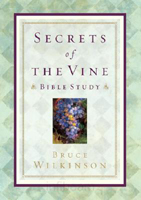
Secrets of the VineI would like to suggest a different book you can read in an hour or so but the application at the end could last several years. The book is Bruce Wilkinson’s Secrets of the Vine. It’s an exposition of John 15 that outlines four stages to a believers life: (1) little fruit, (2) no fruit due to discipline brought on by sin, (3) pruning to produce more fruit, and (4) full abiding. My suspicion is that you are desiring a fully abiding relationship with your Lord, and Wilkinson’s description of his own crisis and his solution will be enlightening and empowering to you.

Unfortunately, in my experience, few Christians get to the place where full abiding is where they want to be. It scares them. It is a full relinquishing of ourselves to Him and Him alone. Abiding truly is just being with Him and not necessarily looking for more ways to serve, more things to accomplish. Abiding is getting to the point where we realize that if we simply pursue Jesus, all He wants from us will flow with almost no effort because we are yielded to Him.

This requires a sharpened sense of knowing His will. To do that one needs to spend time with Him, truly know Him. Wilkinson embarked on a journey of journaling his thoughts with the Lord. I am working on developing that skill. It’s not easy for me, having grown up with a loving but non-communicative father. I’m still learning how to talk to my heavenly Father as a person and not some kind of heavenly czar.

I have led several groups of men through this book, and some get it and get it big. Most, however, are intrigued, enlightened, but non-committal.

Quite simply, yet frustratingly, the meaning of life is Jesus. “I am the way, the truth, and the life.” Ultimately, knowing Him and pursuing Him is the only thing that can bring true meaning, fulfillment, and joy in this life, no matter what we actually do, day in and day out.

Respectfully,

Ray Bohlin, PhD

Thank you very much for your very thoughtful response. I was very encouraged by your comments and felt like you really understand the struggle. Wow, what a breath of fresh air, that another brother understands. I look forward to getting and reading Bruce Wilkinson’s Secrets of the Vine. Thank you for taking the time to respond.

© 2005 Probe Ministries


“Is There a Genetic Component to Homosexuality?”

Dear Dr. Bohlin,

I noticed that you have some background in genetics. I am writing an article involving homosexuality for my own website. Many homosexuals want to say they are “born” that way, or that God made them homosexual. However, the evidence so far is unconvincing.

I am a student of science and scientific knowledge and have some background in science as well. I believe that there may be a genetic component to what some homosexuals experience.

Also, I’ve been thinking that some homosexuals may have a genetic defect somewhere that we may discover. They may not want to hear or believe this, but I think it is a possibility. They don’t seem to realize that just because they may be “born” homosexual does not mean that they were meant to be homosexual. For example, some are born with sickle-cell anemia, but we know that this is due to a genetic defect and that this is abnormal for red blood cells. This is a problem that needs to be fixed. I think we may find in the genetic code a defect that leads some to homosexuality. I purposely used the word “some” in my statements because I think it is pretty well established by now that homosexuality is not a monolith and that some of them do choose this lifestyle deliberately. So what do you think?

No one has identified any gene that has been linked to homosexuality. Dean Hamer reportedly found a chromosomal region that was prevalent in male homosexuals but his work was unrepeatable and has been largely discarded.

It certainly is possible that there may be a gene or sets of genes that predispose someone to homosexuality. But you correctly surmise that this in no way would determine homosexual behavior. We all probably have genetic predispositions of one sort or another that make it easier for us to sin in some areas than in others. This could be similar to suspected predispositions for some to alcoholism (as found in some races and ethnic groups). This does not mean their alcoholism is excused or acceptable. The same would be true of any predisposition to homosexuality.

Keep in mind also that many who desire to leave the homosexual lifestyle can and do, and many have successfully worked to change their romantic and sexual attractions. If it were in any way genetically determined, this would not be possible. It would be like choosing to have genetically blue eyes and blonde hair (hair coloring and colored contact lenses aside).

Also, many in the gay community are distancing themselves from any genetic component to homosexuality because that would mean a genetic test could eventually be developed for it. They know full well that many parents would likely choose to have any embryo/fetus testing positive for homosexuality to be aborted or simply not implanted in the case of IVF.

Respectfully,

Ray Bohlin, PhD
Probe Ministries

2005 Probe Ministries


“Why Would an E.T. Have to Have a Biology Like Ours?”

Love your ministry. Keep up the good work! Just a question on your article UFOs and Alien Beings

You wrote:

In the first place, it is highly improbable that there is another planet in our cosmos capable of supporting physical life. Dr. Ross has calculated the probability of such a planet existing by natural processes alone as less than 1 in 10174.

My question would be: Why would one assume that an E.T would have to have biological mechanism that functions as you and I? Is it possible they can have a body that is not limited or constrained to “our” conditions here on planet earth?

You asked a good and frequent question. Actually complex life would have to be of similar chemistry as us. It turns out that carbon is the only element capable of forming the diversity of bonds and molecules that would allow life. Carbon can form bonds to four other atoms, including hydrogen, oxygen, and nitrogen as well as others. These bonds can serve as the basis for numerable molecules which life depends on. Since other life would necessarily be carbon based, there would also be requirements for water, oxygen, carbon dioxide, phosphorous, sulfur, etc. Eventually life’s chemistry would be similar to our own and intelligent life would have to be similar to us.

Respectfully,

Ray Bohlin, Ph.D.
Probe Ministries

© 2005 Probe Ministries


“You are Full of Hatred and Bigotry”

I just read your article Contact: A Eulogy for Carl Sagan. I hope you live to understand the hatred and bigotry you people spread and the millions of deaths that your kind of blind stupidity has caused. You live based on a political system used to control gullible people; that in itself is not wrong but please try to use the brain you have and think, just once in your life think.

Don’t waste your life with a lie. The universe is a wonderful place, whatever you believe, being so large and wonderful, let’s all think big and not insular and earth bound.

Good luck with seeing the truth and being honest with yourselves.

Sorry you had such a negative reaction to my article concerning Sagan and “Contact.” You’re certainly not the first to respond to me that way.

I certainly do think that the universe is a wonderful place. I simply believe I have a much better reason for thinking that way. The universe is wonderful because God created it that way and I can appreciate the beauty, wonder, and awe of what I see as a reflection of the Creator. Sagan, and I presume you, have no reason for awe and wonder. We’re just cogs in a mechanistic universe that did not have us or anything else in mind. We just happened. When we die, we’re dirt and our lives have had no real significance.

Sagan in his opening monologue to the Cosmos series claims “There is a catch in the voice and a tingle in the spine as we approach the grandest of mysteries.” He is referring to the origin and nature of the universe. However, if it’s just molecules colliding over time, what’s to get excited about? I maintain Sagan is borrowing his awe and wonder from a Christian perspective. When I approach the origin and nature of the universe, I too get a catch in the voice and a tingle in the spine because I am approaching the Creator in all His majesty, wonder, complexity, and mystery. Now that is truly awesome.

Every worldview has had its moments of terror attributed to it. Materialists such as Lenin, Stalin, Hitler, Mao, and Pol Pot have put a dark stain on that worldview. On the other hand, the Christian West literally invented hospitals, orphanages, shelters for the poor and homeless, and relief aid around the world for centuries. Certainly Christianity has had its dark moments such as the Crusades and the Inquisition, to name just a few. However, I would argue that the perpetrators of those events were not consistent in their application of the Bible to their world, where the materialists listed above lived far more consistently within theirs in perpetrating their horrors.

So I agree that we all need to think more clearly and consistently.

Respectfully,

Ray Bohlin
Probe Ministries

© 2005 Probe Ministries


“Your Article on Rock Music is Biased and Unjust”

Dear Mr. Jerry Solomon,

I stumbled across your page when I was looking for a song on the internet, I thought what you noted was extremely biased and unjust. From what I picked up from your page you obviously have a concern for rock music, maybe this email is completely out of no where but I think you are being slightly over the top. I love rock music and I am a Christian, I go to church twice a week every week and my friends at my church love rock too.

Music is just a way of feeling less stressed for me and rock is just a way of getting everything out of my system when I am at home. I think that you should let your daughter decide what music she likes and no offence but I think that what religion she chooses should be up to her. Also many rock bands are Christian based and maybe you should have done a bit more research on “rock music” before you wrote your page for the whole world to see.

Please don’t get me wrong I really don’t want to appear rude I just felt quite offended by what you said about the music I enjoy. Thank you very much for your time and would be interested to hear from you.

Dear ______,

Jerry Solomon went home to be with His Lord several years ago so I will answer your questions.

On the one hand I don’t think you read Jerry’s article very carefully. Jerry’s only real problem with rock music was with the frequent anti-biblical message contained in some lyrics. As the quote below makes clear, he emphatically said that there is nothing “evil” in the music itself.

So rock music basically consists of certain instruments– such as guitars, keyboards, and percussion–a particular rhythm, and the human voice. And none of these is evil. People can be evil, and people abuse rock music, just as they abuse all parts of life. Our sin nature is actively involved in desecrating everything.

This desecration can best be seen in the lyrical content of the songs. We have come a long way from the inane “do-wa-diddies” of early rock history. It is at this point that those in the Christian community are challenged the most. The music alone may be of quality, but the message may be totally in opposition to a Christian worldview. A decision is required. Do I continue to listen, even though the message is awful? Or do I decide to reject it because of the message, even though I like the music?

Unfortunately, the well-worn statement, “I only listen to the beat!” is simply not true. If they are honest, most people who have heard a rock song several times can sing the lyrics upon request. When you consider the fact that most popular songs are heard dozens, if not hundreds, of times, it is not difficult to understand how the messages are embedded. The lyrics come through; we can’t escape that. This does not necessarily mean we always listen and think to the point of really considering what the messages have to say, and that is exactly part of the problem. The lyrics can be subtly incorporated into our thoughts simply because we haven’t stopped long enough to sort them out.

Jerry was simply concerned about young people’s willingness to listen without discerning the message they were pumping into their brain. I am 51 and still listen to some rock music from the 60s and 70s. But I listen selectively and know what the biblical messages are and what is clearly antithetical to what I believe. Jerry was simply appealing to others to do likewise.

I’m sorry you were offended but I simply think you misread Jerry’s intent.

On one further note I would respectfully disagree with your statement that children should be free to choose their own religion. On the one hand, of course, children should choose for themselves, but that doesn’t mean, on the other hand, that I leave them completely to their own search for meaning and truth. If I have found the Truth, why wouldn’t I work to persuade them of that same Truth by taking them to church, providing a copy of the Scriptures for them to read, teaching them from the Scriptures at home, and living a holy life before them to deliberately try to influence them? Anything less is unloving and irresponsible.

Respectfully,

Ray Bohlin, Ph.D.
Probe Ministries

© 2005 Probe Ministries