What the Dallas Mavericks Show Us About Worship

We had a little excitement here in Dallas last week (June 20, 2011). Our Mavericks won the NBA Title. (For you non-sports people—like me, actually—this means that our local professional basketball team won the game that makes them Best Basketball Team in the U.S. It’s like winning the World Series. Or the Superbowl. It’s really big.)

The game was on the TV in our living room, and I (being a non-sports people) was working on my laptop in the same room. I enjoyed watching the Facebook news feed churn out all kinds of happy updates from ecstatic fans. Then the news showed over five thousand Mavs fans crazy happy outside the American Airlines Center in Dallas, the reporters giddy with excitement and the cameras recording people who looked like they were ready to explode with joy. Immediately, scores of people drove to sporting goods stores to buy t-shirts commemorating the freshly-minted champions.

This corporate fervor was so much more than simply being pleased that the home town boys had won a championship! Everybody was a Mavericks fan that night and for the next week, especially leading up to the big parade in downtown Dallas. People were thrilled by the almost electrical connection to The Mavs as a winning team – and the joy of being a part of something bigger than themselves. People streamed to downtown Dallas the night of the big win and to the parade the following Thursday so they could be with other people honoring and praising the heroes.

I was struck by this great illustration of our hearts’ desire to be connected to the transcendent, to be part of something bigger and more important than ourselves. Our hearts were made for something greater than our lives and our individual stories; I believe our hearts were made for Kingdom living, and for a quality and quantity of Life that is far more and better than our puny little earthly kingdoms. And there is something powerful, almost magical, about being connected to a community of joyful people all celebrating the Something-Bigger-Than-Ourselves together. I believe our hearts were made to be knitted together with other Kingdom hearts as well.

People’s desires to shout out happy praises for Dirk Nowitzki (the Mavericks’ superhero) and the rest of the team was, I believe, a part of our design to be worshipers. We were made to worship—and if we won’t worship the One most worthy of worship, our Creator and Lord, then we will worship the creation. Such as the Mavericks. We are incorrigible worshipers. And there is such a feeling of “rightness” when we worship, because that is how we are made. Perhaps those who get the most excited about whooping and hollering at professional and college (and even high school and younger) sporting games, just might be the best worship leaders some of us will ever see, if they would direct their worship to the One worship was created for!

Whenever I hear people say they think heaven will be boring, like one interminable church service, I think about times like the Mavs’ win. Yeah, heaven will be boring like the Mavs winning the NBA title is boring! We were made for worship, and worship is joyous, ecstatic union with God and with other worshipers. So maybe, just maybe, all the hoopla over our team winning the title is an emotional peek into what heaven will be?

Bring it on!

This blog post originally appeared at

blogs.bible.org/what-the-dallas-mavericks-show-us-about-worship/ on June 21, 2011.
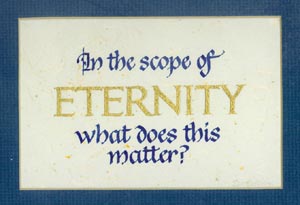

In the Scope of Eternity. . .

There’s a piece of my calligraphy in our bathroom, where it’s been for many years in a place where my sons would see it (over the commode!), of one of life’s most important questions: “In the scope of eternity, what does this matter?”

In the scope of eternity, what does this matter?This simple question can create a lens or filter through which we can assign value and importance to our experiences. It helps us know if something is worth getting upset about or not. If it’s not going to matter two weeks from now, much less in eternity, let it go. Many of our stressors would be less stressful if we would just put them in perspective.

Both of my sons were athletes when they were growing up. They had a full supply of testosterone and were quite competitive. When you play sports, there are going to be wins and losses; when you’re a boy or a young man, you can think those wins and losses are a lot more important than they actually are. But when filtered through the question, “In the scope of eternity, what does this matter,” you can see both wins and losses as valuable for teaching and revealing character. (I put another calligraphy plaque in the bathroom as well: “Win without boasting, lose without excuses.”)

I find myself invoking this question when trying to encourage people caught in the throes of temptation. One of my friends is in the excruciating process of withdrawing from an addictive and sinful relationship. I ask her, “One hundred years from today, where will you be? When you are facing Jesus, what do you want to be glad you did now, and what do you want to avoid regretting? Think back on this difficult time from the position of one hundred years from today, when you are in eternity.”

One of my dear ones has been doing hard work in counseling for over a year. When the challenge of facing one’s internal pain is filtered through this question about eternity, it is encouraging to realize that cooperating with the Holy Spirit to uncover and relinquish his unhealed and broken parts is changing him forever, making him more fit for future Kingdom responsibilities and glory. The answer to the question, “In the scope of eternity, what does this matter,” is “The hard work and pain will be totally worth it.”

It’s helpful to ask myself this question when I’m experiencing nighttime sleeplessness, or physical pain, or financial stress. And it’s also helpful to ask myself this question when I’m concerned about my loved ones; when the answer is, “In the scope of eternity, this is REALLY important,” it motivates me to pray. Hard. And long.

What are you wrestling with? In the scope of eternity, what does it matter, really? Does this question help?


This blog post originally appeared at blogs.bible.org/tapestry/sue_bohlin/in_the_scope_of_eternity on Aug. 30, 2011


Is it Time to Change Your Filter?

Life doesn’t just happen to us; we experience it and interpret it through a filter. That filter, like a pair of glasses, consists of beliefs and values we might not even realize we hold.

The same event could be experienced and interpreted in different ways by different people because of their different filters: for example, getting a flat tire. One person might get out of the car, see the flat, and start to rage: “What the **** is this? Why does this kind of **** always happen to me? You stupid tire!” This response is the result of a filter that believes life should be good and easy, that nothing bad should ever happen to her. This unrealistic expectation is a setup for massive disappointment and anger when life doesn’t cooperate.

Another person might see the flat and think, “Oh bummer! Well, Lord, thank You for protecting me from a dangerous high-speed blowout. Please help me here—would You send a road angel to help me change out the spare?” This very different response is the result of a filter that recognizes we live in a fallen world where unfortunate and even bad things happen, but God is still good and we can call on Him to help us at any and every time.

We can’t change life or the things that happen to us, but we can change our filter to bring it into alignment with biblical truth.

You might need to change your filter if:

• You consistently see the glass half-empty instead of half-full; if you always put a negative spin on any news you hear. [Check out Philippians 4:8]

• You see any comment other than glowing praise as a personal attack that threatens your well-being, and you aggressively growl back. [Check out Philippians 2:3]

• You dismiss other people’s answers to prayers, and blessings they receive, as yet more proof that God loves everybody but you. [Check out Romans 8:38-39]

• You evaluate everything in terms of how you feel about it. You are nice to your spouse or your co-worker only when you feel like being nice; you don’t repent if you don’t feel repentant; you don’t spend time with God if you don’t feel like it; you are obedient when you feel like being obedient, etc. [Check out 2 Corinthians 10:5-6]

• You view everything in terms of the here-and-now, temporal, earthly sphere, and ignore the eternal, spiritual dimension. [Check out 2 Corinthians 4:18]

• You get uncomfortable when people bring spiritual conversations into Monday through Saturday because they only belong to Sunday. [Check out all references to the Lord Jesus Christ]

What do you think. . . is it time to change your filter?


This blog post originally appeared at
blogs.bible.org/engage/sue_bohlin/is_it_time_to_change_your_filter
on Aug. 16, 2011.


Ah, Sweet Mystery of Life. Like It or Not.

Recently I have been engaging in an email conversation with a lady who is deeply burdened by the sinful choices and ungodly thinking of a young man dear to her. As we have talked about what she can do, our conversation turned to prayer. Yesterday she asked, “How does intercessory prayer make/change/mediate the young man’s own will? How does the person we pray for ‘get the message’? How can we pray for God’s will to be done when it is against the will of the person we’re praying for? How does our prayer help the person to want God’s will for themselves? How does my intercessory prayer help the person I’m praying for yield their own will and turn it over to God’s will?”

I answered, “You’re asking about the mechanics of how something spiritual works, and I don’t know that the Word gives us that kind of information. But think about how you have changed your thinking about anything. How did you go from being dead in your trespasses and sins, to being alive in Christ? How did you go from caring more about yourself than anyone else (because sinful humanity is inherently selfish) to having a desire to pray selflessly for others?

“I would suggest that God gave you enlightenment, showing you more and more truth, at the same time drawing you into His own heart. You started gravitating toward what was true, and Jesus said, ‘I am the truth.’

“At the same time, God never violated your will, allowing you to freely choose to turn to Him in faith and in choices that matured you. How those work together, I don’t think anyone understands.”

Ah. Mystery. We keep running into it, don’t we? And that makes sense, since God is so other, so immense, so brilliant—do we really expect that we would be able to figure out how the spiritual realm works, much less figuring out God Himself? But with our modernist, Western, scientific mindset, we are set up to disdain mystery (and all things supernatural). The progression of scientific knowledge and understanding has stripped the apparently mystical and miraculous from things like how babies are conceived and how illness spreads. Our culture’s misplaced confidence in science to solve all problems extends to mystery; we tend to think, “Oh, we just haven’t figured it out yet. . .but we will.”

We want to know how things work, and there’s nothing wrong with that. I think that wrestling with that question is one way we can love God with our minds (Matt. 22:37). But there are also going to be times to choose to be content with mystery, and let it serve its role of pointing us to the One who delights to weave mystery into life like a divine tapestry.

This blog post originally appeared at
blogs.bible.org/engage/sue_bohlin/ah_sweet_mystery_of_life._like_it_or_not.
on Aug. 2, 2011.


Feelings: A Lousy Idol

It’s so easy to look down our 21st-century noses at the “primitive” peoples of biblical times, especially Israel’s problems with idolatry in the Old Testament. “WE don’t bow down before idols and false gods,” we think. “That was when people were less evolved intellectually and spiritually, but we modern people are so much better than that.”

I’m wondering if God agrees. I don’t think so.

I think that idolatry is at least as rampant in our society, but it’s more pervasive because it’s so subtle; the idols we worship aren’t physical, tangible items. We could create a long list of the abstractions we worship, but today I just want to focus on one.

Feelings.

Our culture treats feelings as if they were an inerrant internal compass that always points to truth and reality. “Follow your heart.” “What does your gut say?” “You can’t help who you fall in love with.”

High school and college students flunk out because they don’t feel like getting out of bed and going to school. Then they become people who lose their jobs because they don’t feel like going to work.

Young people of all ages dress, act, and talk in ways that will make them feel popular and accepted by their peers.

Married people find themselves attracted to someone other than their spouse, and they feed the marvelous feelings of infatuation because it makes them feel so alive and magical.

We indulge bodily appetites, whether for sweets or drink or overeating or sexual pleasure, because they feel so good and because refusing to indulge them feels so bad.

The materialism porn of magazines and newspapers starts an internal burning desire to buy and to accumulate. It feels so right to go out and get what we want! If we don’t have the money, we put it on credit because, hey, “I should have what I want.”

We are happily addicted to our comfort because we believe that feeling comfortable is a basic right of life. So we don’t give ourselves away in service projects or missions trips or going without in order to use the money for someone who has less than we do, because then we wouldn’t feel so comfortable.

Why is this? Why do we make our feelings into idols?

I believe it’s because the toxic “pickling brine” of our culture puts a much higher emphasis on the immediate, the here-and-now, of the physical world (which our feelings are part of). The majority of Christians, the research shows, think just like the non-Christian world around us, and that includes ignoring the unseen, eternal world and focusing on the visible, temporal world.

When we recalibrate our focus to include the unseen sphere of life, we are aware of the spiritual dimension of life and not just the physical. It makes us more balanced people. We can put feelings in their place: they are like lights on the dashboard of our car, indicating what’s going on “under the hood.” But if we focus on the dashboard lights while we drive, instead of on the road, we’ll run off the road—or worse, crash. We can acknowledge them but refuse to let them lead us.

For example, Hebrews 12:2 tells us that the Lord Jesus “for the joy set before Him, endured the cross, despising the shame.” He focused on the eternal (the joy set before Him) instead of the temporal (the shame of the cross). Corrie Ten Boom wisely said, “Don’t pray when you feel like it. Have an appointment with the Lord and keep it.” This lady really understood how to put feelings in their place. This survivor of the WWII death camps also said, “Forgiveness is an act of the will, and the will can function regardless of the temperature of the heart.”

Feelings are not evil; we have feelings because we are made in the image of a passionate God who experiences a robust range of feelings. But they are fallen because everything about us is fallen ever since sin entered the world.

That’s why feelings make lousy idols.


This blog post originally appeared at
blogs.bible.org/engage/sue_bohlin/feelings_a_lousy_idol
on May 10, 2011.


Funeral Myths

I went to a friend’s funeral yesterday where I heard a number of things to add to my running mental list of “funeral myths.” With the ever-increasing degree of Bible Illiteracy, combined with the growing number of believers who are “cultural captives,” more conformed to the culture than to Christ (please see my earlier blog “Are You a Pickle?”), it’s not surprising that people would have unbiblical beliefs about death, heaven, and God.

Several songs were played at my friend’s funeral. One is called “Borrowed Angels,” which started like this:

They shine a little brighter, they feel a little more
They touch your life in ways no one has ever done before
They love a little stronger, they live to give their best
They make our lives so blest, so why do they go so soon?
The ones with souls so beautiful
I heard someone say—

There must be Borrowed Angels, here in this life
They come along, into this world, and make this world bright
But they can’t stay forever
Cause they’re heaven sent
And sometimes, heaven needs them back again

No, people are not “borrowed angels.” God created the angels before He created mankind. We are very different from angels; they were created to serve God and serve us, and we are created to be drawn into and enjoy the love, fellowship, joy and delight of the Father, Son and Holy Spirit. They made us in Their image (Genesis 1:26), which elevates us above angels. People and angels are two different kinds of creation, and one does not become the other.

Which brings me to another myth I heard yesterday: that Valerie is now “our guardian angel.” While this may be a comforting thought to those gripped by loss, no she’s not.  She’s enjoying unhindered, face-to-face worship of Jesus and fellowship with those who now live in heaven.

Do we have guardian angels? The Bible doesn’t give a definitive answer on that, although the Lord Jesus did say, “See that you do not look down on one of these little ones. For I tell you that their angels in heaven always see the face of my Father in heaven” (Matthew 18:10). And Psalm 91:11 promises, “For He will command His angels concerning you to guard you in all your ways” (from my article Angels: The Good, the Bad and the Ugly at Probe.org).

At yesterday’s funeral, people stood up to make comments about our friend. One distraught lady concluded her remarks with an angry, “God, You’d better take good care of her.” My heart went out to her, not just because of her grief but because she doesn’t know that God is good and doesn’t need to be cajoled, much less threatened, into caring for His beloved daughter. Sometimes people get angry with God for taking someone home earlier than they want, and the anger comes from a sense of betrayal—as if God doesn’t have the right to determine the length of a person’s life. Yet Psalm 139:16 says, “All the days ordained for me were written in Your book before one of them came to be.” None of us lives a single day more, or less, than God had determined before He even created us. A loving God is in control—and that extends to the days of our birth and our death.

The man who conducted the funeral told a story about how they used to keep a little girl in their family in line by threatening that Valerie would get after her with her spanking switch. “Well now Valerie’s not here,” he told us, “so we tell the little girl, “Valerie’s got her spanking switch with her in heaven and when you get up there she’s gonna bust your butt.”

Uh, no.

Romans 8:1 says, “There is therefore now no condemnation for those who are in Christ Jesus.” Valerie’s not busting any butts in heaven, and part of the good news is that God isn’t either!

When my aunt died, someone tucked a deck of cards under her hands in her casket because Aunt Maggi loved to play cards and they were sure she was having a great time up in heaven playing pinochle with her brothers. When my mother died, several relatives comforted each other by laughing about how Mom had finally joined the great heavenly card party. This is another myth about heaven, that it’s a lot like our human activities on earth, only better. People who believe this myth usually have no concept of the greatness and glory of the Lord Jesus Christ, or they wouldn’t be willing to settle for images of unending card games and fishing and bowling tournaments.

What funeral myths have you come across?


This blog post originally appeared at
blogs.bible.org/engage/sue_bohlin/funeral_myths
on April 12, 2011.


“Why Are Bikinis and Short Skirts Immoral?”

Sue, do you ever wear a bikini? Or have you ever worn one? And couldn’t a lot of the old biblical rules for dress be mostly for those people back in biblical times? And please tell me this: Is there a certain length when a woman’s dress or skirt becomes immoral? For example, are all skirts and dresses above the knee immoral? Just curious.

Sue, do you ever wear a bikini? Or have you ever worn one?

I take it you ask such an intensely personal question because of my answer to email Is It a Sin to Wear a Bikini?. No, I don’t wear a bikini, and I never have.

And couldn’t a lot of the old biblical rules for dress be mostly for those people back in biblical times?

What “old biblical rules for dress” would those be?

Actually, what we find in terms of “biblical rules for dress” are principles that transcend time and culture. Basically,

1) Men should dress like men and women should dress like women, and not blur the lines of gender (Deut. 22:5).

2) Women should dress modestly (1 Tim. 2:9-10). (For great insight into the transcending principle behind Paul’s prohibition on braided hair, gold, pearls or expensive clothes from this verse, see this recent post by my friend and fellow Tapestry blogger Sandra Glahn: blogs.bible.org/tapestry/sandra_glahn/not_with_braided_hair…or_pearls__)

3) We should do everything in love, which includes choosing dress and behavior that will not cause each other to stumble. Causing a brother to stumble by lusting is not loving.

There is nothing about these principles that is limited to biblical times.

And please tell me this: Is there a certain length when a woman’s dress or skirt becomes immoral? For example, are all skirts and dresses above the knee immoral?

People wiser than me have said that the answer to this question depends on the culture, because styles and morals changes over time and geography. There are moral absolutes (like not murdering) and there are relative morals, which would include dress. For example, some monks at the University of Dallas related to my colleague Todd Kappelman that several of them were teaching in Papua New Guinea where both the temperature and the humidity were very high. The young women students sat in the classroom dressed only in some kind of skirt. Toplessness would have been shameful in the U.S., but in a stifling tropical location, the natives thought nothing of it.

The men, too, wore only abbreviated loincloths and strings. On one occasion, the monks went to visit a group of men who were “doing laundry”—their loincloths were hanging on the line and they were lounging around naked. Like our response to being caught in the shower when someone comes to the door, they each quickly grabbed a cord and wrapped it around his waist. Then they were no longer embarrassed, even though their genitals were exposed. That’s the way that culture works.

So, since styles and times change, we have to look at the heart issue that reveals one’s motive in choosing the way we dress. If a woman chooses garments in hopes of making men look at her admiringly in a sexual way, or if she chooses clothes in hopes of making other women compare themselves to her and be jealous, then I would say that is sinful because it falls short of God’s desire for us to honor Him and love each other.

That means there is no absolute line, particularly in relation to the knee, that defines morality.

I would also point you to an excellent answer on the “Got Questions” website:

Whether or not to wear a bikini is a question many women struggle with, but for a Christian woman, the issue takes on additional implications. The Bible tells us that God calls women to modesty, which means to not draw attention to themselves: “I also want women to dress modestly, with decency and propriety, not with braided hair or gold or pearls or expensive clothes, but with good deeds, appropriate for women who profess to worship God” (1 Timothy 2:9-10). God also calls us to purity: “Don’t let anyone look down on you because you are young, but set an example for the believers in speech, in life, in love, in faith and in purity” (1 Timothy 4:12). The question is whether or not a bikini is consistent with modesty and purity.

Another issue to consider is that God calls all people to control their thought lives, so as women, we should not cause men to lust: “You have heard that it was said, ‘Do not commit adultery.’ But I tell you that anyone who looks at a woman lustfully has already committed adultery with her in his heart” (Matthew 5:27-29). When we cause men to look upon our bodies lustfully, we are inducing them to commit the sin of lust and this is displeasing to God.

A further consideration is that our bodies, like our minds and hearts, belong to God and are to be used for His glory, not our own. Romans 12:1 tells us, “Therefore, I urge you, brothers, in view of God’s mercy, to offer your bodies as living sacrifices, holy and pleasing to God-this is your spiritual act of worship.” When we offer our bodies to God as “living sacrifices,” we are saying in effect, “My body is yours, Lord. Use it for your glory.” It’s hard to imagine a bikini-clad body being used for God’s glory. [Sue’s note: This is not talking about the husband-wife relationship, where there is total freedom to dress to please and arouse one’s spouse in private. See the Song of Solomon in the Old Testament.]

Or course, wearing a bikini in a private location, like a fenced-in back yard is probably acceptable, providing there is no visual access to the yard by the neighbors. According to the verses above, we have the responsibility not to put the males around us in a position that they might lust or have impure thoughts (see also Matthew 18:7).

www.gotquestions.org/Christian-bikini.html

Hope you find this helpful.

Sue Bohlin

© 2011 Probe Ministries


“How Does the Bible Support Your View That God Intends for Males to Grow into Masculinity and Females to Grow into Femininity?”

Your article “What is a Biblical View of Transgendered People and Hermaphrodites?” makes this statement: “The biblical view is that God’s intent for every male is to grow into masculinity, and for every female to grow into femininity.” What Bible passages support that contention?

I would define masculinity as the characteristics of being male, and femininity as the characteristics of being female, per God’s intention. I would also suggest that as a culture, we have a too-narrow idea of what it means to be male and to be female. I think that masculinity is a spectrum from the rough-and-tumble, athletic-loving male to the sensitive, artistic, musical, aesthetic-loving male, and everything in between. I think that femininity is a spectrum from the girly-girl to the tomboy/jockette, and everything in between, and it pleased God to make both male and female, masculine and feminine, in His image. That’s a VERY wide range!

But there is a difference between male and female, between masculinity and femininity. When people of one gender long to be the other other, and indulge the fantasy of being or becoming the other, there is a hatred and contempt for the gender that they are—and that means something is wrong. God chose their gender, which means it is good; to hate what God has made means someone’s thinking is skewed and needs to be adjusted, to come into alignment with God’s.

I say this to lay a foundation for the scriptures that answer your question: I believe that “male and female” and “masculine and feminine” mean the same thing. When they don’t, I believe, it’s because we have adopted a too-narrow understanding of masculinity and femininity.

From the beginning, the binary nature of “male and female” has been God’s design and God’s intent:

Genesis 1:27: “God created man in His own image, in the image of God He created him; male and female He created them.”

Genesis 5:2 “He created them male and female, and He blessed them and named them Man in the day when they were created.”

Genesis 6:19 “And of every living thing of all flesh, you shall bring two of every kind into the ark, to keep them alive with you; they shall be male and female.”

Then, in the New Testament, the Lord Jesus reiterated this truth:

Matthew 19:4 “Have you not read that He who created them from the beginning made them male and female. . .”

Mark 10:6 “But from the beginning of creation, God made them male and female.”

Then there’s this:

Deuteronomy 22:5 “A woman shall not wear man’s clothing, nor shall a man put on a woman’s clothing; for whoever does these things is an abomination to the Lord your God.”

The point of this law, like that of many other OT laws, is to underscore the importance of not blurring distinctions, of maintaining boundaries between separate things. One of the reasons for this importance is so that God’s people would think clearly about reality. The differences between male and female are God-designed and good, because He reveals His glory differently through men and through women. (Note throughout the Psalms the way God reveals Himself to be a God of strength and protection, masculine glories, as well as a God of nurture and caring, feminine glories. Our masculinity and femininity both come from the heart of God.)

Scripture also teaches that God’s plan and design is for things and people to grow to the mature forms of what they are (references to animal husbandry; parables of crops growing; God’s intention for us to grow to maturity [Ephesians 4:13]). Apples do not grow up to be corn, and lambs do not grow up to be bulls. Boys grow up to be men, girls grow up to be women.

My husband the scientist points out from Psalm 139 that we are “fearfully and wonderfully made,” as God knits us together in our mother’s womb. Part of that is genetics, which is that God determines if we are male or female. These days, some people are unhappy with their gender as if it were a mistake or a joke, but God has made that determination for His glory and our good.

Thanks for asking.

Sue Bohlin

© 2011 Probe Ministries


Why We Love Celebrity

(April 26, 2011) So I guess there’s going to be a royal wedding “across the pond” on Saturday. Just like when the groom’s mum and dad got married, there will be pre-dawn wedding watching parties over here in the States (since for some reason, the Brits couldn’t be talked into waiting for American prime time, I suppose).

The royal festivities have put Kate Middleton, about to become “Princess Catherine,” in the celebrity spotlight. And oh, how we love our celebrities! Celebrities are people who are famous, sometimes simply because they are celebrities and not because they’ve done anything especially noteworthy.

Technology makes it possible to feed our insatiable hunger for “celebrity news.” 24/7 news channels have to fill their time somehow when there isn’t any real news, so they create news by reporting on people’s divorces and pregnancies, what’s happening in the entertainment world, and show pictures of unrealistically and artificially beautiful women strutting and posing in their gowns on a red carpet somewhere.

Why are people so taken with celebrity, anyway?

I think it is yet another reflection of the brokenness of our fallen world. But I’m getting ahead of myself.

I believe God hard-wired us to worship Him because He is the source of life and all that is good, beautiful, and true. I think He created us as worshiping creatures because He knew it would “fill our tanks” and deeply bless and nurture our souls to pour out adoration and worship on One so infinitely worthy of praise. In the same way that we love to see great beauty in spectacular sunsets and want to share it with someone else, in the same way that we love falling in love, in the same way that we love being part of a crowd when our team is winning—we were created to long for a connection to the transcendent, especially the transcendent God.

God creates us for Himself; He creates us to love us and draw us into intimate fellowship with Father, Son and Spirit. Our natural response to that kind of unimaginably huge and powerful love is worship.

But then sin entered the world, and the Fall distorted and messed up everything. Instead of relating rightly to our Creator and the Lover of our souls, upright with faces upturned in love and adoration, we were bent and twisted. After the fall, when we reach out, we are no longer reaching up—because of our “bentness,” we reach out to other parts of the creation. (See also: idolatry) Yet we are still hard-wired to worship.

So we worship each other.

And celebrities, distant and unattainable, function well as objects of worship since we usually don’t see how they are flawed and fallen just like everyone else. Like us.

Cue hordes of screaming, worshiping fans at rock concerts and movie premieres.

Cue tears of loss and sorrow when a movie star gets married and takes himself out of the pool of eligible bachelors that fuel girls’ fantasies of marrying “Prince Charming.”

Cue “entertainment news” anchors reporting breathlessly about the latest Hollywood gossip and speculations as if TV, movie and music stars were more important than other people.

Celebrity, I submit, is broken, misdirected worship of the creature instead of the Creator. It is yet another way in which we see the brokenness of a fallen world.

But there will come a day when every knee will bow and every tongue confess that Jesus Christ is Lord (Philippians 2:11). There will come a day when Jesus will come with the clouds, and every eye will see Him (Revelation 1:7). And we will worship rightly.

Because Jesus is the ultimate rock star.

This blog post originally appeared at
blogs.bible.org/engage/sue_bohlin/why_we_love_celebrity
on April 26, 2011.


“Do Non-Christians Have Spiritual Gifts?”

I love your ministry and I find myself going to your website a lot as I prepare for Middle School Sunday School lessons. I am going to be teaching on spiritual gifts to teenagers. My 14-year-old son asked a very astute question. He says he knows some very “gifted” non-Christians at school and wondered if the spiritual gifts are only for those who have been born again or if our purpose in life is intertwined with our spiritual gifts. For example, a non-Christian singer who has been given an excellent voice but is not using it for God.

Thank you for the blessing of encouragement! I’m so glad our website is valuable to you!!

I think one’s theology determines the answer. I know lots of people say that spiritual gifts are only given to the born-again believer as if God has nothing to do with people before they trust Christ.

I don’t think it works that way though; I think that since God reveals Himself as Father, Son and Holy Spirit, Who created us for the purpose of bringing us into the circle of Their love and delight and pleasure and fellowship, that a case can be made that God is everyone’s loving Father (“one God and Father of all,” Ephesians 4:6)—but unbelievers don’t recognize it. That doesn’t make Him NOT our Father; it doesn’t make Jesus NOT “the Savior of all men, but especially of believers” (1 Timothy 4:10); it doesn’t make the Holy Spirit NOT the giver of good gifts. So I think God lavishes all kinds of gifts on all people, but they are especially expressed more fully in those who are consciously connected to Him. I keep hearing stories from Christians who saw evidence of their spiritual gifts even before they were Christians; after they came into the Kingdom, they knew what they were.

Now there are also natural talents, which are different from spiritual gifts. Singing, for example, is a talent, not a spiritual gift. For one thing, it’s not on the lists in Romans 12, 1 Corinthians 12, Ephesians 4 and 1 Peter 4. Secondly, you can lose a singing voice, but Romans 11:29 says that the gifts and calling of God are irrevocable.

Have you seen the spiritual gifts evaluation my husband Ray and I put together? www.probe.org/how-do-you-determine-your-spiritual-gift/

Hope you find this helpful.

Sue Bohlin

© 2011 Probe Ministries