“I’m 15 and I’m Afraid I’m Gay”

Dear Mrs. Bohlin,

I really need your help, I am 15 and frightened of being homosexual. About one and a half years ago I was at an all-girls summer camp where a girl told me she had decided to become bisexual. I didn’t know why but this upset me a lot. I had two weeks of camp left, and I was terrified that everyone was gay, finally I became scared that I was gay. I hadn’t really thought that I was attracted to girls before, but I used to be a tomboy and envied all the “girly-girls”. Ever since I went to camp and that happened my fear has gotten worse and worse, I haven’t told anyone for fear of being told that I was. I heard about the “ex-gays” and read a few articles of yours. I don’t know what to do. Please help me I’m very scared, all I want is to live again normally. I’ve been raised Christian and my parents are divorced. I’m sorry to bother you, but I need your advice. God bless you.

______, I’m so glad you wrote to me!

When God made you a female, He made you more emotional than analytical, more intuitive to other people than most males, and very relational. This means you are open to being influenced by other people, especially when you were only 13. For someone to tell you she had decided to label herself as bisexual at the very beginning of puberty, when you both have a LOT of growing, maturing, and learning about yourselves ahead of you, no wonder you were upset! That’s way too much pressure to process information and label oneself at the beginning of adolescence. Which is a time of intense confusion to begin with, totally apart from the whole sexuality issue!

It makes sense you’d be scared that you were gay, for the same reason that when people take health or medical classes that cover different kinds of illnesses, it’s typical to think they’re experiencing the symptoms of a bunch of them. It’s typical to be susceptible to ideas, especially at a time in your life where you “try on” all kinds of identities and values and beliefs to see if they fit.

If you were a tomboy, it’s because God loves tomboys and that’s why He makes you that way! It’s our culture that incorrectly limits femininity to only the “girly-girl” end of the femininity spectrum. Femininity also looks like jeans and t-shirts, tree-climbing, sports- and outdoor-loving girls. It makes sense for you to envy girly-girls because they are a different kind of girl than you are, but they aren’t a BETTER kind of girl than you are! It makes sense because of the false message that tomboys are inferior to girly-girls. Nope! If God won’t agree with it, it’s not true!

Now for another part of the equation: what we know from talking to literally thousands of gay-identifying folks over the years is that envy drives a lot (if not most) of same-sex attraction. Both guys and girls are drawn to whatever they feel they lack. Instead of saying, “This means I’m gay,” it would be far wiser, and true to God’s design, to say instead, “Hmmm. I see where I need to work on myself so I become the kind of person I admire, or to develop the kind of attributes I admire.”

I was teaching at Probe’s Mind Games conference for high school juniors and seniors when I said that many people who are afraid they’re gay, or who think they might be, need to give themselves grace to finish growing up. Being attracted to same-sex peers is part of normal adolescent development, complete with intense crushes, but all we hear in the culture is, “If you like other girls (or boys), it means you’re gay.” No, it doesn’t. It means you haven’t finished growing up yet. One of the students came back the following year as an alumnus and come up to me in private to tell me, “When you said this last year, it was the first time I’d ever heard it. I was able to relax and just give myself permission to finish growing up. And you know what? In the past year, I have! I find myself attracted to girls now, instead of being so stuck on my attractions to other guys. Thanks for speaking truth to us.”

Let me encourage you to bundle up your fears and your feelings and hand them to Jesus, who loves you more than you can possibly imagine, and He will help you sort through them. In fact, the more you concentrate on your relationship with Him, the better every other part of your life will become. In fact, I respectfully urge you to pray every day, “Jesus, show me how You love me,” and then pay attention to the little intimate ways in which He says, “I sure do love you, ______!” When you know God loves you, that gives you a confidence in yourself that nothing else can even come close to. And it helps you sort out the rest of life, and put people in their proper perspective.

Relax and give yourself time to finish growing up without the unnecessary complication of being paralyzed by fear that you’re gay. God doesn’t make anyone gay; He DOES make people to be relational, and the more we do life in community, with friends who will love and accept just as we are, we can grow into emotionally healthy adults.

So. . . how does this hit your heart? Does it make sense?

Warmly,
Sue

© 2011 Probe Ministries


“Why Doesn’t God Answer Prayers to Take Away Gay Feelings?”

I was reading your article about Gay Teen Suicides and Bullying, about how some people pray and pray for God to take away their gay feelings and there is a reason that he doesn’t that they don’t know about. I’d like to know what that reason is. My best friend committed suicide when we were both 18 because he couldn’t accept that he was gay. I learned to accept it and now I’m 36 and quite happy. Luckily, I have found a church that accepts me for who I am and I know that God loves me as does Jesus but I am always curious to hear the ideas and opinions of Christians on what the supposed cure for this condition might be.

First of all, ______, I am so very sorry to hear of your best friend’s suicide. I’m sure that has left a wound on your soul that troubles you to this day.

I want to VERY respectfully suggest that “accepting one’s gayness” is not the best solution to the grief and sadness that comes bound up in realizing one has same-sex desires. That would be like seeing the “check engine” light on your car and deciding to learn to live with it. I know the culture’s pro-gay message is that there’s nothing wrong with homosexuality so just accept it, but that’s not God’s position. Which leads me to answer your question: why would God not take away someone’s gay feelings?

First, because everyone has an area of weakness that makes it easier for us to recognize our need for God and depend on Him more fully, which is His design and intent for us. Some people have physical trials; others struggle with a weakness for alcohol, drugs, or other forms of self-medication. Some struggle with same-sex attractions. Whatever our area of weakness, this is the very avenue by which God can reveal Himself to be strong, to be enough for us. And it is the best way for God to develop us into the people He made us to be, permeated with Christ like character and maturity.

So often, people pray and ask God to relieve their symptoms and make their lives easier (and this, of course, goes way beyond asking God to take away gay feelings. It’s something we all do). Being broken and fallen people, when we pray for that, what we’re really asking is, “I want You to make me comfortable so I won’t need You.” But Jesus doesn’t answer this prayer because there is something so much bigger than our comfort at stake; He wants our hearts. He wants our dependent trust. He wants us to repent of the sin and separation from Himself that results in our brokenness. He wants to heal the real brokenness, not just the symptom of the brokenness. True brokenness is our broken relationship with God.

The struggle (against same-sex feelings) itself is not an evil. The struggle can be a holy instrument in God’s hand if we let it. Please read through to the end of my answer for more on that.

Secondly, it’s helpful to understand the bigger picture of why someone has attractions for someone of the same sex in the first place. No one is born gay; we are such complex creatures, being made in the image of God, that feelings, attitudes and beliefs are shaped over time by our life experiences, and filtered through our temperaments. This is complicated by the fact that we live in a fallen world that has been poisoned by sin, which is separation and independence from God. Fallen people love each other in fallen ways, or not at all.

The three-Personed God (One God in Father, Son and Holy Spirit), who have enjoyed love and fellowship with each other for all eternity, created us in Their image (Gen. 1:26). This means we are created for relationship: to connect and bond with others in ways that would make us feel loved and secure. Living in a fallen world means that sometimes, we don’t connect and bond with the people God intends to love and accept us, and there are serious repercussions from that.

After listening to people’s stories in literally thousands of intake interviews, my friend Ricky Chelette of Living Hope Ministries has identified several common denominators that provide perspective to same-sex desires:

• Little boys are born at some point on a gender spectrum that ranges from the rough-and-tumble athletic boy to the emotionally sensitive, artistic and/or musical, aesthetically gifted boy. Little girls are born at some point on a feminine gender spectrum that ranges from the girly-girl to the tomboy jockette. Our spot on the gender spectrum is God’s choice for His glory and our benefit. Most male same-sex strugglers are on the sensitive end of the spectrum.

• God’s intention is for babies to bond first with Mom, then with Dad, then with same-sex peers, then with opposite-sex peers. Learning to exercise our “attachment muscles” is an essential part of becoming emotionally healthy. Most Moms don’t have any trouble bonding with their babies. (But when something disrupts the process, it seriously messes people up.)

• When emotionally sensitive little boys are born into a family with a rough-and-tumble, emotionally insensitive Dad, the little boy can find himself more comfortable identifying with Mom and her emotionally sensitive femininity than with his Dad. It’s as if Dad speaks Spanish and the little sensitive boy speaks Chinese. They may want to communicate with each other, but they don’t speak the other’s language. Unless the “Spanish-speaking” Dad purposes to learn Chinese to relate to his son on his level, there can be a disconnect between the two.

• There’s a point in a toddler boy’s development where he should realize, “I’m a boy. I’m more like Dad than like Mom.” When Dad involves his son in his world and communicates love and acceptance to his son, he comes to believe that he belongs in the world of males with his Dad.

• The wise author Toni Morrison says that a child knows he’s loved when he walks in a room and his parent’s eyes light up. All children are created with the need to receive “the three A’s”: attention, affection and affirmation. When a Dad pays loving attention to his son, when his eyes light up when his son enters the room, when Dad affirms his son for who he is and not just what he can do, a boy will probably feel secure in his Dad’s love and acceptance. But if there is a disconnect between a Dad and his son, if the Dad thinks it’s too much trouble to try and connect with a son in ways that the son can receive, there will be a father-shaped hole in the little boy’s heart. A rough-and-tumble boy can try and fill that hole with all kinds of activities and risky behaviors to earn his Dad’s attention, affection and affirmation. An emotionally sensitive boy can easily detach himself from Dad and connect himself more strongly with Mom, or detach from everyone. Both kinds of boys are at risk for trying to get a legitimate need met in unwise, illegitimate ways.

• Most little girls don’t have trouble connecting with Mom, but if Mom is not warm and nurturing (or if something happens to disrupt the relationship), they can live with a mother-shaped hole in their heart. A Dad’s role is to support and cherish his daughter’s femininity, regardless of what form it takes. If he remains distant and unsupportive, or if he treats her like a son, she can have serious questions about her feminine identity: “If Dad doesn’t think I’m okay, then I’m not.” Or, if there is no Dad, she can be wracked with doubts about herself; a Dad’s attention, affection and affirmation is huge in a little girl’s life as well. Girls can have a father-shaped hole in their heart as well.

• From four to ten years old, the next stage of development is for boys to learn to attach to other boys and girls to attach to other girls. Both sexes usually have intense “BFF” (best friends forever) friendships that are not romantic or erotic, they are just emotionally intense as they learn to exercise their friendship attachment muscles. If a boy doesn’t learn to make these connections with buddies, he will continue to walk around with a “buddy hole” in his heart. If a girl doesn’t learn to make these connections with other girls, she will walk around with a “girlfriend hole” in her heart. And since nature abhors a vacuum, and because we are all fallen creatures, we will try to stuff all kinds of things into the holes in our hearts.

• At puberty, sex hormones flood the body and hit the mother hole or father hole or friend hole in the heart. That aching desire to connect and attach, the painful longing to be nurtured and to bask in attention, affection and affirmation (“the three A’s”), then gets sexualized. If the adolescent boy or girl fantasizes about the object of their affections accompanied by masturbation and orgasm, brain chemicals get released that act like emotional super-glue. Physical (synaptic) connections are made between the object of affection and sexual pleasure, and then strengthened with repetition. When someone buys into the lie that “if I feel it, it must be true,” the end result can be a homosexual identity.

• (This last point is not limited to same-sex strugglers by any means.) When people experience the trauma of abuse or neglect, when they don’t get their God-given emotional needs met, they stop growing emotionally. They shut down inside. Their bodies keep growing but inside, they are still the emotional age of the point when they stopped growing. Although this sounds like an insult, it’s actually a simple descriptor: many people are emotionally four to ten years old. (Ever see road rage?) This is why wounded people tend to live lives driven by drama, self-centeredness, a lack of self-discipline, and emotional dependency (which is relational idolatry).

Why doesn’t God take away homosexual feelings? Because they are not a separate part of the person like a nasal polyp or an infected appendix that can be cut out to restore health. Feelings are a part of us. They are the product of beliefs, actions, and the way one sees life and reality. Feelings are like the caboose on a train; they trail along at the end, pulled by the parts that do the work.

God will not “zap” us because to do so would be to eradicate who we are. He will not remove feelings because feelings are part of the imago Dei, the image of God. He made us, He loves us just as we are, and He wants to work with us to transform our thinking and our understanding of who He is, who we are, how life works, and what is true. Romans 12:2 says, “Be transformed by the renewing of your mind.” When we change the way we think and the way we do life, our feelings will eventually change. (Not necessarily 180 degrees, but some degree of transformation is part of the power of the Gospel!)

Homosexual feelings come from legitimate, unmet longings for connection, for the “three A’s.” God wants us to be connected to other people; He created us to function best in community. He wants us to experience His love, and the love of other people, in the context of relationship. God wants us in HIS community of believers, and the church is a second chance to be in a different family. He wants to meet our needs for connection and relationship through healthy God-honoring friendships. Many people testify that their same-sex longings decreased as their security as a man or as a woman grew because of belonging to the world of men or the world of women in God’s family. As they took their place in the Body of Christ with their new (church) family and friends, the longings and desires shifted to age- and gender-appropriate feelings. They finished growing up.

But even in those who did not experience a shift in orientation, they still report having a home with God’s people, with relationships that help fill the hole in their hearts.

Let me suggest a related but less emotionally charged illustration. In his excellent book Changes That Heal, Dr. Henry Cloud writes,

It is not unloving for God to say no, even to our healing. He knows that sometimes we need to work out our healing instead of his doing it for us. For example, if I am depressed because I don’t bond with others, for God to “heal” my depression would prohibit me from learning how to bond and becoming loved. He may then say no to my prayer for healing from depression for my benefit. We like Job, must trust God’s no and his timing. It does not mean that he doesn’t love us. It may mean that he wants something better for us.

I believe that God says “no” to zapping away homosexual feelings because He has something better. He is passionate about growing us up to maturity (Eph. 4:13-15). There is no shortcut to maturity; it means struggling through to connect, attach and bond with healthy people until we finish growing up.

Some years ago, someone sent this email about the value of struggling:

A man found a cocoon of a butterfly. One day a small opening appeared, he sat and watched the butterfly for several hours as it struggled to force its body through that little hole.

Then it seemed to stop making any progress. It appeared as if it had gotten as far as it could and it could go no farther.

Then the man decided to help the butterfly, so he took a pair of scissors and snipped off the remaining bit of the cocoon. The butterfly then emerged easily, but it had a swollen body and small, shriveled wings.

The man continued to watch the butterfly because he expected that, at any moment the wings would enlarge and expand to be able to support the body, which would contract in time.

Neither happened! In fact, the butterfly spent the rest of his life crawling around with a swollen body and shriveled wings.

It was never able to fly.

What the man in his kindness and haste did not understand was that the restricting cocoon and the struggle required for the butterfly to get through the tiny opening, were God’s way of forcing fluid from the body of the butterfly into its wings so that it would be ready for flight once it achieved its freedom from the cocoon.

Sometimes struggles are exactly what we need in our life. If God allowed us to go through our life without obstacles, it would cripple us. We would not be as strong as what we could have been, and we could never fly.

I hope you find this helpful.

Sue Bohlin

© 2011 Probe Ministries

“Can You Have Multiple Besetting Sins and Still Be a Christian?”

I read the article that you wrote in response to a gentleman who was almost 70, had prostate cancer and stated that a besetting sin he had caused him to doubt his salvation for years. I related to that somewhat, as I am 68 and also have bouts with doubting my salvation. I always wonder if I have repented as I should and have studied about repentance extensively.

My problem is, I think I have more than one besetting sin. I never can understand whether or not a person can have more than one besetting sin and still be a genuine Christian. My major sin is my weight, having struggled with that for years. But I also struggle, though maybe not as bad, with a temper, easily offended, critical and judgmental thoughts of others, am lazy a lot of the time, sometimes watch TV that I shouldn’t, and I have negative thoughts of God, and probably others as well. So you see, I am at a loss as to what is going on with me.

I would so much appreciate it if you could help me understand rather or not a true Christian (an individual Christian, not a general group) can have struggles with all kinds of sins, not just one and still truly be a Christian. This is what has haunted me for years, I even gave up the Christian life and went back into the world, I am ashamed to say, but have been back in the church now for 30 years.

I am so sorry for the way your fears have beaten you up and stolen your joy! All Christians struggle against our flesh, and we all have a number of sin patterns. That’s just the way the brokenness of sin plays out in our lives. It’s not that you have more sin patterns than other Christians—it’s that you are more aware of your own than of mine, or your pastor’s, or anyone else’s. Everyone has multiple sin issues. Those that don’t think they do, are engaging in the sins of self-deception and pride.

Sin causes such blindness and such brokenness, it’s pretty much amazing that we’re able to do much that IS right. That’s the power of God in our lives.

I love this passage from James Bryan Smith’s book Embracing the Love of God, in the chapter “Forgiving Ourselves”:

[We need to learn] to see ourselves as we truly are. We need to develop a proper identity if we are to forgive ourselves. In today’s world, we are prone to viewing ourselves primarily as righteous people who are capable of doing sinful things, as opposed to being sinful people who are capable of doing righteous things. The difference in perspective is monumental.

If I see myself as a righteous person, I expect very little failure. Doing good is what comes naturally to a good person. God, too, I reason, must expect a lot of success from me. Failure, sin, and error occur only when I lose focus, only when I am lazy. If I work hard enough, I can live flawlessly. God is not particularly pleased when I do something good, some act of kindness or courage, because that is what he expected in the first place.

But if I see myself as a weak and broken person, I am not shocked by failure. It does not throw me out of kilter. I certainly do not hope for it, expect it, or easily excuse it, but I am not startled by it. Failure, sin and error do not happen because I get lazy; they are a part of being a fallen person in a fallen world. God is not shocked by my sin; he knows that I am dust (Ps. 103:14). When I do something courageous, or self-sacrificing, God is pleased. Given all that is against me, a kind act is a thing of awe in God’s eyes.

God expects more failure from us than we do from ourselves because God knows who we are. We are not the righteous person who occasionally sins, we are the sinful person who occasionally—by God’s grace—gets it right. When we start from this perspective we are released from the bondage of perfectionism and are able to forgive ourselves once and for all. We are to take our cue from him. We may be disappointed with ourselves, but God is not. We may feel like condemning ourselves, but God does not.

Let me encourage you to accept yourself as the flawed but beloved person you are, simply because GOD accepts you fully and completely as the flawed but beloved person you are! He loves us just the way we are, but He loves us too much to let us stay there. That’s what sanctification does: it makes messy, broken people over into the image of Jesus. That’s the power of Jesus’ work on earth . . . that’s the power of His love.

Hope you find this helpful in making the decision to accept the grace of God and give it to yourself.

Sue Bohlin

© 2011 Probe Ministries


“Why Does God Create People Born Blind, Deaf, Etc.?”

Why does God create people who are born blind, deaf etc.? Why don’t they get a chance to live life the way others would?

The great thing about your question is that Jesus Himself answered it! This account is found in John 9:1-3:

As He passed by, He saw a man blind from birth. And His disciples asked Him, “Rabbi, who sinned, this man or his parents, that he would be born blind?” Jesus answered, “It was neither that this man sinned, nor his parents; but it was so that the works of God might be displayed in him.”

God’s got a plan for people born with a disability. In their weakness, He can display His strength, His goodness, and His grace. This passage was life-changing for Nick Vujicic, a young man born without arms or legs. After a time of despair-filled depression, he heard this passage and it was a major “light bulb moment” for him. It changed everything. Nick has grasped that the reason he was born without limbs was so that God could be glorified in him in a special way. Today, he is a life-changer in the lives of millions of people worldwide. Check out his website “Life Without Limbs” at www.lifewithoutlimbs.org Here’s a YouTube video of Nick: www.youtube.com/watch?v=H8ZuKF3dxCY

Actually, this is not an abstract concept for me; because I was crippled by polio as an infant, I’ve lived my life as if I were born with a disability. It’s not a matter of “their” weakness, but “our” weakness.

I respectfully suggest that the reason it’s easy to put an inordinate amount of stress on the idea of living a “normal” life free of physical limitations is the culture’s emphasis on the temporal, physical dimension of life. Consider 2 Cor 4:17-18:

“For momentary, light affliction is producing for us an eternal weight of glory far beyond all comparison, while we look not at the things which are seen, but at the things which are not seen; for the things which are seen are temporal, but the things which are not seen are eternal.”

When we ONLY look at “the seen,” the temporal, we can forget that the lasting, unseen realities outweigh them. I can promise you that since God has shown me that the limits of my physical life are only “momentary, light affliction” that are producing in me “an eternal weight of glory far beyond all comparison,” it allows me to focus on the things that really matter—things like letting God shine His light through me. He has shown me that He has been using my disability to scoop out my soul and create a bigger place for Him to fill; that He balances my physically diminished capacity with a larger spiritual capacity–and I’ll take that trade any day!

Now, I do realize that not everyone born blind, dear, lame etc., turns in faith to Christ. Some people live their whole lives consumed by bitterness and anger at God for allowing them to be born that way. That is so sad, that they miss the opportunity to experience God redeeming their painful experience and turning it into something good and beautiful (in the unseen, eternal sphere).

I have written an article on our website called “The Value of Suffering,” that gives more reasons that God allows people to be born with disabilities and experience other kinds of suffering. I hope you will find it helpful in answering your question more fully:

Blessing you today,

Sue Bohlin

P.S. I just came across a phenomenal blog post by Randy Alcorn titled “Insights from a Precious Disabled Child of God.” He offers a short essay by a marvelously articulate 22-year-old woman. It’s one of the best things I’ve ever read.

Hearing God, and Sensing Life
Cass Harris 4/16/11

As I stood on the beach near my home in Alaska, taking in God’s creation, knowing full well that my precious Audience of One had my heart completely, I couldn’t help but remember.

God had never been silent in my life. At 10 months I was diagnosed with a mild case of cerebral palsy. Too early to tell all the implications, the doctor gave my mother and father the gravest of warnings. Known debilitations were the inability to talk, walk, comprehend, eat on my own, use my hands; the list was endless. There was also a possibility of epilepsy, but no one wanted to acknowledge that. So, being the people of faith that they were, my parents did the only thing they knew to do. They thanked the physician, took me home and prayed like crazy that they’d know how to raise a special needs child.

As it turned out, my cerebral palsy wasn’t nearly as bad as—according to the doctors—it should’ve been. My speech abilities left something to be desired, but I was communicating. My entire right side was two times weaker and smaller than my left, but I was walking. I’d never use my right hand as a hand I could depend on, but I could move it. I misunderstood numbers, but I could comprehend the tools given me to overcome that. The dreaded epilepsy turned into a reality when I was 12, and by the time I was 16, I’d already undergone three brain surgeries to ‘fix’ the disorder. In all, my life was an unsung miracle. At least among most humans.

If there’s anything I’ve learned as a disabled individual, it’s that the quantity of misinformed or ignorant individuals is never ending. And on top of that, as sweet as they may come across, those people are the ones that talk and squawk the loudest. My heart was totally God’s, but they had no problem questioning that. And they had no problem testing their boundaries of information in front of my very innocent and sensitive heart.

“So! Cerebral palsy, huh? Did you know that as recently as 1985 they still left kids like you in caves to die in parts of the world?!” The fact that I was born in ‘89 made that ‘fact’ even more fun to spout.

“It’s too bad that your parents didn’t catch the fact that you had cerebral palsy and epilepsy before you were born. Would’ve been so much easier on your parents to just try again, rather than stand by and watch you suffer through so much. You really are proof that abortion is merciful!”

Of all the insults, and all the “well-intentioned fact spewing,” the merciful abortion line got to me the most. What God did they think they understood when they sweetly put the words “merciful” and “abortion” in the same sentence?!

As many disabled Christians will tell you; by the grace of God, having a disability, at times, is just a fast track to understanding His heart. When the rest of the world can rely on intelligent authors to explain heart issues; or motivational speakers to get them out of a funk, there isn’t a known formula to explain away and comfort life-long rejection just because you don’t look right. Sure, parents can give you love and support. And yes, friendship is still very possible, but, the only One that can truly make such pain worth living through is my Lord.

I remember the times that I’d brokenly inquired and cried out to God about how to handle the fact that my young heart felt as if the entire world just wanted me aborted; only because of two or three sweet yet ignorant individuals. I also remember feeling God’s arm around me, rocking me to sleep after a mind-numbing seizure and my thought that “maybe abortion would’ve been a Godsend!

His answer was simple, but amazingly just the thing that my broken heart had needed at the time. And to this day, at almost 22 years old, I still remember smiling as I heard Him explain.

“Child, your heart breaks because you only hear the fact that people are trying to reason away their moral mistakes by making it logical; and you’re the perfect subject. My heart breaks, however, because in announcing that they think abortion is merciful, they are telling ME that they believe I wasn’t involved in your creation. That I somehow turned my back while you were being created, and when I looked at you again, there was an irreversible mistake that I could just hope one of my other creations would step in and fix themselves.

“What they don’t seem to understand is that the precious ones they decide they should have aborted, are the ones that I created exactly that way for a reason. Although I love each creation, I also love the fact that there are some where their hearts are 20 times stronger than their bodies, and I can give them tasks that I would never give someone who is what some may deem perfect.

“My Precious Little One, I made you this way because I love you. I knew that your strong will, crazy adventurous heart and love for people would have been amazing tools used to make you forget me if you had the chance. And although you still walked away for a time, and didn’t hear or see me, you remembered the fellowship we were perfecting within your imperfections—not outside of them.

“Abortion? Why would you ever take the chance away to see just how deep My love goes, just because you want to ‘try again.’ My sweet Baby Girl, I knew what I was doing when I allowed your mama to carry you in her womb the way she did. I saw the pain she went through, and I had one hand on your little head, and the other hand held your heart, the entire time.

“You’re my beloved, my child. And I wanted you here. Don’t let the world tell you otherwise.”

© 2011 Probe Ministries


Praying for Japan

I don’t know about you, but the continuing news stream (March 15, 2011) of devastation in Japan just breaks my heart. The compassion of even the most tender-hearted person in the world, I believe, is just a drop in the bucket compared to the infinitely huge compassion of our God. He weeps over the death and destruction unleashed by the effects of sin in a fallen world. I cannot imagine the sound or the size of the tears of God.

But I think Jesus invites us to take His yoke upon us (Matthew 11:29) and co-labor with Him in intercessory prayer. How can we pray for such an unspeakable tragedy?

I think we can pray on a scale big and small. “Oh God, help Japan and the Japanese people” seems like such a pitifully inadequate prayer—and in our own puny human strength, it is. But the Word tells us that “the Spirit also helps our weakness; for we do not know how to pray as we should, but the Spirit Himself intercedes for us with groanings too deep for words” (Romans 8:26). We can trust the Holy Spirit to translate our inadequate, too-small prayers into the language of God. We can rely on Him to be faithful to His promise.

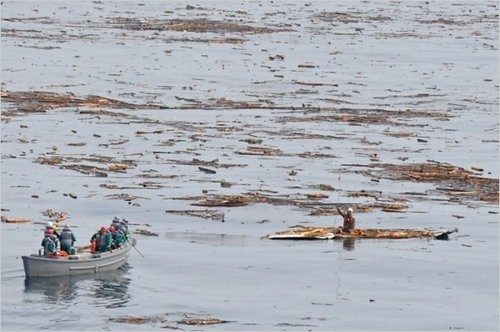
But then, we can also pray with the newspaper (or website) in hand, guided to pray for specific people highlighted in the news. I keep thinking about the man rescued on the rooftop of his house two days after the tsunami and almost ten miles out to sea. I think about how Jesus was with him on his roof as the house floated away from land, and when his wife slipped into the water. I pray for him, that he would be granted grace to sense Jesus’ presence and comfort, and turn to Him in faith.

Rescue of Japanese man on his roof

I pray for the people named in the Dallas Morning News stories, that they would not rest with the fact that their lives were spared, until they come to Jesus in faith. I pray for the spiritual cataracts that would keep them blind to His reality to fall from their eyes so they can see the truth:  God loves them personally and passionately, and saved them from death for a reason.

I pray for the people not named, but mentioned: those searching for bodies. The survivors of lost loved ones. The officials responsible for cremating an unrealistic number of bodies. Those trying to restore water and electricity. The workers in the nuclear power plants who knowingly expose themselves to the risk of deadly levels of radiation. Those securing and those passing out food. Those plagued by nightmares that don’t go away, and those who will help the traumatized process their terror.  All of them need God’s help and grace. Their ancestors will not help them. False gods will not help them. Only the true God is there for them.

And so I pray for the Christ-followers and the churches in Japan, few though they be, to shine in this time of breathtaking need, to be “Jesus with skin on” in this crisis.

Lord, have mercy. Lord, show up in Japan in a way never before seen.

And Lord, what would You have ME do?


This blog post originally appeared at blogs.bible.org/engage/sue_bohlin/praying_for_japan


Prayer Notch-Bumpers

This weekend my understanding of the power of prayer was bumped up a notch.

I was at a retreat that was being bathed in prayer; 50 young people, all battling unwanted same-sex attractions, gathered to find fellowship with each other and pursue greater intimacy with Jesus. The fact that they were there at all is an evidence of the power of God and the fact that He answers the prayers of their loved ones. The fact that so many of them are experienced some degree of change in the way they think and act, with a resulting change in the intensity of their feelings, is also evidence of the power of God. Nothing builds my faith like seeing His love and grace and power released into the lives of precious people like these dear friends of mine.

But the “notch-bumper” came in the form of two incidents.

Several of the board members of this ministry, of which I am one, came to teach seminars. After we finished, I visited with two of them, both pastors. We were talking about how spiritual warfare rages in the weeks before, during and after our retreats. One pastor said, “I confessed to the Lord the other day, ‘I know You say to pray without ceasing, but I just don’t.’ He said, ‘If I let you see for just one second the battle that rages around you, you would never stop.’” Whoa. It was a good reminder to not remain content with simply looking at the physical, material world as if that were all that exists. There are angels and demons at work and at war all around us—all the time!

That night, while we were all singing worship songs, a young lady asked to speak to me outside in private. She asked permission to leave the building because she needed to be alone with God. I had a sense there might be something else going on even if I didn’t know what it was, but the Lord didn’t give me a “red light” in my spirit about letting her go. So we agreed that she would be back by 9:00.

By 9:10, she still hadn’t returned. I started praying that the Holy Spirit would draw her back to the rest of us. I envisioned a rope tied around her heart, and in my spirit I kept pulling on the rope. A few minutes later she walked in the door with a funny look on her face. I walked over and gave her a long, warm hug, whispering, “I’m so glad you came back.”

The next day a group of us were talking with her about her time alone with God. Apparently, she was unhappy with Him and was arguing with Him about something. I told her about my prayer and my pulling on the rope, and her eyes grew big. “That was you??” she asked. “I didn’t want to go back, I had no intention of going back, but all of a sudden I found myself on my feet, and then I was walking back to the building where everyone was, and I was saying, ‘What’s going on? I don’t want to do this!’ But then I found myself in the room with everyone.”

It gave me spiritual goosebumps. When we abide in Jesus—the theme of the retreat—our prayers are His prayers, and He answers them. In ways that bring Him glory. . . and bring us goosebumps.


This blog post originally appeared at blogs.bible.org/engage/sue_bohlin/prayer_notch-bumpers on March 1, 2011.


Dangerous Worldviews

Warm greetings from cold, cold Belarus, a country which is part of the former Soviet Union (between Poland and Russia). My husband and I are here this week to teach Christian worldview and apologetics to Christ-followers. One’s worldview (and everyone has one, whether they know it or not) is comprised of a set of beliefs or presuppositions that are like a pair of glasses through which we interpret the world and our experiences in it.

In order to help our friends understand the importance of viewing reality accurately, which is only possible with a pair of glasses that consist of truths that align with what God has revealed in scripture, we brought along a prop. We brought a pair of goggles called “Drunk Busters” that give the wearer a dizzying approximation of what being drunk does to your vision. State police and drivers’ education programs use them to demonstrate why it’s deadly to drink and drive.

We ask for a volunteer to first navigate a simple obstacle course of chairs, catch an object we toss to them, and pick up that object from the floor. No one has any trouble doing these things.

Then they put on the goggles. They usually say, “Whoa!” It’s very disorienting.

Navigating their way around the chairs, catching the objects we toss, and picking up anything from the floor suddenly becomes not only difficult but comical to those watching. Nothing is where they think it is. Their eyes lie to them about reality. If they were behind the wheel of a car, they would be very dangerous.

Then we make the point that having the wrong worldview, the wrong set of beliefs and assumptions about reality, is also very dangerous.

It is dangerous eternally for a person to believe that God does not exist, or that God is anything other than what He has revealed Himself to be in His word and in His Son. It is equally disastrous for someone to believe in no God (atheism), and for someone to believe in a divine impersonal force that permeates everything (variations on pantheism).

But the wrong worldview can also be dangerous for Christians whose pair of glasses consists of a prescription with some truth and some error. The majority of American Christians who claim to be born again do not have a biblical worldview. What they believe differs from what the Bible says. For example, many believe in reincarnation. Many trust in astrology. Some believe that God is distant, angry, and doesn’t particularly like us, that this “Gee-Oh-Dee” will begrudgingly let us into heaven only because Jesus died in our place. They don’t understand that God is Father, Son and Spirit, Who have always loved us and welcome us enthusiastically into the circle of Their divine love, fellowship, joy and camaraderie.

Some believers think that they put their trust in Christ to save them when they die, but Jesus has nothing to say about their life between salvation and death. So they live their lives depending on the surrounding culture to give them wisdom and instruction about how to be educated, how to choose a mate and be married, how to parent, what kind of job to get, how to spend their money and other resources, and where to find satisfaction in their lives while they wait for heaven. They miss what Paul meant by “Christ, who is our life” (Col. 3:4). The phrase “Christ in you, the hope of glory” (Colossians 1:27) is only an abstract concept unrelated to the way they live their lives: essentially, “Jesus is in my heart, and I keep Him stashed there till it’s time to go to heaven.”

It’s dangerous to have the wrong worldview that misses the glorious truth that real life is only found in Jesus, that any love we give or receive comes from Jesus to and through us, that light comes from Jesus and all else is darkness. And it’s far more tragic than bumping into an obstacle course or dropping a ball tossed to us.

How’s your worldview? If your beliefs and the things you assume are not corrected and established by God’s word, invite Him to change your prescription, and expect Him to joyfully start to transform your thinking!

Lord Jesus, transform me by renewing my mind (Romans 12:2). I don’t even know what I don’t know; I don’t know what my blind spots are, and I don’t know what I have wrong in my thinking. I invite You to change me from the inside out so I think like You!


This blog post originally appeared at blogs.bible.org/engage/sue_bohlin/dangerous_worldview on Feb. 15, 2011


Pods, Aliens, and the Incarnation

There is a moment in the 1985 sci-fi movie Cocoon that has haunted me for 25 years now. Senior citizens discover that the water in the pool they’ve been swimming in has a marvelously rejuvenating effect on them. Aliens have stashed the cocoon pods of their cohorts in the bottom of the pool of a rented house, awaiting their return to the mother ship.

These aliens are light-filled, radiant creatures who cover themselves in human skin to pass as one of us.

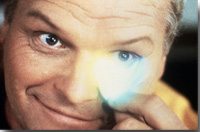
The alien (Brian Dennehy) reveals the light inside his human fleshThe moment in the film that has stayed with me all this time is when the lead alien, played by Brian Dennehy, checks his human disguise in the mirror. He pulls down his lower eyelid, revealing the light within that shoots out in a beam. I gasped internally: what a picture of the Incarnation of the Lord Jesus Christ!

Now the Word became flesh and took up residence among us. We saw his glory — the glory of the one and only, full of grace and truth, who came from the Father. (John 1:14)

When the Lord Jesus wrapped Himself in human flesh and entered our world, He did not leave His glory behind—He covered it up. “Glory” can mean splendor and brilliance and magnificence, but it also connotes the essential nature of a person or thing. Jesus brought His essential nature of the eternally existent Father’s Son into His human body, into our world. John 1 tells us that Jesus brought with Him—because He is—life, light, truth, fullness. He embodies the things our broken souls long for.

I love the Incarnation. I love the fact that Jesus entered into our “garbage pail” of human darkness and brokenness to redeem it all. I love that He brought His light and His glory into our blindness and lifelessness. But (in the famous words of the TV infomercials) . . . “That’s not all!”

I am still amazed that not only did the Lord of glory “tabernacle among us” (John 1:14), not only did He pitch His tent in our midst, He gladly sets up house inside us! When we accept the Father, Son and Spirit’s invitation to join Their circle of divine love and joy and fellowship and community, He brings His glory inside of us! Literally!

Suddenly, the image of the light inside the Brian Dennehy/alien character is not just about Jesus being light on the inside and human flesh on the outside, it’s a picture of “Christ in [us], the hope of glory” (Colossians 1:27). He brings HIS light inside of us.

Amazing. Staggering. And yet it’s real, it’s true, and if we lived it out, if we lived an incarnational life of allowing Jesus to express the love and glory of God through what we think and say and do, the people in our lives would think, “Where do I get me some of that??”

Oh Lord Jesus! Deepen my understanding of this truth so that I continually choose to let You live Your glory through me, drawing others to Yourself!


This blog post originally appeared at
blogs.bible.org/pods-aliens-and-the-incarnation/
on Feb. 1, 2011


The Last Christian

I just finished another novel by one of my favorite authors, David Gregory. I really enjoyed The Last Christian for several reasons, including the creation of characters I truly cared about, but there are two big reasons that I find myself continuing to think about.

The Last ChristianThe book is set in 2088. Abby Caldwell, who grew up as the daughter of missionaries in Papua New Guinea in a tribe cut off from the rest of the world, comes back to the U.S. and learns that Christianity has died out. She is “the last Christian.” Her grandparents had left her a message sixteen years before telling her that God had impressed on both of them that she was His choice to bring Christianity back to this country, but because she had no contact with the outside world, she hadn’t received it. At the same time as Abby’s entry to American culture (quite a shock for someone who grew up in a primitive jungle culture), stories start popping up on “the Grid” about people having dreams of Jesus.

One reason the book was compelling is its explanation of how Christianity died out. One of the main characters is a history professor at a Dallas university who gives a five-point lecture about what rendered Christianity so irrelevant and obsolete as to have no presence in the culture at all. The biggest point was the lack of distinctiveness between believers and unbelievers. Since professing Christians had the same beliefs and the same behaviors of those with no allegiance to Christ, there was no reason for anyone to become a Christian.

And that’s where we are today in 2011: in an excruciatingly dangerous position of losing our Christian voice in the culture because in the majority of our lives, Jesus Christ makes absolutely no difference at all. At Probe Ministries, we call this being “culturally captive.” When our beliefs and behaviors are informed and shaped more by the surrounding culture than by the Word of God and the character of God, we have been taken captive. Paul warned the first-century Christians about this very thing: “See to it that no one takes you captive through philosophy and empty deception, according to the tradition of men, according to the elementary principles of the world, rather than according to Christ” (Colossians 2:8). The Last Christian paints a chilling scenario of what could happen right here in the United States, just as the light has gone out in Europe (except for small pockets of believers—God is still faithful!).

The other thing I really loved about the book is the heroine’s progression of understanding of her faith. When she arrives in the U.S., convinced God wants her to share the gospel with her home country, she defines it as “we are sinners and Jesus died to pay the penalty for our sin so we can go to heaven when we die.” Naturally, this message does not resonate with a completely secular audience. The author uses marvelous means to enlighten her to the much larger, far more compelling description of the gospel as the truly good news that God invites us into His life, a quality of abundance and joy and love today that is so much bigger than simply having one’s ticket-to-heaven card punched.

For the past year, reading through all four gospels, I’ve been meditating a lot on what Jesus preached: the Kingdom of God, which He sometimes also called the Kingdom of Heaven. The Kingdom is a party! Do a word search for “kingdom” in the New Testament, and you’ll see it connected with words like righteousness, peace, joy, power, treasure, fine pearls, fruit, and eating and drinking at God’s table. Sounds like a party to me! In John’s gospel, Jesus refers to the kingdom as “life.” Over and over and over again.

If people saw the Christian life as being connected to the source of life—Jesus our Lord—and saw Christians living lives marked by peace, joy, power, treasure, fruitfulness, and a radiant quality of life that comes from letting Jesus shine through us in His beauty and power, we wouldn’t need to fear that the horrible scenario painted in The Last Christian will come to pass.

Party on!

This blog post originally appeared at
blogs.bible.org/engage/sue_bohlin/the_last_christian
on Jan. 18, 2011.


Finally! Quality YA Fiction from a Christian Worldview

May 30, 2009

Phantom IslandKrissi Dallas has hit the road running with her debut novel, Phantom Island: Wind. It instantly found its way to the number one selling spot at Authorhouse.com as the word-of-mouth buzz about this page-turner spread like wild fire surrounding the novel’s release. The novel is Young Adult fiction; it’s full of drama, adventure, suspense, and romance. As a vested seventh and eighth grade teacher and the wife of a youth pastor, YA fantasy-fiction is something Krissi Dallas is an expert on and has a passion for. Her love and affinity for her students, as well as the openly autobiographical nature of much of the book, have allowed Dallas to “open a vein,” and write from the depths of who she is, from the heart. This deep connection transfers itself to the reader. I found myself desperately curious; no, not just curious, committed and concerned about the characters. Reading until the end of the chapter wasn’t enough: I had to find out what would happen next and would they be okay. I don’t think I have ever read a book this size this quickly—not even any of the Harry Potter series… which I also toted obsessively wherever I went so I could read every chance I got.

Phantom Island: Wind is divided into three parts, and it’s part two that really gets you. If you weren’t addicted already in part one, you definitely will be when part two begins. This is also where the fantasy part of this fantasy-fiction novel really kicks in. You know how you can tell when you’re reading really good fantasy-fiction? When you can’t tell. If you ever find yourself questioning the reality the author’s created, it isn’t good fantasy-fiction. While reading Wind I never once caught myself raising my eyebrow thinking, I don’t know about that. I was completely engrossed.

Wind is well written. Dallas has a captivating command of detail. Good literature is good literature, regardless of the target audience. Phantom Island isn’t just for teenagers; it’s for anyone who hasn’t forgotten how to read — how to imagine and empathize and create. The plot and character development; the intrigue, the tension, the romance, the journey, the discovery; every thing about the Island kept me turning pages when I should have been sleeping.

Wind is the first book in the Phantom Island series. Water, is scheduled to come out Summer 2010. It’s always nice to have something to look forward to, especially the “small” things; I can’t wait to find out what happens next. For more about Phantom Island visit www.krissidallas.com/.

This blog post originally appeared at reneamac.com/2009/05/30/phantom-island-wind/