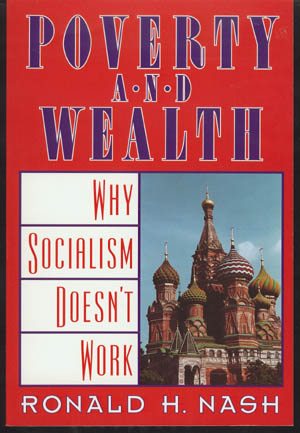
Poverty and Wealth

Don Closson examines the arguments in Ronald Nash’s book Poverty and Wealth: Why Socialism Doesn’t Work and concludes that capitalism is compatible with biblical ethics.

It’s disheartening to meet young Christians who are convinced of the immorality of capitalism and the free market system. Sincere Christians often quote the second chapter of Acts which describes how the church in Jerusalem held all things in common as proof that socialism or collectivism is more biblical than the free market. Sometimes they use the Marxist critique that “poor nations are poor because rich nations oppress them.” It’s unusual to meet students who wholeheartedly endorses capitalism. They recognize that it works well enough to make the U.S. the richest nation on earth, but it’s not something to be proud of or openly endorse.

download-podcastThere continues to be a heated debate in our country over which economic system is the most just and best able to weather the inevitable economic ups and downs in today’s complex worldwide economy. Christians wonder if capitalism is inherently incompatible with Christian ethics. Is it driven by greed and self-interest alone? Does it thrive on oppression? Does it conflict with a biblical view of human nature?

Ronald Nash’s book Poverty and Wealth: Why Socialism Doesn’t Work{1} faces these questions head on and concludes that free market capitalism leads to abundance and political freedom because it is based on the laws of economics and the truth about human nature. Social and economic programs that ignore these laws will inevitably cause more harm than good. Even more importantly, Nash argues that capitalism is compatible with biblical ethics. He writes,

Capitalism is quite simply the most moral system, the most effective system, and the most equitable system of economic exchange. When capitalism, the system of free economic exchange, is described fairly, there can be no question that it, rather than socialism or interventionism, comes closer to matching the demands of the Biblical ethic.{2}

In order to understand Dr. Nash’s point we will define some basic economic concepts and compare capitalism with socialism and interventionism. Neither Dr. Nash’s book nor I question the intentions of Christians who have accepted Marxist solutions, but we do question their wisdom. In the words of Dr. Nash,

“Unfortunately, many Christians act as though the only thing that counts is intention. But when good intentions are not wedded to sound theory, especially sound economic theory, good intentions can often result in actions that produce consequences directly opposite to those we planned.”

Even the acceptance of free markets by China and Eastern Europe have not swayed the true believer of Marxist thinking. Our young people will encounter a Marxist critique of capitalism and the free market system at some point in their education. As parents we owe it to our children to have an answer to their certain questions.

The Market System

The market system is the set of rules that creates a voluntary system of exchange resulting in the price, selection, and quantity of products that are made and sold in an economy. Those who support capitalism believe that both parties benefit from the voluntary exchange of goods and services. Marxists, on the other hand, often argue that the free market system results in a win/lose relationship. What are the rules that define a free market system and what role should government play in maintaining it?

The rules of a free market system are simple. First, people should not be coerced into making economic exchanges. This means that they should be free from force, fraud, or theft. Another rule is that people must honor their contracts to buy or sell with another party. Just as local government provides for the traffic signals in a town, government is responsible for enforcing the basic rules of the free market. Traffic signals create order out of potential chaos on our roads. Likewise, the rules of the free market system create order out of potential economic chaos. But in neither case do the rules tell people where to go or what to trade. Both systems are neutral to an individual’s personal goals.

The decentralized actions of producers and consumers encourage the production of a vast array of products at prices that people are willing to pay. These goods and services are produced, not because someone is forced to, but because they know that by satisfying needs they can earn an income and satisfy their own desires. Free market capitalism is based on this principle of mutual accommodation. The market also encourages the efficient use of resources. Price is a factor of demand for a product and the scarcity of its components. It is the market which takes into account an almost infinite number of decisions and variables to make goods available at the best possible price. Profits and losses within the market encourage producers to move into or out of the production of a given item. Inefficient production or over-production of an item will result in losses sufficient enough to change a producer’s behavior.

Government is necessary for enforcing the basic rules of a free market economy. Its interest should be to make sure that justice prevails, and to ensure the common good. This includes the right to own and exchange property, the enforcement of contracts, as well as laws forbidding the use of force, fraud, and theft. If the government itself begins to intervene beyond this role, it becomes a detriment to the market and can itself become the source of injustice. A system based on, or highly influenced, by government coercion cannot be called a free market system.

Capitalism vs. Socialism

A former president of the Evangelical Theological Society has written that capitalism violates “the basic ethical principles of Christianity” and that there is an essential political and economic dimension to the Kingdom of God which capitalism defiles. This thinking has the effect of placing supporters of capitalism among the heretics and against the Kingdom of God. Does capitalism really violate the gospel message and a biblical worldview? Does socialism offer the only righteous means for creating and distributing wealth?

Capitalism argues that individuals have the right to make decisions about what they own. This not only assumes the right to own property, but to exchange what one owns for something else, and to be free from force in the form of fraud, theft, or the violation of a contract. The moral base of “thou shalt not steal” and “thou shalt not lie” are essential to the success of a capitalistic system. In fact, these basic rules of capitalism are very similar to an Old Testament view of righteousness which focused on the completion of covenant agreements. God is considered a righteous God partially because He fulfills His covenants with His creation.

Marxists love to point to examples like the Philippines under Ferdinand Marcos in order to criticize capitalism. This corrupt regime can surely be criticized, but not as an example of capitalism. It is representative of what might be called an interventionist economy. There are three general types of economies: capitalist, interventionist, and socialist. Capitalism and socialism are at the two ends of the continuum with interventionism in the middle. The two opposites represent two possible means of exchange. Capitalism is defined by its advocacy of free or peaceful exchange, allowing individual choice regarding the use of personal property. Socialism is defined by centralized planning, using force to get individuals to conform to its decisions. A system becomes less capitalistic and more interventionist as more and more economic decisions are coerced by the government. It becomes socialistic when basic needs are met only by the government, forcing people to deal with it exclusively. The ideal of capitalism is freedom; the ideal of socialism is forced compliance with government planning.

Critics of capitalism condemn economic systems in which interest groups use the power of government to intervene on their behalf, forcing consumers via taxes or mandates to spend their money or use their talents in a way they would not freely choose. But this isn’t capitalism; it’s interventionism, and unfortunately a pretty good description of where the U.S. is headed.

Economic Systems and Human Nature

Is capitalism the primary cause of world poverty? Although the Bible does teach that exploitation is one cause of poverty, it also teaches that it results from indigence and sloth as well as accidents, injuries, and illness. When the prophet Amos condemned the Jews for forcing the poor to give them grain, for taking bribes, and depriving the oppressed justice, he was highlighting violations of free market capitalism as well.

Some believe that capitalism is built on greed, which the Bible condemns. However, the Bible does teach a certain level of self-interest. For example, 1 Timothy 5:8 is critical of anyone who does not provide for the needs of his family. And although selfishness exists in capitalistic countries, it is not inherent to the system; it is inherent to humanity. Either we allow people to make choices based on their own self-interest and moral virtue, or we turn those decisions over to a central government. Could it be naïve to think that government officials will use wealth in a morally superior way to those outside of government? History teaches that when power is centralized it has the tendency to be abused.

In a non-coercive free market environment, those who serve the needs of others will prosper. As long as the rule of law prevails and the government isn’t allowed to stack the deck for one particular group against another, the market protects us from the greed of others. The free market is by definition one place where coercion is not possible.

Socialists contend that competition is another evil of capitalism, but is competition itself an evil? We can agree that using force, fraud, or theft to compete is morally wrong, but can we really say that all competition is wrong? Scarcity demands competition; as long as resources are limited we will find some competitive means for allocating them. Socialist societies use long waiting lines and bureaucratic red tape to dole out limited goods, and competition is intense for political positions that result in material gain.

There are only two ways to resolve conflict that results from scarcity. One is by force, the other is by free market competition. Non-violent free market competition has helped to alleviate the effects of scarcity by stirring people to high levels of excellence in manufacturing and services. Socialist countries are not usually known for the quantity or quality of their goods and services.

Economist Walter Williams notes that “Capitalism has a strong bias toward serving the common man. . . . Political allocation of resources, regardless of its stated purpose, is strongly biased in favor of the elite.”{3} Maybe that is why the elite have such disdain for capitalism.

Critiquing Socialism

Highly collectivist economies are not known for producing what people need at a price they can afford. In the 1920s, economist Ludwig von Mises showed why central planners can never replace the market: they are unable to gather the necessary information to plan accurately. The market system provides incentives to both producers and buyers that are missing in socialistic countries. Under socialism “rewards are not related to effort and commercial risk-taking, but to party membership, bureaucratic status, political fiat and corruption.”{4} Sociologist Peter Burger writes, “Simply put, Socialist equality is shared poverty by serfs, coupled with the monopolization of both privilege and power by a small (increasingly hereditary) aristocracy.”{5}

One evangelical writer contends that Marxism has “a deep compassion for people. Unlike present political systems—big business, even the Church—it [Marxism] does not seem to have any particular vested interests to defend.”{6} In other words, only Marxists really care about people. However, history has not been kind to Marxist collectivism. Some of the worst human rights records have been accumulated by Marxist regimes in the U.S.S.R., China, Cambodia, North Korea and Cuba. I find it hard to imagine that the millions who died at the hands of Stalin, Mao Tse Tung, or the Khmer Rouge were very impressed by the compassion of their nation’s Marxist leaders.

But what about the example in Acts of all Christians sharing their goods in common or of Barnabas selling his property for the good of other believers? What some people miss is that both of these examples are of individuals making free moral choices to use their property for the good of others. They are making free market decisions regarding their possessions. This can only occur when individuals have the freedom to use their possessions to help others. If all economic decisions are made by centralized planners, moral choice is removed and the option to act upon personal moral convictions is reduced.

Living within a capitalistic society allows believers to exercise their personal responsibility to provide for the poor and less fortunate. This has resulted in remarkable examples of philanthropy in America and other capitalistic nations. In fact, no other people on earth have given as much to other nations as have Americans.

A properly functioning market system is an effective tool against oppression and corruption because it promotes the rule of law for all citizens. However, a strong moral system is necessary to keep it from being controlled by special interests. There are too many examples of economies that have been shaped for the benefit of a few. Christ’s advocacy for the poor should make us a strong moral barrier to this kind of corruption.

Notes

1. Ronald H. Nash, Poverty and Wealth: Why Socialism Doesn’t Work (Dallas: Probe Books, 1986).
2. Ibid., 80.
3. Ibid., 75.
4. Ibid., 87.
5. Ibid.
6 . Andrew Kirk, The Good News of the Kingdom Coming (Downers Grove, IL: InterVarsity Press, 1985), 45, quoted in Nash, Poverty and Wealth, 191.

© 2009 Probe Ministries


Coddling of the American Mind

Drawing on the book The Coddling of the American Mind, Kerby Anderson examines the insanity on college campuses where students cannot handle ideas and people they disagree with.

download-podcastIn this article we will talk about what is happening on college campuses, and even focus on why it is happening. Much of the material is taken from the book, The Coddling of the American Mind.{1}

Greg Lukianoff was trying to solve a puzzle and sat down with Jonathan Haidt. Greg was a first amendment lawyer working with the Foundation for Individual Rights in Education (FIRE). He was trying to figure out why students (who used to support free speech on campus) were now working to prevent speakers from coming on campus and triggered by words or phrases used by professors.

Greg also noticed something else. He has suffered from bouts of depression and noticed some striking similarities with some of the comments by students. He found in his treatment that sometimes he and others would engage in “catastrophizing” and assuming the worst outcome. He was seeing these distorted and irrational thought patterns in students.

After a lengthy discussion they decided to write an article about it for The Atlantic with the title, “Arguing Towards Misery: How Campuses Teach Cognitive Distortions.” The editor suggested the more provocative title, “The Coddling of the American Mind.” The piece from The Atlantic was one of the most viewed articles of all time and was then expanded to this book.

That book used the same title: The Coddling of the American Mind. Jonathan was on Point of View last year to talk about the book. The authors believe that these significant psychological changes that have taken place in the minds of students explain much of the campus insanity we see on campus today.

They point out that two terms rose from obscurity into common campus parlance. Microaggressions are small actions or word choices that are now thought as a kind of violence. Trigger warnings are an alert the professors now must use if they may be discussing a topic that might generate a strong emotional response.

Before we talk about some of the insight in the book, it is worth mentioning that though there is a psychological component to all of this insanity, there is also an ideological component. When the original article appeared, Heather MacDonald asked if “risk-adverse child-rearing is merely the source of the problem. For example, why aren’t heterosexual white males demanding safe spaces?”{2} They all had the same sort of parents who probably coddled many of them.

It would probably be best to say that the mixture of psychological deficits also with the liberal, progressive ideological ideas promoted on campus have given us the insanity we see today. We have had liberal teaching on campuses for a century, but the problem has become worse in the last decade because of the psychological issues described in the book, The Coddling of the American Mind.

Three Untruths (Part 1)

The book can easily be summarized in three untruths that make up the first three chapters of the book. The first is the “Untruth of Fragility: What Doesn’t Kill You Makes You Weaker.” Nietzsche’s original aphorism was, “What doesn’t kill you makes you stronger.” The younger generation has turned this idea on its head.

It is true that some things are fragile (like china teacups), while other things are resilient (and can withstand shocks). But they also note that some things are antifragile. In other words, they actually require stressors and challenges to grow. Our muscles are like that. Our immune system is like that. And university education is supposed to be like that. Students are supposed to be challenged by new ideas, not locked away in “safe spaces.”

Unfortunately, most young people have been protected by a culture that promotes what they refer to as “safetyism.” It has become a cult of safety that is obsessed with eliminating threats (whether real or imagined) to the point where fragility becomes expected and routine. And while this is true for the millennial generation (also called Generation Y), it is even truer for the iGen generation (also called Generation Z) who are even more obsessed with safety.

Part of the problem in these untruths is what they call “concept creep.” Safety used to mean to be safe from physical threats. But that has expanded to the idea that safety must also include emotional comfort. In order to provide that comfort, professors and students a few years ago introduced the idea of creating “safe spaces” for students. And in order to keep those students emotionally safe in the classroom, professors must issue “trigger warnings” so these students don’t experience trauma during a classroom lecture or discussion.

The second untruth is the “Untruth of Emotional Reasoning: Always Trust Your Feelings.” You can get yourself in some difficult circumstances quickly if you always trust your emotions. It is easy in this world to get frustrated, discouraged, and even depressed. Psychologists have found that certain patients can get themselves caught in a feedback loop in which irrational negative beliefs cause powerful negative feelings. We are seeing that on college campuses today.

Psychologists describe “the cognitive triad” of depression. These are: “I’m no good” and “My world is bleak” and “My future is hopeless.” Psychologists have effective ways of helping someone break the disempowering feedback cycle between negative beliefs and negative emotions. But very few adults (parents, professors, administrators) are working to correct mistaken ideas.

Three Untruths (Part 2)

In a college classroom, students are apt to make some sweeping generalization and engage in simplistic labeling of the lecture or reading material. In that case, we would hope that a professor would move the discussion by asking questions or even challenging the assertion.

Instead, many professors and colleges go along with the student comments. In fact, many even argue that any perceived slight adds up to what today are called “microaggressions.” In many cases, slights may be unintentional and actually wholly formed from the listener’s interpretation.

Here is how it develops. First, you prevent certain topics from being discussed in class. Next, you prevent certain speakers from coming to campus because they might present a perspective that aggrieved students believe should not be discussed. In the book is a chart illustrating how many speakers have been disinvited from universities. Five years ago, the line jumps up significantly.

The third untruth follows from that assumption. It is the “Untruth of Us Versus Them: Life is a Battle Between Good People and Evil People.” The authors argue that “the human mind is prepared for tribalism.” They even provide psychological research demonstrating that. But that doesn’t mean we have to live that way. In fact, conditions in society can turn tribalism up, down, or off. Certain conflicts can turn tribalism up and make them more attentive to signs about which team a person may be on. Peace and prosperity usually turn tribalism down.

Unfortunately, in the university community, distinctions between groups are not downplayed but emphasized. Distinctions defined by race, gender, and sexual preference are given prominence. Mix that with the identity politics we see in society, and you generate the conflict we see almost every day in America.

The authors make an important distinction between two kinds of identity politics. Martin Luther King, Jr. epitomized what could be called “common-humanity identity politics.” He addressed the evil of racism by appealing to the shared morals of Americans using the unifying language of religion.

That is different from what we find on college campuses today that could be called “common-enemy identity politics.” It attempts to identify a common enemy as a way to enlarge and motivate your tribe. Their slogan sounds like this: Our battle for identity and survival is a battle between good people and bad people. We’re the good guys and need to defeat the bad guys.

An Example: Evergreen State College

One good example of how these untruths play out can be found at what happened on a college campus in Olympia, Washington. The entire story is described in chapter five but also is featured prominently in the opening chapter of the book No Safe Spaces and in the movie with the same title.

Just a few years ago, Evergreen State College was probably best known as the alma mater for rapper Macklemore and Matt Groening, the creator of The Simpsons. That all changed with an email biology professor Bret Weinstein sent.

In the past, the school had a tradition known as the “National Day of Absence.” Usually, minority faculty and students leave the campus for a day to make a statement. But in 2017, the college wanted to change things and wanted white students and faculty to stay away from campus.

Professor Weinstein argued in an email that there is a difference between letting people be absent and telling people “to go away.” And he added that he would show up for work. When he did, he was confronted by a mob of students. When the administration tried to appease the demonstrators, things got worse.

Weinstein has described himself as a political progressive and left-leaning libertarian. But his liberal commitments did not protect him from the student mob. The campus police warned him about a potential danger. The next morning, as he rode his bike into town, he saw protesters poised along his route tapping into their phones. He rode to the campus police department and was abruptly told: “You’re not safe on campus, and you’re not safe anywhere in town on your bicycle.” Weinstein and his wife eventually resigned and finally received a financial settlement from the
university.

The Evergreen students and faculty displayed each of the three great untruths. The Untruth of Fragility (What doesn’t kill you makes you weaker) came from a faculty member who supported the protesters and addressed some of her faculty colleagues in an angry monologue. She warned, “I am too tired. This [blank] is literally going to kill me.” A student at a large town hall meeting verbalized her anxiety and illustrated the Untruth of Emotional Reasoning (Always trust your feelings). She expressed, “I want to cry. I can’t tell you how fast my heart is beating. I am shaking in my boots.”

And the whole episode illustrates the Untruth of Us Versus Them (Life is a battle between good people and evil people). The students and faculty engaged in common-enemy identity politics by labeling a politically progressive college and liberal professors as examples of white supremacy. One student (who refused to join the protest) later testified to the college trustees, “If you offer any kind of alternative viewpoint, you’re the enemy.”

What Can We Do?

The book, The Coddling of the American Mind, identifies many disturbing trends on college campuses that are beginning to spill over into society. What can we do to stem the tide?

Obviously, the long-term solution to the insanity on campus and in society is to pray for revival in the church and spiritual awakening in America. But there are some practical things that must be done immediately.

First, college administrators must get control of their campus. The riots at some of these universities resulted in violence and property destruction. Often the campus police and even the local police failed to take action. Sadly, the university administration rarely took action afterwards.

Some form of deterrence would have prevented future actions on the University of California, Berkeley campus. Instead, the inaction established a precedent that likely allowed the conflict at Middlebury College. Students not only shut down the lecture, but they assaulted one of the campus professors. Once again, no significant action was taken against the students and outside agitators. The problem will get worse if there is no deterrence.

Second, professors must get control of their classrooms. Students cannot be allowed to determine what subjects cannot be taught and what topics cannot be discussed. The authors of this book are concerned about the tendency to encourage students to develop extra-thin skins just before they enter into the real world. Employers aren’t going to care too much about their feelings. Students don’t have the right not to be offended.

Third, we need to educate this generation about free speech. One poll done by the Brookings Institute discovered that nearly half (44%) of all college students believe that hate speech is NOT protected by the First Amendment. And since many students label just about anything they don’t like as hate speech, you can see why we have this behavior on college campuses. More than half (51%) of college students think they have a right to shout down a speaker with whom they disagree. A smaller percentage (19%) of college students think it is acceptable to use violence to prevent a speaker from speaking on campus.

Finally, the adults need to make their voice heard. We pay for public universities through our tax dollars. Parents send their kids off to some of these schools. We should not tolerate the insanity taking place on many college campuses today.

The authors have identified certain concerns that colleges and universities need to address. They remind us how hostile the academic world has become, not only to traditional Christian values, but also to mere common sense. We need to pray for what is taking place in the college environment.

Notes

1. Jonathan Haidt and Greg Lukianoff, et al., The Coddling of the American Mind: How
Good Intentions and Bad Ideas Are Setting Up a Generation for Failure.
New York City: Penguin Press, 2018.
2. www.thecollegefix.com/heres-the-9-best-takeaways-from-heather-mac-donalds-new-diversity-delusion-book/

©2020 Probe Ministries


The Contrasting Worldviews in ‘That Hideous Strength’

Dr. Michael Gleghorn demonstrates how C.S. Lewis’s ‘That Hideous Strength’ illustrates the cosmic war of good and evil through supernatural spiritual warfare.

A Study in Contrasts

In this article we’re concluding a three-part series examining C.S. Lewis’s “Cosmic Trilogy.”{1} We’ve already looked at Out of the Silent Planet and Perelandra, which you can find on our website at Probe.org. Now we turn to That Hideous Strength, the third and final novel of the trilogy, originally published in 1945. In many ways, the story is a study in contrasts between two very different communities characterized by two very different worldviews.{2}

On the one hand there is the National Institute for Coordinated Experiments (or N.I.C.E.), which might initially appear to embrace a naturalistic worldview, but which is actually governed by a kind of pragmatism that accepts whatever is useful for advancing its own nefarious purposes. On the other hand, there is the community at St. Anne’s, which is generally animated by a Christian worldview.

Ransom, the hero of the first two novels, comes into this story as the “Head” or “Director” of St. Anne’s, and he’s a very different leader than the “Head” of the N.I.C.E. (as we’ll see later). Whereas the first two novels largely took place on Mars and Venus respectively, this story takes place on Earth, specifically in England, sometime after World War 2.{3}

That Hideous Strength is a long novel. It covers a lot of ground and deals with an incredible variety of ideas and issues. Because of this, we can only hit a few of the highlights here.

With this in mind, let’s begin by noticing two important statements on the book’s title page. First, the book’s subtitle: “A Modern Fairy-Tale for Grown-Ups.” This tells us something about the genre of the story. It’s intended as a kind of “fairy-tale.” But this is a “fairy-tale” for grown-ups. And indeed, much of this novel would be inappropriate for children.

Second, there’s a quotation from the 16th century Scottish poet, Sir David Lyndsay. In fact, the title of Lewis’s book is taken from this quotation, for Lyndsay mentions “that hyddeous strength” with reference to the Tower of Babel, a story originally told in Genesis 11. The Tower of Babel, you may recall, was a monument to human pride and rebellion against the Lord. In response, the Lord came down in judgment and confused the languages of those building the tower, and they were subsequently scattered over the face of the earth.

If we are to correctly interpret Lewis’s novel, then, we must not lose sight of these two clues. Lewis intends this story as a kind of modern-day “fairy-tale” that, in one way or another, also alludes to something like the Tower of Babel.

Supernatural Influences

Above, I mentioned Lewis’s subtitle for the novel: “A Modern Fairy-Tale for Grown-Ups.” This, I said, tells us something about the genre of the story. Lewis intended the story as a kind of fairy-tale. But what are fairy-tales, and how might this help us interpret Lewis’s novel?

On the English-Studies website, we learn that fairy-tales “are types of literature . . . featuring magical elements, mythical creatures, and moral lessons. Characterized by simple . . .  characters, these stories typically involve a protagonist overcoming challenges with the help of magic or supernatural aid.”{4} As we’ll see, this description fits Lewis’s novel fairly well.

Consider, for example, the concluding statement about “overcoming challenges with the help of magic or supernatural aid.” In Lewis’s novel, Ransom and the community at St. Anne’s overcome the challenges posed by the National Institute of Coordinated Experiments (or N.I.C.E.) with help both magical and supernatural. From the depths of Arthurian legend, Merlin the magician returns to lend his aid to St. Anne’s. Moreover, the community is also helped by powerful angelic authorities who can best be described as something like a cross between Christian archangels and Roman gods or goddesses.{5} Hence, Mercury, Venus, Mars, Jupiter, and Saturn all descend from the heavens to help the community in its time of need.

And this helps us see an important contrast between St. Anne’s and the N.I.C.E., for it turns out that both are receiving a kind of supernatural aid, though the source of that aid is very different. The Christian community at St. Anne’s is receiving supernatural aid from loyal, angelic, servants of God. The N.I.C.E., however, is receiving aid from dark spirits, who are in rebellion against God. The leaders of the N.I.C.E. refer to these spirits as “macrobes,” and recognize that they are “more intelligent than Man.”{6} While the good spirits communicate to the company of St. Anne’s through Ransom, the “Head” of that community, the evil spirits communicate to the leaders of the N.I.C.E. through the decapitated “Head” of a former criminal, which is being artificially preserved in a laboratory. We thus begin to see how the contrasting worldviews of these two communities have led them into very different spiritual alliances.

Science and Magic

One of the strangest aspects of C. S. Lewis’s novel, That Hideous Strength, concerns the return of Merlin to help the community of St. Anne’s in their battle against the National Institute of Coordinated Experiments (or N.I.C.E.). Stranger still is the fact that the leaders of the N.I.C.E. initially hope to recruit Merlin to their own side in this struggle. But isn’t the N.I.C.E. a scientific institute? Why would its leaders want to enlist the aid of an enigmatic magician from the days of King Arthur? It would seem that the governing principles of the N.I.C.E. are really rather different from what one might expect from a scientific institute.

Consider, for example, the character of William Hingest. Lewis describes him as “a physical chemist” and one of  only two men at his college “who had a reputation outside England.”{7} Hingest is a true scientist. But when he visits the N.I.C.E. to find out more about it, he quickly decides to leave. As he tells Mark Studdock, another character in the novel, “I came here because I thought it had something to do with science. Now that I find it’s something more like a political conspiracy, I shall go home.”{8}

Hingest realizes that the N.I.C.E. is quite different from a scientific institute. He rightly senses that there is something dark and corrupt at the institute’s core. As readers, we learn that the leaders of the N.I.C.E. are actually taking orders from demonic spirits. They want to recruit Merlin because they hope to make use of his powers to advance their own agenda. What they fail to realize, however, is that in the world of Lewis’s novel, Merlin is a Christian, and he joins forces with the company at St. Anne’s.

In his book, The Abolition of Man, Lewis described the birth of magic and applied science as “twins.” Both desired “to subdue reality to the wishes of men,” but only science was successful.{9} In Lewis’s novel, however, the leaders of the Institute have stumbled upon a source of power that might arguably trump that of science, namely, the demonic “macrobes.” They want Merlin because he will increase their power still further. The leaders of the N.I.C.E. are not really interested in truth, beauty, or goodness, but only in the power “to subdue reality” to their own wishes. Like the ancient builders of Babel, they are in prideful rebellion against the Lord. And this is why, in Lewis’s “fairy-tale” novel, their work also must be destroyed.{10}

The Problem of Violence

C. S. Lewis’s novel, That Hideous Strength, has often been criticized for its alarming depictions of violence. Near the end of the novel, when the leaders of the National Institute of Coordinated Experiments (or N.I.C.E.) are destroyed by Merlin and the heavenly powers, Lewis describes their deaths in rather grisly detail. Some are trampled and torn apart by wild animals, others are shot or decapitated, and one character chooses to be incinerated by his own hands.{11} Why does Lewis include such horrific scenes?

David Downing has a good discussion of this issue in his book, Planets in Peril: A Critical Study of C.S. Lewis’s Ransom Trilogy. He first observes that “Lewis was writing” this novel “during the bleakest years of World War II and that he draws explicit parallels between the leaders of N.I.C.E. and the Nazis.”{12} He notes that, like the Nazis, the N.I.C.E. also rely upon a “secret police” force. Like the Nazis, they too “control the press . . . use criminals for barbaric medical experiments” and “dream of creating a master race.” Hence, just as it was necessary for the Allies to fight and defeat the Nazis, so also it is necessary for Ransom, Merlin, and the heavenly powers to fight and defeat the N.I.C.E.

But was it necessary for Lewis to describe the deaths of his villains in such “gruesome detail”?{13} Why not simply have the angelic-god Jupiter destroy the leaders of the N.I.C.E. with a well-aimed thunderbolt? Why does Lewis insist on narrating their deaths in such graphic terms? Downing argues that Lewis was using Dante’s Inferno as a “subtext” for this novel.{14} He shows how the journey of Mark Studdock (a major character in the novel) into the heart of the N.I.C.E. parallels Dante’s journey through the nine circles of hell.{15} As Downing observes, the leaders of the N.I.C.E. joined forces with dark spirits. They thus experience a dark end to their earthly pilgrimage.{16}

The violence in That Hideous Strength makes more sense when we remember the comparisons Lewis makes between the N.I.C.E. and the Nazis, as well as the many literary connections between his own story and Dante’s Inferno. Moreover, we must not forget that such violence fits in rather well with Lewis’s description of the story as a kind of “fairy-tale.” Fairy tales, after all, often have a dark side, and Lewis’s tale is no exception.

Babel and the Word of God

C. S. Lewis intended the final novel of his “Cosmic Trilogy,” That Hideous Strength, to be read as a kind of fairy tale with allusions to the biblical Tower of Babel. We’ve mentioned several ways in which Lewis’s novel resembles a fairy tale, but we’ve said little about its allusions to the Tower of Babel. Although Lewis draws several connections between the National Institute for Coordinated Experiments (or N.I.C.E.) and the Tower of Babel, we here have time to mention only a couple.

The story of the Tower of Babel occurs in Genesis 11. In that story, all humanity speaks the same language, and they determine to build “a city and a tower with its top in the heavens” (Genesis 11:4). They do this in order to “make a name” for themselves. But the Lord, who has told humanity to “fill the earth” (Genesis 9:1), comes down and confuses their language, thus dispersing them throughout the world (Genesis 11:8-9).

Like the builders of Babel, the leaders of the N.I.C.E. also want to “make a name” for themselves. The N.I.C.E. aims to achieve something like the deification of humanity, though this will only be accomplished by the destruction of virtually everything that makes human life worthwhile (and only a few, and eventually perhaps just one person, will be the beneficiary of their evil schemes).{17} For this reason, God permits some of His loyal servants, the Heavenly Powers, to descend to earth and bring linguistic confusion to the leaders of the N.I.C.E., thus forcing them to abandon their project.{18}

Merlin the magician, who has joined forces with Ransom and the community at St. Anne’s, is the human instrument through which the Heavenly Powers work to release the “curse of Babel” upon the N.I.C.E. The leaders of this institute have joined forces with dark spirits to achieve their ends. Hence, once the “curse of Babel” is in full force among them, Merlin 7calls out over the din of confusion: “They that have despised the word of God, from them shall the word of man also be taken away.”{19} The inability of the leaders of the N.I.C.E. to understand one another plays a significant role in ending their tyranny, thus saving humanity from their evil intentions.

In That Hideous Strength, Lewis has contrasted two very different communities, with two very different worldviews. Presented as a kind of fairy-tale, with allusions to the biblical Tower of Babel, he has developed an intriguing story about the ongoing battle between good and evil.

Notes
1. Wayne Shumaker uses this terminology in the title of his essay, “The Cosmic Trilogy of C. S. Lewis,” in The Longing for a Form: Essays on the Fiction of C. S. Lewis, ed. Peter J. Schakel (Kent State University Press, 1977), 51-63.
2. See Richard L. Purtill, “That Hideous Strength: A Double Story,” in The Longing for a Form, 91-102, for an excellent treatment of this issue.
3. C. S. Lewis, That Hideous Strength: A Modern Fairy-Tale for Grown-Ups (New York, NY: Macmillan, 1965), 7.
4. See English Studies, “Fairy Tale: A Literary Genre,” English Studies, english-studies.net/fairy-tale-a-literary-genre/#google_vignette (accessed October 29, 2024).
5. I discuss this issue in my first program on the trilogy: “Smuggling Theology into Out of the Silent Planet,” which you can find here: Smuggling Theology into Out of the Silent Planet
6. Lewis, That Hideous Strength, 257.
7. Ibid., 56.
8. Ibid., 70.
9. C. S. Lewis, The Abolition of Man (New York: Macmillan, 1955), 87-89.
10. Lewis, That Hideous Strength, 293-94.
11. Ibid., 343-358. See the chapter, “Banquet at Belbury.”
12. All the quoted material in this paragraph can be found in David Downing, Planets in Peril: A Critical Study of C.S. Lewis’s Ransom Trilogy (University of Massachusetts Press, 1995), 152.
13. Ibid.
14. Ibid., 94.
15. Ibid., 94-99.
16. Ibid., 99.
17. See Lewis, That Hideous Strength, 176-80.
18. Ibid., 320-58.
19. Ibid., 351. In the story, Merlin says this in Latin, but there is a translation in the footnote on this page.

©2025 Probe Ministries


Abortion: A Biblical View

Sue Bohlin calls for a spiritual and moral reflection on the topic of abortion, urging people to consider the eternal implications and affirming that God’s love, grace, and forgiveness extend even to those who have committed this sin.

Spanish flag An earlier version of this article is also available in Spanish.

Abortion as Spiritual Warfare

Abortion continues to be a volatile issue, and an emotional one, in the United States. It is usually seen as a political issue, but I think it’s way bigger than that.

download-podcastI believe we need to see abortion as spiritual warfare.

We live in two dimensions at the same time: the physical world that we can see and touch and measure, and the unseen spiritual realm that is filled with God, angels and demons (2 Corinthians 4:17-18). Jesus revealed to us that Satan is the thief who “comes only to steal and kill and destroy” (John 10:10); abortion is one of the most wicked, heinous ways he inflicts pain and destruction on people God loves.

He steals joy and peace from women who have had abortions, as well as some of the fathers of the babies who were killed in the womb. He steals babies from what should be the safest place on earth. He steals motherhood from women and fatherhood from men. Through abortion, he steals grandchildren from grandparents.

Satan uses abortion to kill. Just in the United States, since Roe v. Wade made abortion legal, over 64 million babies have been murdered.{1} In China, the horrible one-child policy that terrorized the Chinese people for 35 years resulted in 350 million baby deaths.{2}

Satan uses abortion to destroy. Willingly choosing abortion for a pregnant teenager has been Satan’s foothold in many families that were torn apart, a phenomenon I have seen with my own eyes. Abortion—and its evil twin infanticide—destroyed the natural ratio of boys to girls in China. Today, there are 30 million young men who cannot find a girl to marry because there aren’t enough to go around.{3}

The rallying cry of abortion is, “It’s my body”—even though there is another human being’s body involved as well. Theologian Dr. Peter Kreeft’s insight is breathtaking to me: “Abortion is the Antichrist’s demonic parody of the Eucharist. That is why it uses the same holy words, ‘This is my body,’ with the blasphemously opposite meaning.”{4}

Abortion is an evil weapon in the hands of an unspeakably evil enemy. In Genesis 3, Satan declared war on the people God created and loves, and he has been warring with us ever since. The Lord Jesus triumphed over this defeated foe at the cross, but He allows battles to continue on this side of eternity to strengthen us and help us learn to depend on Him and grow stronger in our faith. In this article we’ll be talking about the spiritual battlefield of abortion, but please remember that not only does Jesus win in the end, He has provided us with spiritual armor that starts with TRUTH. Let’s go there now.

The Bible’s View of the Unborn

Pro-choice advocates don’t like the use of the word “murder.” Many of them maintain that no one really knows when human life begins, and they choose to believe that the idea of personhood at conception is a religious tenet and therefore not valid. But it is a human life that is formed at conception. The zygote contains 46 chromosomes, half contributed by each parent, in a unique configuration that has never existed before and never will again. It is not plant life or animal life, nor is it mere tissue like a tumor. From the moment of conception, the new life is genetically different from his or her mother, and is not a part of her body like her tonsils or appendix. This new human being is a separate individual living inside the mother. Rather like an astronaut being protected and kept alive in space.

The Bible doesn’t specifically address the subject of abortion, probably since it is covered in the commandment, “Thou shalt not murder.” (Exodus 20:13) But it does give us insight into God’s view of the unborn. In the Old Testament, the Hebrew word for the unborn (yeled) is the same word used for young children. The Hebrew language did not have or need a separate word for pre-born babies. All children were children regardless of whether they lived inside or outside the womb. In the New Testament, the same word is used to describe the unborn John the Baptist and the already-born baby Jesus. The process of birth just doesn’t make any difference concerning a baby’s worth or status in the Bible.

We are given some wonderful insights into God’s intimate involvement in the development and life of the pre-born infant in Psalm 139:13-16:

For you created my inmost being;
you knit me together in my mother’s womb.
I praise you because I am fearfully
and wonderfully made;
your works are wonderful, I know that full well.
My frame was not hidden from you
when I was made in the secret place.
When I was woven together in the depths of the earth,
your eyes saw my unformed body.
All the days ordained for me
were written in your book before one of them came to be.

All people, regardless of the circumstances of their conception, or whether they are healthy or handicapped, are God’s image bearers who have been personally knit together by His fingers. He has planned out all the days of the unborn child’s life before one of them has happened.

Chemical Abortion: “The Abortion Pill”

Chemical abortions now account for the majority of induced abortions in the U.S.{5}

Two drugs are used in tandem to end a pregnancy. The first pill, RU-46 or Mifepristone or Mifeprex (all the same drug), shuts down progesterone. That’s the pregnancy hormone that the developing embryo or fetus needs to survive and thrive. Progesterone allows the mother’s body to feed and nourish and oxygenate the baby. The first abortion pill blocks progesterone, so the baby dies. Then the next drug, Misoprostol or Cytotec, causes the uterus to contract and squeeze out the baby and other pregnancy tissue like the placenta.{6}

These drugs are very disruptive to the natural progress of growing a baby inside a womb. They are unfortunately quite effective up to seven weeks’ gestation, and then their effectiveness drops off. By the time the baby is ten weeks along, for one in six women the drugs won’t fully empty theuterus. Dangerous complications can set in, like:

  • An infection caused by an incomplete or failed abortion where the fetus remains in the uterus
  • An undetected ectopic pregnancy, which can be dangerous and is a medical emergency
  • Blood clots remaining in the uterus
  • Heavy bleeding

What is also scary is that chemical abortions are so easy to obtain they are like over-the-counter medications. No doctor is needed to supervise. If a woman has an ectopic pregnancy, where the embryo grows in her Fallopian tube instead of her uterus, she’s going to have awful pain and needs a sonogram to see where the baby is. Some of the deaths from Mifeprex abortions were from women that never had an ultrasound; they were given the drug and they had a pregnancy in their tube, and they died.

Thousands of women experience complications, called “adverse events” that require hospital intervention, but the FDA does not require adverse events to be reported unless someone dies. The abortion pill is being touted as being “safe as Tylenol,” which is a life-threatening lie.{7} But then, abortion is spiritual warfare, and the enemy constantly lies and deceives us.

But there is good news! Many times, even while swallowing the abortion pills and immediately afterwards, women wrestle with regret for starting the regimen. There is a protocol called Abortion Pill Reversal where a doctor prescribes a dose of progesterone, the pregnancy hormone, to counteract what the mifepristone did. If started quickly enough within 72 hours of a woman taking mifepristone and before she takes the second drug, there is about a 70% chance of saving her child!{8} Thank You Lord!

Handicapped Children

What if prenatal tests reveal that a baby is going to be born sick or handicapped? There’s no doubt about it, raising a handicapped child is painful and hard. Is it ever okay to abort a child whose life will be less than perfect?

We need to ask ourselves, does the child deserve to die because of his handicap or illness? Life is hard, both for the handicapped person and for her parents. But it is significant that no organization of parents of mentally retarded children has ever endorsed abortion.

Some people honestly believe that it’s better to abort a handicapped child than to let him experience the difficult life ahead. Dr. C. Everett Koop, former Surgeon General of the United States, has performed thousands of pediatric surgeries on handicapped children. He remarks that
disability and unhappiness do not necessarily go together. Some of the unhappiest children he has known had full mental and physical faculties, and some of the happiest youngsters have borne very difficult burdens.{9} Life is a lot harder for people with disabilities, but I can tell you personally that there is a precious side to it as well. I have lived most of my life with a physical handicap, but it hasn’t stopped me from experiencing a fierce joy from living life to the fullest of the abilities I do have. I can honestly rejoice in my broken body because it is that very brokenness and weakness that makes it easier for others to see the power and glory of my Lord in me, because His power is perfected in weakness.

Often, parents abort children with defects because they don’t want to face the certain suffering and pain that comes with caring for a handicapped individual. By aborting the child, they believe they are aborting the trouble. But as we discussed earlier, there is no way to avoid the consequences of abortion: the need to grieve, the guilt, the anger, the depression.

What if a baby is going to die anyway, such as those with fatal genetic birth disorders? I think we need to look at the larger picture, one that includes God and His purposes for our lives. When a tragedy like this occurs, we can know that it is only happening because He has a reason behind it. God’s will for us is not that we live easy lives, but that we be changed into the image of Jesus. He wants us to be holy, not comfortable. The pain of difficult circumstances is often His chosen method to grow godliness in us and in the lives of those touched by the tragedy of a child’s handicap. When it is a matter of life and death, as abortion is, it is not our place to avoid the pain.

My husband and I know what it is to bury a baby who only lived nine days. We saw God use this situation to draw people to Himself and to teach and strengthen and bless so many people beyond our immediate family. Despite the tremendous pain of that time, now that I have seen how God used it to glorify Himself, I would go through it again.

Not all abortions are performed as a matter of convenience. Some are performed in very hard  cases, such as a handicapped child or as the result of rape or incest. But again, we need to back off and view abortion—for whatever reason—from an eternal perspective. God is the One who gives life, and only He has the right to take it away. Every person, born or unborn, is a precious soul made by God, in His image. Every life is an entrustment from God we need to celebrate and protect.

Post-Abortion Syndrome

Millions of women live with the emotional and physical aftershock of abortion. Although some do not seem to have been rocked by their choice, many many women live with deep guilt and shame and denial. Some live with the physical effects of the hormonal shock of suddenly ending the massive construction job of their body building another human being inside her womb. It’s something like throwing a car into park when it was going full speed down the road.

Post-abortion syndrome or stress disorder is real for many women. The grief is real; the deep loss of the child is real. And many people need help facing the pain and getting through it. I asked a dear friend about her experience. It’s been 48 years since her abortion. She wrote to me,

“Though the procedure was fairly easy, I knew the second it was over that I had done the wrong thing.  I left that clinic empty, guilty, and depressed.  It was the start of a lifetime of sadness and regret.  I told no one other than my husband and kept that secret for over 30 years.  I suffered in silence.  I knew then that I had made the choice to end a human life.

“When I became pregnant later, the sadness and guilt actually multiplied. When I could feel the baby inside me, the intense feelings of shame and guilt consumed me for ending my first child’s life.  When my daughter was born and I held her for the first time and looked into her eyes, as happy as I was to have her, I also felt the worst pain I had ever felt because of what I had done 7 years earlier.”

Ending another’s life, whether freely chosen or being pressured into it, is capital-T Trauma. The woman is shaped and changed by this trauma, and I am so grateful for abortion recovery programs. They help women (and men, though there are far fewer programs for Forgotten Fathers) to experience grace and compassion as they confess their sin and receive forgiveness and cleansing from Jesus, who died for their abortion.

Abortion is a hard choice for which there are hard consequences. But God’s love and compassion and grace are bigger than all of it, and there is such good news in Romans 8:28—God is able to make all things work together for good for those who love Him and are called according to His
purpose.

Notes

1. nrlc.org/communications/0123saus/

2. www.wired.com/story/china-one-child-policy-in-numbers/

3. youtu.be/u6tOe7naoEw?si=VGq2XzV8PDsWRfxs

4. www.churchpop.com/its-my-body-how-abortion-is-the-opposite-of-the-eucharist/

5. www.cnn.com/2024/03/18/health/abortion-data-guttmacher/index.html

6. www.biola.edu/blogs/think-biblically/2021/the-over-the-counter-abortion.

7. aaplog.org/wp-content/uploads/2023/08/20230728-Chem-Ab-One-Pager.pdf

8. aaplog.org/abortion-pill-reversal/

9. C. Everett Koop, “The Slide to Auschwitz,” in Ronald Reagan, Abortion and the Conscience of the Nation (Nashville: Thomas Nelson, 1984), 45-46.

©1992, updated 2024 Probe Ministries


The Great Reset

The Great Reset means different things to different people. Kerby Anderson provides an overview and a biblical perspective.

Is the idea of “The Great Reset” merely a conspiracy theory? That seems unlikely, given the fact that if you type in those three words in a search engine you will find more than 900 million hits. But the phrase “great reset” apparently means different things to different people, so getting a clear definition is important.

download-podcast
In 2020, the founder of the World Economic Forum co-authored and published a book called COVID-19: The Great Reset.{1} This organization is composed of political, economic, and cultural elites who meet regularly in Davos, Switzerland. The two authors of this book see the current situation in the world as a means of dealing with the “weaknesses of capitalism” supposedly exposed during the pandemic.

But to understand the history of “The Great Reset” you need to go back to the beginning of the World Economic Forum. Klaus Schwab introduced the idea of “stakeholder capitalism.”{2} This is a term sometimes used by progressives to reset the management goals in corporations from shareholders to stakeholders.

The actual term “Great Reset” can be found in a book by that title written by urban studies scholar Richard Florida.{3} He argued that the 2008 economic crash was the latest in a series of great resets that included the Great Depression of the 1930s. A few years later, the book and its ideas became the basis for wanting to “push the reset button” on the world economies.

As you might expect, the pandemic and lockdowns have provided a context in which a reset could take place. The goal would be to make the world greener, more digital, and fairer. Given what the world has been through these last few years, the proponents hope to change the economies of nations, so that they benefit not only shareholders but employees, consumers, communities, and the environment.

Some of the comments proponents have made about “The Great Reset” have become fodder for various conspiracy theories. But it is probably fair to say that the phrase “The Great Reset” means different things to different people. Environmental groups want to reset how we use resources and focus on sustainability. Business leaders want banks and corporations to use an ESG index (environmental, social, and governance index). Globalists want to reset the economy and move us toward a different view of capitalism.

Critics talk about some of the other factors associated with “The Great Reset.” That would include such things as the promotion of uncontrolled immigration along with significant money printing that results in such problems as open borders and uncontrolled inflation.

In this article we look at this important issue from an economic, political, and biblical perspective. As you will see, Christians need to pay attention to this issue in the news.

The Great Reset of Capitalism

The primary focus from the World Economic Forum has been on the attempt to move our current economic system into “stakeholder capitalism.” Some critics have renamed it “corporate socialism” or even “communist capitalism.”

The plan is to change the behavior of corporations to no longer benefit shareholders but to focus on stakeholders. This would be done by requiring businesses and corporations to take a more central role when a crisis, like the recent pandemic, adversely affects society.

Climate change is another “crisis” that corporations need to address. Put simply, corporations need to be involved in social justice issues. That is why we are seeing major corporations getting more involved in political issues and expressing their opinions on issues ranging from transgenderism to voter integrity laws. One effective tactic being used is to rate businesses and corporations with an ESG index (environmental, social, and governance index).

The ESG index can be used to force businesses to comply with a woke agenda or else be squeezed out of the market. Some have suggested that the ESG index is essentially a social credit score being applied to businesses and corporations.

Andy Kessler, writing in the Wall Street Journal, argues that ESG is a loser and that you pay higher expenses for a fund with similar stocks but worse performance.{4} In fact, he encourages investors to buy stocks of companies with great prospects over the next decade at reasonable prices.

Aren’t the companies and countries with a high ESG score better investments? A professor at the University of Colorado evaluated the system in the Harvard Business Review and made four key points about ESG.{5}

First, ESG funds have underperformed. Second, companies that tout their ESG credentials have worse compliance records for labor and environmental rules. Third, ESG scores of companies that signed the UN Principles of Investment, didn’t improve after they signed, and their financial returns were lower for those who signed. His final point was even more significant. He concluded that often companies publicly embrace ESG as a cover for poor business performance. In other words, when earnings are bad, the company cites its ESG score.

Klaus Schwab believes that companies should try and optimize for more than short-term profits and focus on achieving the goals set forth by the UN for sustainable development. That may sound like a good idea until you look at the economic data behind it.

Why Now?

Why has there been such a push for significant changes in this decade? Activists wanting to make changes in society and our economy see the pandemic and governmental response as a political opportunity. It is the familiar phrase, “Never let a crisis go to waste.”

Most social and political change occurs gradually. The crisis of the pandemic forced big government and big pharma to move at a much faster rate. Public acceptance of larger governmental control became a paradigm shift that allowed political leaders and even corporate leaders to move faster than the incremental pace of the past. The pandemic threw open the window for change. The only question is how much of “The Great Reset” will be put in place before it closes.

The pandemic is the external reason for pushing “The Great Reset” but there is also an internal reason. An entire generation of college students learning woke ideology in the universities are now filling positions in various companies. Many commentators naively suggested that once coddled college students enter the “real world,” they will drop their woke ideas and face the reality of making a living in the business world and the free market.

Instead, those woke students brought their ideas into corporate boardrooms and embraced attempts to reset capitalism and corporations. Their professors taught them that capitalism is evil, and that America is riven with racism, sexism, homophobia, and xenophobia. It is time, they believe, to join arms with activists and reformers and bring about “The Great Reset.” We might add that the American consumer hasn’t been so accepting of these ideas, which is why we sometimes hear the phrase “go woke, go broke.”

The push for a “Great Reset” is also taking place during what many commentators refer to as the fourth industrial revolution. The first industrial revolution was a mechanical revolution. The second and third revolutions were electrical and digital revolutions. This fourth industrial revolution brings together diverse technologies like artificial intelligence, robotics, nanotechnology, and biotechnology. It also includes philosophical ideas like transhumanism.

In previous programs, I have discussed the impact of surveillance on our privacy. We warned about the influence of Big Tech and Big Data. And we have also talked about the merging of humans and machines. Each new technological development brings progress and benefits, but they also bring legitimate concerns about how these technologies can be abused in the wrong hands.

How then will this be accomplished?

Administrative State

It may be difficult to imagine how the great reset programs could be implemented in the US. Only a few members of Congress would support these ideas. As we have discussed above, many of these ideas have been implemented in woke corporations. But these programs could also be implemented by the administrative state or what some have called “the deep state.”

Two books document the deep state. Michael Glennon (Tufts University law professor) wrote about National Security and Double Government.{6} This dual-state system, he explained, began under President Bush but was continued under President Obama.

Mike Lofgren (former congressional aide) wrote about The Deep State: The Fall of the Constitution and the Rise of a Shadow Government.{7} He argued that there is “the visible government situated around the Mall in Washington, and then there is another, more shadowy, more indefinable government that is not explained in Civics 101 or observable to tourists at the White House or the Capitol.” He explained that it wasn’t a “secret, conspiratorial cabal” but rather “the state within a state is hiding mostly in plain sight.”

The reason we have an executive bureaucracy is to benefit from the research and experience of public servants who have devoted their lives to understanding the social and political implications of federal policies. This has always been a necessary function, but especially with the last few presidents. The experts in the bureaucracy can provide context and prevent presidents and their cabinets from making huge mistakes.

But there is another side to the federal bureaucracy. We may suppose that bureaucrats are there to implement the policies of the President and administration. Political appointees to the cabinet always say that they “serve at the pleasure of the president.”

That may be true for them. But a career civil servant has a different perspective and expects to be in government much longer than the four or eight years a president holds office. We may think of the bureaucracy as like a military unit (where every order is routinely obeyed). But the bureaucracy is often more like a university faculty (where you are part of a team but also have many of your own ideas about what should be done). Often the federal bureaucracy slows down the implementation of the president’s policies or even chooses to ignore them.

As I discussed in a previous program on The Liberal Mind, even with the best of bureaucrats, the “road to serfdom” can be paved with good intentions. Fredrick Hayek wrote his book with that title because he was concerned that most government officials and bureaucrats write laws, rules, and regulations with good intention. They desire to make the world a better place and may believe that the best way to achieve that is to implement many of the great reset policies. That is why we need to pay attention to the “deep state” and administration policies.

Biblical Perspective

What is a biblical perspective on the great reset? It would be easy to merely link all these ideas to end-time prophecy. It is easy to see how these emerging technologies and the concept of the “great reset” could be used by the Antichrist (2 Thessalonians 2, Revelation 13). Computer technology and enhanced surveillance would allow this future leader to control the world. But it is important to consider how we should respond in our current world to these proposals.

We are seeing many examples of leftist authoritarianism today and need to be alert and involved. James 4:7 says we have a responsibility to resist evil, and Paul tells us to fight the good fight (2 Timothy 4:7). Jesus teaches that we are to be the salt of the earth and the light of the world (Matthew 5:13-16).

Christians can agree with the goals of addressing economic inequality and the need to care for the environment. We are to defend the poor and oppressed (Psalm 82:3) and to be good stewards of God’s creation (Genesis 1:27-28). But we should also be concerned about the authoritarian impulses we see not only in government but in major corporations.

First, we should separate the message from the messenger. The World Economic Forum and its participants are sometimes naïve and they even propose disturbing solutions to very real problems in our society. We can agree with their attempts to deal with poverty and economic inequality, but we must reject some of the ways in which they want to reset the world and bring about change.

Second, we should apply the Bible and a biblical worldview to each issue. For example, a biblical view of justice usually differs from many of the secular, progressive ways of working for justice that also includes such things as the promotion of sexual and gender identities.

Third, we should apply a biblical perspective to technology. The Bible does not condemn technology but often reminds us that tools and technology can be used for both good and evil. The technology that built the ark (Genesis 6) also was later used to construct the Tower of Babel (Genesis 11). A wise and discerning Christian should evaluate the benefits and drawbacks of each technology.

Christians will need discernment (Proverbs 18:15) in judging the ideas associated with the “great reset.” The phrase can mean different things to different people. Many of the ideas associated with it are bad for our country and us. But we can join hands with those who desire to make a better world and want to do it in ways that don’t contradict the Bible.

Additional Resources

Kerby Anderson, A Biblical View on The Great Reset, Point of View booklet, 2022.

Marc Morano, The Great Reset: Global Elites and the Permanent Lockdown, Washington, DC: Regnery, 2022.

Vivek Ramaswamy, Woke, Inc. New York: Center Street, 2021.

Michael Rectenwald, “What is the Great Reset?” Imprimis, December 2021.

Notes
1. Klaus Schwab and Thierry Malleret, COVID-19: The Great Reset, Agentur Schweiz, 2020.
2. Klaus Schwab, Stakeholder Capitalism: A Global Economy that Works for Progress, People and Planet, NY: Wiley, 2021.
3. Richard Florida, The Great Reset: How the Post-Crash Economy Will Change the Way We Live and Work, NY: Harper Business, 2011.
4. www.wsj.com/articles/esg-loser-funds-costs-basis-points-blackrock-500-environment-green-sec-11657461127
5. hbr.org/2022/03/an-inconvenient-truth-about-esg-investing
6. Michael Glennon, National Security and Double Government. Oxford University Press, 2016.
7. Mike Lofgren, The Deep State: The Fall of the Constitution and the Rise of a Shadow Government, NY: Penguin Books, 2016.

Notes
1. Klaus Schwab and Thierry Malleret, COVID-19: The Great Reset, Agentur Schweiz, 2020.
2. Klaus Schwab, Stakeholder Capitalism: A Global Economy that Works for Progress, People and Planet, NY: Wiley, 2021.
3. Richard Florida, The Great Reset: How the Post-Crash Economy Will Change the Way We Live and Work, NY: Harper Business, 2011.
4. www.wsj.com/articles/esg-loser-funds-costs-basis-points-blackrock-500-environment-green-sec-11657461127
5. hbr.org/2022/03/an-inconvenient-truth-about-esg-investing
6. Michael Glennon, National Security and Double Government. Oxford University Press, 2016.
7. Mike Lofgren, The Deep State: The Fall of the Constitution and the Rise of a Shadow Government, NY: Penguin Books, 2016.

©2023 Probe Ministries


Nuclear War

Kerby Anderson provides an overview of nuclear war from Annie Jacobsen’s book Nuclear War: A Scenario with a biblical response.

Hell on Earth

Annie Jacobsen begins her book with a scenario:{1} a one-megaton thermonuclear bomb strikes the Pentagon and vaporizes the building and the 27,000 employees within it. A mile away the marble columns of the Lincoln and Jefferson memorials burst apart and disintegrate. Two and a half miles west at National Park, the clothes of a majority of the 35,000 people watching the ballgame catch on fire.

download-podcastHer book, Nuclear War: A Scenario, takes you through, in a minute-by-minute description, what would happen if a “bolt out of the blue” nuclear attack took place on U.S. soil. This 370-page book isn’t for the faint-hearted, but it is an in-depth investigation in how we got to this place in world history and what would happen if the unthinkable became reality. And the book provides a sequel to the 2023 biographical film, Oppenheimer.

Why are we discussing this difficult topic of nuclear war now? First, there is a need to educate a new generation. Although Americans talked about the danger of nuclear war during the Cold War years, much less has been said in recent years. Second, the threat of nuclear war is even greater today because of countries like North Korea that have nuclear weapons and other countries like Iran that are attempting to develop nuclear weapons. Third, this discussion is relevant because so many documents about nuclear war have been declassified. We know so much more about nuclear war than we knew just a few years ago.

It is impossible for our minds to comprehend what happens in a nuclear blast. The air heats to one hundred and eighty million degrees Fahrenheit. This is nearly five times hotter than the temperature in the center of the sun. The blast levels any structure within miles, but also creates winds travelling at several hundred miles per hour.

The nuclear fireball then rises like a hot-air balloon forming the iconic mushroom cloud with cap and stem. Then the inferno begins. Gas lines explode and look like giant blowtorches. Washington, D.C. has now become a mega-inferno. Asphalt streets turn to liquid from the intense heat. More than a million people are dead or dying within two minutes after the detonation.

Outside of the blast area, the electromagnetic pulse obliterates all radio, television, and the Internet. Cars with electric ignition systems cannot start. Water stations cannot pump water. And deadly radiation spreads to those who survived the initial blast.

Nuclear war may be unthinkable, but that is why we are thinking and talking about it.

Happens Too Fast

Nuclear war could develop unthinkably fast and devastate our world.

An intercontinental ballistic missile is a long-range missile that delivers nuclear weapons to political and military targets on the other side of the world. These ICBMs exist to do one thing: kill millions of people in another country.

Back when the ICBM was invented, Herb York, the Pentagon’s chief scientist, wanted to calculate how many minutes it would take for it to reach the Soviet Union.{2} A group of defense scientists estimated that it would take 26 minutes and 40 seconds. From launch to annihilation takes just 1,600 seconds. Nuclear war happens too fast.

Today that estimate varies because we have nine countries that possess nuclear weapons: Russia, France, China, Pakistan, India, Israel, North Korea, the UK, and the US. Given North Korea’s geographical location, the launch-to-target time frame from the Korean peninsula to the East Coast of the US would be about 33 minutes.

But a nuclear blast can come even sooner from nuclear-armed, nuclear-powered submarines. These submarines are called “boomers” or even have been called the “handmaidens of the apocalypse.” They are undetectable under the sea and can sneak up very close to a nation’s coast and launch a first-strike attack. This is why the president actually has only a six-minute window to decide on a nuclear counterattack.

Launch on Warning

America has a policy known as “launch on warning.”{3} What that means is that America will launch its nuclear weapons once its early-warning electronic sensor system warns of an impending nuclear attack. Put another way, the US won’t wait to check if a warning is accurate, it will not wait and physically absorb a nuclear blow before launching its own nuclear weapons at whoever sent a missile to them.

This policy has been in place since the height of the cold war and represented an incredibly high risk. As one advisor explains, launch on warning during at time of intense crisis is a recipe for catastrophe.

Presidential candidates have promised to change this policy, but nothing has happened so far. George W. Bush in 2000 vowed to address this policy: “Keeping so many weapons on high alert may create an unacceptable risk for accidental of unauthorized launch.” Barack Obama argued that “keeping nuclear weapons ready to launch on a moment’s notice is a dangerous relic of the Cold War.” President Biden has also encouraged to eliminate this perilous policy. No change has been made.

President’s Football

The decision to launch a nuclear strike comes from the president. How did the government decide to give the president the nuclear football? The story begins with Harold Agnew back in 1959.{4}  He visited a NATO base and noticed there were four F-84F aircraft at the end of the runway; each was carrying two nuclear gravity bombs. This meant that these nuclear bombs were in the custody of one U.S. Army private armed with a M1 rifle with eight rounds of ammunition. The only safeguard against unauthorized use of an atomic bomb was this single GI surrounded by numbers of foreign troops on foreign territory with thousands of Soviet troops just miles away.

When he got back to the U.S., Agnew contacted a project engineer at Sandia Laboratories and asked if they could put an electronic “lock” on the bomb’s firing circuits that would prevent others from arming the nuclear bomb. They produced a lock and coded switch that would be activated with a three-digit code.

They presented the idea and the device to the Joint Committee on Atomic Energy and then to President Kennedy who ordered it to be done. But the military objected. A general asked how a pilot somewhere in the world could get a code from the President of the United States to arm a nuclear weapon before being overrun by a massively superior number of Soviet troops? And why not have other nuclear bombs also coded?

The answer came in the creation of the President’s Football, which is an emergency satchel. This gave the president, not the military, control of America’s nuclear arsenal. The Football must always be near the president.

There is a story of how important it is for the president to have access to the Football.{5} When President Clinton was visiting Syria, President Hafez al-Assad’s handlers tried to prevent Clinton’s military aide from riding in an elevator with him. The Secret Service would not let that happen, and they did not let that happen.

Inside is a set of documents known as the Black Book. Robert “Buzz” Patterson served as a military aide to President Clinton, and I was able to interview him one time on my radio program. He likened the Black Book to a “Denny’s breakfast menu” because of how it looked. The president must choose retaliatory targets from a predetermined nuclear strike list on the menu.

Let me end with this question: Do you believe the current president has a mental capacity to make a rational decision of about launching nuclear weapons?

War Games

One question that was asked more than forty years ago was whether anyone could win a nuclear war. Spoiler alert: no one can. President Reagan ordered a simulated war game with the name Proud Prophet to explore the outcome and long-term effects of a nuclear war.{6}

The research used mathematical models to predict outcomes and was conducted at the National War College. Participants were cloistered away inside a secure location to prevent leaks. The results were only declassified in 2012, but much of the material was blacked out. Fortunately, this declassification allowed participants to discuss it without violating the Espionage Act of 1917.

Over the two weeks, every simulated scenario ended the same way. Sometimes they began with a tactical nuclear strike and a so-called limited nuclear war. Other times they simulated exercises with NATO and then with other exercises without NATO. There were scenarios where the U.S. launched nuclear war preemptively. Sometimes that was when the Pentagon was supposedly in focused calm and other when in a crisis mode.

Sadly, the result was the same. Once a nuclear war starts, there is no way to win it or even end it. No matter how a nuclear war begins, it ends with complete Armageddon-like destruction. As one participant put it, this destruction “made all the wars of the past five hundred years pale in comparison.” At least a half billion (and probably more like a billion) people die in the war’s opening salvo. Then billions more die of radiation poisoning and starvation.

Nuclear Winter

When the bombs cease striking targets, the world turns cold and dark. Everything is on fire. Smoke produces noxious smog of pyrotoxins. Fires in the cities ignite other fires. Even in the less-populated areas, forest fires rage.

The density of soot reduces global temperatures by 20-40 degrees depending on the location. Earth plunges into the horror known as a “nuclear winter.” This might be a familiar term for those of us who lived in the 1980s.  Astronomer Carl Sagan wrote about it and warned us of the dangers of nuclear war.

A nuclear war would change the troposphere and thus the amount of sunlight reaching the earth. Once the radioactive fog and haze diminish, the ozone layer disappears, and the sun’s warming rays are now killer UV rays.

Earth is no longer as hospitable for humans as it once was. After millennia of planting and harvesting, the few humans to survive return to a hunter-gatherer existence.

Biblical Perspective

We will conclude this discussion of nuclear war with a biblical perspective. Let’s begin with the realization that God is sovereign and in control. But that doesn’t mean that He would never allow a nuclear war to take place. Throughout history, we have had tyrants and armies destroy people groups and civilizations. God used pagan nations to judge the nation of Israel.

How should we respond? Since the first atomic bombings at the end of World War II, there has been a condition known as “nuclear anxiety.” Jesus instructs us not to “be anxious about tomorrow” (Matthew 6:34), and Paul also tells us not to “be anxious about anything” (Philippians 4:6). Jesus even says that “if those days had not been cut short, no human being would be saved” (Matthew 24:22).

In the book of Daniel, we have another reminder of God’s sovereignty that came in the second dream of Nebuchadnezzar. It reminded him of the fact that God “rules the kingdom of men and gives it to whom he will and sets over it the lowliest of men” (Daniel 4:17). Nebuchadnezzar knew more about human sovereignty than anyone and proclaimed God’s sovereignty over the earth at the end of his days (4:34).

Some Christians have suggested that the Bible may be describing a nuclear war. In the book of Revelation, there is a description of the poisoning of the waters (8:11), death of the earth’s vegetation (8:17), the end of ocean life (16:3), and the inability to block the sun’s rays resulting in severe burns (16:8).

There is a description of stars of heaven falling to earth (6:13) that some have suggested might be describing nuclear missiles raining down on earth during a nuclear war. These would be visible as they enter the atmosphere and begin striking the cities on earth.

Even passages in the Old Testament might point to the effects of a nuclear war. For example, in Zechariah 14:12 we read that “the Lord will strike all the peoples that wage war against Jerusalem: their flesh will rot while they are still standing on their feet, their eyes will rot in their sockets, and their tongues will rot in their mouths.”

One prophecy yet to be fulfilled can be found in Ezekiel 38 that describes nations that will come against Israel. But critics point to the fact that it says they are riding horses, wearing helmets and armor, and wielding swords (38:4-5). That doesn’t look like a modern army. But I remember a famous quote from Albert Einstein: “I know not with what weapons World War III will be fought, but World War IV will be fought with sticks and stones.” The world might look very different after a nuclear war.

In this article we have been discussing the unthinkable: a nuclear war. We should remember the words of Jesus: “In the world you will have tribulation. But take heart; I have overcome the world” (John 16:33).

Notes
1. Annie Jacobsen, Nuclear War: A Scenario, NY: Dutton, 2024, xvii.
2. Ibid., 53-55.
3. Ibid., 59-60.
4. Ibid., 86-87.
5. Ibid., 84-85.
6. Ibid., 173-178.

©2024 Probe Ministries


Ransom and the Martial Spirit in Perelandra

Dr. Michael Gleghorn explores the spiritual dimensions of Dr. Elwin Ransom in C.S. Lewis’s space novel Perelandra.

In C. S. Lewis’s novel, Perelandra, the second book in what some have called the “Cosmic Trilogy,” Dr. Elwin Ransom is sent by God to the planet Venus on a mission of great importance.{1} Although Ransom has learned that dark spiritual powers on earth are plotting “some sort of attack on Perelandra” (or Venus), he doesn’t know precisely what he’s to do about it once he arrives, nor why he’s been chosen for such a venture.{2} But God knows, and he’s specially prepared Ransom for this mission (though this doesn’t mean it will be easy).{3}
download-podcast
In a prior article, I observed how God had providentially orchestrated Ransom’s earlier adventures on the planet Mars in order to help him develop some of the “martial” virtues—traits like grit, courage, and perseverance.{4} As this second story on the planet Venus (or Perelandra) unfolds, the reader gradually comes to see how important this preparation was.{5} Indeed, before his mission can be completed, Ransom will need all these virtues (along with the grace and help of God) if he’s to successfully realize the purpose for which he’s been sent.

In the first two chapters of the novel, Lewis foreshadows key themes that will surface later in the story. These include demonic opposition to the plans and purposes of God, the importance of dying to one’s self-will and yielding that will to God, and the possibility of Ransom’s physical combat and injury.

The most important of these is probably that of dying to one’s self-will by continually surrendering that will to God. As Lewis makes clear elsewhere, such surrender might be harder or easier depending on the spiritual condition of the one who needs to do the surrendering.{6} For an unfallen creature, such surrender could be experienced as a kind of pleasure. For a fallen and sinful creature, however, it involves a kind of death. This is foreshadowed in the novel by the fact that Ransom is transported to Perelandra in “a large coffin-shaped casket.”{7} The very means by which he’s taken to Perelandra symbolizes the fact that God is taking Ransom on a journey that will require him to die to his own will by surrendering to the Divine will.{8}

In the remainder of this article, we’ll consider some of the key issues that Lewis explores in this novel, particularly as these concern the martial spirit in Ransom, who functions as God’s representative in Perelandra.

Beauty and the Beast

In C. S. Lewis’s “Cosmic Trilogy,” each planet in our solar system is governed by a powerful spiritual intelligence that combines aspects of a Christian archangel with the characteristics of a Roman god or goddess.{9} Hence, in Lewis’s first novel of the trilogy, Out of the Silent Planet, we learn that the planet Mars is governed by a powerful angelic ruler with qualities like the Roman god Mars (though void of all the negative characteristics attributed to Mars in Greco-Roman mythology). In a similar way, in Lewis’s second novel, Perelandra, we learn that Perelandra (or Venus) is governed by an angelic ruler with characteristics like those of the Roman goddess Venus, the goddess of love and beauty.{10}

After initially being deposited in the ocean of Perelandra, and then making his way to one of the many “floating islands” of that world, Ransom soon discovers that the planet is replete with beauty and pleasure. The colors, the fragrances, the taste of the fruits—everything about the planet exudes beauty, wonder, joy, and pleasure.{11}

Eventually, Ransom meets Tinidril, the unfallen first mother of Perelandra, also known as “the Green Lady” (due to the color of her skin).{12} She has been separated from Tor, the first father and king of Perelandra, in part because of the floating islands. At this stage in the history of Perelandra, Tor and Tinidril occupy a position much like that of Adam and Eve before the fall.

One day, while Ransom is conversing with the Green Lady, they see something “like a shooting star” race “across the sky” and fall into the ocean.{13} They later discover that Weston, the physicist who originally kidnapped Ransom and took him to Mars, has come to Perelandra on a spaceship.

Given his history with Weston, Ransom is naturally worried about why he should have come to Perelandra. Talking with Weston only increases his concerns, for Weston’s previously naturalistic philosophy now has a decidedly religious bent. He claims to have been “guided” to Perelandra by a spiritual force and the more Ransom hears, the more he thinks this force may well be diabolical. When Weston arrogantly calls “that Force” into himself, he is suddenly possessed by a demonic spirit.{14} He is the “bridge” by which this evil spirit has entered Perelandra.{15} Ransom now understands that he has been sent to Perelandra to protect the Green Lady from Weston.

Temptation

Perelandra (or Venus) exists in a state much like that of Earth prior to the fall of Adam and Eve. It is an unfallen paradise.

But there’s a problem. Weston, a proud and arrogant scientist, has come to Perelandra at the behest of an evil spirit. Shortly after landing on the planet, he is completely possessed by this spirit. Ransom, the hero of the story, now realizes that God has sent him to Perelandra in order to prevent the planet’s first couple from falling into the same disobedience as our first parents.

Weston (now referred to as the “Un-man”) soon begins tempting Tinidril (the Perelandrian “Eve”) to disobey God, trying to get her to sleep on the fixed land. You see, Perelandra consists of both floating islands and fixed land, and God has forbidden the first couple to sleep on the fixed land, just as Adam and Eve were forbidden to eat fruit from the Tree of the Knowledge of Good and Evil.{16}

Initially, Ransom tries to counter the Un-man’s arguments to disobey God with arguments of his own. After many days, however, he realizes that he cannot allow this to continue. Tinidril has been faithfully resisting the Un-man’s temptations, but she seems to be growing weaker and Ransom sees that something more definitive must be done.{17}

While thinking about this issue, Ransom realizes that God is calling him to confront and physically fight the Un-man.{18} This is where Ransom’s prior experience on Mars and his development of the martial spirit become particularly important. God has prepared Ransom for this and now calls upon him to destroy the corrupt demonic evil that has invaded His good world.

Ransom initially resists this idea, fearing that he may well be killed in such a violent encounter. But God impresses upon Ransom that he’s His representative in Perelandra—and if he fails, there will be very real consequences. Perelandra really can fall into the hands of the enemy, just as Earth did. Ransom is forced to confront the agonizing reality that his choices are significant and make a real difference. If he chooses to do nothing, then evil will win, and Perelandra will be ruined. He thus decides that he must yield his will to God’s will, fight the Un-man, and attempt to rid this beautiful world of its evil invader.{19}

Holy War

Above we saw how Dr. Ransom, the hero of the story, comes to realize that God is calling him to fight and destroy the Un-man. The Un-man is a demon-possessed physicist whose humanity has been obliterated by the demonic spirit inhabiting his body. He wants to persuade Tinidril (the Perelandrian “Eve”) to disobey God, thus introducing sin and evil into this unfallen paradise.

Although some might find it startling that God would call Ransom to fight and destroy the Un-man, we must not forget that at this point the Un-man is mostly just a demon-possessed corpse, an enemy of both God and the innocent persons on Perelandra. Moreover, Lewis carefully contextualizes this battle within the larger mythological world of his story. As Ransom realizes while contemplating this issue, “Whatever happened here would be of such a nature that earth-men would call it mythological.”{20}

The bottom line is that evil has invaded and is attempting to destroy God’s good world of Perelandra—and God is utterly serious about eliminating it. As a just and holy being, God cannot allow evil to go unjudged and unpunished, for evil (by its very nature) deserves punishment. Moreover, since evil will always seek to corrupt and destroy all that is good, it must either be set right (through repentance and submission to God’s will) or else be completely eliminated from God’s good creation. There is no other alternative if God wants to restore His world to perfect goodness, peace, and rest.

The battle begins the next morning and Ransom gets an initial victory. The Un-Man flees, Ransom pursues, and they eventually end up in a large, dark, underground cavern. Although it’s too dark to see, Ransom finally believes that he has killed the Un-Man and he sets off to find his way out of the darkness. Unfortunately, however, the demonic spirit reanimates Weston’s corpse and pursues him. As the Un-Man comes up out of a tunnel, Ransom confronts him, crushes his head with a large stone, and pushes the corpse over a ledge into a “sea of fire” below.{21} Here Lewis probably intends an allusion to the biblical “lake of fire,” into which the devil and his “offspring” are ultimately cast (Revelation 20:10-15). Ransom, imbued with the martial spirit, has been victorious, and the evil which had invaded Perelandra has been defeated.

Ransom as a Christ-Figure

In the previous section we covered how Dr. Ransom, the hero of the novel, killed the demonically possessed “Un-man” by crushing his head with a large stone. After the battle, Ransom, completely exhausted, falls into a deep sleep (possibly symbolic of death). After waking, he eventually emerges (with the aid of Divine providence), from the deep, dark, tomb-like cavern (in which the final battle had taken place) into the light and air of Perelandra (which is possibly symbolic of resurrection).{22}

Given the extent of Ransom’s injuries, it takes some time for him to recover. During “this long Sabbath,” Ransom lay by a stream, eating, drinking, and sleeping.{23} Only when he is “nearly well” does he discover “his most serious injury.” “It was a wound in his heel,” inflicted by the Unman in one of their many violent encounters. The wound is still bleeding when Ransom first notices it, and “nothing he could do would stop it.”{24}

Here we see Ransom emerge from his martial victory over the Un-man as a type of Christ. Those familiar with the Bible will recall Genesis 3:15, in which the Lord tells the serpent, who led Adam and Eve into disobedience, that He will put “enmity” between the serpent and his offspring and the woman and her offspring. “He shall bruise your head,” God tells the serpent, “and you shall bruise his heel” (Genesis 3:15).

Lewis is clearly portraying Ransom as a Christ-figure, who has acted as God’s representative in Perelandra. In a small and limited way, Ransom did something similar to what Jesus had already perfectly accomplished on earth. In the mythological world of the story, he crushed the head of the serpent’s offspring and, in turn, received a wound in his heel. This might remind us of the Apostle Paul’s concluding words to the church in Rome: “The God of peace will soon crush Satan under your feet” (Romans 16:20). Insofar as we belong to Christ, we act as His representatives in the world. What is true of Christ is also, in some sense, true of his people.

Having thus secured martial victory in Perelandra, Ransom returns to Earth with the wound in his heel as a continual reminder of his battle against the forces of evil. And it is in this condition that we will meet him for the last time in the concluding novel of this series, That Hideous Strength.

Notes
1. C. S. Lewis, Perelandra (New York, NY: Macmillan, 1965). “Cosmic Trilogy” is the terminology used by Michael Ward in “Voyage to Venus: Lewis’s Imaginative Path to Perelandra,” in C. S. Lewis’s Perelandra: Reshaping the Image of the Cosmos. ed. Judith Wolfe and Brendan Wolfe (Kent, OH: Kent State University Press, 2013), 28.
2. Lewis, Perelandra, 23.
3. The idea for investigating Ransom and the “martial spirit” in Perelandra is indebted to the work of Christiana Hale, Deeper Heaven: A Reader’s Guide to C. S. Lewis’s Ransom Trilogy (Moscow, ID: Roman Roads Press, 2020), particularly pp. 70-76.
4. See Michael Gleghorn, “Smuggling Theology into Out of the Silent Planet,” Probe Ministries, 29 October
2023 probe.org/smuggling-theology-into-out-of-the-silent-planet/).
5. See Hale, Deeper Heaven, 76.
6. See C. S. Lewis, The Problem of Pain (New York: NY: Macmillan, 1962), 90-92.
7. Lewis, Perelandra, 21.
8. I borrow this insight from Tami Van Optal’s insightful essay, “Perelandran Diction: A Study in Meaning,” in C. S. Lewis’s Perelandra: Reshaping the Image of the Cosmos, 112.
9. See Gleghorn, “Smuggling Theology.”
10. See the brief discussion of these planets in C. S. Lewis, The Discarded Image (Cambridge University Press, 1964), 106-07.
11. Lewis, Perelandra, 37.
12. Ibid., 55.
13. Ibid., 76.
14. Ibid., 96.
15. Ibid., 111-12.
16. Ibid., 74.
17. Ibid., 131-34.
18. Ibid., 143-47.
19. Ibid., 146-50.
20. Ibid., 144.
21. Ibid., 182. Note: the content mentioned in this brief paragraph is covered in the novel on pp. 151-82.
22. Ibid., 182-85. See also the discussion in Bruce R. Johnson’s essay, “Frightful Freedom: Perelandra as Imaginative Theodicy,” in C. S. Lewis’s Perelandra: Reshaping the Image of the Cosmos, 140.
23. Ibid., 185.
24. Ibid., 187.

©2024 Probe Ministries


Transhumanism and Artificial Intelligence

Kerby Anderson provides an overview of transhumanism and AI, considering its impact on us and our families.

Over the last few years, we have heard more pundits and futurists talk about transhumanism. What is this philosophy? How will it affect our families and us? How should a Christian think about transhumanism?

Transhumanism is an intellectual and cultural movement that seeks to transform the human condition. The leaders of this movement want to use the developing technologies to eliminate aging and enhance human potential (physical, psychological, and mental).

Nick Bostrom explains that transhumanism views human nature as a “work-in-progress, a half-baked beginning that we can learn to remold in desirable ways.” He goes on to explain the transhumanist vision: “Transhumanists hope that by responsible use of science, technology, and other rational means we shall eventually manage to become posthumans, beings with vastly greater capacities than present human beings have.”{1}

Two primary ways they want to do this is through genetic engineering and artificial intelligence. They want to genetically create “the new man,” and they want to use technology to merge humans with machines.

The genetic part of this equation claims that we can use gene splicing and other genetic modification techniques so that genes can be easily transferred between species. But we should be concerned about geneticists who want to create a superhuman race. Leon Kass warned that “Engineering the engineer seems to differ in kind from engineering the engine.”{2}

The other part of the equation concerns technology. The leaders of transhumanism believe we are on the cusp of a technological threshold in both artificial intelligence and human-machine technology.

The “humanism” in transhumanism reminds us that this is a philosophy rooted in Enlightenment humanism. But it is different. Whereas the goal of humanism was to develop the ideal human, the goal of transhumanism is to transcend what we have traditionally considered human.

The Transhumanist Declaration provides eight key points to describe what the signers believe should be the future of humans.{3} It begins with this claim: “Humanity stands to be profoundly affected by science and technology in the future. We envision the possibility of broadening human potential by overcoming aging, cognitive shortcomings, involuntary suffering, and our confinement to planet Earth.”

Two Principles of Transhumanism

Now I would like to look at the two foundational principles of transhumanism.

The first principle is “metaman.” Futurists predict that our current human condition will evolve into being a cyborg (short for cybernetic organism). Our bodies will be joined to machines as we “evolve” through technological progress.

Transhumanists believe we will have immense knowledge and information because of the rapid advances in artificial intelligence and computing power. These advances will eventually exceed human intelligence. Meanwhile, advances in genetic engineering will allow scientists to modify the human body to keep pace with these technological advances.

This is the two-fold hope of the transhumanists: artificial intelligence and genetic engineering. One represents biological change through mixing and matching genes. The other presents the merging of human intelligence with artificial intelligence.

In fact, the hope is to create a superorganism through the transference of genes between species. This may even eradicate the differences between species. One scientist even suggested that tampering with the genetic codes of all plants and animals on this planet would cause the “definition of human beings to drift.”{4} Humans would merge with the rest of nature, thereby creating a planetary superorganism he calls “Metaman.”

In essence, transhumanists would like to erase any distinction between human, other forms in nature, and machines. Humans would now control the future direction of evolution and merge all forms of life and non-life together in one enormous superorganism.

The second principle is “the singularity.” Transhumanists wait for the arrival of a technological threshold that will be achieved through artificial intelligence. Futurists predict that sometime in the middle of this century, we will achieve what transhumanists call “the singularity.”{5} The current distinction between humanity and nature and machine will fade and there will no longer be any barriers between the natural world and artificial world.

This utopian view assumes that humans will be able to transcend the limitations of our biological bodies and brains. There will no longer be any distinction between humans and machines. And this, say the transhumanists, will allow humanity to no longer be resigned to death as the end. All of this, they predict, will usher in a technological millennium.

History of Artificial Intelligence

The term artificial intelligence was coined in 1956 by the American computer scientist John McCarthy. He defines it as “getting a computer to do things which, when done by people, are said to involve intelligence.” Unfortunately, there is no standard definition of what constitutes AI. Part of the problem is the lack of agreement on what constitutes intelligence and how it relates to machines.

McCarthy proposes that “Intelligence is the computational part of the ability to achieve goals in the world. Varying kinds and degrees of intelligence occur in people, many animals, and some machines.”{6} This would include such capabilities as logic, reasoning, conceptualization, self-awareness, learning, emotional knowledge, planning, creativity, abstract thinking, and problem solving.

Researchers have for decades hoped to build machines that could do anything the human brain could do. Progress was slow for many decades but has accelerated in the last few years. A significant breakthrough occurred in 2012, when an idea called the neural network shifted the entire field. This is a mathematical system that learns skills by finding statistical patterns in enormous amounts of data.

The next big step came around 2018 with large language models. Companies such as Google, Microsoft, and OpenAI began building neural networks trained on vast amounts of text including digital books, academic papers, and Wikipedia articles. Surprisingly, these systems learned to write unique prose and computer code and to carry on sophisticated conversations. This breakthrough has been called “generative AI.”

These AI algorithms are based on intricate webs of neural networks and allow for what is considered “deep learning.” These advanced AI systems collect huge amounts of data and can correct mistakes and even anticipate future problems.

The benefits are significant. Factory automation, self-driving cars, efficient use of resources, correlating massive amounts of data, and fewer errors in medical diagnoses are just a few of the many ways in which AI will improve our lives in the 21st century.

Unfortunately, AI poses dangers to us.

Dangers of Artificial Intelligence

Although artificial intelligence offers some significant benefits, it also poses many dangers. The authors of the open letter on AI warn that human beings are not ready for a powerful AI under present conditions or even in the foreseeable future. What happens after AI becomes smarter than humans? That is a question that bothered Eliezer Yudkowsky. In his opinion piece for Time magazine, he argued that “We Need to Shut It All Down.”{7}

He warned that “Many researchers steeped in these issues, including myself, expect that the most likely result of building a superhumanly smart AI, under anything remotely like the current circumstances, is that literally everyone on Earth will die.” He doesn’t think this is merely a possibility but believes it is a virtual certainty.

He uses this illustration to drive home his point: “To visualize a hostile superhuman AI, don’t imagine a lifeless book-smart thinker dwelling inside the internet and sending ill-intentioned emails. Visualize an entire alien civilization, thinking at millions of times human speeds, initially confined to computers—in a world of creatures that are, from its perspective, very stupid and very slow.”

Bill Gates understands both the benefits and dangers of AI. He explains that the “development of AI is as fundamental as the creation of the microprocessor, the personal computer, the Internet, and the mobile phone.” While these changes in how we work, learn, and communicate are good, there is also “the possibility that AIs will run out of control.”{8}

He asks, “Could a machine decide that humans are a threat, conclude that its interests are different from ours, or simply stop caring about us?” He recognizes that “superintelligent AIs are in our future” and that they “will be able to do everything that a human brain can, but without any practical limits on the size of its memory or the speed at which it operates.” However, these “strong AIs” will “probably be able to establish their own goals.” Those would likely conflict with our best interests.

Notice the number of dystopian movies where the machines have taken over. That would include movies like 2001: A Space Odyssey, Avengers: Age of Ultron, I, Robot, the Matrix series, and the Terminator series. That is why many people fear how AI will be used in the future.

Biblical Perspective

How should Christians respond to transhumanism? We should begin by looking at the philosophical foundation of this movement. It begins with a belief that there is no God and we are responsible for our own destiny. It also is based upon an evolutionary foundation that assumes that we are the product of millions of years of chance process.

The leaders of transhumanism see genetic engineering as a tool to be used to speed up the process of evolution. We can use genetics to enhance and improve the human race. If we believe that humans are merely the product of the undirected force of evolution, then certainly intelligent scientists can “improve on nature.”

The evolutionary argument goes like this. Humans die due to some technological glitch (e.g., heart stops beating). Therefore, “Every technical problem has a technical solution. We don’t need to wait for the Second Coming in which to overcome death. A couple of geeks in a lab can do it. If traditionally death was the specialty of priests and theologians, now the engineers are taking over.”{9}

The leaders of transhumanism believe we should use technology to improve the human race so that we are perfect and immortal. In many ways, this technological imperative harkens back to the Tower of Babel (Genesis 11). Instead, we should use technology wisely as we exercise dominion over the world (Genesis 1:28).

Here are a few biblical principles. First, we begin with the reality that each human being in created in God’s image (Genesis 1:26-27, Psalm 139:13-16, Isaiah 43:6-7, Jeremiah 1:5, Ephesians 4:24). We have been given dominion and stewardship over the creation (Genesis 1:28, Colossians 1:16) and should reject any form of technology that would usurp or subvert that stewardship responsibility.

Second, humans are created as moral agents. Computer technology can aid us in making moral decisions because of its powerful ability to process data. But we can never cede our moral responsibility to those same computers. God will hold us responsible for the moral or immoral decisions we make (Roman 2:6-8, Galatians 5:19-21, 2 Peter 1:5-8). We should never give computers that authority.

We should reject the vision of transhumanism that looks forward to the day in which man and machine become one in the singularity. We must reject the idea that this is the next step in human evolution. We should reject the worship of technology and reject the idea that AI will make us more human. And we should reject the false utopian vision of a world when machines are given co-equal value to humans created in the image of God (Genesis 1:26-27).

Notes
1. Nick Bostrom, “Transhumanist Values,” Ethical Issues for the Twenty-First Century (2005): 3-14.
2. Kass, Leon. “The New Biology: What Price Relieving Man’s Estate?” Science, 19 November 1971, 779.
3. Transhumanism Declaration, www.humanityplus.org/the-transhumanist-declaration.
4. Gregory Stock, Metaman: The Merging of Humans and Machines Into a Global Superorganism, NY: Simon and Schuster, 165.
5. Ray Kurtzweil, The Singularity Is Near, NY: Penguin, 2005.
6. John McCarthy, “What is AI/Basic Questions,” jmc.stanford.edu/artificial-intelligence/what-is-ai/index.html
7. Eliezer Yudkowsky, “Pausing AI Developments Isn’t Enough. We Need to Shut it All Down,” Time, March 29, 2023.
8. Bill Gates, “The Age of AI has Begun,” March 21, 2023, www.gatesnotes.com/The-Age-of-AI-Has-Begun.
9. Yuval Noah Harari, Homo Deus: A Brief History of Tomorrow, London: Penguin, 2016, 23.

For Further Reading

Kerby Anderson, Christian Ethics in Plain Language, Nashville, TN: Thomas Nelson, 2005, chapter 20.
Kerby Anderson, Technology and Social Trends Cambridge, OH: Christian Publishers, 2016, chapter 3.
Jacob Shatzer, Transhumanism and the Image of God Downers Grove, IL: IVP Press, 2019.
Lawrence Terlizzese, Into the Void: The Coming Transhuman Transformation, Cambridge, OH: Christian Publishers, 2016.

©2024 Probe Ministries


The Rise of the Nones – Reaching the Lost in Today’s America

Steve Cable addresses James White’s book The Rise of the Nones in view of Probe’s research about the church.

The Rise of the NonesProbe Ministries is committed to updating you on the status of Christianity in America. In this article, we consider James White’s book, The Rise of the Nones, Understanding and Reaching the Religiously Unaffiliated.{1} His book addresses a critical topic since the fastest-growing religious group of our time is those who check “none” or “none of the above” on religious survey questions.

download-podcastLet’s begin by reviewing some observations about Christianity in America.

From the 1930’s{2} into the early 1990’s the percentage of nones in America{3} was less than 8%. But by 2012, the number had grown to 20% of all adults and appears to be increasing. Even more alarming, among those between the ages of 18 and 30 the percentage grew by a factor of three, from 11% in 1990 to nearly 32% in 2012.

Another study reported Protestantism is no longer the majority in the U.S., dropping from 66% in the 1960’s down to 48% in 2012.

The nones tend to consider themselves to be liberal or moderate politically, in favor of abortion and same-sex marriage being legal, and seldom if ever attend religious services. For the most part, they are not atheists and are not necessarily hostile toward religious institutions. However, among those who believe in “nothing in particular,” 88% are not even looking for a specific faith or religion.

One report concludes, “The challenge to Christianity . . . does not come from other religions, but from a rejection of all forms of organized religions. They’re not thinking about religion and rejecting it; they are not thinking about it at all.”{4} In fact, the 2011 Baylor survey found that 44% of Americans said they spend no time seeking “eternal wisdom,” and a Lifeway survey found that nearly half of Americans said they never wonder whether they will go to heaven.

As White notes, these changes in attitude come in the wake of a second major attack on traditional Christian beliefs. The first set of attacks consisted of:

1. Copernicus attacking the existence of God

2. Darwin attacking God’s involvement in creation, and

3. Freud attacking our very concept of a creator God.

The second storm of attacks focuses on perceptions of how Christians think in three important areas.

1. An over entanglement with politics linked to anti-gay, sexual conservatism, and abrasiveness

2. Hateful aggression that has the church talking in ways that have stolen God’s reputation, and

3. An obsession with greed seen in televangelist transgressions and mega-pastor materialism, causing distrust of the church.

These perceptions, whether true or not, create an environment where there is no benefit in the public mind to self-identifying with a Christian religious denomination.

Living in a Post-Christian America

A 2013 Barna study{5} shows America rapidly moving into a post-Christian status. Their survey-based study came to this conclusion: over 48% of young adults are post-Christian, and “The influence of post-Christian trends is likely to increase and is a significant factor among today’s youngest Americans.”{6}

White suggests this trend is the result of “three deep and fast-moving cultural currents: secularization, privatization, and pluralization.”{7}

Secularization

Secularization teaches the secular world is reality and our thoughts about the spiritual world are fantasy. White states: “We seem quite content to accept the idea of faith being privately engaging but culturally irrelevant.”{8} In a society which is not affirming of public religious faith, it is much more difficult to hold a vibrant, personal faith.

Privatization

Privatization creates a chasm between the public and private spheres of life, trivializing Christian faith to the realm of opinion. Nancy Pearcy saw this, saying, “The most pervasive thought pattern of our times is the two-realm view of truth.”{9} In it, the first and public realm is secular truth that states, “Humans are machines.” The second and private realm of spirituality states, “Moral and humane ideals have no basis in truth, as defined by scientific naturalism. But we affirm them anyway.”{10}

Pluralization

Pluralization tells us all religions are equal in their lack of ultimate truth and their ability to deliver eternity. Rather speaking the truth of Christ, our post-modern ethic tells us we can each have our own truth. As reported in our book, Cultural Captives{11}, about 70% of evangelical, emerging adults are pluralists. Pluralism results in making your own suit out of patches of different fabrics and patterns and expecting everyone else to act as if it were seamless.

White sums up today’s situation this way: “They forgot that their God was . . . radically other than man . . . They committed religion functionally to making the world better in human terms and intellectually to modes of knowing God fitted only for understanding this world.”{12}

This combination of secularization, privatization and pluralization has led to a mishmash of “bad religion” overtaking much of mainstream Christianity. The underlying basis of the belief systems of nones is that there is a lot of truth to go around. In this post-modern world, it is considered futile to search for absolute truth. Instead, we create our own truth from the facts at hand and as necessary despite the facts. Of course, this creates the false (yet seemingly desirable) attribute that neither we, nor anyone else, have to recognize we are sinners anymore. With no wrong, we feel no need for the ultimate source of truth, namely God.

If You Build It, They Won’t Come

We’ve been considering the beliefs and thinking of the nones. Can we reach them with the gospel, causing them to genuinely consider the case for Christ?

We are not going to reach them by doing more of the same. Statistics indicate that we are not doing a good job of reaching the nones.

As James White notes, “The very people who say they want unchurched people to . . . find Jesus resist the most basic . . . issues related to building a relationship with someone apart from Christ, . . . and inviting them to an open, winsome, and compelling front door so they can come and see.”{13}

Paul had to change his approach when addressing Greeks in Athens. In the same way, we need to understand how to speak to the culture we want to penetrate.

In the 1960’s, a non-believer was likely to have a working knowledge of Christianity. They needed to personally respond to the offer of salvation, not just intellectually agree to its validity. This situation made revivals and door-to-door visitation excellent tools to reach lost people.

Today, we face a different dynamic among the nones. “The goal is not simply knowing how to articulate the means of coming to Christ; it is learning how to facilitate and enable the person to progress from [little knowledge of Christ], to where he or she is able to even consider accepting Christ.”{14}

The rise of the nones calls for a new strategy for effectiveness. Today, cause should be the leading edge of our connection with many of the nones, in terms of both arresting their attention and enlisting their participation.

Up through the 1980s, many unchurched would respond for salvation and then be incorporated into the church and there become drawn to Christian causes. From 1990 through the 2000s, unchurched people most often needed to experience fellowship in the body before they were ready to respond to the gospel. Today, we have nones who are first attracted to the causes addressed by Christians. Becoming involved in those causes, they are attracted to the community of believers and gradually they become ready to respond to the gospel.

We need to be aware of how these can be used to offer the good news in a way that can penetrate through the cultural fog. White puts it this way, “Even if it takes a while to get to talking about Christ, (our church members) get there. And they do it with integrity and . . . credibility. . . Later I’ve seen those nones enfolded into our community and before long . . .  the waters of baptism.”{15}

Relating to nones may be outside your comfort zone, but God has called us to step out to share His love.

Combining Grace and Truth in a Christian Mind

Every day we are on mission to the unchurched around us. James White suggests ways we can communicate in a way that the nones can understand.

We need to take to heart the three primary tasks of any missionary to an unfamiliar culture. First, learn how to communicate with the people we are trying to reach. Second, become sensitized to the new culture to operate effectively within it. Third, “translate the gospel into its own cultural context so that it can be heard, understood, and appropriated.”{16}

The growth of the nones comes largely from Mainline Protestants and Catholics, right in the squishy middle where there is little emphasis on the truth of God’s word. How can we confront them with truth in a loving way?

The gospel of John tells us, “Grace and truth came through Jesus Christ.”{17} Jesus brought the free gift of grace grounded in eternal truth. As we translate the gospel in today’s cultural context for the nones, this combination needs to shine through our message. What does it look like to balance grace and truth?

• If we are communicating no grace and no truth, we are following the example of Hinduism.

• If we are high on grace – but lacking in truth, we give license to virtually any lifestyle and
perspective, affirming today’s new definition of tolerance.

• On the other hand, “truth without grace: this is the worst of legalism . . . – what many nones
believe to be the hallmark of the Christian faith.” The real representative of dogma without grace is Islam.” In a survey among 750 Muslims who had converted to Christianity, they said that as Muslims, they could never be certain of their forgiveness and salvation as Christians can.

• Grace is the distinctive message of Christianity but never remove it from the truth of the high cost Christ paid. Jesus challenged the religious thought of the day with the truth of God’s standard. Recognizing we cannot achieve that standard, we are run to the grace of God by faith.

To communicate the truth, we need to respond to the new questions nones are asking of any faith. As White points out, “I do not encounter very many people who ask questions that classical apologetics trained us to answer . . . Instead, the new questions have to do with significance and meaning.” Questions such as, “So, what?” and “Is this God of yours really that good?”

We need to be prepared to “give a defense for the hope that is within us” in ways that the nones around us can resonate with, such as described in our article The Apologetics of Peter on our website.

Opening the Front Door to Nones

The nones desperately need the truth of Jesus, yet it is a challenge to effectively reach them. “Reaching out to a group of people who have given up on the church, . . .  we must renew our own commitment to the very thing they have rejected – the church.”{18} The fact that some in today’s culture have problems with today’s church does not mean that God intends to abandon it.

The church needs to grasp its mandate “to engage in the process of ‘counter-secularization’. . . There are often disparaging quips made about organized religion, but there was nothing disorganized about the biblical model.”{19} We all have a role to play in making our church a force for the gospel in our community.

It must be clear to those outside that we approach our task with civility and unity. Our individual actions are not sufficient to bring down the domain of darkness. Jesus told us that if those who encounter the church can sense the unity holding us together they will be drawn to its message.

How will the nones come into contact with the unity of Christ? It will most likely be through interaction with a church acting as the church. As White points out, “If the church has a “front door,” and it clearly does, why shouldn’t it be . . . strategically developed for optimal impact for . . . all nones who may venture inside?”{20} Surveys indicate that 82 percent of unchurched people would come to church this weekend if they were invited by a friend.

One way we have a chance to interact with nones is when they expose their children to a church experience. Children’s ministry is not something to occupy our children while we have church, but is instead a key part of our outreach to the lost nones in our community. “What you do with their children could be a deal breaker.”

In today’s culture, we cannot overemphasize the deep need for visual communication. Almost everyone is attuned to visually receiving information and meaning. By incorporating visual arts in our church mainstream, “it has a way of sneaking past the defenses of the heart. And nones need a lot snuck past them.”{21}

We need to keep evangelism at the forefront. “This is no time to wave the flag of social ministry and justice issues so single-mindedly in the name of cultural acceptance and the hip factor that it becomes our collective substitute for the clear articulation of the gospel.”{22}

White clearly states our goal, “Our only hope and the heart of the Great Commission, is to stem the tide by turning the nones into wons.”{23}

Notes

1. James Emery White, The Rise of the Nones: Understanding and Reaching the Religiously Unaffiliated, Baker Books, 2014.
2. Katherine Bindley, “Religion Among Americans Hits Low Point, As More People Say They Have No Religious Affiliation: Report,” Huffington Post, March 1, 2012.
3. General Social Survey conducted over multiple years by the National Opinion Research Center and accessed through the Association of Religion Data Archives, www.TheARDA.com.
4. ARIS, “American Nones: The Profile of the No Religion Population”, Trinity College, commons.trincoll.edu/aris/fiiles/2011/08/NONES_08.pdf.
5. Barna Group, How Post-Christian is America?, 2013, barna.org/barna-update/culture/608-hpca.
6. Ibid.
7. White p. 46.
8. White p. 47.
9. Ibid, p. 121.
10. Ibid p. 109.
11. Stephen Cable, Cultural Captives: The Beliefs and Behavior of American Young Adults, 2012, p. 60.
12. James Turner, Without God, Without Creed: The Origins of Unbelief in America, Johns Hopkins Press, 1985.
13. White, p. 83.
14. White, p. 93.
15. White, p. 108.
16 White, p. 114.
17. John 1:15.
18. White, p. 155.
19. White, p. 169.
20. White, p. 152.
21. White, p. 163.
22 White, p. 180.
23. White, p. 181.

©2016 Probe Ministries


Smuggling Theology Into “Out of the Silent Planet”

Dr. Michael Gleghorn provides an overview of how C.S. Lewis wove theology into his ‘Out of the Silent Planet,’ the first book of his space trilogy,

Out of the Silent Planet, C.S. Lewis’ first foray into the science-fiction genre, was originally published in 1938.{1} Lewis, who appreciated the science-fiction stories of authors like H. G. Wells, was nonetheless troubled by elements in these stories that were morally and intellectually objectionable. According to Alister McGrath, Lewis realized “that the forms of science fiction . . . used to promote various forms of atheism and materialism could . . . be used to critique these viewpoints and advocate an alternative.”{2} This is what Lewis did in Out of the Silent Planet—and what he continued to do in two follow-up books: Perelandra and That Hideous Strength. Together, these books are commonly known as “the Space Trilogy.”

download-podcastOut of the Silent Planet tells the story of Dr. Elwin Ransom, who is drugged, kidnapped, and taken aboard a spaceship traveling to Mars. Weston and Devine, the two men who kidnap Ransom, have been to Mars before and believe that the planet’s inhabitants want them to bring back another human being (wrongly assuming that the person may be wanted as a sacrificial offering). Weston is a physicist, interested in finding potential planets for humanity to colonize once our own planet becomes uninhabitable. Devine is an investor, hoping to make some money from the enterprise.

On their way to Mars (known as Malacandra to its own inhabitants), Ransom learns that his life may be in danger once they reach the planet. Hence, shortly after their arrival, Ransom escapes his kidnappers and ends up meeting a creature called a Hross, one of the planet’s native inhabitants. He soon discovers that, much like himself, these are intelligent and moral beings. Indeed, in some ways they, along with the other intelligent species on the planet, are superior to human beings, for they have not been infected with the same moral illness that plagues our own species. Eventually, Ransom even meets the designated ruler of the planet, a spiritual intelligence referred to as an Oyarsa. He then learns why earth is known as “the silent planet.”{3}

After publishing the book, Lewis confided to one interested correspondent that most of the early reviews had completely missed of Christian theology that he had woven into his narrative. He humorously noted that, apparently, “any amount of theology can now be smuggled into” such a book without anyone’s even noticing.{4} So how much theology did Lewis “smuggle into” Out of the Silent Planet? That’s what we’ll discuss in the remainder of this article.

The Heavens Declare the Glory

As Weston, Devine, and Ransom travel through space on their way to Mars, Ransom is surprised by just how good he is feeling: courageous, joyful, alert, and full of life. He reflects upon the fact that he had been educated to regard space as “the black, cold vacuity” separating the worlds. He comes to realize, however, that this was all wrong. The term “space,” he muses, was utterly inadequate “for this . . . ocean of radiance in which they swam.” He thus rejects the term, observing that “Older thinkers had been wiser when they named it simply the heavens—the heavens which declared the glory.”{5}

Ransom is here reflecting upon the words of King David in Psalm 19:1, “The heavens declare the glory of God; the skies proclaim the work of his hands.”  As one commentator remarks, “David was moved by observing that the heavens, under the dominating influence of the sun, declare the splendor of God’s handiwork.”{6} The reference to the sun here is apt, for it is largely through the influence of the solar rays that Ransom feels “his body and mind daily rubbed and scoured and filled with new vitality.”{7}

Of course, we must remember that Lewis is here writing science fiction—and not science fact. While “the substitution of heaven for space” was Lewis’s “favorite idea in the book,” he also acknowledged “that the rays in interplanetary space, so far from being beneficial,” would actually be harmful to us.{8} But Lewis was attempting to reintroduce a conception of wonder and beauty into the world. He wanted to move his readers’ understanding of “space” from something merely cold, dark, and dead, to a conception of the “heavens” as something radiant and alive with the goodness and bounty of their Creator. And this, in the fictional (and even mythological) world of the story, he has arguably achieved.

Indeed, it’s one of the reasons that many dislike referring to these books as “the space trilogy.” Such language misses the fact that Lewis was attempting to shift our attention from the darkness and deadness of “space” to the glory and splendor of the “heavens.” It’s just one of the ways in which Lewis was attempting to reclaim for God a genre of literature that was so often dominated by atheistic and materialistic forms of thinking.{9}

War in Heaven

Before we go any further, we must address the meaning of Lewis’s title, “Out of the Silent Planet.” The novel concerns a voyage from Earth to Mars, and details the adventures of the main character, Dr. Elwin Ransom, after his arrival. In the novel, Earth is known as “the silent planet.” But why?

The answer has partly to do with “smuggled theology” and partly with the mythological world of the story created by Lewis. In this mythological world, we are introduced to the idea that each planet in our solar system is ruled by a very great, though still created, spiritual being. These beings were created by God and are something like a cross between a Christian archangel and a Roman god or goddess. Hence, the spirit that governs Mars is something like a cross between the archangel Michael and the Roman god Mars (devoid, of course, of all the negative characteristics traditionally ascribed to Mars in Greco-Roman mythology). In fact, this being is a loyal servant of God and was created (at least in part) for the purpose of ruling the planet assigned to it. In the novel, such a ruling spiritual power is referred to an Oyarsa.

Eventually, Ransom meets this ruling power and learns why Earth is known as “the silent planet.” He is told that the Oyarsa of our world was once very great, even greater than that of Mars.{1}10} Unfortunately, however, he became “bent” (or evil). This happened in the distant past, before there was any life on Earth. Because this “Bent One” desired to destroy “other worlds besides his own,” there was “great war” in the heavens. Eventually, he was “bound . . . in the air of his own world.” “There,” Ransom learns, “doubtless he lies to this hour.”{11} The other planets have no communication with Earth. It is “silent.”

Do you see what Lewis is doing? In the fictional world of the novel, he is telling us a story very similar to that of the fall of the devil. In the Bible, the Apostle Paul refers to Satan as the “prince of the power of the air” (Ephesians 2:1-2) and the “god of this world” (2 Corinthians 4:4). Lewis is doing something similar in his description of the “Bent One” who rules the Earth as a rebel against God. But Lewis goes much further than this.

War on Earth

Above, we left Ransom, the hero of C. S. Lewis’s novel, Out of the Silent Planet, deep in conversation with the divinely appointed spiritual ruler of Mars. After telling Ransom that Earth, alone among the planets in our solar system, is “silent,” being ruled by a “bent” (or evil) power, the Martian ruler then says something quite intriguing.

He tells Ransom that they do not think that “Maleldil” (more on this in a moment) would completely surrender Earth to the “Bent One.” Indeed, he says, “there are stories among us” that Maleldil has done some “strange” and wonderful things, even personally appearing on Earth and “wrestling with the Bent One” for the right to rule. “But of this,” he says, “we know less than you; it is a thing we desire to look into.”{12}

So who is Maleldil, and what exactly has he done? In the world of the novel, Maleldil is the name for God in the Old Solar language, which Ransom has gradually learned during his time on Mars.{13} Hence, the Martian ruler is essentially telling Ransom that they do not believe that God would completely surrender Earth to the devil. Indeed, they have even heard stories that God (or Maleldil) has visited “the silent planet” and done battle with the evil one. He admits that there is much they do not know about all this but says that he (and other loyal servants of God) long to look into these things.

Those familiar with the Bible will doubtless see what Lewis is doing here, for he concludes this passage with what is basically a biblical quotation. The Apostle Peter wrote of “the prophets who prophesied about the grace” that was to be ours in Christ. So great was the content of this revelation, notes Peter, that even “angels long to look” into such things (1 Peter 1:10-12). Thus, as Christiana Hale rightly notes, the “strange counsel” that Maleldil has taken, and the wonderful things he has done, “the things that all the angels desire to look into, is the Gospel of Jesus Christ: the Incarnation, birth, death, and resurrection of the Son of God.”{14}

Once again, therefore, we see Lewis “smuggling theology” into his interplanetary space adventure. In this case, though not stating it explicitly, he clearly alludes to the whole gospel message about Jesus. Next, we’ll consider one final example of “smuggled theology” in C. S. Lewis’s Out of the Silent Planet.

Divine Providence and the Martial Spirit

Although God, who is known as Maleldil in the novel, is mentioned repeatedly, He is always mentioned in the third person. We hear about things that Maleldil has done, is doing, or may one day do, but we do not hear directly from God (or Maleldil) himself. Nevertheless, it is clear that He is ultimately in charge, and He is providentially at work in and through His creatures.{15}

For example, the spiritual power that Maleldil created to govern Mars, tells Ransom (the hero of the novel) that it was only by Maleldil that he had been able to save his own planet from the destructive rage of the “Bent One” (or devil). Indeed, it was only by Maleldil that the heavenly host were able to stop the “Bent One’s” ambitious cruelty and confine him to the Earth.{16} Moreover, we learn that Maleldil has done marvelous things and even personally visited Earth to do battle with the devil.{17}

Lewis thus portrays God (or Maleldil) not only as a king, but also as a warrior. He is characterized (in an appropriate way) by what might be called the “warrior” or “martial spirit.” Moreover, the spiritual power that Maleldil created to govern Mars is also (like the god of Roman mythology) imbued with the martial spirit. He, too, is a warrior, loyally engaged in fighting in the service of God. In light of this, once we learn that Ransom has been called to Mars by its planetary ruler, we can rightly surmise that it was, in fact, God’s will for Ransom to make this journey. We might even guess that one of the purposes of this journey was to develop the “martial spirit” in Ransom himself.

As Christiana Hale observes, “Lewis does not randomly pick Mars as the location, as if any alien planet would do. No, he chooses Mars for a reason, and an enormous part of that reason is to mold Ransom into a Martial character.”{18} In other words, God (or Maleldil) wants to develop certain martial virtues in Ransom, things like courage, strength, determination, perseverance, and grit. Indeed, this is providentially necessary, for He is preparing Ransom for something far greater in the future. Hence, through the providence of God and the influence of Mars, we witness Ransom’s growth in the martial spirit, thus preparing him for his next great adventure on a different alien world, that of Perelandra.

Notes
1. C. S. Lewis, Out of the Silent Planet (New York, NY: Macmillan, 1965).
2. Alister McGrath, C. S. Lewis: A Life: Eccentric Genius, Reluctant Prophet (Carol Stream, IL: Tyndale House Publishers, 2013), 234-35.
3. Lewis, Out of the Silent Planet, 120-21.
4. C. S. Lewis to Sister Penelope CSMV, August 9, 1939, in The Collected Letters of C. S. Lewis, ed. Walter Hooper, vol. 2, Books, Broadcasts and War 1931-1949 (New York, NY: HarperCollins, 2004), 262.
5. All quotations in this paragraph are taken from Lewis, Out of the Silent Planet, 32.
6. Allen P. Ross, “Psalms,” in The Bible Knowledge Commentary: Old Testament Edition. ed. John F. Walvoord and Roy B. Zuck (Victor Books, 1985), 807.
7. Lewis, Out of the Silent Planet, 31-32.
8. C. S. Lewis to Mrs. Stuart Moore (Evelyn Underhill), October 29, 1938, in The Collected Letters of C. S. Lewis, ed. Walter Hooper, vol. 2, Books, Broadcasts and War 1931-1949 (New York, NY: HarperCollins, 2004), 233-34.
9. See Alister McGrath, C. S. Lewis: A Life: Eccentric Genius, Reluctant Prophet (Carol Stream, IL: Tyndale House Publishers, 2013), 234-35.
10. See Lewis, Out of the Silent Planet, 120-21.
11. All quotations in the paragraph are taken from Lewis, Out of the Silent Planet, 121.
12. Lewis, Out of the Silent Planet, 121.
13. Christiana Hale, Deeper Heaven: A Reader’s Guide to C. S. Lewis’s Ransom Trilogy (Moscow, ID: Roman Roads Press, 2020), 155.
14. Hale, Deeper Heaven, 88.
15. Lewis, Out of the Silent Planet, 67-8.
16. Ibid., 121.
17. Ibid.
18. Hale, Deeper Heaven, 70.

©2023 Probe Ministries