Tron Legacy: A 21st Century Frankenstein

[Editor’s Note: Movie spoilers ahead!]

A culture, like the human body, gives warning signs when it feels sick. If an infection enters the body, fever breaks out. This serves as a demand for treatment. Science fiction has served this purpose in modern culture since the first sci-fi novel, Frankenstein, appeared in 1818. A well–intended scientist creates new life that could impart immortality to all, only to immediately cast it aside. However, being an emotional creature, Frankenstein’s creation will not be dismissed so easily and demands that his maker take responsibility and introduce him to the human community. Put very simply, all Frankenstein’s Monster asked of his creator was to be loved! In the absence of love and acceptance the creature wreaks a terrible revenge and destroys his creator.

The story is so well-tread in popular culture that it provides a guiding motif for most sci–fi stories; thus it serves as a prophetic warning to all technological innovation. In literature, folklore and the movies, a monster means WARNING! “Victor’s monster, then, which brings about his death, is a warning to us all. Monster derives from the Latin monere, to warn.”{1} Science fiction acts as the Socratic gadfly of scientific advance. “From its very birth . . . modern science fiction has functioned as a critic of the scientific enterprise . . . . [It] both educates the general public in science and advises the scientists as to the appropriate projected goals of science . . . . [In] the context of explosive technological advance and ‘future shock,’ science fiction is the only literature that seriously attempts to explore the social consequences of scientific innovation.”{2} Theologian Elaine Graham notes that the Greek word for monster is teras, which means something both abhorrent and attractive. The monster is pure paradox and incarnates a contradictory state of existence. “It is both a sight of wonder—as divine portent—and loathing, as evidence of heinous sin.”{3} Awful and “aweful,” the monster embodies a liminal{4} being caught between two worlds. It represents the ambivalence of our creations. “Monsters embody fearful warnings of moral transgression . . . [they] herald new possibilities . . . the otherness of possible worlds, or possible versions of ourselves, not yet realized.”{5} This is not unlike ancient maps that demarcate unexplored territory with the warning: “HERE BE MONSTERS!” So our popular fictional monsters beckon us to heed their cries to take care for what we create.

The film Tron Legacy (2010, directed by Joseph Kosinki) continues this theme for the next generation. The movie is so visually spectacular in 3–D that the audience may easily forget its prophetic warning in a clear case where the medium threatens to overpower the message. As a visual spectacle Tron Legacy transforms the original Tron (1982, Steven Lisberger) from a cult movie following filmed in animation and live–action into a magnificent film that is also an amusement park ride.

The story follows Sam Flynn (Garret Hedlund) a disinterested majority share holder in Encom, a giant computer software company, as he pulls pranks on the board. Sam responds to a mysterious page sent from his father’s old arcade haunt and stumbles upon a teleport machine and is transported into The Grid.

Sam’s father, Kevin Flynn (Jeff Bridges), was a radical who believed quantum teleportation represents the “digital frontier.” Inside the computer, humanity can alter itself to create the perfect world. “In there is a new world! In there is our future! In there is our destiny!” Flynn emphatically states in a public address. He wants to reshape the human condition through digital manipulation. Flynn, Sr. discovers a serendipitous miracle in the process of creating utopia: a new life form bursts into existence through spontaneous generation; he calls them “isomorphic algorithms” (ISO’s). These self–forming programs hold the potential for solving all the mysteries of science, religion and medicine. They could end all disease and would be Flynn’s gift to the world! However, Flynn’s own created program CLU (Codified Likeness Utility)—designed to create perfection in The Grid—destroys the ISO’s in a coup because they threaten their shared vision for creating perfection within The Grid. This traps Flynn in the digital world with the last surviving ISO, Quorra (Olivia Wilde), forcing them into hiding.

CLU (pronounced “clue”; Jeff Bridges playing his own clone) traps Sam in a vicious gladiatorial game—that he has stacked to be impossibly difficult, despite Sam’s skill and determination—in an effort to lure Flynn Sr. from hiding. Quorra rescues Sam and brings him to his father. Flynn Sr. has been languishing all these years because he believes that his only viable option is to remain in his Zen Buddhist retreat. When Sam asks his father to fight CLU in order to escape with him back to the real world, his response is “We do nothing.”  The elder Flynn hopes against hope for the help of Tron, a warrior program designed to resist assimilation; but we discover that even Tron has been co–opted by CLU. The “Son of Flynn,” as programs call Sam, botches an escape attempt, triggering a surprise rescue by Flynn Sr. and Quorra, who then seize the opportunity to exit through the rapidly closing window on the portal back to the actual world. Unfortunately, a Program steals Flynn Sr.’s memory disc in the process, giving CLU complete control over the entire Grid. Using his newfound power, CLU raises an army ready to escape the digital world and enter the real one. “Out there is a new world! Out there is our victory! Out there is our destiny!” CLU proclaims to his troops in Hitlerian Nuremburg Rally style.

Sam and Quorra escape dramatically through the open portal with the help of Tron, who has finally decided that he fights for the Users (the people who write the Programs). In a dramatic climax, Flynn reintegrates with CLU, destroying both of them.

The movie recapitulates the Frankensteinesque fear of technology turning on its creator. CLU represents the dark doppelganger{6}, or alter ego, of Kevin Flynn in his youthful days when he believed perfection was an attainable goal.

Biblical allusions emerge, as well. CLU demonstrates a Luciferian jealousy when Flynn discovers the ISO’s and seeks their destruction to spite his creator’s love for them. Trinitarian imagery abounds throughout the movie, especially in the continual triangular juxtaposition of Flynn the Creator, Son of Flynn and Quorra who represents new life and remains the heart and soul of the movie through her innocence. In one scene, Flynn resides in the background with a glowing halo over his head as Sam and Quorra sit adjacent to each other discussing the beauty of a sunrise, forming a perfect triangle in the center of the screen. This symbolism reminds us that humanity creates the digital world, much the same as the Creator did the real one, and this co–creation can just as easily turn on us. The human condition is one of rebellion against creation. CLU’s programmed perfectionism seeks eradication of all that is other than itself including the reclusive creator Flynn and plans to extend that stultifying perfection to the non–digital world.

Flynn’s problem, like that of Victor Frankenstein, is that he no longer cares for CLU, but runs away and hides from his darker self. He rejects his creation and does not seek to reintegrate him into the society into which he has been “born,” just as Victor Frankenstein disavows his creation. Technology critic Langdon Winner gives us an excellent explanation of the Frankenstein / Tron analogy, relating it to our spiritual reality. Winner argues that we fail to take sufficient care as to the consequences of our creations or how these innovations may change our lives negatively, and then we act shocked when they return to us as demonic powers instead of blessings. “Victor Frankenstein [Kevin Flynn] is a person who discovers, but refuses to ponder, the implications of his discovery. He is a man who creates something new in the world and then pours all his energy into an effort to forget. His invention is incredibly powerful and represents a quantum jump in the performance capability of a certain kind of technology. Yet he sends it out into the world with no real concern for how best to include it in the human community. . . . He then looks on in surprise as it returns to him as an autonomous force, with a structure of its own, with demands upon which it insists absolutely. Provided with no plan for its existence, the technological creation enforces a plan upon its creator.”{7}

Sam emerges back into the real world with Quorra a changed man, refusing his father’s Zen retreat and ready to assert responsibility for his company by taking it back from greedy executives. Tron Legacy warns of the dangers of the digital frontier including cells phones, online dating and WiFi. Only through our care to assert responsibility for our technology through ethical control will it bring positive change to the human condition. But the movie also offers hope in the astounding potential digital technology offers through Sam’s transformation coupled with Quorra’s ability. The movie is a welcome tonic to a perfectionist and paranoid age obsessed with an elusive ideal of perfection. Flynn Sr. states, “Perfection is not knowable, but right in front of us all the time.” The movie proclaims that utopia, or human happiness, is not an ideal such as a computer program, but is found in our loved ones who are right in front of us.

Notes

1. Eric S. Rabkin, “Imagination and Survival: The Case of Fantastic Literature” in Brett Cooke and Frederick Turner, eds. Biopoetics: Evolutionary Explorations in the Arts (Lexington, KY: ICUS, 1999), 304.

2. Joseph D. Miller, “The ‘Novel’ Novel: A Sociobiological Analysis of the Novelty Drive As Expressed in Science Fiction”in Brett Cooke and Frederick Turner, eds. Biopoetics: Evolutionary Explorations in the Arts (Lexington, KY: ICUS, 1999), 326.

3. Elaine L. Graham, Representations of the Post/Human: Monsters, Aliens and Others in Popular Culture (New Brunswick, NJ: Rutgers University Press, 2002), 53.

4. According to Encarta Dictionary: English (North America) accessed via Microsoft Word, “liminal” [liminl] means: “belonging to the point of conscious awareness below which something cannot be experienced or felt.”

5.  Graham, Representations of the Post/Human: Monsters, Aliens and Others in Popular Culture 53, 54.

6. Encarta Dictionary: “dop·pel·gang·er [dɑp(ə)lɡæŋər]: 1. someone who looks like someone else; 2. spirit that looks like someone alive; 3. a spirit that some people believe looks like someone who is alive.

7. Langdon Winner, Autonomous Technology: Technics-out-of-Control as a Theme in Political Thought (Cambridge, MA: MIT Press, 1977), 313.

© 2011 Probe Ministries


Boy Scouts and the ACLU: A War of Worldviews

Byron Barlowe, an Eagle Scout and Assistant Scoutmaster, assesses the battle with the values of the ACLU from an insider’s perspective.

Traditional Mainstay As Good Cultural Influence vs. Liberal Legal Activists with Social Engineering Agenda

In a gang-ridden section of Dallas, 13-year-old Jose saw a Boy Scouts recruiting poster. That started Jose’s improbable climb to Scouting’s highest rank of Eagle and a life of beating the odds. He said this about Scoutmaster Mike Ross: “He was a father figure watching over me, the first time I felt it from someone other than my [single] mom.”{1}

In February 2010, the Boy Scouts of America, or BSA, celebrated a century of building traditional values into nearly 100 million youths like Jose through adults like Mr. Ross. The original Boy Scouts began in England in 1907. The Prime Minister said the new movement was “potentially ‘the greatest moral force the world has ever known’.” Yet surprisingly, there are those who would gut the movement of its culture-shaping distinctives.

In this article we take a look at the warring worldviews of The BSA and its arch-enemy, The American Civil Liberties Union (ACLU). In his book On My Honor: Why the American Values of the Boy Scouts Are Worth Fighting For, Texas governor and Eagle Scout Rick Perry writes, “The institutions we saw as bulwarks of stability—such as the Scouts—are under steady attack by groups that seem intent upon remaking (if not replacing) them in pursuit of a very different [worldview].”{2} In a crusade to elevate the minority viewpoints of girls who want entry, as well as atheists and gay activists, the ACLU’s unending efforts to ensure inclusiveness undermine the very Scout laws and oath that make it strong—commitment to virtues like kindness, helpfulness and trustworthiness. This is no less than a war of worldviews.

I ran through all the ranks from Cub Scouts to Eagle Scout, worked professionally with the BSA, and now serve as Asst. Scoutmaster. I have first-hand, lifelong knowledge of Scouting’s benefits to boys, their families, and society. Nowhere else can young men-in-the-making be exposed to dozens of new interests (which often inspire lasting careers) and gain confidence in everything from leadership to lifesaving to family life. Scouting is good life skills insurance!

The pitched battle between the BSA and the ACLU embodies what many call the Culture Wars—battles that in this case reveal contrasting values like humanism vs. religious faith, politically correct “tolerance” vs. more traditional, absolutist views and radical individual rights vs. group–centered freedoms of speech and association. The contrast is stark.

Conservatives relate most to Scouting. “Of course, the Boy Scout Handbook is rarely regarded as being a conservative book. That probably accounts for why the Handbook has managed to continuously stay in print since 1910. If it were widely known how masterly the book inculcates conservative values, it would, like Socrates, be charged with corrupting the nation’s youth.”{3}

Scouting is also good for culture. Harris pollsters found that former Scouts agreed in larger numbers than non-Scouts that the following behaviors are “wrong under all circumstances”: to exaggerate one’s education on a resume, lie to the IRS, and steal office supplies for home use. Scouts pull well ahead of non–Scouts on college graduation rates. The “stick-to-it” mentality that Scouting demands comes into play here and in other findings. Scouting positively affects things like treating co–workers with respect, showing understanding to those less fortunate than you and being successful in a career. “This conclusion is hard to escape: Scouting engenders respect for others, honesty, cooperation, self–confidence and other desirable traits.”{4} It also promotes the freedom to exercise a Christian worldview within its program, which provides a venue for transmitting a Christian worldview within the context of the outdoors and community service.

The absolutist morality of Scouting stands in stark relief to the moral relativism of our day and to the ACLU’s worldview. Wouldn’t you prefer to hire someone with Scouting’s values of trustworthiness and honesty?

The Battles, Including Girls Joining the BSA

The Boy Scouts of America celebrates its centennial this year, but its long-time nemesis the ACLU isn’t celebrating. In fact, they and other litigants have maintained a siege against the BSA in court in order to transform key characteristics including Scouting’s “duty to God,” the exclusion of openly gay leaders, and Scouting’s access to government forums like schools. “In all, the Boy Scouts have been involved in thirty lawsuits since the filing of the [original] case,” many brought by the ACLU.{5}

The opening salvo was a string of lawsuits on behalf of girls who wanted membership, many brought by the ACLU. The primary legal issue regarding these kinds of cases is “public accommodation.” The BSA’s position is that refusing membership to certain individuals like girls and open gays is its right as a private organization. Freedoms of speech and association are at stake for the BSA. Indeed, the definition of freedom of association is “the right guaranteed especially by the First Amendment . . . to join with others . . . as part of a group usually having a common viewpoint or purpose and often exercising the right to assemble and to free speech.”{6}

In the case of Mankes vs. the BSA, the plaintiff claimed that restricting membership to boys amounted to sex discrimination. Yet the court decided against the claim on the basis that “the Boy Scouts did not, in creating its organization to help develop the moral character of young boys, intentionally set out to discriminate against girls.”{7} Even the U.S. Congress chartered separate Scouting organizations, one for girls and one for boys, not one unisex organization.

C.S. “Lewis puts it this way in discussing the crisis of post-Christian humanist education: ‘We make men without chests and expect of them virtue and enterprise. We laugh at honor and are shocked to find traitors in our midst.’”{8} I believe that even the most committed feminist would inwardly hope for brave, virtuous men of integrity. That’s what Boy Scouts is all about: engendering young men with chests.

Underneath these battles lies an aversion to any kind of discrimination of supposed victims. The ACLU’s goals raise ethical concerns: when one individual or a minority seeks rights that are not in the best interest of the community at large, it leads to unintended consequences, like possibly shutting down good institutions like the Scouts.

It’s understandable why some girls would want to participate. However, given gender differences and the right to freedom of association, it seems best to restrict the Boys Scouts to boys.

The Battles over Gay Leaders (the Scouts’ Doctrine of “Morally Straight”)

A very contentious battle between the Boy Scouts of America and equal rights advocates revolves around disallowing openly gay leaders from joining the organization. “The BSA’s position is that a homosexual who makes his sex life a public matter is not an appropriate role model of the Scout Oath and Law for adolescent boys.”{9} Or as Rick Perry puts it, “Tolerance is a two-way street. The Boy Scouts is not the proper intersection for a debate over sexual preference.” He continues, “A number of active homosexuals, with the assistance of the ACLU and…various gay activist organizations have challenged the BSA’s long-standing policy.” {10}

The landmark Dale case featured a lifelong Scouter who discovered his gay identity only then to realize the Scouts’ policy against openly gay leaders. Eventually landing in the U.S. Supreme Court, BSA vs. Dale marked the end of cases in this category. The Supreme Court ruled 5-4 that state laws may not prohibit the BSA’s moral point of view and the right to expressing its own internal leadership.{11}

Ultimately, gay people could launch their own organization and any good Scout would recognize the right for them to do this. Even the courts have implied this view, again and again upholding the Scout’s rights to operate the way they see fit. Why would it be improper for a private organization like the BSA to restrict leadership to those who share its values?

“BSA units do not routinely ask a prospective adult leader about his (or her) sex life,” writes Perry.{12} This approach falls in line with the controversial “Don’t ask, don’t tell” doctrine of the U.S. military that’s currently being challenged in court. Where members of the military may be concerned about the affect of another squad member’s sexuality on its rank-and-file members, Scout units are concerned with the even greater influence of adults on the minds and morals of the children they lead.

A biblical worldview recognizes that belief that gay rights supersede traditional moral teachings springs from the fleshly, fallen state of man’s soul. Romans 1 says humans “suppress the truth,” and speaks out against unnatural acts in a clear allusion to homosexual unions. People—sometimes believers—fight morality as revealed by God through our conscience and stated moral law. The virtue ethics of the Scouts at least makes room for this morality.

Despite all the cases, “evidence of a planned, strategic legal assault on the Scouts didn’t arise until the ACLU became involved, with cases that focused Scouts’ ‘duty to God.’”{13}

The Battle over “Duty to God”

Boy Scouts and Scout leaders are really into patches for our uniforms. One of the most beautiful I’ve ever owned is my Duty to God patch earned at the legendary Rocky Mountain Scout adventure ranch known as Philmont. The requirements were minimal: take part in several devotions and lead blessings over the food. Nothing dictated which god to pray to, just a built-in acknowledgement of the Creator. This non-sectarian, undirected acknowledgement of God is classic Scout stuff. The program has long featured specific special awards for all major world religions, including Christianity. Scouting’s Creator-consciousness can seem vague or even smack of animistic Native American religion, but troops chartered by Christian organizations like ours simply turn it into a chance to honor the God of the Bible.

This hallmark of Scouting is vilified by atheists and agnostics who would participate in Scouting only minus the nod to God. The ACLU has carried out a culture-wide campaign to cut out all mention of God from the public square, motivated by a warped value of self-determination.{14} Seeking protections from all things religious, the ACLU’s activist lawyers have raised human autonomy up as the ultimate good. And the Boy Scouts are a tempting target to further this cause célèbre. From where do the ACLU’s motivations spring? Apparently, from the ideology known as humanism, a philosophical commitment to man as the measure of all things coupled with an atheist anti-supernatural bias. But not even Rousseau, whose political theory emphasized individual freedoms, would likely have gone so far. In his view, the individual was subordinate to the general will of the people—and most people in American society agree that the BSA’s values and impact outweighs any individual right “not to hear” anything at all of religion.{15}

When the BSA lays out its broad yet very absolute requirements, the most prominent and controversial are a “duty to God”{16} and a Scout’s pledge to be reverent.{17} This in no way dictates which or even what kind of deity one’s faith is ascribed to, but it sharply clashes with the ACLU’s ideals of secularism and humanism. In effect, the BSA directly challenges the sacred-secular split so prevalent today, where faith is to be kept totally private and godless science serves as the only source of real knowledge. As a result of this worldview mistake, religious commitments and the supernatural are relegated to the personal, subjective, and ultimately meaningless level.

One blogger opines about a duty to God passage in the original 1910 Scout handbook:

“A Scout is reverent toward God. He is faithful in his religious duties. He respects the beliefs of others.” Such an earnest and irony-free worldview is naturally antithetical to the South Park-style mock-the-world moronity that pervades the culture. In a society that combines libertarian Me-ism with a liberal nanny state that suckles “men without chests,” it is not surprising that the ranks of Boy Scouts are dwindling (Scouting is down 11 percent over the last decade). But we should be cheerful that an institution where self-sacrifice and manly virtues are encouraged manages to survive at all.{18}

The ACLU was not involved in the first “duty to God” case against the Scouts. Yet by 2007, its “involvement in fourteen cases against the Boy Scouts had covered, cumulatively, more than 100 years of litigation.”{19} The ACLU’s view, according to Governor Perry, “is that if one citizen believes there is no God, they must be protected from public references to or acknowledgement of an Almighty Creator. . . . When they get their way, the ACLU enforces upon us the tyranny of the minority.”{20}

Thank God the courts have not yet allowed this to happen.

Pluralism Done Right

A fellow in my Sunday school sounded alarmed when I asked the class to pray for a Scouting trip: “Isn’t The Boy Scouts a Mormon outfit?” Since Mormons use Scouts as their official youth program for boys, his experience was skewed. Yet, the BSA is a non-sectarian association that simply requires chartering groups to promote belief in God and requires boys to reflect on reverence according to their family’s chosen religion. The Boy Scout Handbook, (11th ed.) explains a Scout’s “duty to God” like this: “Your family and religious leaders teach you about God and the ways you can serve. You do your duty to God by following the wisdom of those teachings every day and by respecting and defending the rights of others to practice their own beliefs.” Note the genuine tolerance toward other religions. Even a pack or troop member cannot be forced by that unit to engage in religious observances with which they disagree.{21} This policy is the best way to handle a wide-open boys’ training program in a very pluralistic culture.

Many Christians talk as if any kind of pluralism is anathema, especially the religious kind, as if we should live in a thoroughly Christianized society that, for all intents and purposes, is like church. However, this is unrealistic. America’s Founding Fathers guarded against state-sanctioned religion.

God Himself tacitly acknowledged, even in the theocracy of the Old Testament period that living around His people were those of other religions. Jehovah didn’t force people to believe in Him. God was pluralistic in the sense of allowing man’s free will.

The Boy Scouts reflects this larger reality and it serves the organization well. It is not seeking to be a church or synagogue or temple. The BSA’s Scoutcraft skills and coaching, its citizenship and moral training, remains open to people of all religions. The BSA’s vagueness regarding “duty to God” is actually a plus for Christians interested in promoting their own understanding of God and His world. Talk about a platform to pass along a biblical worldview! Think of it: Scouting’s genius is that it combines outdoor exploits like regular camping trips and high-adventure activities with moral and religious instruction in the context of boy-run leadership training. Regular and intensive meetings with dedicated adults to review skills and Scouting’s ideals provide ample time for what amounts to discipleship. Some of the richest ministry opportunities in my quarter-century as a full-time minister have been during Scoutmaster-to-Scout conferences in the great outdoors.

If you’re committed to seeing the next generation of boys walk into adulthood not only as capable young men but with their faith intact, Scouting is one of the best venues out there. Hopefully, the ACLU won’t be able to quash that.

Notes

1. Readers Digest, May, 2010, 138.
2. Rick Perry, On My Honor: Why the American Values of the Boy Scouts Are Worth Fighting For (Macon, GA: Stroud & Hall Publishers, 2008).
3. Carter, Joe, “The Most Influential Conservative Book Ever Produced in America,” First Thoughts (the official blog of the journal First Things), posted February 8, 2010: http://bit.ly/fI8V9Z.
4. Perry, On My Honor, 163.
5. Ibid., 57.
6. Dictionary.com. Merriam-Webster’s Dictionary of Law. Merriam-Webster, Inc. http://dictionary.reference.com/browse/freedom of association (accessed: April 21, 2010).
7. Perry, On My Honor, 59.
8. Lewis, C.S., The Abolition of Man (Macmillan Publishing: New York, NY) 1947, p. 34; as quoted by R. J. Snell, “Making Men without Chests: The Intellectual Life and Moral Imagination,” First Principles: ISI Web Journal, posted Feb. 25, 2010: www.firstprinciplesjournal.com/articles.aspx?article=1380.
9. Ibid., 69.
10. Ibid., 71.
11. Ibid., 71-73.
12. Ibid., 69.
13. For a brief list of individual cases, some of which are being brought by the ACLU, see: www.bsalegal.org/duty-to-god-cases-224.asp.
14. Evans, C. Stephen, Pocket Dictionary of Apologetics & Philosophy of Religion: 300 Terms & Thinkers Clearly & Concisely Defined (Intervarsity Press: Downer’s Grove, Ill.), 2002, p. 103.
15. The Scout Oath, quoted in reprint of 1910 original Boy Scouts of America: The Official Handbook for Boys, Seventeenth Edition p. 32, accessed 1-20-11 http://bit.ly/gaM5OM. (Note, the table of contents links to page 22, but page 32 is the actual location in this format.)
16. The Scout Law, 33-34.
17. Carter, “The Most Influential Conservative Book Ever Produced in America.”
18. Perry, On My Honor, 64 and 66.
19. Ibid, 87-88.
20. Bylaws of Boy Scouts of America, art. IX, § 1, cls. 2-4, as quoted on the BSA legal Web site: www.bsalegal.org/duty-to-god-cases-224.asp.

© 2011 Probe Ministries


Glee-wind: Grilled Cheesus

Oct. 16, 2010

Episode background: Major character Finn Hudson accidentally burns his grilled cheese sandwich, imprinting one side of it with the face of Jesus Christ. Finn takes this as a sign to take his nominal Christianity more seriously, irony intended by the writers it seems as Finn begins to pray to his sandwich which he now refers to as Grilled Cheesus. Every trivial and selfish thing Finn asks of Grilled Cheesus comes to pass; meanwhile, Finn’s Glee Club friend Kurt might be losing his father to heart disease — it doesn’t dawn on Finn to pray for Kurt or his father; instead he prays that he might be quarterback again.

Most of the Glee kids turn to their faith in trying to deal with the news of Kurt’s father and more poignantly, the immense pain of their friend. Kurt refuses to be comforted with his friends’ prayers or anything which derives from religious faith, which he considers ridiculous, irrelevant, and ignorant.

So… Grilled Cheesus the sacred sandwich very well may be the most sacrilegious (and hilarious) thing since Monty Python. But the episode as a whole really brought some very important spiritual issues to the table. Issues like: It’s okay to publicly deny faith but not proclaim it. Conundrums like: You can’t prove God doesn’t exist and you can’t prove he does. Problems like Hell; questions like: Why does it sometimes seem God answers prayers about winning football games but not about real human pain and suffering. It also highlights the fact that, for many, intellectual objections toward, and knee-jerk reactions against, religion are often on some level a shield protecting deeply painful, deeply real experiences: Sue’s inability to pray hard enough to help her “handicapable” sister, Kurt’s being rejected and marginalized and bullied by those who should love him most. Sure, both Sue and Kurt misunderstand certain aspects of God’s nature and the way he works in the world. But so what? That can’t really be addressed until we walk with them in their pain, like Mercedes does. Mercedes didn’t give up on loving Kurt even after he rejected her and ridiculed her religion out of the abyss of his pain. She wasn’t pushy. She just loved him. She “had [him] at ‘fabulous hat’.”

This episode seems to reject Sue’s wrong, but widely held, understanding of separation of Church and State. The episode seems to reject Kurt’s aggressive atheism (so at least it’s equal opportunity religious tolerance), growing him from this position to one that’s more open — to others’ spirituality and how that affects the way they inevitably relate to him if nothing else. “Grilled Cheesus” rejects the moralistic therapeutic deism rampant among Christian teens (and adults); and through Emma’s talk with Finn it also rejects over-spiritualizing everything that happens. The episode affirms the reality of religious doubt and uncertainty and the often person-relative struggles of everyone’s own spiritual journeying, which we should affirm. It affirms religious pluralism, which we reject. (See Bethany Keeley-Jonker’s post at ThinkingChristian.com which makes this important point about Mercedes’s pluralism.)

There’s much, much more to dig out and explore in this episode, which isn’t uncommon for Glee. And there are multiple possible interpretations among all that lies beneath, and that isn’t uncommon for Glee either; things are often complicated and ambiguous. You can’t judge Glee by a single episode, or by what’s on the surface. It’s a project where characters and ideas are allowed to grow and develop in real-life messiness.

This blog post originally appeared at reneamac.com/2010/10/16/glee-wind-grilled-cheesus/


Every Story Whispers His Name

May 1, 2009

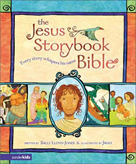
Jesus Storybook BibleI am so excited about this. It just came in the mail from Amazon, and I have been bringing it with me everywhere I go like show-and-tell because I am that pumped about it. Here’s the thing; I started thinking about my first-graders and how I’d love to simply read a chapter book to them from week to week rather than individual stories. That got me to wondering if such a thing existed: a chapter-book version of the Bible. In my search, I stumbled across The Jesus Storybook Bible, which is pretty close. I love the byline: “Every story whispers his name.” Every story in the Bible (even the Old Testament ones) whisper the name of Jesus.

Listen to this excerpt from the introduction: read it out loud; it was meant to be read aloud:

No, the Bible isn’t a book of rules, or a book of heroes. The Bible is most of all a Story. It’s an adventure story about a young Hero who comes from a far country to win back his lost treasure. It’s a love story about a brave Prince who leaves his palace, his throne — everything — to rescue the one he loves. It’s like the most wonderful of fairy tales that has come true in real life!

You see, the best thing about this Story is — it’s true.

There are lots of stories in the Bible, but all the stories are telling one Big Story. The Story of how God loves his children and comes to rescue them.

It takes the whole Bible to tell this Story. And at the center of the Story, there is a baby. Every Story in the Bible whispers his name. He is like the missing piece in a puzzle — the piece that makes all the other pieces fit together, and suddenly you can see a beautiful picture.

And this is no ordinary baby. This is the Child upon whom everything would depend. This is the Child who would one day — but wait. Our Story starts where all good stories start. Right at the very beginning. . .

I’m impressed by the style and the quality of the writing and the art in this Bible. I’m impressed by the author’s use of punctuation and parallelism and alliteration to make the story come to life. I’m impressed by the way she introduces ideas like God’s “Never Stopping, Never Giving Up, Unbreaking, Always and Forever Love,” ideas like Home (and ontology), Good and Evil, and the Creation-Fall-Redemption narrative. Sally Lloyd-Jones acknowledges Tim Keller for giving her this “vocabulary of faith.” I’m impressed by that too. It sounds a bit high-falutin’ when it’s described by how it has impressed me; but I promise you, it is not. It’s a children’s book that young children can read themselves and enjoy. But like any good children’s literature, it’s a good read for adults too.

Literally every story in this Bible from Genesis to Revelation hints at Jesus, speaks to the Logos, the Center of God’s Story (and ours). This children’s Bible is creative; it’s fresh; it’s intellectually ingenuous. It’s what we’ve been waiting for.

The Jesus Storybook Bible isn’t a replacement for your Children’s NIV, but it’s a good place to start, and a good supplement — for your personal Bible reading as well as your children’s.

Check it out here where you can also enjoy video segments where the reading is done by the masterful David Suchet!


This blog post originally appeared at reneamac.com/2009/05/01/the-jesus-storybook-bible/


Finally! Quality YA Fiction from a Christian Worldview

May 30, 2009

Phantom IslandKrissi Dallas has hit the road running with her debut novel, Phantom Island: Wind. It instantly found its way to the number one selling spot at Authorhouse.com as the word-of-mouth buzz about this page-turner spread like wild fire surrounding the novel’s release. The novel is Young Adult fiction; it’s full of drama, adventure, suspense, and romance. As a vested seventh and eighth grade teacher and the wife of a youth pastor, YA fantasy-fiction is something Krissi Dallas is an expert on and has a passion for. Her love and affinity for her students, as well as the openly autobiographical nature of much of the book, have allowed Dallas to “open a vein,” and write from the depths of who she is, from the heart. This deep connection transfers itself to the reader. I found myself desperately curious; no, not just curious, committed and concerned about the characters. Reading until the end of the chapter wasn’t enough: I had to find out what would happen next and would they be okay. I don’t think I have ever read a book this size this quickly—not even any of the Harry Potter series… which I also toted obsessively wherever I went so I could read every chance I got.

Phantom Island: Wind is divided into three parts, and it’s part two that really gets you. If you weren’t addicted already in part one, you definitely will be when part two begins. This is also where the fantasy part of this fantasy-fiction novel really kicks in. You know how you can tell when you’re reading really good fantasy-fiction? When you can’t tell. If you ever find yourself questioning the reality the author’s created, it isn’t good fantasy-fiction. While reading Wind I never once caught myself raising my eyebrow thinking, I don’t know about that. I was completely engrossed.

Wind is well written. Dallas has a captivating command of detail. Good literature is good literature, regardless of the target audience. Phantom Island isn’t just for teenagers; it’s for anyone who hasn’t forgotten how to read — how to imagine and empathize and create. The plot and character development; the intrigue, the tension, the romance, the journey, the discovery; every thing about the Island kept me turning pages when I should have been sleeping.

Wind is the first book in the Phantom Island series. Water, is scheduled to come out Summer 2010. It’s always nice to have something to look forward to, especially the “small” things; I can’t wait to find out what happens next. For more about Phantom Island visit www.krissidallas.com/.

This blog post originally appeared at reneamac.com/2009/05/30/phantom-island-wind/


Glee-tastic!

May 4, 2010

I love this show. I’m not afraid to admit it. The raw talent of the cast, the character development, the geekiness, the music (duh), and the wonderful caricature of the American high school experience. I come back week after week for the clever plot lines and dialogue, and the overall impeccable artistry. I know what some of you are thinking–Glee is just a show about sex-crazed teenagers, pushing a liberal agenda! How can you watch that stuff and call yourself a Christian? And you’re right… on the surface. If you look deeper, you’ll find more depth—just like with teenagers, come to think of it. They can be a mess on the outside, seemingly concerned with nothing but what’s superficial, shiny, sexy; but if you take the time to look deeper, wow: what perspective, passion, potential. (Whereas we adults tend to keep our messiness better concealed.)

Glee has such high appeal in part because almost everyone, both in and out of high school, feels like somewhat of a misfit; and Glee is a show which highlights that fact and how essential it is for us as unique and even flawed human beings to have a safe place to be unique and even flawed, giving us our common ground back and showcasing what the Church ought to: hospitality. The show also has lots of appeal because it’s good art: it’s well made and speaks to the human condition. If we don’t want to forfeit our influence in our world, then we need to be more discerning about art: just because a show (or song or sculpture or painting or novel) depicts unChristian ethics or values doesn’t mean it’s bad art. Likewise, just because a piece of art depicts Christian values doesn’t mean it’s good art.

Sometimes the art we come in contact with will match up pretty solidly with the Creation-Fall-Redemption narrative of Scripture. Sometimes it represents the complete opposite ideas about what life is like and what it means to be human. But most of the time, as with the TV show Glee, we are presented with ideas that partly conform to Christian doctrine or ethics, or are but a shadow—”All truth is God’s truth.” Art comes out of the ideas in the heart and minds of the women and men who create the work, and Romans 2 tells us that God has written his truth on the hearts of all people. Certainly Glee is a shadow, and at times, in that shadow are moral messes and liberal agendas. So we have to watch Glee through the lenses of our biblical worldview. We have to watch Glee with our brains turned on.

Watching Glee with our brains turned on, we can be aware of and reject what goes in opposition to a biblical framework, and affirm what is good, even if those good qualities and ideas about life fall short of what Christ gives as we pray his Goodness come; his Good be done (Mt 6:10). My favorite quality about Glee is the unexpected dives into full-bodied, deeply human characters. And it’s Glee‘s knack for flipping expectations and busting through the stereotypes, stereotypes Glee has set up itself, that allows me to write the following as a way of merely observing while withholding judgment, because you never know when Glee will flip something.

So what are Glee‘s flat places that I’m hoping will curve and plunge and flip? Well, I’m afraid they’re pretty typical: a woman’s choice; hypocritical, asinine Christians; “I knew you were gay when you were three”; and my personal favorite, feelings-driven love. That’s where I’m going to camp out, but I will make a small note about a woman’s choice. This problem goes deeper than abortion. Because regardless of whether or not we murder the child (and the good news is that more and more people [and movies and other social media] paint abortion in a negative light and favor life), when the choice is all Hers, we kill off the humanity of the father too. He becomes just a sperm donor. There’s a very important episode of Glee admonishing young men to treat women like persons and work against objectifying them. There needs to be one about how women objectify men.

Which leads me to feelings-driven love and false romantic ideals. Have you ever stopped to think about what books and movies and TV shows and pop songs are all telling us about what love is and what ideal romance looks like? If you haven’t noticed, love is a feeling. And romance is an intense, often tumultuous, chemistry-infused whirlwind affirmed by good sex great sex.

Already there are some elements of the romantic plot-lines in Glee that cause me to be hopeful that things will flip, but until they do, the following scenes perfectly expose the love = feelings definition that we know in our heads isn’t right but aren’t doing much to counter in our own lives.*

Before I dive into the scenes, a little Will & Terri Schuester background:

Once upon a time Will, the goody choir boy had a crush on an older girl named April. That didn’t work out so he dated and subsequently fell in love with Terri. Together for many years, their marage [sic] appeared to grow stagnant until Terri announced she was pregnant. Will was quick to step up to be the daddy despite his wandering eye for the ginger co-worker [Emma]. (Glee Wiki)

Okay. Scene: Will finds out Terri’s been faking the pregnancy and freaks out (naturally). After ripping the pregnancy pad from Terri’s waist, Will tearfully tries to make sense of his upside-down world:

Why did you do this to us? I don’t understand.

I thought you were leaving me. You’re so different, Will. We both know it; I can feel you, you’re pulling away from me.

Why, because I – I started standing up to you, trying to make this a relationship of equals?

No, because of the damn Glee club! Ever since you started it you just started walking around like you were better than me.

I should be allowed to feel good about myself!

Who are we kidding, Will? This marriage works because you don’t feel good about yourself.

[…]

I loved you Terri, I really loved you.

I’m so sorry, Will. I’m so sorry. Do you remember at that appointment? Do you remember what we said? That at that moment, no matter what happened, we loved each other. We could get that feeling back again. You could love me back, Will. (“Mattress”)

Exit Will.

Next episode. The Glee Club kicks tail (and Lea Michele does the best “Don’t Rain on My Parade” I’ve ever heard) and take Sectionals, after which Will comes back home for the first time since he left to change clothes for Emma’s wedding.

Enter Terri:

I want you to know I’ve been seeing a therapist. It’s just at the local community center, but still.

Good. I hope it works out for you.

I’m taking responsibility, Will. I mean, I’m weak, and I’m selfish, and I let my anxiety rule my life. But you know I wasn’t always that way. It’s just that I wanted so many things that I know we’re never gonna have. But that was okay as long as I still had you. Will… say something.

I’m looking at you, and I’m trying… I mean, I really want to feel that thing I always felt when I looked at you before, that feeling of family, of love. But that’s gone.

Forever?

I don’t know. (“Sectionals”)

So there it is. Love = feelings and this distorted love defines our relationships and whether or not they’re worth fighting for. At least for episodes 12 and 13… The writers have very cleverly set things up so that we experience the relationship almost entirely from Will’s perspective; and we are set up to dislike and distrust Terri and root for Emma. We soothe ourselves for hoping Emma and Will get together even though Will is married to Terri because Terri is selfish, often mistreats Will (and others), and is antagonistic toward Glee, the one thing outside of family that makes Will come alive. While Emma is adorable and caring and seems to have more in common with Will; she’s entirely the lovable underdog we love to cheer for.

But… I kind of feel as though Glee is setting us up to see ourselves for what we really are: unsympathetic, quick to judge and slow to search for the whole story, quick to follow and go after what feels good rather than what is good. Because while Terri Schuester says and does a lot of things that make us question her right to take up space (without the comic relief of Sue Sylvester), there are these deftly placed moments—those Glee -moments—where Terri is human, vulnerable and hurting. And you begin to feel sympathy and find yourself thinking… Is this a trick?

So we’ll see what happens. With each new episode I look forward to more plot twists, magical musical numbers, Sue Sylvester quotes, and busting of social myths and categories.

___________________________________________________________

*A 2008 survey on the divorce rate in America: about one in three. (And Christians? Largely the same: about one in three.)
Christian porn and masturbation and the connection to fantasy-inflated expectations of real life.
“Christian” novels are just as bad, if not worse, at proliferating a false romantic ideal.

This blog post originally appeared at reneamac.com/2010/05/04/glee-tastic/


Go to the Movies. . . But Don’t Turn Off Your Brain!

Feb. 12, 2010

How many of you have seen one movie in the past month (on TV or at the theater)? Two movies? Three? Ten? How many of you, like me, see so many movies on a regular basis it’s too hard to count? Do you know how many movies are made on average per year in Hollywood? Over the last ten years or so, Hollywood puts out an average of six hundred movies each year. That’s almost two a day–many many more if you include Bollywood. Movies are everywhere! They show up in abundance in our culture and in our lives. On that level alone movies are important to think about and discuss in our Christian communities as we try to help one another live more like Christ.

But movies aren’t only important because they’re prevalent. Movies are important because they communicate ideas about what is true. We’ve always used art as a way of expressing our beliefs about and experiences of reality: what is true about life and what it means to be a person, why is there evil and how can we be saved from it… “Man has always and will continue to express his hope and excitement, as well as his fears and reservations, about life and what it means to be human through the arts. He will seek to express his world through any and all available mediums, and presently that includes film.”{1}

So movies are important not just because they’re everywhere, but because they tell us about life and what it mans to be human. Normally, in church, when we talk about where our ideas about life and what it means to be a person and how we should live, where do we say those ideas come from? Right, the Bible.

And that’s true! But God has given us art too. And we need art and science and nature and each other and the Bible to interpret what is real, what is true. We need all of these things together to help us make sense of life; because life can sometimes be a mess. When your friend betrays you and you don’t know why. When your parents divorce. When life isn’t bad just uncertain, or confusing… or complicated because two boys like you at the same time or you’re not exactly sure where you want to go to college… Now, the Scriptures come first among all informers of reality; but we’ll come back to that.

I have to thank my friend and colleague Todd Kappelman; he works with me at Probe and he is a professor of philosophy at Dallas Baptist University. I’ll be pulling a lot from his lecture “Perspectives on Film: What’s in a movie?” Let me quote Todd:

“A film is able to convey an enormous range of human experience and emotions. A good film maker, script writer, director, producer, or actor can take us to places that we might never be able to see through our everyday experiences.”

Can you think of some examples? Avatar. Lord of the Rings. Even movies like Saving Private Ryan or Braveheart. And because movies are able to involve us in situations that are outside of our everyday experiences, but that we can relate to, “[movies] may also show us things about our world that would otherwise remain hidden to the untrained eye.” For example, Wall-E. How many of you have seen Wall-E? So basically humanity destroys all oxygen-producing plant life and has to ship civilization out into outer space. Everyone’s on a giant cruise ship in space, lounging in these mobile recliners that take them wherever they want to go and they have these screens that pop up and they can order whatever food they want, and it comes right to them. And they’ve been living like this in space for years so everyone is super fat. There are a couple of underlying messages in this movie; they’re pretty obvious, right? Take care of the Earth our home and discipline yourself in this world of modern convenience. But because these messages are communicated to us, not directly in the world in which we live, but indirectly through a world with robots and space cruise ships, it’s a message that’s easier to swallow.

The underlying messages of Wall-E are pretty obvious; however, many movies have messages which are much more subtle. And unless we know what to look for and how to look for it we will miss it. We will miss what the movie is really saying behind the special effects and witty dialogue. Often movies communicate ideas about life and reality through symbols; it’s like code. The movies don’t often just come out and say, “This is the message about life from this movie.” So we need to learn how to interpret the code.

Movies have ideas and those ideas come from the women and men who make them. Duh. Right, I know. But we don’t always think about it. Every person has a worldview and that worldview is always in a person’s art.

My colleague Todd gives us five basic questions to ask when watching movies:

1. How important is life to the director/writers, etc? Are tough issues dealt with or avoided? “Christian” movies come to mind when I think of this question. Sometimes these movies are really bad about candy-coating life–everything ends nice and neatly and all the bad stuff about life is kind of skipped over or neatly dealt with. This is a disservice because it isn’t true to life.

2. Is there a discernible philosophical position in the film? If so, what is it, and can a case be made for your interpretation? How many of you saw Avatar? I saw it twice. It was awesome in 3D. I hear it’s even cooler in XD. I’ll let you in on a not-so-secret secret. Hollywood’s favorite and most popular worldview right now is pantheism. Think about Avatar and look at your chart (under Cosmic Humanism). See anything that rings familiar from the movie?

3. Is the subject matter of the film portrayed truthfully? Here the goal is to determine if the subject matter is being dealt with in a way that is in agreement with or contrary to the experiences of daily reality. Let me think here… what comes to mind? Um… romantic comedies. Don’t get me wrong, I like many romantic comedies, but I also go to those movies with my brain turned on, watching the screen through my biblical worldview lenses. And it’s important we do that because those movies aren’t just fun-loving and warm-fuzzy, they also communicate ideas about romance and marriage and dating and sex. And if we go into these movies with our brains turned off, we will begin to subconsciously absorb these false ideas. If I’m not filtering the film with my biblical worldview, I can easily begin to expect my love life to be like the movies, which when I say it out loud like that sounds ridiculous. But it happens in subtle ways and more often than we think.

4. Is there a discernible hostility toward particular values and beliefs? Does the film seek to be offensive for the sake of sensationalism alone? I think a case can be made that The DaVinci Code fits into this category. But you know, hostility toward Christianity is all over, not just movies, but TV too. When Christians are portrayed on the show Criminal Minds for example, they’re often extreme fundamentalists who hate gays and repress women. And you know, that’s a legitimate complaint against some who call themselves Christians. But when those are the only types of Christians shown time and time again on TV and in the movies, the whole picture isn’t being shown. It’s being distorted.

5. Is the film technically well made, written, produced and acted? I confess, Transformers II was a major disappointment. It was technically well done; I mean, the special effects were awesome. But the writing… I felt like I was getting dumber sitting there listening to that dialogue. Even the plot had some holes in it, which was disappointing because I like action flicks.

Now as Christian interpreters, we have three more questions to ask ourselves:

1. Does the interpretation of reality in this work conform to or fail to conform to Christian doctrine or ethics? Sometimes a movie will match up pretty solidly with the Creation-Fall-Redemption narrative of Scripture. Sometimes a movie will represent the complete opposite ideas about what life is like and what it means to be human. But most of the time, movies present to us ideas that partly conform to Christian doctrine or ethics. Because movies come out of the ideas in the heart and minds of the women and men who create them, and Romans 2 tells us that God has written his truth on the hearts of all people.

2. If some of the ideas and values are Christian, are they inclusively or exclusively Christian? That is, do these ideas encompass Christianity and other religions or philosophic viewpoints, or do they exclude Christianity from other viewpoints? The case could be made that The Book of Eli presents Christian values in an inclusive way. It’s subtle, and if you blinked you might have missed it. The movie isn’t about preserving the Word of God. It’s about preserving the religious books of the world. And it is no mistake that the Bible was placed right next to the Koran in the library at the end.

3. If some of the ideas and values in a work are Christian, are they a relatively complete version of the Christian view, or are they a relatively rudimentary version of Christian belief on a given topic? (Like Criminal Minds.)

Finally, a few cautions:

1. Just because a movie depicts unChristian ethics or values doesn’t mean it’s bad art. Likewise, just because a movie depicts Christian values doesn’t mean it’s good art.

2. Be careful not to allow your personal perspective to dominate the description of a particular work. Try to understand as many other perspectives as you can.

3. Do not expect a non-Christian to agree with you, arrive at the same conclusions, or completely understand your perspective. At best we can hope to offer a clear and coherent insight into a work and thereby gain an opportunity for a Christian voice to be heard.

Okay. So movies are important. And so is the need for Christian interpretation. So if you like movies as much as I do, I hope you will go to the movies and keep your brain turned on because movies communicate messages about life and what it means to be human. And if we don’t turn on our brains, we will unknowingly begin to believe untruths about life and what it means to be human. Movies are also important because they provide a good, nonthreatening way to talk about truth and worldview—ideas about life and what it means to be human—with our friends.

______________________________________________________________

1. Kappelman, Todd, Film and the Christian, bit.ly/LvfUe1

This blog post originally appeared at reneamac.com/2010/02/12/go-to-the-movies-but-dont-turn-off-your-brain/


Should Christians Respect Obama?

Mar. 9, 2010

The email below titled “Should Christians Respect Obama?” was forwarded to me. Perhaps you’ve seen it too. (I have formatted the spacing to fit below; however, all emphases—bolds, italics, exclamation marks, words in all caps—are original.)

Dr. David Barton is more of a historian than a Biblical speaker, but very famous for his knowledge of historical facts as well as Biblical truths.

Dr. David Barton – on Obama
Respect the Office? Yes. Respect the Man in the Office? No, I am sorry to say. I have noted that many elected officials, both Democrats and Republicans, called upon America to unite behind Obama. Well, I want to make it clear to all who will listen that I AM NOT uniting behind Obama !

I will respect the Office which he holds, and I will acknowledge his abilities as an orator and wordsmith and pray for him, BUT that is it. I have begun today to see what I can do to make sure that he is a one-term President !

Why am I doing this ? It is because:
– I do not share Obama’s vision or value system for America ;
– I do not share his Abortion beliefs;
– I do not share his radical Marxist’s concept of re-distributing wealth;
– I do not share his stated views on raising taxes on those who make $150,000+ (the ceiling has been changed three times since August);
– I do not share his view that America is Arrogant;
– I do not share his view that America is not a Christian Nation;
– I do not share his view that the military should be reduced by 25%;
– I do not share his view of amnesty and giving more to illegals than our American Citizens who need help;
– I do not share his views on homosexuality and his definition of marriage;
– I do not share his views that Radical Islam is our friend and Israel is our enemy who should give up any land;
– I do not share his spiritual beliefs (at least the ones he has made public);
– I do not share his beliefs on how to re-work the healthcare system in America ;
– I do not share his Strategic views of the Middle East ; and
– I certainly do not share his plan to sit down with terrorist regimes such as Iran .

Bottom line: my America is vastly different from Obama’s, and I have a higher obligation to my Country and my GOD to do what is Right ! For eight (8) years, the Liberals in our Society, led by numerous entertainers who would have no platform and no real credibility but for their celebrity status, have attacked President Bush, his family, and his spiritual beliefs !

They have not moved toward the center in their beliefs and their philosophies, and they never came together nor compromised their personal beliefs for the betterment of our Country ! They have portrayed my America as a land where everything is tolerated except being intolerant ! They have been a vocal and irreverent minority for years ! They have mocked and attacked the very core values so important to the founding and growth of our Country ! They have made every effort to remove the name of GOD or Jesus Christ from our Society ! They have challenged capital punishment, the right to bear firearms, and the most basic principles of our criminal code ! They have attacked one of the most fundamental of all Freedoms, the right of free speech !

Unite behind Obama? Never ! ! !

I am sure many of you who read this think that I am going overboard, but I refuse to retreat one more inch in favor of those whom I believe are the embodiment of Evil! PRESIDENT BUSH made many mistakes during his Presidency, and I am not sure how history will judge him. However, I believe that he weighed his decisions in light of the long established Judeo-Christian principles of our Founding Fathers!!! Majority rules in America , and I will honor the concept; however, I will fight with all of my power to be a voice in opposition to Obama and his “goals for America .” I am going to be a thorn in the side of those who, if left unchecked, will destroy our Country ! ! Any more compromise is more defeat ! I pray that the results of this election will wake up many who have sat on the sidelines and allowed the Socialist-Marxist anti-GOD crowd to slowly change so much of what has been good in America !

“Error of Opinion may be tolerated where Reason is left free to combat it.” – Thomas Jefferson
GOD bless you and GOD bless our Country ! ! !
(Please, please, please, pass this on if you agree.)
Thanks for your time, be safe. “In GOD We Trust”
“If we ever forget that we’re one nation under GOD, then we will be a nation gone under.” – Ronald Reagan
I WANT THE AMERICA I GREW UP IN BACK…..

In GOD We Trust……..

Respectfully, I disagree. The person who wrote this email didn’t say how to respect the office without respecting the person holding it. It may be possible to do so; however, I believe it is more important to respect people than positions. It sounds very noble to say, “I respect the office but not the man.” It’s like saying, “I respect my boss’s position of authority over me, but I don’t respect my boss.” But in my experience, this attitude makes it very difficult to “do everything without complaining or arguing.” That habit derives only from love. And love is expressed by subordinates to their authorities largely through respect (Eph 5:21–6:8; note especially 5:33 and 6:5).

It is possible not to respect the positions the President holds and still respect the President as an Image-bearing human creation if nothing else. But this kind of generosity which derives from thinking Christianly (a Christian worldview) is not expressed in this email. The tone of this email conveys contempt, not respect. I’m particularly unnerved by the way the term “embodiment of Evil” was tossed out there. Calling liberals Satan incarnate is sensationalist at best and certainly doesn’t portray the high view of human dignity that Christianity gives us.

A few other side notes to consider when viewing email forwards like this one:

• It is highly unlikely that a PhD wrote an email in such broad strokes with such inflammatory language, not to mention so many exclamation points. (In fact, I would be cautious of anything with this many exclamation marks, whether it claims to be from a PhD or not because when every sentence is exclaiming, that’s a sign that the email is not trying to get you to think about the topic, but is only interested in goading an inordinately emotional reaction from you (as opposed to an emotionally passionate response tempered with thought-full-ness).)

• From Dad: “Dr. Barton’s website does not have a record of this document – so, I doubt that it is from him. I sent an e-mail inquiry to wallbuilders.com asking them to comment on its authenticity.” Thanks Dad!

• Thirdly, there are at least three of the President’s views/positions that have been distorted and intentionally misrepresented in this email. Email forwards are notorious for this, and there is very little that is less Christian than bearing false witness.

• Finally, I just want to comment that it is okay for Christians to disagree about most of the items in that list. This email implies that a Christian nation (whatever that means anyway) would resemble the exact set of beliefs behind this email; it implies that any good Christian would agree with this email wholesale.

So, should Christians respect President Obama? We, more than anyone, should—especially if you dislike him and/or disagree with his basic platforms. It is easy to love people we like: people who are like us, people with whom we agree. But Christ demands we love those who are irritating to us.

But I say to you, love your enemies and pray for those who persecute you, so that you may be sons of your Father who is in heaven; for He causes His sun to rise on the evil and the good, and sends rain on the righteous and the unrighteous. For if you love those who love you, what reward do you have? Do not even the tax collectors do the same? If you greet only your brothers, what more are you doing than others? Do not even the Gentiles do the same? Therefore you are to be perfect, as your heavenly Father is perfect.

This blog post originally appeared at reneamac.com/2010/03/09/respect-obama/


Banned Books Week

Oct. 1, 2010

We have come to the end of Banned Books Week, where avid readers everywhere band together to protest the idea of banning books (or more accurately, band together to celebrate books they love that have been banned by having readings and themed parties). Books are banned and protested for a sundry of reasons, reasons we sympathize with and some we certainly do not sympathize with. But even when it comes to books we don’t think are appropriate, movements for the outright, absolute banishment of these books from libraries or from Christian society is rarely helpful. Such movements cause division over matters which are disputable and sometimes simply draw more attention to and raise more interest in the book a particular group is trying to get rid of.

Often, books are banned by people who haven’t read them and do not understand them; people simply join the banned books bandwagon. And while fight or flight may be more natural, only the act of humbly engaging is constructive. We are called to act in creative and redemptive ways as we pray, “Thy Kingdom come; Thy will be done on earth as it is in heaven.” It is essential to engage, not merely absorb or avoid, books (and ideas) that scare and/or anger us, books that feel wholly foreign to us. Although—for of a variety of factors, not the least of which because each of us has our own sin-issues particular to our personality and set of experiences—not everyone will be able to engage with everything at the same level. And it’s the which and by whom and the how that requires more individual discernment than broad banishings. Even when you cannot personally engage by reading this or that book for whatever reason, abiding an attitude of general engagement as a member of the Body of Christ fosters that humility-infused unity so foundational to our new life.

As we celebrate Banned Books Week here at Probe, we invite you to chew with us on the questions such an acknowledgment brings to the table. We’d love to hear your thoughts, and as always, keep reading.

• What are some constructive alternatives to banning or burning books? ie. discussion forum, panel discussion (even at the library in question) or for a meeting of the PTA

• Should a Christian pause and ask, Am I being retributive to “those liberals” and others who certainly ban Christian or conservative viewpoints? Is that something that promises to be profitable, biblically speaking? Is it a Christlike motive?

• While understandably fighting for convictions, could I be guilty of putting my own personal convictions on others inappropriately? How could this be detrimental or even wrong to do with non-believers? With believers? [disputable matters passage, like meat offered to idols]

• Would it be more profitable to read and discuss the book in question with my children and even others’ kids w/parental permission (perhaps with some blocking of objectionable portions) than to rail against the author, message or library?

• Pragmatically speaking, am I simply bringing objectionable materials to light and putting them up on a stage by the attention they are now getting because of my lobbying efforts? Am I offering ammo to those who oppose any censure or social accountability?

• Am I giving the Enemy a foothold for bitterness in me or my kids? In onlookers?

This blog post originally appeared at reneamac.com/2010/10/01/banned-books-week/


Privacy 2010

Introduction

Ten years ago, I did a Probe radio program called “Privacy 2000.”{1} At the time, American citizens were concerned about some of the new technological advances and government programs that seemed to be threats to their privacy.

So much has happened in the last ten years. Technological developments have provided individuals, companies, and governments with new tools which could be used to violate our privacy. A war on terror has changed our perception of what is or is not appropriate for government to know about its citizens. In fact, I developed a week of radio programs on “Homeland Security and Privacy.”{2}

One thing I have noticed is that most Americans seem less concerned about intrusions into their lives. Part of it may be due to a resigned assumption that we have to give up some of our privacy to fight the terrorists. But another significant reason, I believe, is a younger generation that seems completely unconcerned with threats to their privacy. After all, many of them are sharing intimate details of the lives on Facebook and MySpace. Why be concerned if companies, the government, or the general public knows details of their lives when they voluntarily share those details on social networks?

This is not to say that all citizens are unconcerned about privacy violations. Recent debates about a national ID card and the collecting and centralization of medical information for government health care programs illustrate that many people are concerned about privacy. But the percentage of citizens concerned about privacy seems to be decreasing.

Privacy is something that most of us take for granted until we lose it. And often we lose our privacy in incremental steps so we are less aware of our increased exposure. Some events can shock us back to reality. Identity theft or the posting of embarrassing information on the Internet can quickly remind us how much privacy we have lost.

We should also make a distinction between privacy and secrecy. Whenever someone expresses concern over a violation of their privacy, another is sure to ask, “What do you have to hide?” The question confuses privacy with secrecy. You may not have anything to hide, but that doesn’t mean that you are willing to have companies collect lots of information about you and then sell it to other companies for a profit. You may not want your future boss to know about a medical procedure that was done twenty years ago. You may not want a telemarketer to have your purchasing history so he can call your mobile phone.

In this article we look at various ways we have lost our privacy. These range from intrusion to deception to profiling to identity theft.

Seven Sins against Privacy: Intrusion

Privacy is a common word but often misunderstood because of it various meanings. We know when we feel that someone have violated our privacy, but we can’t always give a definition to it, especially in this age in which new technology allows perpetrators to cross boundaries more easily than in the past.

David Holzman describes three basic meanings for privacy.{3} They are easy to remember because they all begin with the letter s. The first is seclusion. That is the right to be hidden from the perceptions of others. The second meaning is solitude. This is the right to be left alone. The third meaning is self-determination, which is the right to control information about oneself.

He suggests that privacy violations can be viewed as seven sins ranging from intrusion to deception to profiling to identity theft. Let’s look at each one of these sins against privacy.

Sin of Intrusion – The classical form of privacy abuse is intrusion. This “is the uninvited encroachment on a person’s physical or virtual space.”{4} In previous ages, it took the form of voyeurism or peeping. Technology today allows for a much great intrusion into our lives and is often much more difficult to detect.

In recent years, we have read about how actors, models, and sportscasters have had their privacy violated by people who placed cameras or listening devices in their rooms or on their person and recorded them. But it isn’t just the famous that are being recorded. Every day pictures are being taken of us as we walk into banks, into grocery stores, or past ATM machines. We are being recorded on the streets and at traffic lights. It has been estimated that the average person is caught on surveillance cameras three hundred times a day in London.{5}

And it is not just big brother that is watching and listening to you. Voyeurism technology is available to anyone who wants to purchase it. Stores and Web sites “sell remote listening devices, digital optics, scanners for picking up cell-phone conversations, and even infrared scanners.”{6}

Radio Frequency Identification Devices (RFID) act like a wireless bar code and is being used more often in stores and other establishments (such as libraries) for inventory control. Geographic Positioning System (GPS) receivers are satellite locating devices that are found in cars, cell phones, and many other devices.

Intrusion violations have been made easier by technology. In the past, someone had to get near to you in order to spy on you. And that increased the possibility that you would find out that someone is watching you. Now we live in a world where your privacy is being violated, and you are probably not even aware that it is happening.

Seven Sins against Privacy: Latency and Deception

Sin of Latency – Most of the damage to your privacy comes from stored information. The harm is minimized if personal information is not retained. The sin of latency comes from the excessive hoarding of information beyond an agreed-upon time. Most companies do not have a data-aging policy.

It is understandable why companies and the government collect excessive information. First, they need to have enough information so they know they have the right person. There are lots of John Smiths in a particular locality. They need to know you are the particular John Smith they want. In the past, a telephone number was sufficient identification. Now we have more than one phone and change numbers regularly. So our Social Security number and other identifiers are necessary.

A second reason for companies to collect information is so they can more effectively sell their products and services to you. They collect that information from the forms you fill out and even place cookies on your computer in order to catalogue your visits to their Web site.

We might assume that a company would delete your information when you close your account. Most companies merely mark your file as inactive. And many of them sell your information to others. “A consumer record with up-to-date information is worth around $200 for cell phone information. Social Security information sells for $60 and a student’s university class schedule goes for $80.”{7}

One of the largest collectors of personal data is Google. When you search for items on the Internet, Google collects that information, and that reservoir of information can begin to paint a picture of your interests, opinions, and worldview. And because Google saves that information for a long time, it can do extensive database matching.

Google was involved in a legal battle with the U.S. Department of Justice that subpoenaed their log files. They wanted to use them to make the case that pornography constitutes a substantial part of Internet searching. A judge ruled that Google needed to only turn over a limited set of information with identifying notations stripped off.{8}

Sin of Deception – With so much electronic information available in databases, it is tempting for individuals, companies, and even bureaucrats to use personal information in a way that was not authorized by the person.

Here are some principles that arise from our discussion so far. When a company or governmental agency asks for personal information we should have the right to know three things: what they are going to do with it, how long they will keep it, and whether they will make it available to others. When we fill out a form for a credit card or enter into a contract for a car or house, we reveal lots of information. We may naively assume that they will be the only ones who will see that information. That is not so. Regularly we see stories in the news about companies selling consumer data to third parties. Most of us would be shocked at how much information about us in the hands of people who have never met or done business with.

Seven Sins against Privacy: Profiling and Identity Theft

Sin of Profiling – Past behavior is not always a perfect predictor of future behavior, but it can be a surprisingly accurate one. That is where profiling comes in. Collecting information about what goods and services someone purchases can enable companies to predict a consumer’s future purchases.

Profiling is often used to predict more than that. David Holzman says that he worked with one credit card company that said “it was able to pinpoint when its consumers were having life crises such a mid-life depression by psychographically analyzing their buying patterns.”{9}

One of the best known examples of profiling is credit scoring. Equifax, Experian, and TransUnion rely on FICO scores. A high score will help you get a home loan. A low score may result in being denied a home loan and even having to pay higher interest on other forms of credit. Most Americans don’t know their credit score (only about two percent), and most do not understand the algorithm used to calculate it.

Profiling is also used to fight terrorism, but have also caught innocent people in their profiling net. For some time my name was on a watch list, and people like columnist Cal Thomas and Senator Ted Kennedy were on a no-fly list.

These mistakes prove an important point: profiling is a guessing game. And sometimes a wrong guess can have a detrimental impact on citizens and consumers.

Sin of Identity Theft – Most of us know what identify theft is because it has happened to someone we know or else we have heard commercials about how to protect ourselves from identity theft. Although this crime did exist in the past, it has exploded on the scene now because of technology and the changing nature of transactions. Personal information is readily accessible on the Internet. And in the electronic marketplace of today, purchases are not made face-to-face. It is easy for someone to assume your identity and leave you with the consequences.

How easy is it? A New York busboy was caught stealing the identities of people on the Forbes 400 list. He used the Internet to do the research and had been successful in stealing the identities of famous people like Steven Spielberg, Oprah Winfrey, and Ted Turner.{10}

Sometimes all a hacker or thief needs is your Social Security number and your mother’s maiden name. Unfortunately it is relatively easy to obtain this information. Universities, banks, and all sorts of institutions use your Social Security number as your identification number. Genealogy files online most likely have your mother’s maiden name. Once a theft has that information, he or she is ready to access your financial accounts.

Sometimes we inadvertently give out that information. A phone call from someone pretending to be a bank executive can often elicit confidential information. “Phishing” is a mass e-mail with a message pretending to be a bank or brokerage. People who believe that it is genuine will enter information that the theft can use to drain their bank accounts.

Seven Sins against Privacy: Outing, Lost Dignity

Sin of Outing – Some privacy violations are deliberate and can take place when someone reveals information that another person would like to remain hidden. The term “outing” is usually used to describe a public revelation of a closet homosexual, but we can use the term to describe any information that is published about a person they do not want to be public.

Citizens, politicians, and even corporations have been the targets of Internet messages that have been used to damage their reputation. A number of court cases have attempted to force Web site managers to reveal the identities of those who are spreading false and libelous information.

Sometimes outing is a good thing. Think of all the potential pedophiles that have been caught because they thought they were chatting online with a potential underage victim. Sting operations by the police have successfully revealed the motives of some who intend to proposition their young victims.

Sin of Lost Dignity – This last concern is more difficult to quantify, but we all realize that when private information is made public, we can lose a part of our dignity. What if all of your medical records were made public? What if every essay you ever wrote in school was available online?

Even public figures (like politicians) believe they should have a zone of privacy. Past and current presidents have refused to publish all of their medical records, school records, and other private information. While we may debate whether public figures should reveal all of this information, we would probably all agree that private citizens should not lose a zone of privacy in their lives.

In this article we have talked about how technology allows us to peer into other people’s lives. That is why we need to revisit the subject of ethics as it relates to technology that can violate our privacy. We shouldn’t use technology to spy on others or to hurt their reputation. Christians should express their concerns about intrusions into their privacy.

This subject also reminds us that we must live our lives above reproach. Philippians 2:14-15 says “Do all things without grumbling or disputing, that you may prove yourselves to be blameless and innocent, children of God above reproach in the midst of a crooked and perverse generation, among whom you appear as lights in the world.” 1 Timothy 3:2 says that an elder must be “above reproach” which is an attribute that should describe all of us. Live a life of integrity and you won’t have to be so concerned about what may be made public in age where we are losing our privacy.

Notes

1. Kerby Anderson, “Privacy 2000,” Probe Web site, 2000, www.probe.org/privacy-2000/.
2. Kerby Anderson, “Homeland Security and Privacy,” Probe Web site, 2003, www.probe.org/homeland-security-and-privacy/.
3. David Holzman, Privacy Lost: How Technology is Endangering Your Privacy (San Francisco: Josey-Bass, 2006), 4.
4. Ibid., 5.
5. Ibid., 6.
6. Ibid.
7. Ibid., 10.
8. Ibid., 13.
9. Ibid., 19.
10. Ibid., 23.

© 2010 Probe Ministries