A Biblical View of Economics – A Christian Life Perspective

Kerby Anderson shows that economics is an important part of one’s Christian worldview.  Our view of economics is where many of Christ’s teachings find their daily application.

In this article we are going to be developing a Christian view of economics. Although most of us do not think of economics in moral terms, there has (until the last century) always been a strong connection between economics and Christian thought.

If you look at the Summa Theologica of Thomas Aquinas, you find whole sections of his theological work devoted to economic issues. He asked such questions as: “What is a just price?” or “How should we deal with poverty?”

Today, these questions, if they are even discussed at all, would be discussed in a class on economic theory. But in his time, these were theological questions that were a critical and integral part of the educational curricula.

In the Protestant Reformation, we find the same thing. In John Calvin’s Institutes of the Christian Religion, whole sections are devoted to government and economics. So Christians should not feel that economics is outside the domain of Christian thinking. If anything, we need to recapture this arena and bring a strong biblical message to it.

In reality, the Bible speaks to economic issues more than any other issue. Whole sections of the book of Proverbs and many of the parables of Jesus deal with economic matters. They tell us what our attitude should be toward wealth and how a Christian should handle his or her finances. The Bible also provides a description of human nature, which helps us evaluate the possible success of an economic system in society.

The Bible teaches that there are two aspects to human nature. First, we are created in the image of God and thus able to control the economic system. But second, human beings are sinful and thus tend towards greed and exploitation. This points to the need to protect individuals from human sinfulness in the economic system. So Christians have a much more balanced view of economics and can therefore construct economic theories and analyze existing economic systems.

Christians should see the fallacy of such utopian economic theories because they fail to take seriously human sinfulness. Instead of changing people from the inside out as the gospel does, Marxists believe that people will be changed from the outside in. Change the economic base, they say, and you will change human beings. This is one of the reasons that Marxism was doomed to failure, because it did not take into account human sinfulness and our need for spiritual redemption.

It is important for Christians to think about the economic arena. It is a place where much of everyday life takes place, and we can evaluate economics from a biblical perspective. When we use the Bible as our framework, we can begin to construct a government and an economy that liberates human potentiality and limits human sinfulness.

Many Christians are surprised to find out how much the Bible says about economic issues. And one of the most important aspects of the biblical teaching is not the specific economic matters it explores, but the more general description of human nature.

Economics and Human Nature

When we are looking at either theories of government or theories of economics, an important starting point is our view of human nature. This helps us analyze these theories and predict their possible success in society. Therefore, we must go to the Scriptures to evaluate the very foundation of each economic theory.

First, the Bible says that human beings are created in the image of God. This implies that we have rationality and responsibility. Because we have rationality and volition, we can choose between various competing products and services. Furthermore, we can function within a market system in which people can exercise their power of choice. We are not like the animals that are governed by instinct. We are governed by rationality and can make meaningful choices within a market system.

We can also assume that private property can exist within this system because of the biblical idea of dominion. In Genesis 1:28, God says we are to subdue the earth and have dominion over the creation. Certainly one aspect of this is that humans can own property in which they can exercise their dominion.

Since we have both volition and private property rights, we can then assume that we should have the freedom to exchange these private property rights in a free market where goods and services can be exchanged.

The second part of human nature is also important. The Bible describes the fall of the world and the fall of mankind. We are fallen creatures with a sin nature. This sinfulness manifests itself in selfishness, greed, and exploitation. Thus, we need some protection in an economic system from the sinful effects of human interaction.

Since the Bible teaches about the effects of sinful behavior on the world, we should be concerned about any system that would concentrate economic power and thereby unleash the ravages of sinful behavior on the society. Christians, therefore, should reject state-controlled or centrally controlled economies, which would concentrate power in the hands of a few sinful individuals. Instead, we should support an economic system that would disperse that power and protect us from greed and exploitation.

Finally, we should also recognize that not only is human nature fallen, but the world is fallen. The world has become a place of decay and scarcity. In a fallen world, we have to be good managers of the limited resources that can be made available in a market economy. God has given us dominion over His creation, and we must be good stewards of the resources at our disposal.

The free enterprise system has provided the greatest amount of freedom and the most effective economic gains of any economic system ever devised. Nevertheless, Christians often wonder if they can support capitalism. So the rest of this article, we are going to take a closer look at the free enterprise system.

Capitalism: Foundations

Capitalism had its beginning with the publication of The Wealth of Nations, written by Adam Smith in 1776. He argued that the mercantile economic system working at that time in Great Britain was not the best economic foundation. Instead, he argued that the wealth of nations could be increased by allowing the individual to seek his own self-interest and by removing governmental control over the economy.

His theory rested on three major premises. First, his system was based upon the observation that people are motivated by self-interest. He said, “It is not from the benevolence of the butcher, the brewer, or the baker that we expect our dinner, but from their regard to their own interest.” Smith went on to say that “neither intends to promote the public interest,” yet each is “led by an invisible hand to promote an end that was not part of [his] intention.”

A second premise of Adam Smith was the acceptance of private property. Property was not to be held in common but owned and freely traded in a market system. Profits generated from the use and exchange of private property rights provided incentive and became the mechanism that drives the capitalist system.

From a Christian perspective we can see that the basis of private property rests in our being created in God’s image. We can make choices over property that we can exchange in a market system. The need for private property grows out of our sinfulness. Our sinful nature produces laziness, neglect, and slothfulness. Economic justice can best be achieved if each person is accountable for his own productivity.

A third premise of Adam Smith’s theory was the minimization of the role of government. Borrowing a phrase from the French physiocrats, he called this laissez-faire. Smith argued that we should decrease the role of government and increase the role of a free market.

Historically, capitalism has had a number of advantages. It has liberated economic potential. It has also provided the foundation for a great deal of political and economic freedom. When government is not controlling markets, then there is economic freedom to be involved in a whole array of entrepreneurial activities.

Capitalism has also led to a great deal of political freedom, because once you limit the role of government in economics, you limit the scope of government in other areas. It is no accident that most of the countries with the greatest political freedom usually have a great deal of economic freedom.

At the outset, let me say that Christians cannot and should not endorse every aspect of capitalism. For example, many proponents of capitalism hold a view known as utilitarianism, which is opposed to the notion of biblical absolutes. Certainly we must reject this philosophy. But here I would like to provide an economic critique.

Capitalism: Economic Criticisms

The first economic criticism is that capitalism leads to monopolies. These develop for two reasons: too little government and too much government. Monopolies have occurred in the past because government has not been willing to exercise its God-given authority. Government finally stepped in and broke up the big trusts that were not allowing the free enterprise system to function correctly.

But in recent decades, the reason for monopolies has often been too much government. Many of the largest monopolies today are government sanctioned or sponsored monopolies that prevent true competition from taking place. The solution is for government to allow a freer market where competition can take place.

Let me add that many people often call markets with limited competition monopolies when the term is not appropriate. For example, the three major U.S. car companies may seem like a monopoly or oligopoly until you realize that in the market of consumer durables the true market is the entire western world.

The second criticism of capitalism is that it leads to pollution. In a capitalistic system, pollutants are considered externalities. The producer will incur costs that are external to the firm so often there is no incentive to clean up the pollution. Instead, it is dumped into areas held in common such as the air or water.

The solution in this case is governmental intervention. But I don’t believe that this should be a justification for building a massive bureaucracy. We need to find creative ways to direct self-interest so that people work towards the common good.

For example, most communities use the water supply from a river and dump treated waste back into the water to flow downstream. Often there is a tendency to cut corners and leave the waste treatment problem for those downstream. But if you required that the water intake pipe be downstream and the waste pipe be upstream you could insure less pollution problems. It is now in the self-interest of the community to clean the wastewater being pumped back into the river. So while there is a need for governmental action, much less might be needed if we think of creative ways to constrain self-interest and make it work for the common good.

We can acknowledge that although there are some valid economic criticisms of capitalism, these can be controlled by limited governmental control. And when capitalism is wisely controlled, it generates significant economic prosperity and economic freedom for its citizens. Next, let us discuss some of the moral problems of capitalism.

Capitalism: Moral Critiques

One of the first moral arguments against capitalism involves the issue of greed. And this is why many Christians feel ambivalent towards the free enterprise system. After all, some critics of capitalism contend that this economic system makes people greedy.

To answer this question we need to resolve the following question. Does capitalism make people greedy or do we already have greedy people who use the economic freedom of the capitalistic system to achieve their ends? In light of the biblical description of human nature, the latter seems more likely.

Because people are sinful and selfish, some are going to use the capitalist system to feed their greed. But that is not so much a criticism of capitalism as it is a realization of the human condition. The goal of capitalism is not to change people but to protect us from human sinfulness.

Capitalism is a system in which bad people can do the least harm, and good people have the freedom to do good works. Capitalism works well if you have completely moral individuals. But it also functions adequately when you have selfish and greedy people.

Important to this discussion is the realization that there is a difference between self-interest and selfishness. All people have self-interest and that can operate in ways that are not selfish. For example, it is in my self-interest to get a job and earn an income so that I can support my family. I can do that in ways that are not selfish.

Adam Smith recognized that every one of us have self-interest and rather than trying to change that, he made self-interest the motor of the capitalist system. And before you react to that, consider the fact that even the gospel appeals to our self-interest. It is in our self-interest to accept Jesus Christ as our savior so that our eternal destiny will be assured.

By contrast, other economic systems like socialism ignore the biblical definitions of human nature. Thus, they allow economic power to be centralized and concentrate power in the hands of a few greedy people. Those who complain of the influence major corporations have on our lives should consider the socialist alternative of how a few governmental bureaucrats control every aspect of their lives.

Greed certainly occurs in the capitalist system. But it does not surface just in this economic system. It is part of our sinfulness. The solution is not to change the economic system, but to change human nature with the gospel of Jesus Christ.

In conclusion, we may readily acknowledge that capitalism has its flaws as an economic system, but it can be controlled to give us a great deal of economic prosperity and economic freedom.

©2001 Probe Ministries.


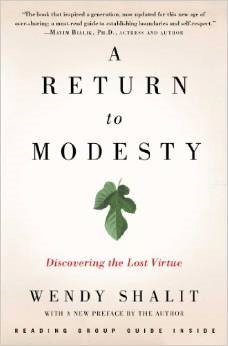
A Return to Modesty

The Loss of the Virtue of Modesty

A Return to ModestyThis article is an examination of Wendy Shalit’s book A Return to Modesty: Discovering the Lost Virtue. The book was written in 1999 and addressed to her “parents, and anyone who has ever been ashamed of anything.” A Return to Modesty is an examination of public and personal attitudes toward the problems faced by young women at the end of the twentieth century, and the beginning of the twenty-first.

Shalit’s starting point is the change from a healthy modesty toward sexual experience to a sheer embarrassment at the lack of experience. Her book is not a call to a prudish, Victorian sexuality, but a reminder of the value inherent in female modesty and the rewards for those who wait until marriage to become sexually active. Arguing against a culture which systematically attempts to rid us of our romantic hopes and natural embarrassments, Shalit offers young women an open invitation to cultivate one of the most feminine of all virtues, and to do so without shame or regret.


A Return to Modesty is divided into three parts: the first concerns our present view of sexual modesty and the problems with this view. The second section surveys the intellectual battles which led to our present situation. And the third is a look at women who are saying “no” to contemporary values and returning to an earlier conception of modesty.


The War on Embarrassment, the title of the first chapter, looks at the early and middle ’80s when sex education in grade schools was beginning to become more commonplace in the United States. Young girls ten and eleven years of age sat in mixed company as instructors discussed the particulars of intercourse, venereal disease, and birth control. The result, argues Shalit, is that subjects that had been discussed privately among the separate genders are brought into the open in such a way that all modesty is systematically removed. Preteen girls are taught to be ashamed if they are embarrassed, and embarrassed if they are ashamed. The ensuing confusion leads to a schizophrenic approach to sexuality which will follow the young girl through puberty and into young womanhood.

The impact of this early exposure to sexuality is discussed in the second chapter, Postmodern Sexual Etiquette. Here the modern dating scene is shown to be a direct revolt against the supposedly debilitating sexual disease of Puritanism and the Judeo-Christian ethic.{1} The traditional maturation cycle of courtship, love, and marriage has been replaced by a sequence of hook-ups, dumpings, and post-dumping checkups. The result, which we will discuss, has been that women are generally disrespected, trivialized, and abused in ways that should concern us all.

The Normalization of Pornography

As we continue our examination of modesty, I would like to cover the statistical fallout from our behavior during the last half of the century.

Stalking, rape, and harassment of women in the work place and at home all increased dramatically during the latter part of the twentieth century. But nothing is as alarming an indicator, says Shalit, as the “normalization of pornography.”{2} The contemporary debate is little more than a “ping-pong” game over censorship with feminists and conservatives crying “yes,” and the civil libertarians volleying back “no.” What is missing is the realization of how our views of pornography have shifted and a recognition of the impact that this has on the lives of ordinary men and women.{3}

One indicator of our growing acceptance of recreational pornography is the increase in strip clubs in the past decade, up over 100 percent from 1992. Strippers have become a kind of cultural wallpaper, and are present to such an extent that they are no longer shocking.{4} Women who object to their husbands and boyfriends looking at porn are accused of being prudish and full of hang-ups. The result has been a plethora of diseases and disorders as women attempt to look like the airbrushed super models seen in magazines and film.

A young woman named Jennifer Silver was concerned that her boyfriend was reading Playboy magazine, but she and her friends were reluctant to say anything which would make them seem prudish or un-cool. In a porn-friendly culture Miss Silver’s opinion was only valued if it was sympathetic to the norm. She said in an article to Mademoiselle magazine:

The real reason I hated Playboy was that the models established a standard I could never attain without the help of implants, a personal trainer, soft lighting, a squad of makeup artists and hairdressers, and airbrushing. It’s a standard that equates sexuality with youth and beauty. I didn’t want my boyfriend buying into Playboy’s definition of sexuality.{5}

Her boyfriend discontinued his reading in light of Miss Silver’s observations, but many men, even Christian men, do not see the harm in this kind of indulgent and sinful behavior.

It is not enough to say we want to return to a more modest culture; we must actively strive to create such a culture. If women are ever going to be able to be modest, men will have to value that modesty, and one way to do so is by allowing women to be who they are and not place impossible demands on them.

The Intellectual Landscape

In part two of her book Shalit takes aim at the intellectual battles which have led to the present crises in virtue. Under the guise of “being comfortable with our bodies,” our universities, advertising companies, and even fellow Christians have urged women in the last half century to “let it all hang out.” Indicative of this attitude is a quote from Bazaar, a leading women’s magazine, in response to a cover which offended some readers:

The barely revealed breast on our August cover wasn’t meant to offend. It was meant to celebrate the beauty of the female form. Bazaar believes that women should feel comfortable with their bodies.

The response to this reader’s letter was in effect saying that, if one should choose to be modest, then it is a reflection of not being “comfortable with one’s body.” The result is that we’ve become so comfortable with the body that people feel free to dress immodestly from the beach to the grocery store.

Shalit continues her examination of the intellectual landscape of modesty with a glimmer of hope based on nation-wide surveys in some of the most prominent women’s magazines. Her findings are that 49 percent of women wish they had slept with fewer men, and the happiest women were those who had the fewest partners.{6} In addition to these observations, one could add that the same women’s magazines that frequently advocate a more progressive and immodest lifestyle are also full of the confessions of women who have low self-esteem and feel that they are ugly and do not measure up to an increasingly critical society.

Following the statistical surveys, Shalit examines the idea of “male obligation.” In an unusual turn she says that it is difficult to expect men to be honorable. Many women send messages that men are no longer expected to behave like gentlemen.{7} The short skirts, plunging necklines, and pouty lips so popular today are an invitation for men to stare at and perceive women as objects. The honor women want from men, argues Shalit, begins with the signals that women send. Those interested in a clear guide to a return to modesty, in their own lives or that of their friends and daughters, will find such a guide in Shalit’s book A Return to Modesty.

Modest Dress

In an effort to find a way back to a more modest approach to sexuality, Shalit turns to some themes common in most religions. First she makes the observation that there is almost unanimous agreement among religions that modesty is inextricably linked to holiness.{8} In the first of several examples, Shalit quotes Christ’s admonition: “Blessed is he that watcheth, and keepeth his garments, lest he walk naked and then see his shame.”{9} After this she recalls the occasion when Moses covers his face, and is afraid to look upon God. Finally, she considers the account of Isaiah when he sees the fiery angels surrounding the throne of God, and four of the six angels’ wings are not functional because they are used to cover their feet. The rationale, says Shalit, is that in the presence of the Holy One, they should cover themselves.

In the section titled The Return to Modest Dress, Shalit documents the changing trends in women’s dress. She discusses how women who have rebelled against the immodest dress characterized by spandex, push-up bras, and bikinis have found a new self-respect they never knew was available. In addition to this, these same women have found that they are attracting the kind of men they really desire as opposed to men who approach them for their outward beauty alone.

There is a difficulty for young women who choose to be a part of the counter-culture of modesty Shalit is advocating. We live in a time when the loss of one’s virginity is considered a right of passage into maturity. Young women who choose to hold on to their virginity are often ostracized by other girls who wish to have partners in their loss. The result is that one must frequently choose between the loss of innocence, or the loss of fellowship with one’s peers. This is a tragic choice to ask of a young, teenage girl who desperately wants to be accepted.

The problem is not confined to young women alone, but is played out among more adult women with the same dire consequences. Men no longer have to marry a woman to get them to sleep with them and the result has been a growing hostility toward the institution of marriage.{10} The power to say “no” that women once collectively possessed, has been surrendered to the point that it is very difficult to reclaim. Shalit’s book shows the way out of a dark forest of our own making.

How To Get There

“Loss of innocence is nothing new,” writes Shalit, “but it is our assumption that there is now nothing to lose.”{11} We frequently act as though previous generations have decided that young women need not value their innocence, and we are powerless to resist the pressures of society. However, we are told exactly the opposite throughout the Scriptures. We are told that we can, and must, resist the world. We are told that the individual can choose to behave differently than societal norms. And, we are reminded that the failure to resist the temptations and standards set by secular society is sin.

The first thing we must do in order to return to a more modest society is to believe that it is possible, and to voice our desires for such a return actively. The second thing we must do is realize that cultures differ about what exactly is modest. Shalit cites examples of eighteenth century France where women would not bare their shoulders, Chinese women shy about their feet being exposed, and native women of Madagascar who would “rather die of shame than expose their arms.”{12}

Shalit proposes that we listen to the universal instinct within us which has been systematically suppressed. We know that we are naturally shy and sensitive to some things and should sometimes, but not always, cultivate our reservations rather than trying to overcome them. Quoting Francis Benton, Shalit writes:

Specific rules about modesty change with the styles. Our Victorian ancestors, for instance, would judge us utterly depraved for wearing the modern bathing suit. Real modesty, however, is a constant and desirable quality. It is based not on fashion, but on appropriateness. A woman boarding a subway in shorts at the rush hour is immodest not because the shorts themselves are indecent, but because they are worn in the wrong place at the wrong time. A well-mannered and self-respecting woman avoids clothes or behavior that are inappropriate or conspicuous.{13}

In order for society, and especially Christians within a secular and hostile society, to return to modesty we must be willing to look a little awkward in our actions and appearances. God has called us to be a strange and peculiar people for His purposes. One of the easiest and most influential ways to do this is through our outward appearances and actions. We should return to modesty before it really is too late.

Notes

1. Wendy Shalit, A Return To Modesty: Discovering the Lost Virtue (New York: The Free Press, 1999), 26.
2. Ibid., 49-54.
3. Ibid., 49.
4. Ibid.
5. Ibid., 52.
6. Ibid., 90.
7. Ibid., 104-105.
8. Ibid., 218.
9. Rev. 16:15.
10. Shalit, 227.
11. Ibid., 241.
12. Ibid., 232.
13. Ibid., 232.
©2000 Probe Ministries.


The Social and Historical Impact of Christianity

Probe founder Jimmy Williams examines the charge that Christianity has been detrimental to society, providing evidence for the contrary–that it has been a force for good.

Introduction

W.E.H. Lecky has commented on the Enlightenment that “The greatest religious change in the history of mankind” took place “under the eyes of a brilliant galaxy of philosophers and historians who disregarded as contemptible an Agency (Christianity) which all men must now admit to have been . . . the most powerful moral lever that has ever been applied to the affairs of men.”{1}

And yet, the West is in the process of abandoning its Judeo-Christian base which was the very source of this social development (Is this good or bad? Can we even ask such questions of history?).

The Negative Charge:
Christianity has been a repressive force against the advancement of civilization.

A. Karl Marx termed Christianity an opiate of the masses, a tool of exploitation.

B. Sigmund Freud called Christianity an illusion, a crutch, a source of guilt and pathologies.

C. Bertrand Russell: “I say quite deliberately that the Christian religion, as organized in its churches, has been and still is the principal enemy of the moral progress in the world.”{2}

D. Arnold Toynbee: “When the Greco-Roman world was converted to Christianity, the divinity was drained out of nature and concentrated in a single, transcendent God. Man’s greedy impulse to exploit nature used to be held in check by his awe, his pious worship of nature. Now monotheism, as enunciated in Genesis, has removed the age-old restraint.”{3}

E. Gloria Steinem observed that human potential must replace God by the year 2000.

F. Lyn White: “Christians, in absolute contrast to ancient paganism and Asia’s religions, not only established a dualism of man and nature, but also insisted that it is God’s will that man exploit nature for his proper ends.”{4} “The crisis will not abate until we reject the Christian axiom that nature has no reason for existence save to serve man.”{5}

Summary: Christianity. . .
1. Is a crutch
2. Impedes science
3. Is a source of bigotry
4. Causes wars
5. Causes pollution and animal extinction
6. Contributes to the population explosion
7. Causes inflation.

Analysis of the Charges

(Unfortunately, some of the charges are true.)

A. The church, as an institution, has not always been a positive influence for social change.

1. Two major errors:

Platonism — The spiritual sphere is the real world. Matter is evil. Thus, the body is the prison of the soul. This sacred/secular distinction has resulted in the “pie in the sky” religion which has at times not been concerned about social reform.

Humanism — Views the physical and social needs of man as the only importance. The institutional church has, at times, failed at preaching regeneration.{6}

2. Jesus was concerned for the total man. Should we put a “new suit” on the man, or a “new man” in a suit? Jesus would have done both—put a new suit on a new man! (See the Gospels).

B. When the church is assimilated by the culture in which it finds itself, it loses its cutting edge. Example: Under Constantine in the 4th century, “The church became a little worldly and the world became a little churchy.”

C. The institutional church and true Christianity are not always synonymous. Professing Christians many not live up to the ideals and practices of its Founder (“Faith without works is dead,” James 2:26).

1. Renaissance popes are not Christianity; St. Francis of Assisi is.

2. Pizarro and Cortez are not Christianity, Bartolome de Las Casas is.

3. Captain Ball, a Yankee slave captain, is not Christianity, Wilburforce is.

D. Jesus Himself foretold that “tares” would be won among the “wheat.” (Matt. 13:25-39 ff).

Christianity’s Positive Impact

A. The Rise of Modern Science

1. Science rose in the West, not in the East. Why?

2. Whitehead and Oppenheimer insisted that modern science could not have been born except in a Christian milieu.

3. Many pioneering scientists were not only theists, but Christians: Newton, Pasteur, Kepler, Paschal, Fleming, Edwards.

4. Concepts conducive to scientific inquiry were expressly Christian:

a. Positive attitude toward the world.

b. Awareness of order (i.e. cause/effect, cf. Rom. 1:20).

c. Views of man as a superintendent of nature.

d. Positive attitude toward progress (“Have dominion . . .” [Gen. 1:28ff])

B. The Development of Higher Education

1. The Puritans were 95 per cent literate.

2. The University movement and the quest for knowledge (Berkeley, Descartes, the British Empiricists, Locke & Reid).

3. 100 of the first 110 universities in America were founded for the express purpose of propagating the Christian religion.

4. The American university emerged from American Seminaries (Witherspoon, Princeton; Timothy Dwight, Yale).

C. Christianity and the Arts: the influence has been so broad as to be inestimable.

D. Social Change

1. Means of Social Change

a. Reform—moderately effective, but slow. Not always good.

b. Revolution—more rapid, but usually bloody.

c. Regeneration—Changing persons changes society. Jesus said, “Except a man be born again, he cannot see the kingdom of God. . .That which is born of flesh is flesh: that which is born of spirit is spirit” (John 3:3,6). Paul spoke of the Christian rebirth in this way, “Do not be conformed to this world-system, but be transformed by the renewing of your mind . . .” (Romans 12:2).

d. There is a difference between professing Christianity and possessing a personal relationship with Christ.

2. Examples in the Early Church

a. In 252 A.D., the Christians of Corinth saved the city from the plague by responding to the needs of those who were simply dragged into the street.

b. In 312 A.D., half of the Roman Empire came under the political and social influence of Christianity under the rule of Constantine.

c. Early Christians stood in opposition to infanticide, degradation of women, gladiatorial combats, slavery, etc.

3. Examples in the Middle Ages (Consider the Monks, not the knights.)

a. Monasteries served as hospitals, places of refuge.

b. Monastic schools trained scribes to preserve manuscripts.

c. Monasteries also developed agricultural skills and knowledge.

d. The Scholastics remain a pivotal period of intellectual growth.

e. A time of major artistic development: architecture, music, literature.

4. Examples during the Reformation

a. A myriad of forces were at work in the vast social and religious shift known as the Reformation (i.e. Luther, printing, Gutenberg Bible).

b. Calvin and the other reformers must not be ignored. Says Fred Graham in The Constructive Revolutionary, “Economic, scientific, and political historians . . . generally know little about Calvin’s own secular ideas. They assume that it was simply the rupture with tradition made by Calvinists which produced certain changes of life-styles which, in turn, affected society in Protestant countries in later centuries. But the heart of this study shows clearly that Calvin himself was aware of the epochal character of his own (social and economic) teaching and of the transforming implications of the Genevan pattern which he had a hand in forming” (11).

5. Examples in Colonial America.

a. The First Great Awakening (1725-75) raised up many American universities. 100 of the first 110 American universities were founded expressly founded for the purpose of training men to propagate the Christian faith.

b. American educational and political systems, Christian influences.

1) Colonial education was classical and Christian, with the Bible and its principles primary to all learning. The New England Primer appeared about 1690 and was almost universally adopted. It was the chief beginning reading book for American schools for over 100 years. The contents clearly show its religious character and purpose which included forty pages containing the Westminster Shorter Catechism.

2) Framers of the Constitution and Declaration of Independence. The vast majority at the Constitutional Convention (55 delegates) were members of Protestant churches: 28 Episcopalians, eight Presbyterians, seven Congregationalists, two Lutherans, two Dutch Reformed, two Methodists, two Roman Catholics, three Deists, one unknown.

c. The Wesley-Whitefield revivals resulted in millions of Christian conversions. Wesley, the founder of Methodism, was converted after hearing the preface of Luther’s commentary on Romans read at Aldersgate: “About a quarter before nine, which they were describing the change which God works in the heart through faith in Christ, I felt my heart strangely warmed. I felt I did trust in Christ, I felt my heart strangely warmed. I felt I did trust in Christ, and Christ alone, for my salvation, and an assurance was given me that He had taken away my sins, even mine.”

d. Wesley preached the social responsibilities of Christian piety:

1772 – Slavery was judicially excluded from England, 14,000 freed

1792 – Conditions aboard slave ships were regulated by law

1808 – The English slave trade was abolished.

1831 – All European slave trade abolished. England spent 15 million pounds for enforcement, even making payments to Spain and Portugal to stop the trade.

1833 – Slavery abolished in British Empire: 45 million pounds paid in compensation to free 780,933 slaves. Wilberforce, along with Buxton, Macaulay, and Clark . . . all evangelicals who were converted under Wesley’s ministry, were the top leaders in ending slavery (This British action in the 1830’s profoundly affected American attitudes which resulted in the Civil War).

e. Prison reform: John Howard, Elizabeth Fry (England); Fliedner (Germany). Florence Nightingale, the mother of modern nursing, was trained in one of Fliedner’s schools in Kaiserswerth.

f. Labor reform: Anthony Ashley Cooper (Earl of Shaftesbury, self-described “Evangelical of the Evangelicals” pioneered child-labor laws, prohibited women working in the mines, established mental health sanitarium, built parts and libraries).

g. Harriett Beecher Stowe. Daughter of a preacher, married to a preacher; all her brothers were preachers. Her book, Uncle Tom’s Cabin ignited the minds and imaginations of people in both North and South. “So this is the little lady who made this big war,” said Abraham Lincoln upon meeting her for the first time. Her book was the first great American bestseller. (Initial print run was 300,000 copies. Sold three million copies in America, then 40 million worldwide in 40 languages).

h. The Third Great Awakening (1858-59) produced a rash of missionary and philanthropic organizations in the U. S. and England:

• Barnardo’s Homes (world’s largest orphanage system)
• William Booth’s Salvation Army
• Henri Dunant, a student evangelist in Geneva, founded the Red Cross in 1865
• YMCA was founded in 1844 and grew greatly
• The missionaries from William Carey on:

—CMS (Christian Missionary Society) taught 200,000 to read in East Africa in one generation
—Secured the abolition of widow-burning and child sacrifice
—Brought medicine to the world
—Actually founded the educational systems in China, Japan, and Korea.

i. Today: World Vision, Wycliffe Bible Translators, Mission agencies, Parachurch groups, Denominational missionaries, medical personnel, teachers, and volunteers.

Conclusion

“It is impossible to exaggerate the importance of the coming of Christianity. It brought with it, for one thing, an altogether new sense of human life. For the Greeks had shown man his mind; but the Christians showed him his soul. They taught that in the sight of God, all souls were equal, that every human life was sacrosanct and inviolate. Where the Greeks had identified the beautiful and the good, had thought ugliness to be bad, had shrunk from disease and imperfection and from everything misshapen, horrible, and repulsive, the Christian sought out the diseased, the crippled, the mutilated, to give them help. Love, for the ancient Greek, was never quite distinguished from Venus. For the Christians held that God was love, it took on deep overtones of sacrifice and compassion.” – R. R. Palmer (standard college history text)

“The history of Christianity is inseparable from the history of Western culture and of Western society. For almost a score of centuries Christian beliefs, principles, and ideals have colored the thoughts and feelings of Western man. The traditions and practices have left an indelible impress not only on developments of purely religious interest, but on virtually the total endeavor of man. This has been manifest in art and literature, science and law, politics and economics, and, as well, in love and war. Indeed, the indirect and unconscious influence Christianity has often exercised in avowedly secular matters—social, intellectual, and institutional—affords striking proof of the dynamic forces that have been generated by the faith over the millenniums. Even those who have contested its claims and rejected its tenets have been affected by what they opposed. Whatever our beliefs, all of us today are inevitable heirs to this abundant legacy; and it is impossible to understand the cultural heritage that sustains and conditions our lives without considering the contributions of Christianity.”

“Since the death of Christ, his followers have known vicissitudes as well as glory and authority. The Christian religion has suffered periods of persecution and critical divisions within its own ranks. It has been the cause and the victim of war and strife. It has assumed forms of astonishing variety. It has been confronted by revolutionary changes in human and social outlooks and subjected to searching criticism. The culture of our own time, indeed, has been termed the most completely secularized form of culture the world has ever known. We live in what some have called the post-Christian age. Yet wherever we turn to enrich our lives, we continue to encounter the lasting historical realities of Christian experience and tradition.”{7}

In contrast to the Christian system, modern materialistic philosophies do not provide a strong basis for reform. Humanism is, in effect, a philosophic smuggler; it has borrowed the “dignity of man” from Christian precepts and has not bothered to say, “Thank you.”

Notes

1. W. E. H. Lecky, History of European Morals, NY: Appleton, 1905, Vol. I, 28-29) (explanatory insert mine).
2. Bertrand Russell, Why I Am Not a Christian, p. 21.
3. Arnold Toynbee, Horizon magazine, 1973).
4. Lyn White, Science Magazine, 1967.
5. The Environmental Handbook, p. 25.
6. Alan Menninger: Whatever Became of Sin?
7. Roland H. Bainton, Professor Emeritus, Ecclesiastical History, Yale University. Horizon Magazine, Marshall B. Davidson, et. al., American Heritage Publishing Co., Inc.: New York. Distributed by Harper and Row, 1964.

FOR FURTHER READING

Cairns, Earle E. Saints and Society. Moody Press, Chicago, 1960.

Graham, W. Fred. The Constructive Revolutionary. Atlanta: John Knox, 1971.

Hooykaas, R. Religion and the Rise of Modern Science. Grand Rapids, MI: Eerdmans.

Kirk, Russell. The Roots of American Order. LaSalle, IL: Open Court, 1975.

Latourette, Kenneth Scott. A History of Christianity. New York: Harper & Brothers, 1953.

Moberg, David O. Inasmuch. Grand Rapids: Eerdmans.

Moeler, Bernd. Imperial Cities and the Reformation. Philadelphia: Fortress Press. 1972.

Rookmaaker, H. R. Modern Art and the Death of Culture. Downers Grove, IL: InterVarsity Press, 1970.

Whitehead, Alfred North. Science and the Modern World. New York: Macmillan Co., 1926.

© 2000 Probe Ministries International


Technological Challenges of the 21st Century

We live in historic times. And we will face new challenges as we enter the 21st century, especially in the area of technology. The fields of biotechnology and information technology have the capacity to change the social landscape and even alter the way we make ethical decisions. These are not challenges for the faint-hearted. We must bring a tough- minded Christianity into the 21st century.

We are reminded in 1 Chronicles 12:32 (NIV) that the men of Issachar “understood the times and knew what Israel should do.” Likewise, we must understand our times and know what we should do. New ethical challenges await us as we consider the moral issues of our day and begin to analyze them from a biblical perspective.

We should also enter into the task with humility. Over a hundred years ago, Charles Duell, Director of the U.S. Patent Office, was ready to close his office down because he believed that “Everything that can be invented has been invented.”{1} We should not make the mistake of thinking that we can accurately see into the future. However, we can analyze trends and look at new inventions and begin to see the implications of these remarkable changes. Our challenge will always be to apply the timeless truths of Scripture to the quickly changing world around us.

How should Christians analyze the technological changes taking place? First we must begin by developing a theology of technology.

Theology of Technology

Technology is really nothing more than the systematic modification of the environment for human ends. This might be a process or activity that extends or enhances a human function. A telescope extends man’s visual perception. A tractor extends one’s physical ability. A computer extends a person’s ability to calculate.

The biblical mandate for developing and using technology is stated in Genesis 1:28. God gave mankind dominion over the land, and we are obliged to use and manage these resources wisely in serving the Lord. God’s ideal was not to have a world composed exclusively of primitive areas. Before the Fall (Gen. 2:15) Adam was to cultivate and keep the Garden of Eden. After the Fall the same command pertains to the application of technology to this fallen world, a world that “groans” in travail (Rom. 8:22). Technology can benefit mankind in exercising proper dominion, and thus remove some of the effects of the Fall (such as curing disease, breeding livestock, or growing better crops).

Technology is neither good or evil. The worldview behind the particular technology determines its value. In the Old Testament, technology was used both for good (e.g., the building of the ark, Gen. 6) and for evil (e.g., the building of the Tower of Babel, Gen. 11). Therefore, the focus should not be so much on the technology itself as on the philosophical motivation behind its use. Here are three important principles that should be considered.

First, technology should be seen as a tool, not as an end in itself. There is nothing sacred about technology. Unfortunately, Western culture tends to rely on it more than is appropriate. If a computer, for example, proves a particular point, people have a greater tendency to believe it than if the answer was a well-reasoned conclusion given by a person. If a machine can do the job, employers are prone to mechanize, even if human labor does a better or more creative job. Often our society unconsciously places machines over man. Humans become servants to machines rather than the other way around.

There is a tendency to look to science and engineering to solve problems that really may be due to human sinfulness (wars, prejudice, greed), the fallenness of the world (death, disease), or God’s curse on Adam (finite resources). In Western culture especially, we tend to believe that technology will save us from our problems and thus we use technology as a substitute for God. Christians must not fall into this trap, but instead must exhibit their ultimate dependence on God. Christians must also differentiate between problems that demand a technological solution and ones that can be remedied by a social or spiritual one.

Second, technology should be applied in different ways, according to specific instructions. For example, there are distinctions between man and animal that, because we are created in God’s image (Gen. 1:26-27), call for different applications of medical science. Using artificial insemination to improve the genetic fitness of livestock does not justify using it on human beings. Christians should resist the idea that just because we can do something, we should do it. Technological ability does not grant moral permission.

Third, ethics, rather than technology, must determine the direction of our society. Jacques Ellul has expressed the concern that technology moves society instead of vice versa.{2} Our society today seems all too motivated by a technological imperative in our culture. The technological ability to do something is not the same as a moral imperative to do it. Technology should not determine ethics.

Though scientists may possess the technological ability to be gods, they nevertheless lack the capacity to act like gods. Too often, man has tried to use technology to become God. He uses it to work out his own physical salvation, to enhance his own development, or even to attempt to create life. Christians who take seriously human fallenness will humbly admit that we often do not know enough about God’s creation to use technology wisely. The reality of human sinfulness means that society should be careful to prevent the use of technology for greed and exploitation.

Technology’s fruits can be both sweet and bitter. C. S. Lewis writes in the Abolition of Man, “From this point of view, what we call Man’s power over Nature turns out to be power exercised by some men over men with Nature as its instrument. . . . There neither is nor can be any simple increase of power on Man’s side. Each new power won by man is a power over man as well. Each advance leaves him weaker as well as stronger. In every victory, besides being the general who triumphs, he is also the prisoner who follows the triumphal car.”{3}

Christians must bring strong biblical critique to each technological advance and analyze its impact. The goal should be to liberate the positive effects of technology while restraining negative effects by setting up appropriate constraints against abuse.

The Challenge of Biotechnology

The age of biotechnology has arrived. For the first time in human history it is possible to completely redesign existing organisms, including man, and to direct the genetic and reproductive constitution of every living thing. Scientists are no longer limited to breeding and cross-pollination. Powerful genetic tools allow us to change genetic structure at the microscopic level and bypass the normal processes of reproduction.

For the first time in human history it is also possible to make multiple copies of any existing organism or of certain sections of its genetic structure. This ability to clone existing organisms or their genes gives scientists a powerful tool to reproduce helpful and useful genetic material within a population.

Scientists are also developing techniques to treat and cure genetic diseases through genetic surgery and genetic therapy. They can already identify genetic sequences that are defective, and soon scientists will be able to replace these defects with properly functioning genes.

Gene splicing (known as recombinant DNA technology) is fundamentally different from other forms of genetic breeding used in the past. Breeding programs work on existing arrays of genetic variability in a species, isolating specific genetic traits through selective breeding. Scientists using gene splicing can essentially “stack” the deck or even produce an entirely new deck of genetic “cards.”

But this powerful ability to change the genetic deck of cards also raises substantial scientific concerns that some “sleight-of-hand” would produce dangerous consequences. Ethan Singer said, “Those who are powerful in society will do the shuffling; their genes will be shuffled in one direction, while the genes of the rest of us will get shuffled in another.”{4} Also there is the concern that a reshuffled deck of genes might create an Andromeda strain similar to the one envisioned by Michael Crichton is his book by the same title.{5} A microorganism might inadvertently be given the genetic structure for some pathogen for which there is no antidote or vaccine.

The potential benefits of gene splicing are significant. First, the technology can be used to produce medically important substances. The list of these substances is quite large and would include insulin, interferon, and human growth hormone. The technology also has great application in the field of immunology. In order to protect organisms from viral disease, doctors must inject a killed or attenuated virus. Scientists can use the technology to disable a toxin gene, thus producing a viral substance that triggers production of antibodies without the possibility of producing the disease.

A second benefit is in the field of agriculture. This technology can improve the genetic fitness of various plant species. Basic research using this technology could increase the efficiency of photosynthesis, increase plant resistance (to salinity, to drought, to viruses), and reduce a plant’s demand for nitrogen fertilizer.

Third, gene splicing can aid industrial and environmental processes. Industries that manufacture drugs, plastics, industrial chemicals, vitamins, and cheese will benefit from this technology. Also scientists have begun to develop organisms that can clean up oil spills or toxic wastes.

This last benefit, however, also raises one of the greatest scientific concerns over the use of biotechnology. The escape (or even intentional release) of a genetically engineered organism might wreak havoc on the environment. Scientists have created microorganisms that dissolve oil spills or reduce frost on plants. Critics of gene splicing fear that radically altered organisms could occupy new ecological niches, destroy existing ecosystems, or drive certain species to extinction.

A significant question is whether life should be patented at all. Most religious leaders say no. A 1995 gathering of religious leaders representing virtually every major religious tradition spoke out against the patenting of genetically engineered substances. They argued that life is the creation of God, not humans, and should not be patented as human inventions.{6}

The broader theological question is whether genetic engineering should be used and, if permitted, how it should be used. The natural reaction for many in society is to reject new forms of technology because they are dangerous. Christians, however, should take into account God’s command to humankind in the cultural mandate (Gen. 1:28). Christians should avoid the reflex reaction that scientists should not tinker with life; instead Christians should consider how this technology should be used responsibly.

One key issue is the worldview behind most scientific research. Modern science rests on an evolutionary assumption. Many scientists assume that life on this planet is the result of millions of years of a chance evolutionary process. Therefore they conclude that intelligent scientists can do a better job of directing the evolutionary process than nature can do by chance. Even evolutionary scientists warn of this potential danger. Ethan Singer believes that scientists will “verify a few predictions, and then gradually forget that knowing something isn’t the same as knowing everything. . . . At each stage we will get a little cockier, a little surer we know all the possibilities.”{7}

In essence biotechnology gives scientists the tools they have always wanted to drive the evolutionary spiral higher and higher. Julian Huxley looked forward to the day in which scientists could fill the “position of business manager for the cosmic process of evolution.”{8} Certainly this technology enables scientists to create new forms of life and alter existing forms in ways that have been impossible until now.

How should Christians respond? They should humbly acknowledge that God is the sovereign Creator and that man has finite knowledge. Genetic engineering gives scientists the technological ability to be gods, but they lack the wisdom, knowledge, and moral capacity to act like God.

Even evolutionary scientists who deny the existence of God and believe that all life is the result of an impersonal evolutionary process express concern about the potential dangers of this technology. Erwin Chargaff asked, “Have we the right to counteract, irreversibly, the evolutionary wisdom of millions of years, in order to satisfy the ambition and curiosity of a few scientists?”{9} His answer is no. The Christian’s answer should also be the same when we realize that God is the Creator of life. We do not have the right to “rewrite the fifth day of creation.”{10}

What is the place for genetic engineering within a biblical framework? The answer to that question can be found by distinguishing between two types of research. The first could be called genetic repair. This research attempts to remove genetic defects and develop techniques that will provide treatments for existing diseases. Applications would include various forms of genetic therapy and genetic surgery as well as modifications of existing microorganisms to produce beneficial results.

The Human Genome Project has been able to pinpoint the location and sequence of the approximately 100,000 human genes.{11} Further advances in biotechnology will allow scientists to repair these defective sequences and eventually remove these genetic diseases from our population.

Genetic disease is not part of God’s plan for the world. It is the result of the Fall (Gen. 3). Christians can apply technology to fight these evils without being accused of fighting against God’s will.{12} Genetic engineering can and should be used to treat and cure genetic diseases.

A second type of research is the creation of new forms of life. While minor modifications of existing organisms may be permissible, Christians should be concerned about the large-scale production of novel life forms. That potential impact on the environment and on mankind could be considerable. Science is replete with examples of what can happen when an existing organism is introduced into a new environment (e.g., the rabbit into Australia, the rat to Hawaii, or the gypsy moth in the United States). One can only imagine the potential devastation that could occur when a newly created organism is introduced into a new environment.

God created plants and animals as “kinds” (Gen. 1:24). While there is minor variability within these created kinds, there are built-in barriers between these created kinds. Redesigning creatures of any kind cannot be predicted the same way new elements on the periodic chart can be predicted for properties even before they are discovered. Recombinant DNA technology offers great promise in treating genetic disease, but Christians should also be vigilant. While this technology should be used to repair genetic defects, it should not be used to confer the role of creator on scientists.

A related issue in the field of biotechnology is human cloning. It appears that the cloning of a human being will no doubt take place some time in the future since many other mammals have been cloned. Proponents of human cloning argue that it would be a worthwhile scientific endeavor for at least three reasons. First, cloning could be used to produce spare parts. The clone would be genetically identical to the original person, so that a donated organ would not be rejected by the immune system. Second, they argue that cloning might be a way to replace a lost child. A dying infant or child could be cloned so that a couple would replace the child with a genetically identical child. Third, cloning could produce biological immortality. One woman approached scientists in order to clone her deceased father and offered to carry the cloned baby to term herself.{13}

While cloning of various organisms may be permissible, cloning a human being raises significant questions beginning with the issue of the sanctity of life. Human beings are created in the image of God (Gen. 1:2728) and therefore differ from animals. Human cloning would certainly threaten the sanctity of human life at a number of levels. First, cloning is an inefficient process of procreation as shown in cloning of a sheep. Second, cloning would no doubt produce genetic accidents. Previous experiments with frogs produced numerous embryos that did not survive, and many of those that did survive developed into grotesque monsters. Third, researchers often clone human embryos for various experiments. Although the National Bioethics Advisory Commission did ban cloning of human beings, it permitted the cloning of human embryos for research. Since these embryos are ultimately destroyed, this research raises the same pro-life concerns discussed in the chapter on abortion.

Cloning represents a tampering with the reproductive process at the most basic level. Cloning a human being certainly strays substantially from God’s intended procedure of a man and woman producing children within the bounds of matrimony (Gen. 2:24). All sorts of bizarre scenarios can be envisioned. Some homosexual advocates argue that cloning would be an ideal way for homosexual men to reproduce themselves.

Although this would be an alternative form of reproduction, it is reasonable to believe that human clones would still be fully human. For example, some people wonder if a clone would have a soul since this would be such a diversion from God’s intended process of procreation. A traducian view of the origin of the soul, where a person receives both body and soul from his parents rather than an act of special creation by God, would imply that a cloned human being would have a soul. In a sense a clone would be no different from an identical twin.

Human cloning, like other forms of genetic engineering, could be used to usher in a “brave new world.” James Bonner says “there is nothing to prevent us from taking a thousand [cells]. We could grow any desired number of genetically identical people from individuals who have desirable characteristics.”{14} Such a vision conjures up images of Alphas, Betas, Gammas, and Deltas from Aldous Huxley’s book Brave New World and provides a dismal contrast to God’s creation of each individual as unique.

Each person contributes to both the unity and diversity of humanity. This is perhaps best expressed by the Jewish Midrash: “For a man stamps many coins in one mold and they are all alike; but the King who is king over all kings, the Holy One blessed be he, stamped every man in the mold of the first man, yet not one of them resembles his fellow.”{15} Christians should reject future research plans to clone a human being and should reject using cloning as an alternative means of reproduction.

The Challenge of Information Technology

The information revolution is the latest technological advance Christians must consider. The shift to computers and an information-based society has been swift as well as spectacular. The first electronic digital computer, ENIAC, weighed thirty tons, had 18,000 vacuum tubes, and occupied a space as large as a boxcar.{16} Less than forty years later, many hand-held calculators had comparable computing power for a few dollars. Today most people have a computer on their desk with more computing power than engineers could imagine just a few years ago.

The impact of computers on our society was probably best seen when in 1982 Time magazine picked the computer as its “Man of the Year”–actually listing it as “Machine of the Year.”{17} It is hard to imagine a picture of the Spirit of St. Louis or an Apollo lander on the magazine cover under a banner “Machine of the Year.” This perhaps shows how influential the computer has become in our society.

The computer has become helpful in managing knowledge at a time when the amount of information is expanding exponentially. The information stored in the world’s libraries and computers doubles every eight years.{18} In a sense the computer age and the information age seem to go hand in hand.

The rapid development and deployment of computing power however has also raised some significant social and moral questions. People in this society need to think clearly about these issues, but often ignore them or become confused.

One key issue is computer crime. In a sense computer fraud is merely a new field with old problems. Computer crimes are often nothing more than fraud, larceny, and embezzlement carried out by more sophisticated means. The crimes usually involve changing address, records, or files. In short, they are old-fashioned crimes using high technology.

Another concern arises from the centralization of information. Governmental agencies, banks, and businesses use computers to collect information on its citizens and customers. For example, it is estimated that the federal government has on average about fifteen files on each American.{19} Nothing is inherently wrong with collecting information if the information can be kept confidential and is not used for immoral actions. Unfortunately this is often difficult to guarantee.

In an information-based society, the centralization of information can be as dangerous as the centralization of power. Given sinful man in a fallen world, we should be concerned about the collection and manipulation of vast amounts of personal information.

In the past, centralized information processing was used for persecution. When Adolf Hitler’s Gestapo began rounding up millions of Jews, information about their religious affiliation was stored in shoe boxes. U.S. Census Bureau punch cards were used to round up Japanese Americans living on the West Coast at the beginning of World War II.{20} Modern technology makes this task much easier. Governmental agencies routinely collect information about citizens’ ethnic origin, race, religion, gross income, and even political preference.

Moreover, the problem it not limited to governmental agencies. Many banking systems, for example, utilize electronic funds-transfer systems. Plans to link these systems together into a national system could also provide a means of tracking the actions of citizens. A centralized banking network could fulfill nearly every information need a malevolent dictator might have. This is not to say that such a thing will happen. It does mean, however, that societies that want to monitor their citizens will be able to do so more efficiently with computer technology.

A related problem arises from the confidentiality of computer records. Computer records can be abused like any other system. Reputations built up over a lifetime can be ruined by computer errors and often there is little recourse for the victim. Congress passed the 1974 Privacy Act which allows citizens to find out what records federal bureaucracies have on them and to correct any errors.{21} But more legislation is needed than this particular act.

The proliferation of computers has presented another set of social and moral concerns. In the recent past most of that information was centralized and required the expertise of the “high priests of FORTRAN” to utilize it. Now most people have access to information because of increasing numbers of personal computers and increased access to information through the Internet. This access to information will have many interesting sociological ramifications, and it is also creating a set of troubling ethical questions. The proliferation of computers that can tie into other computers provides more opportunities for computerized crime.

The news media frequently carry reports about computer “hackers” who have been able to gain access to confidential computer systems and obtain or interfere with the data banks. Although these were supposed to be secure systems, enterprising computer hackers broke in anyway. In many cases this merely involved curious teenagers. Nevertheless computer hacking has become a developing area of crime. Criminals might use computer access to forge documents, change records, and draft checks. They can even use computers for blackmail by holding files for ransom and threatening to destroy them if their demands are not met. Unless better methods of security are found, professional criminals will begin to crack computer security codes and gain quick access into sensitive files.

As with most technological breakthroughs, engineers have outrun lawmakers. Computer deployment has created a number of legal questions. First, there is the problem of establishing penalties of computer crime. Typically, intellectual property has a different status in our criminal justice system. Legal scholars should evaluate the notion that ideas and information need not be protected in the same way as property. Legislators need to enact computer information protection laws that will deter criminals, or even curious computer hackers, from breaking into confidential records.

A second legal problem arises from the question of jurisdiction. Telecommunications allows information to be shared across state and even national borders. Few federal statutes govern this area and less than half the states have laws dealing with information abuse.

Enforcement will also be a problem for several reasons. One reason is the previously stated problem of jurisdiction. Another is that police departments rarely train their personnel in computer abuse and fraud. A third reason is lack of personnel. Computers are nearly as ubiquitous as telephones or photocopiers.

Computer fraud also raises questions about the role of insurance companies. How do companies insure an electronic asset? What value does computer information have? These questions also need to be addressed in the future.

Technology and Human Nature

These new technologies will also challenge our views of human nature. Already medical technology is challenging our views of what it means to be human. A key question in the abortion debate is, When does human life begin? Is an embryo human? What about a developing fetus? Although the Bible provides answers to these questions, society often takes its cue from pronouncements that do not square with biblical truth.

Biotechnology raises yet another set of questions. Is a frozen embryo human and deserving of a right to life? Is a clone human? Would a clone have a soul? These and many more questions will have to be answered. Although the Bible doesn’t directly address such issues as genetically engineered humans or clones, key biblical passages (Ps. 139, Ps. 51:5) certainly seem to teach that an embryo is a human created in the image of God.

Information technology also raises questions about human nature in an unexpected way. Researchers believe that as computer technology advances, we will begin to analyze the human mind in physical terms. In The Society of Mind, Marvin Minsky, professor at the Massachusetts Institute of Technology, says that “the mind, the soul, the self, are not a singly ghostly entity but a society of agents, deeply integrated, yet each one rather mindless on its own.”{22} He dreams of being able ultimately to reduce mind (and therefore human nature) to natural mechanism. Obviously this is not an empirical statement, but a metaphysical one that attempts to reduce everything (including mind) to matter.

Will we some day elevate computers to the level of humanity? One article asked the question, Would an Intelligent Computer Have a “Right to Life?”{23} Granting computer rights might be something society might consider since many are already willing to grant certain rights to animals.

In a sense the question is whether an intelligent computer would have a soul and therefore access to fundamental human rights. As bizarre as the question may sound, it was no doubt inevitable. When 17th century philosopher Gottfried Wilhelm von Leibniz first described a thinking machine, he was careful to point out that this machine would not have a soul–fearful perhaps of reaction from the church. Already scientists predict that computer intelligence will create “an intelligence beyond man’s” and provide wonderful new capabilities.{25} One of the great challenges in the future will be how to manage new computing power that will outstrip human intelligence.

Once again this is a challenge for Christians in the 21 st century. Human beings are more than just proteins and nucleic acids. Human being are more than bits and bytes. We are created in the image of God and therefore have a spiritual dimension. Perhaps this must be our central message to a world enamored with technology: human beings are created in the image of God and must be treated with dignity and respect.

Notes

1. Memo from Charles H. Duell, Director of the U.S. Patent Office, 1899.

2. Jacques Ellul, The Technological Society (New York: Vintage, 1964).

3. C. S. Lewis, The Abolition of Man (New York: Macmillan, 1947), 6869, 71 (italics his).

4. Ethan Singer, cited in Nicholas Wade, “Gene Splicing: Congress Starts Framing Law for Research,” Science, 1 April 1977, 39.

5. Michael Crichton, The Andromeda Strain (New York: Dell, 1969).

6. Kenneth Woodward, “Thou Shalt Not Patent!” Newsweek, 29 May 1995, 68.

7. Testimony by Ethan Singer before the Subcommittee on Health and the Environment, House Committee on Interstate and Foreign Commerce, Hearings, 15 March 1977, 79.

8. Julian Huxley, cited in Joseph Fletcher, The Ethics of Genetic Control (Garden City, NY: Anchor, 1974), 8.

9. Erwin Chargaff, cited in George Wald, “The Case against Genetic Engineering,” The Sciences, May 1976, 10.

10. Nancy McCann, “The DNA Maelstrom: Science and Industry Rewrite the Fifth Day of Creation,” Sojourners, May 1977, 2326.

11. Philip Elmer-Dewitt, “The Genetic Revolution,” Time, 17 January 1994, 49.

12. Skeptics sometimes argue that fighting disease is the same as fighting against God’s will. Albert Camus poses this dilemma for Dr. Reux in The Plague. Christians should follow the cultural mandate (Gen. 1:28) and use genetic technology to treat and cure genetic disease.

13. Sharon Begley, “Little Lamb, Who Made Thee?” Newsweek, 10 March 1997, 55.

14. James Bonner, quoted in Los Angeles Times, 17 May 1971, 1.

15. N. N. Glazer, Hammer on the Rock: A Short Midrash Reader (New York: Schocken, 1962), 15.

16. Philip Elmer-De-Witt, “A Birthday Party for ENIAC,” Time, 24 February 1986, 63.

17. “Machine of the Year,” Time, 3 January 1983, 1324.

18. “Harper’s Index,” Harper’s, October 1984, 9.

19. Ted Gest, “Who Is Watching You?” U.S. News and World Report, 12 July 1982, 35.

20. David Burnham, The Rise of the Computer State (New York: Random House, 1983).

21. Martha Farnsworth Riche, “The Rising Tide of Privacy Laws,” American Demographics, March 1990, 24.

22. Richard Lipkin, “Making Machines in Mind’s Image,” Insight, 15 February 1988, 812.

23. Robert Mueller and Erik Mueller, “Would an Intelligent Computer Have a ‘Right to Life?’” Creative Computing, August 1983, 14961.

24. Danny Hillis, “Can They Feel Your Pain?” Newsweek, 5 May 1997, 57.

25. Robert Jastrow, “Toward an Intelligence beyond Man’s,” Time, 20 February 1978, 59.

©2000 Probe Ministries.


Partial Birth Abortion – From a Biblical Perspective

A Commitment to Gruesomeness

This year is the twenty-seventh year of legal abortion, and the only thing that appears to have changed in the debate is the addition of newer and more gruesome abortion procedures. At the top of the list is partial birth abortion.

The first legislative debate on partial birth abortion took place back in 1995 when Representative Charles Canady introduced a bill to ban this unknown procedure. Congressional testimony revealed that a fetus was delivered feet first, up to the head, so that the skull could be pierced and the brain suctioned out.

Canady’s bill was a response to a paper delivered by Martin Haskell, a doctor from Dayton, Ohio, at the National Abortion Federation. At the time, reaction to Haskell’s practice ran high in Ohio and eventually nationwide. The state of Ohio became the first state to prohibit the procedure and Canady’s bill began to focus the issue on a national level.

Who would have predicted that such a long and protracted battle would take place over the last five years? And perhaps that shows how extreme the abortion lobby has become by its willingness to defend any abortion procedure no matter how far advanced the pregnancy might be. It also demonstrates the judiciary’s willingness to defend abortion at every turn.

Although Charles Canady’s bill was passed by both the House (288 to 139) and Senate (54 to 44), it was vetoed by President Clinton in April of 1996. Meanwhile, pro-life advocates were turning their energies to state legislatures. Partial birth abortion bans spread like wildfire through the legislatures. Today nearly three out of every five state legislatures have passed a ban, and some of these bans have been passed over gubernatorial vetoes. Unfortunately, liberal judges in various judicial jurisdictions have overturned many of these bans, alleging that they are vague or could threaten the life of the mother.

Congress has also reconsidered the issue again. Senator Rick Santorum reintroduced the ban in January 1997. A month later the newspaper American Medical News published an interview with Ron Fitzsimmons, executive director of the National Coalition of Abortion Providers. He admitted that he lied on national television regarding the number of partial birth abortions performed and the reasons for them. This was a stunning revelation that thousands of such abortions had been performed and usually for no medical indications. The momentum for a ban on partial birth abortions seemed to be growing. And the bill again passed both houses of Congress with a larger margin. But the Senate vote (64 to 36) was still not quite large enough to ensure an override of the expected veto by President Clinton.

Currently Congress is considering the issue again. And there are many political commentators who wonder if the margin may grow again since this is an election year. Also, as we will discuss in more detail, the Supreme Court seemed poised to act on the issue as well. While that does not insure that a federal ban on partial birth abortion will pass this year, it does raise the stakes over this controversial and gruesome procedure. Will Congress or the courts eventually ban this procedure? That seems more likely now than at any time in the past. Certainly the next few months will tell. But how will that take place?

The Current Climate

Publicity over the partial birth abortion procedure has helped build momentum. During the debate in October of 1999, Senator Rick Santorum and Senator Barbara Boxer engaged in the following exchange.

Santorum: But, again, what you are suggesting is if the baby’s toe is inside the mother, you can, in fact, kill that baby.

Boxer: Absolutely not.

Santorum: Okay. So if the baby’s toe is in, you can’t kill the baby. How about if the baby’s foot is in?

Boxer: You are the one who is making these statements.

Santorum: We are trying to draw a line here.

Boxer: I am not answering these questions.

Santorum: If the head is inside the mother, you can kill the baby.

Discussion and dialogue like this has helped solidify and bolster public opposition to partial birth abortion. Democratic Senator Daniel Patrick Moynihan has called this procedure “near-infanticide.” Opinion polls show that he is not alone in his assessment. Even citizens and politicians who are sympathetic to abortion rights are repulsed by partial birth abortion.

Throughout this year the battle against partial birth abortion will be fought on two fronts: Congress and the courts. Pro-life advocates point out that vote counts in the Senate show they are getting very close to a veto-proof margin. Key senators forced to vote on this measure during an election year might make the difference.

Meanwhile, federal courts have forced the Supreme Court to deliberate on the issue. This fall federal judges in Wisconsin and Illinois found the partial birth abortion bans in their states to be constitutional. Before the laws could be implemented, Supreme Court Justice John Paul Stevens issued a stay that holds the two state laws in limbo until the high court disposes of the appeals.

Legal experts say that the order is written in such a way as to force the court to directly consider the constitutionality of partial birth abortions, or else the court must leave these state laws in place. In either case, this appears to be a pro-life victory.

Last summer in Arizona, an abortionist was performing a partial birth abortion on what he thought was a twenty-three week old. Suddenly he realized the baby was actually thirty-seven weeks old. He stopped the abortion and delivered the baby. The police said that, “At this point it doesn’t appear that anybody will be charged with anything.” The reason? Nothing illegal was done.

President Clinton continues to veto congressional bans on this procedure, and judges continue to overturn state bans on this procedure. But it appears that in the year 2000 that is about to change.

The Biblical Perspective

Before we continue this discussion I wanted to focus on the biblical perspective of abortion. A key passage in this discussion is Psalm 139, where David reflected on God’s sovereignty in his life.

The psalm opens with the acknowledgment that God is omniscient; He knows what the psalmist, David, is doing. God is aware of David’s thoughts before he expresses them. Wherever David might go, he could not escape from God, whether he traveled to heaven or ventured into Sheol. God is in the remotest part of the sea and even in the darkness. David then contemplated the origin of his life and confessed that God was there forming him in the womb.

For you created my inmost being; you knit me together in my mother’s womb. I praise you because I am fearfully and wonderfully made; your works are wonderful, I know that full well. My frame was not hidden from you when I was made in the secret place. When I was woven together in the depths of the earth, your eyes saw my unformed body. All the days ordained for me were written in your book before one of them came to be.

Here David wrote of God’s relationship with him while he was growing and developing before birth. The Bible does not speak of fetal life as mere biochemistry. This is not a piece of protoplasm that became David. This was David already being cared for by God while in the womb.

Verse 13 speaks of God as the Master Craftsman, weaving and fashioning David into a living person. In verses 14-15 David reflected on the fact that he was a product of God’s creative work within his mother’s womb, and he praised God for how wonderfully God had woven him together.

David drew a parallel between his development in the womb and Adam’s creation from the earth. Using figurative language in verse 15, he referred to his life before birth when “I was made in secret, and skillfully wrought in the depths of the earth.” This poetic allusion hearkens back to Genesis 2:7, which says that Adam was made from the dust of the earth.

David also noted that “thine eyes have seen my unformed substance.” This shows that God knew David even before he was known to others. The term translated “unformed substance” derives from the verb “to roll up.” When David was forming as a fetus, God’s care and compassion were already extended to him. The reference to “God’s eyes” is an Old Testament term connoting divine oversight of God in the life of an individual or a group of people.

While there are certainly other passages in the Old and New Testament that speak to the sanctity of human life, I believe that Psalm 139 is sufficient to show why Christians must oppose abortion, especially partial birth abortion. The unborn baby is a human being that God cares for. It should not be sacrificed in the womb for convenience or even for fetal parts that might improve the medical condition of another person. The unborn must be protected at every stage of development.

Partial birth abortion is a controversial and gruesome procedure. It is also against the will of God. Christians must speak out against the horror of this procedure and do whatever they can to make the procedure illegal.

Fetal Tissue Trafficking

I would like to turn our focus to a related issue: the traffic of fetal tissue parts. In the fall of 1999, a pro-life group by the name of Life Dynamics published their two-year investigation of the traffic of fetal body parts. They produced copies of brochures, protocols, and price lists that document the interstate commerce of fetal body parts. One brochure touts “the freshest tissue available.” A price list provides a grim picture of the trafficking in cannibalized body parts: eyes are $50 to $75 depending on the age of the fetus, skin is $100, a spinal cord is $325.

The investigation provided new insight into why the fight against partial birth abortion has been so tough. Partial birth abortion, after all, is a difficult procedure that involves turning the fetus in the womb and removing it feet first. This complicates the abortion and therefore poses more risk to the mother. So why do abortionists do it? Fetal tissue parts. Quite simply, if you want an intact brain, spinal cord, or limbs, partial birth abortion will provide that in ways that other abortion techniques will not.

Essentially scientists who need human body parts for research have found a loophole in the federal law that prohibits the sale of body parts. Abortion clinics provide these companies with whole or dismembered aborted fetuses for a service fee. This is listed as a “site fee” which is “rental on the space” that a body parts company employee occupies within the clinic. The company can, therefore, argue that they are donating the parts, but charging reasonable costs for retrieval which the federal law does allow. As long as the retrieval fees are higher than the site fee, they can make a profit.

Just one look at the “Fees for Services Schedule” can be chilling. Prices for every conceivable body part are listed. But it’s important to notice that an intact embryonic cadaver costs $600. Why should there be a retrieval fee for that? Why not just list the cost of shipping? This discrepancy illustrates how the body parts companies are trying to circumvent the law.

Gene Rudd, an obstetrician and member of the Christian Medical and Dental Society’s Bioethics Commission, said: “It’s the inevitable logical progression of a society that, like Darwin, believes we came from nothing. . . . This is the inevitable slide down the slippery slope.” He is appalled by this “death for profit” scheme that takes the weakest of the species to satisfy our desires.

Apparently women who come into an abortion clinic are asked to sign a document allowing the clinic to donate their aborted baby to research. No fetus may be used without permission. Then the clinic receives orders (usually from their fax machine) for parts that will be retrieved and shipped. Many of the protocols require that the specimens be obtained within minutes after the abortion and frozen or preserved.

Life Dynamics’ two year investigation clearly documents what many of us suspected all along. The fight against partial birth abortion was so tough because a lot of money and fetal tissue was a stake. This procedure has little to do with providing women with choice and everything to do with the interstate trafficking of fetal body parts.

A technician identified as “Kelly” came to Life Dynamics with this story of the traffic of fetal body parts.

The doctor walked into the lab and set a steel pan on the table. “Got you some good specimens,” he said. “Twins.” The technician looked down at a pair of perfectly formed 24-week-old fetuses moving and gasping for air. Except for a few nicks from the surgical tongs that had pulled them out, they seemed uninjured. “There’s something wrong here,” the technician stammered. “They are moving. I don’t do this.”

She watched the doctor take a bottle of sterile water and fill the pan until the water ran over the babies’ mouths and noses. Then she left the room. “I would not watch those fetuses moving,” she recalls. “That’s when I decided it was wrong.”

Back in the fall of 1999, Life Dynamics published its two-year investigation of the traffic of fetal body parts. They produced copies of brochures, protocols, and price lists that document the interstate commerce of fetal body parts.

I believe their investigation provided new insight into why the fight against partial birth abortion has been so tough. This procedure provides fetal tissue parts that are intact and thus available to research labs for a profit. And these are respected, tax-funded laboratories pursuing laudable goals like treating diabetes and Parkinson’s disease.

“Kelly” says that it was her job to go to abortion clinics to procure tissue “donations.” She would get a generated list each day of what tissue researchers needed and then look at the particular patient charts to determine where the specimens would be obtained. She would look for the most perfect specimens to give the researchers “the best value that we could sell for.”

Fetuses ranged in age from seven weeks to 30 weeks and beyond. Typically, “Kelly” harvested tissue from 30 to 40 “late” fetuses each week. These are delivered using the partial birth abortion procedure.

“Kelly” and others like her would harvest eyes, livers, brains, thymuses, and especially cardiac blood. Then they would pack and freeze the tissue and send them out by standard couriers (UPS, FedEx) to the research laboratories requesting the material. Life Dynamics has produced copies of forms for fetal parts from researchers. They contain the names of researchers, universities, pharmaceutical companies, and more.

Proponents of the research argue that the goal justifies the means. After all, these babies would have been aborted anyway. Why not use the discarded parts to further science and improve the quality of living of others? Christopher Hook, a fellow with the Center for Bioethics and Human Dignity calls this exploitation of the unborn “too high a price regardless of the supposed benefit. We can never feel comfortable with identifying a group of our brothers and sisters who can be exploited for the good of the whole.” He believes that, “Once we have crossed that line, we have betrayed our covenant with one another as a society and certainly the covenant of medicine.”

This is the sad legacy of partial birth abortion and the international traffic of fetal body parts. Christians must stand up against this gruesome practice and reassert the sanctity of human life and work for the banning of these procedures.

© 2000 Probe Ministries International


West Africans to African-Americans: “We Apologize for Slavery”

Rusty Wright presents a contemporary example of a new Christian offering repentance for past sins committed by his people and reconciliation through Christ in moving forward in the forgiveness of God.  This is an excellent example of how those with a Christian worldview can work to bring healing to those wounded by past, grievous sins.

The president of the West African nation of Benin has a message for African-Americans: His compatriots are sorry for their ancestors’ complicity in the slave trade. During December, he’s going to tell them that at a special Leadership Reconciliation Conference on his soil.

An often-overlooked facet of slavery’s ugly historical stain is that black Africans sold other black Africans into slavery. When rival tribes made war, the victors took prisoners and made them indentured servants, often selling them to white slave merchants. Tribal animosity seethed.

Benin president Matthieu Kerekou says intertribal hostility over the slave trade still exists. Many of his people have never seen descendants of their forebears who were shipped off to the Americas.

Kerekou attended the National Prayer Breakfast in Washington last February and sought African-American church leaders to whom he could apologize. The pastors offered forgiveness. As a result, 125 Western leaders will gather with tribal chiefs from across Benin for the reconciliation event. U.S. Senator James Inhofe (R, Oklahoma) and Congressman Tony Hall (D, Ohio) will participate along with pastors, athletes, celebrities and representatives of European (former) slave-trading nations.

Brian Johnson, an African-American living in Virginia, heads a U.S. sponsoring group COMINAD (Cooperative Missions Network of the African Dispersion) and works with many black churches. Johnson says the infamous “Gate of No Return” that stands on the Benin beach where slaves embarked will be renamed the “Gate of Return” and/or destroyed. African-Americans will be granted Benin citizenship.

Plans exist for a larger reconciliation event in 2000. A ship will sail the old slave route from the Canary Islands to Benin and business leaders will host an international business exposition to help stimulate trade.

Johnson says President Kerekou’s mission has a spiritual flavor motivated by the president’s own recent commitment to Christ. “In the same way that God offered forgiveness by presenting His Son, who was offended first,” Johnson notes, African-American church leaders want to offer forgiveness to the descendants of their ancestors’ captors. Both the president and the pastors hope to effect reconciliation and to provide an example to help ease global racial tensions.

Johnson says the realization that blacks sold other blacks into slavery has been hard for many African-Americans to handle. “This made it difficult to just hold the white man responsible,” he notes. “This creates some problems in our own psyche. We have to deal with another angle to this and it makes it difficult. It’s not [merely] a black/white thing.”

He says the problem is in human hearts. ” ‘All have sinned,’” he claims, quoting the New Testament. “All of us need to confess our wrong and appeal to [God] for forgiveness.”

Former Senator George Aiken of Vermont once said that if we awoke one morning to find everyone were the same race, color and creed, we’d find a new cause for prejudice by noon. Russian novelist Leo Tolstoy lamented that “Everybody thinks of changing humanity, but nobody thinks of changing himself.” Perhaps Johnson’s and President Kerekou’s prescription is worth considering.

© 1999 Rusty Wright. Used by permission. All rights reserved.


Privacy Issues

The Need to Discuss Privacy Issues

Privacy is something I believe we all take for granted until we lose it. Then we begin to think about how someone invaded our privacy, often by incremental steps. In this article we are going to talk about ways in which we have lost our privacy. Most of the intrusion into our lives comes from government, but not all. Businesses also buy and sell information about us every day. Most of us would be shocked to find out how much personal information is in databases around the country.

As I address this important issue, I will focus on several specific threats to our privacy. I want to begin, though, by discussing how quickly our privacy is being lost and how often it takes place without any debate.

Let’s look at the last session in Congress. It’s amazing to me that there never was an extended debate on the issue of privacy. Granted there wasn’t much debate on a number of issues, but the lack of debate on this fundamental issue shows how far down the road we have gone.

For example, we saw absolutely no debate on issues such as the national ID card, the medical ID number, the Clinton administration encryption policy, the expansion of the FBI’s wiretap capability, along with the Clinton administration’s Executive Order authority and federal databases.

Some of the proposals were defeated, at least for now. The national ID card was defeated, for example, not because Congress debated the issue, but because thousands of Americans wrote letters and made phone calls. Meanwhile, plans by the Clinton administration to develop a medical ID number are on hold, but could surface at any time.

Most other issues, however, are moving ahead. Congress gave the FBI permission to use “roving wiretap surveillance.” That means that the next time you use a pay phone at your local grocery store, it may be tapped merely because there’s a criminal suspect within the area. And if you think I am overreacting, look at what has already happened in California. One wiretap order there authorized surveillance on 350 phones for over two years. In another case, five pay phones were tapped, intercepting 131,000 conversations.

Recently, the Federal Communications Commission mandated that cell phones and other wireless telephone companies track the location of the customers from the time the call was initiated until the time it was terminated. By locating the cell site the person was using, the government can pinpoint the location of every citizen who uses a cell phone since the telephone companies must track and log the locations.

Those are just a few of the examples we will discuss on the subject of privacy. Unfortunately, whenever someone cries for privacy, another is sure to ask, “What do you have to hide?” The question confuses privacy and secrecy. I don’t really have anything I want to keep secret, but I’m not terribly excited about the government listening to every one of my phone conversations. You may not want your future boss to know that you have a genetic predisposition to breast cancer. You may not want a telemarketer to know what you just recently purchased so that he can call your home number and try to sell you more.

The point is that each day we are losing a bit of our privacy. And we will continue to do so unless we work to establish some limits to these invasions of our privacy.

National ID Card

Issuing internal passports has been one of the methods used by communist leaders to control their people. Citizens had to carry these passports at all times and had to present them to authorities if they wanted to travel within the country, live in another part of the country, or apply for a job.

The Department of Transportation has recently called for the establishment of a national ID system by the first of October, in the year 2000. Although presented as merely a move toward standardization, this seemed to many as a move toward a national passport to allow the government to “check up” on its citizens.

A little history is in order. Back in 1996, Congress passed the Illegal Immigration Reform and Immigrant Responsibility Act. This charged the federal Department of Transportation with establishing national requirements for birth certificates and drivers’ licenses. Add to this the 1996 Kennedy-Kassebaum health care law that implies that Americans may be required in the future to produce a state-issued ID that conforms to federal specifications.

If all of this sounds to you like Big Brother or even the mark of the beast, then you have company. Congressman Ron Paul believes that the Department of Transportation regulations would adversely affect Americans. He says, “Under the current state of the law, the citizens of states which have drivers’ licenses that do not conform to the federal standards by October 1, 2000, will find themselves essentially stripped of their ability to participate in life as we know it.”

Congressman Paul adds that, “On that date, Americans will not be able to get a job, open a bank account, apply for Social Security or Medicare, exercise their Second Amendment rights, or even take an airplane flight, unless they can produce a state-issued ID that conforms to the federal specifications.”

The law orders the Attorney General to conduct pilot programs where the state driver’s license includes a “machine-readable” Social Security number. It also orders the development of a Social Security card that uses magnetic strips, holograms, and integrated circuits. The law also requires that states collect Social Security numbers from all applicants for various licenses. It requires states to transmit the name, address, and Social Security number of every new worker to a Directory of New Hires.

The good news is that the work by Congressmen Ron Paul and Bob Barr paid off and the attempt to create a national ID card was stopped, for now. But it is likely to surface again.

After all, there has been a push to establish a federal database for Americans and having each person carry an ID card would allow that information to be linked to a federal database. And while it would help the government catch illegal aliens, it could also be used to track law-abiding American citizens.

Tracking down illegal aliens and standardizing licenses are worthy goals. But the ends do not justify the means. That is why so many people wrote Congress to stop this push for a national ID card. Sometimes in the midst of this political debate, citizens must determine how much they value their freedom and privacy.

Congressman Bob Barr says, “Novelists Aldous Huxley and George Orwell have given us countless reasons why we shouldn’t trade our privacy for any benefit, no matter how worthwhile it sounds.” In the end, we must ask, At what cost? Is it worth trading our privacy for the benefits government promises?

Medical ID Number

While the Department of Transportation is moving ahead with plans for a national ID card, the Department of Health and Human Services is working to assign everyone a lifetime medical ID number.

The purpose of the ID number is to make it easier to keep accurate records of patients as they change doctors and health plans. The identification was required in a 1996 law that guarantees workers continued access to health coverage even if they change jobs.

One solution proposed is to merely use Social Security numbers. But doing that could give credit card companies and other organizations access to medical records. This would raise a greater concern over privacy of medical records. And that’s the point. Even a secure number still could pose a privacy nightmare by potentially giving everyone from insurance companies to computer hackers access to medical histories.

One doctor expressed his concern that a “unique patient identifier could lead to a central database.” He fears that “someone without permission could break into those records.” But even if the record is secure, doctors fear that patients will withhold embarrassing information if there is a chance someone else might get access to the records.

Robert Gellman, an information policy consultant said at a recent hearing, “Once everyone’s required to use a government-issued health identification card, it may become impossible for any American citizen to walk down the street without being forced to produce that card on demand by a policeman.”

Why are so many people concerned? Perhaps past history is an indication. One of the features of Hillary Clinton’s national health care plan was a federal database of every American’s medical records. During one of his State of the Union addresses, President Clinton waved a card with a “unique identifier number” that would give government bureaucrats and health care providers easy computer access to everyone’s medical history.

Although the American people rejected that plan back in 1993 and 1994, the government is still moving ahead with a plan to give every American an “unique identifier number” and to compile medical records into a federal database. Five years ago the argument for a medical card and number linked to a federal database was to aid in health care planning and to eliminate fraud by health care providers. The American people, however, feared it would end medical privacy and increase federal control over health care.

The fear is justified. Just listen to what has already happened in a system without a medical ID number. For example, there is the banker on a county health care board who called due the mortgages of people suffering with cancer. There was a congresswoman whose medical records, revealing a bout of depression, were leaked before primary day. And there are a number of drug store chains that sell the name, address, and ailments of their customers to marketing firms.

The Hippocratic Oath says, “That whatsoever I shall see or hear of the lives of men, which is not fitting to be spoken . . . I shall keep inviolably secret.” Current attempts by the federal bureaucracy to standardize and centralize medical information are presented as a way to make health care delivery more effective and efficient, but they also have the potential to invade our privacy and threaten doctor-patient confidentiality. Frankly, I think the administration needs to rethink their current proposal. Or, to put it in medical terms, I think they need a second opinion.

Encryption

As we have been looking at the issue of privacy, we’ve considered attempts to establish a national ID card and a medical ID number. I want to turn to computers and talk about another important issue: encryption. Now I know that’s probably an unfamiliar word. But stay with me. Encryption is big word for a big issue that I think you need to know about.

Encryption is a relatively new technology that enables you to have private phone conversations and send e-mail messages that are secure. Encryption codes your words so that they cannot be deciphered by people listening in on your conversation or reading your mail.

As you may know, nosy people already can listen in on your wireless phone calls (cellular or cordless phones). And they can intercept and read your e-mail. Sending e-mail without encryption is like mailing a postcard — everyone can read it along the way. And we all know that people will do exactly that. If you have ever had a phone on a party line, you know that people listen in.

What you may not know is that various members of the Clinton administration (like Attorney General Janet Reno and FBI Director Louis Freeh) are demanding the authority to read encrypted messages. Now remember that the Fourth Amendment guarantees citizens be free of unreasonable searches and seizures. Nevertheless, these and other law enforcement officers believe they have the right to open your mail.

What they are asking for is the key to the code. When you send a message in code, you need a key to enable you to send the code and the recipients need the same key to read the code. The Clinton administration is demanding access to all encryption keys. This is like giving the government the power to steam open all the letters we send in the mail. Frankly, you only see this level of surveillance in totalitarian countries. If the government has the key, then it could call up information on you, your family, your medical records, your bank records, your credit card purchases, and your e-mail messages to all of your friends and relatives.

What is even more disturbing is the current attempt by the government to limit an American citizen’s access to strong and powerful encryption software. A new study from the Cato Institute says that “People living outside the United States find it amusing and perplexing that U.S. law regulates the distribution of strong encryption.” Critics of the administration’s policy point out that true criminals (terrorists, drug dealers, the mafia) are unlikely to use anything less than the strongest encryption for their communication and data storage. The government will unlikely have a key to that level of encryption. Meanwhile, the average citizen must use weak encryption to protect private data and run the risk that the government will have a key to access it.

Everyone wants encryption in the computer age. Citizens want private communication. Businesses want to prevent billing records and personnel records from falling into the wrong hands. Consumers don’t want their credit card numbers widely distributed. That is why we need strong encryption software, and that is why government should not be given a key to the messages we send. Most Americans would not like to turn over so much of their privacy to the government, but unfortunately most Americans don’t realize that they already have.

Privacy and Your Life

Dave Ballert thought he was being a savvy consumer when he attempted to download a copy of his credit report from a web site. He hadn’t checked it recently and thought it was worth paying the eight bucks. But when the report arrived a few minutes later, it wasn’t his. It was a report for someone in California. The next thing he knew he received a call from the Washington Post, who said they received his report. The web site halted access later, but the damage was already done. How would you like a major newspaper to have a copy of your credit report?

Consider the case of the Social Security Administration. They provided earnings information to individuals via the Internet. After more than a month of virtually unfettered access for disgruntled employees, ex-spouses, and their attorneys, the Social Security Administration pulled the plug.

Such is life in the cyberage. More and more people are seeing their privacy violated and wonder what to do in a time of financial and personal indecent exposure. What used to be called public records weren’t all that public. Now they are all too public. And what used to be considered private records are being made public at an alarming rate. What should we do?

First, don’t give out personal information. You should assume that any information that you do give out will end up on a database somewhere. Phone solicitors, application forms, warranty cards all ask for information you may not want to give out. Be careful how much information you disclose.

Second, live your life above reproach. As it is written in Philippians 2:14-15, “Do all things without grumbling or disputing, that you may prove yourselves to be blameless and innocent, children of God above reproach in the midst of a crooked and perverse generation, among whom you appear as lights in the world.” 1 Timothy 3:2 says that an elder must be “above reproach,” which is an attribute that should describe all believers. If you live a life of integrity, you don’t have to be so concerned about what may be made public.

Third, exercise discretion, especially when you use e-mail. Too many people assume they have a one-on-one relationship with someone through the Internet. The message you send might be forwarded on to other people, and the message may even be read by other nosy people. One web site provider advises, “A good rule of thumb: Don’t send any e-mail that you wouldn’t want your mother to read.”

Finally, get involved. When you feel your privacy has been violated, take the time to complain. Let the person or organization know your concerns. Many people fail to apply the same rules of privacy and confidentiality on a computer that they do in real life. Your complaint might have a positive effect.

Track congressional legislation and write letters. Many of the threats to privacy I’ve talked about started in Congress. Citizens need to understand that many governmental policies pose a threat to our privacy. Bureaucrats and legislators are in the business of collecting information and will continue to do so unless we set appropriate limits.

Sadly, most Americans are unaware of the growing threats to their privacy posed by government and private industry. Eternal vigilance is the price of freedom. We must continue to monitor the threats to our privacy both in the public and private sector.


©1999 Probe Ministries.


Points of Contact

Making Contact

In 1988 at the Republican National Convention, George Bush called for “a thousand points of light” as a part of his campaign for president. His intention was to encourage the involvement of a small but committed number of people who could make a difference. If only a few would answer the call, a thousand points of light emanating from communities large and small would touch the country. The implications of President Bush’s phrase remind me of a phrase designed to instill the same concept in the members of a branch of our military: “The few, the proud, the Marines.”

These ideas are not far removed from a concept that should be descriptive of Christian communities. We should be “points of light” to the surrounding world, even if we are “the few.” After all, Jesus said His disciples are “…the light of the world” (Matt. 5:14). (Of course He did not say we are to be “the proud,” and most of us are not Marines. But I think you get the idea.) Jesus continues with this exhortation: “Let your light shine before men in such a way that they may see your good works, and glorify your Father who is in heaven” (Matt. 5:16). How can we shine the light of Christ in the surrounding world? I submit that one response to this question is this: We can be points of light by establishing points of contact.

You may be thinking, “Just what is meant by a point of contact?” Good question! Let me attempt to explain. For our purposes in this series a “point of contact” contains several points (pardon the pun).

1. Its purpose is to activate conversation that leads to evangelism.

2. It stimulates dialogue.

3. It enables you to make a transition from a non-Christian worldview to a Christian worldview.

4. It serves as a “bridge” to someone who might not otherwise respond to the gospel.

5. It encourages you to meet a person where “he lives” mentally and spiritually.

6. It provides a positive challenge to use your God-given creativity, instead of relying on a “canned” approach.

7. It stretches you to converse with non-believers in ways that can be understood by them. As C. S. Lewis wrote, “I have come to the conviction that if you cannot translate your thoughts into uneducated language, then your thoughts were confused. Power to translate is the test of having really understood one’s own meaning.”{1} Christians tend to have their own “educated language.” We may understand one another. But the non-Christian probably has no idea what we are saying; he is uneducated in our language.{2}

All of these points assume that you are sharing what we will call a “common life” with those around you. What are some of the elements of this common life? You probably share time and space each day with friends, business colleagues, neighbors, sports opponents, people on the train or plane, and a host of other possibilities. But these refer only to the physical portion of your common life. What about such things as the news media, television programming, movies, magazines, sporting events, and many others that are shared, paradoxically, when we may be alone? They too are part of the common life we share, whether Christian or non-Christian. Such things provide points of contact. They can be bridges to the gospel.

Pertinent Points

Have you ever traveled over the Golden Gate Bridge, or maybe the bridge over the Royal Gorge? If so, why were you on such bridges? Usually we assume they have been constructed to transport us from one side of a gap to another. There is a significant gap between you and your destination on the other side. A bridge provides at least one way to get there.

How large is the gap between Christians and non-Christians? Most Christians would reply that the gap is enormous, and in a theological sense they are correct. The Christian worldview is on one side of a chasm, and non-Christian worldviews are on the other. Such a predicament could be left as it is, which is the case for too many Christians. But part of the Christian’s responsibility is to “bridge” that gap with the amazing truth of the gospel. Points of contact can provide the raw materials for the building of such a bridge.

Alister McGrath, a great theologian and apologist of our time, has suggested several such points of contact that are shared by all people. These can be useful as you begin to erect a bridge.{3} As we consider such points, use your imagination and think of ways in which you might engage someone in conversation.

First, most people have a sense of unsatisfied longing. We are made in the image of God. We have an inbuilt capacity–indeed, an inbuilt need–to relate to God. Nothing that is transitory can ever fill this need. Created things are substituted for God, and they do not satisfy.

A major portion of my life includes involvement in the musical world. I have performed a wide assortment of music styles. But in particular, I have developed a great appreciation for what most people call “classical music.”

One of the more intriguing aspects of classical music history of the nineteenth and early twentieth centuries is a “sense of unsatisfied longing.” For example, Gustav Mahler continually composed in order to come to grips with that longing. One of his close friends, the great conductor Bruno Walter, put it like this: “Fundamentally, there never was relief for him from the sorrowful struggle to fathom the meaning of human existence.”{4} When I hear Mahler’s music, I hear that “sorrowful struggle” and think of how I may have talked with the great composer himself.

Second, most people have a sense of human rationality. This resonance of reason with God is a harmony of rationality, hinting that human nature is still marked with the imago Dei [image of God]. Given the Christian understanding of who God is and what He is like, our knowledge of both our rational selves and the rational world ties in with belief in His rational and creative existence.

C. S. Lewis expressed this point by focusing on the probability of a mind. He wrote, “What is behind the universe is more like a mind than it is like anything else we know. That is to say, it is conscious, and has purposes, and prefers one thing to another. It made the universe, partly for purposes we do not know, but partly, at any rate, in order to produce creatures like itself . . . to the extent of having minds.”{5}

Third, most people have a sense of the ordering of the world. Modern science has demonstrated that the world is ordered. But its disclosure of an intelligible and delicately balanced structure raises questions that transcend the scientific and provide an intellectual restlessness that seeks adequate explanation. Perhaps the most fundamental of these questions can be summarized in a single word: Why?

Think of the newspapers, books, and magazines you read. They consist of ordered arrangements of ink on paper. “Neither the chemistry of the ink nor the shapes of the letters determines the meaning of the text. In short, the message transcends the properties of the medium.”{6} The message requires a messenger.

Fourth, most people have a sense of human morality. Most humans realize the importance of moral obligation or at least they have an awareness of the need for some kind of agreement on morality.{7}

Perhaps this is noticed most easily when sensational crimes are committed, as when Charles Manson murdered Sharon Tate and her friends. Even though the public may not agree on how justice should be carried out, seldom do we hear that the crime was a good thing. Invariably there is a sense of moral outrage and a cry for justice.

Fifth, many people struggle with a sense of existential anxiety and alienation. This reflects a deeply rooted fear of meaninglessness and pointlessness, a sense of the utter futility of life, even sheer despair at the bewildering things that threaten to reduce us to nothing more than a statistic–ultimately a mortality statistic. While it seems trite to talk about “the meaning of life,” it is a question that lingers at the edges (and sometimes squarely in the center) of reflective human existence.{8}

The twentieth century is replete with famous examples of this point. From the philosophical intricacies of people such as Jean-Paul Sartre, to the expletives of punk-rocker Johnny Rotten, many have struggled with anxiety and alienation. Even a German word, angst, has entered our vocabulary as a statement of such states of mind. “Man has a sense of dread (Angst); he is a being thrust into the world and headed for death (nothingness) with no explanation [that] ‘there is something rather than nothing at all.’”{9} Contrary to the openness of those such as Sartre and Rotten, this point of contact is one of the more “quiet” ones, in that it is not openly stated. Anxiety and alienation generally are not easily seen and heard; one has to be sensitive to what lies below the surface.

Sixth, most people have an awareness of finitude and mortality. The fear of death, often voiced in terms of a radical inability to cope with the brute fact of human existence, runs deep in human nature. As the writer/director/actor Woody Allen said, “I’m not frightened of dying. I just don’t want to be there when it happens.”

Physical death, perhaps the most universally realized truth, may be the least discussed. It is inevitable, but its mystery so often stirs terror or resignation. Listen to Shakespeare’s Macbeth:

To-morrow, and to-morrow, and to-morrow,
Creeps in this petty pace from day to day
To the last syllable of recorded time,
And all our yesterdays have lighted fools
The way to dusty death.
Out, out, brief candle!
Life’s but a walking shadow, a poor player
That struts and frets his hour upon the stage
And then is heard no more: it is a tale
Told by an idiot, full of sound and fury,
Signifying nothing.{10}

If you could talk with people like Charles Manson, Johnny Rotten, Woody Allen, or the fictional Macbeth, how would you respond? Would you consider how these points of contact could be used to engage them in conversation? Would you think carefully about how God may use you to get their attention?

Biblical Points of Contact

Mustard seeds, hidden treasure, vineyards, debtors, fig trees, sheep, money. What do such things have in common? You probably recognize such terms from the parables that Jesus used to teach spiritual principles. We could add many more phrases, because the Gospels contain many instances when Jesus used His favorite teaching device as a point of contact with His listeners.

Just what is a parable? Literally, the word means, “to throw alongside.” Parables “…were used by Jesus to teach a truth, illustrate a doctrine, or move His audience to a moral attitude or act.”{11} Apparently they were used spontaneously in light of an immediate situation or conflict, and they focused on what was familiar to the audience.{12} These characteristics are indicative of how Jesus was able to get the kind of attention that opened doors to important truths. When we attempt to find a point of contact, we are following Jesus’ example. We may not use a parable, but we are responding to an immediate situation spontaneously in a way that is familiar to our audience.

So a parable is one device found in the Bible that can be used as a point of contact. When we read the Gospels they are hard to miss. But Jesus used other devices as well.

One example of this is found in the story of His encounter with the Samaritan woman at the well. Both Jesus and the woman initially were at the well for water, but Jesus quickly engaged her in conversation concerning something beyond physical water. His point of contact was the water, but He quickly used that as a “springboard” that drew her focused attention. He said, “If you knew the gift of God, and who it is who says to you, ‘Give Me a drink,’ you would have asked Him, and He would have given you living water” (John 4:10). Imagine if you had heard such a response! Don’t you think your interest would have been piqued? This encounter provides an example very different from a parable. Let’s call it a “curiosity contact.” That is, Jesus raised the woman’s curiosity about whom He was and what He had to say. Her life was forever changed as a result.

At this point you may be thinking, “Yes, I see what Jesus did through points of contact. But obviously, I’m not Jesus. I can’t do what He did.” To a point, you are correct. You certainly are not Jesus, but you can follow His example. The book of Acts contains instances of this. Let’s consider two of those.

The eighth chapter of Acts includes Philip’s famous dialogue with an Ethiopian eunuch. The Holy Spirit had led Philip to the eunuch, but it appears that Philip creatively and spontaneously addressed the man. He saw that he was reading, so he asked, “Do you understand what you are reading?” (Acts 8:30). What a wonderful point of contact! Philip then was given an opportunity to direct their conversation towards the gospel. Such an encounter reminds me of a question most of us have asked: “What are you reading?” In addition to asking that question, today we may ask, “What are you watching?”

Paul’s defense of the faith at Mars Hill in Athens provides another illustration of selecting a point of contact. The city was filled with thousands of idols. Paul had noticed one such idol that was inscribed, “to an unknown god” (Acts 17:23). An idol became his point of contact! Thus he began to proclaim the truth in response to their admitted ignorance.

What are some of the points of contact in your daily life?

Contemporary Contacts

You are taking a walk around your neighborhood. As you turn a corner a few blocks from your house, you see an old friend whom you have not seen in a couple of years. She is riding a bicycle in your direction. As she gets closer she recognizes you and stops. The two of you strike up a conversation that revolves around the kinds of things that usually are discussed on such occasions: Have you seen Sally lately? Did you hear about Jim’s divorce? How are your children? Then you realize that God’s Spirit is encouraging you to guide the conversation toward Christ. You are thinking of a way to do this when you suddenly notice that she is wearing an especially beautiful necklace with a cross. You comment on her jewelry, then you ask, “What does the cross represent?” She responds by saying it’s just a nice piece of jewelry that was given to her by her daughter. But it has no “religious significance.” You respond to her statement by sharing the true meaning and significance of the cross.

This fictitious story demonstrates how a point of contact can lead to an opportunity to share the gospel. In order to bring this discussion to a conclusion, we will give attention to six ways points of contact can give you an open door for God’s truth.

First, be attentive to your God-given imagination. Of all people, Christians should creatively interact with the world around them for the glory of God. This may mean you will need to practice the habit of “sharpening your focus” on the world around you. Maybe you can begin to see with new eyes and hear with new ears.

Second, be attentive to the things most people have in common. A piece of jewelry was the common element in the illustration that was used to begin this program. Jewelry is something most people have in common. But whether it’s jewelry, clothes, houses, cars, children, sports, or a long list of other things, you can find a point of contact among them.

Third, be attentive to those things that are most important to the person with whom you are sharing. For example, most people think of their immediate family as the most important part of their lives. Points of contact abound when you are sensitive to what is most important in a person’s life.

Fourth, be attentive to the subjects that occupy someone’s conversations. If the person with whom you are conversing talks a great deal about movies, find a point of contact there. If another person is fanatical about sports, find a point of contact there. If a hobby is the center of conversation, find a point of contact there. Such a list virtually is endless.

Fifth, be attentive to areas of greatest immediate need. Some people may dwell on their poor health. Others may concentrate on failures in their lives. Or maybe you will find yourself in conversation with someone who is bitter about something that happened in the past. Again, such a list of possibilities virtually is endless. All of them supply points of contact.

Sixth, and most important, be attentive to what the Spirit of God is telling you. He is not silent; He will bring appropriate things to your attention. Any point of contact will only be effective as the Spirit guides you to respond.

The world around us is starving for contact. People need to hear what God has to say through us. He will guide us to make contact for His glory. We are God’s messengers of hope. I hope we get the point.


Notes

1. C. S. Lewis, God in the Dock (Grand Rapids, MI: Eerdmans, 1970), 98.

2. See my article Christian Cliches.

3. Alister McGrath, Intellectuals Don’t Need God & Other Modern Myths (Grand Rapids, MI: Zondervan, 1993),30-47.

4. Bruno Walter, Gustav Mahler (New York: Vienna House, 1941), 129.

5. C. S. Lewis, Mere Christianity (New York: Macmillan, 1952), 31-32. Quoted in McGrath, Intellectuals Don’t Need God, 35.

6. Stephen C. Meyer, “The Explanatory Power of Design: DNA and the Origin of Information.” In Mere Creation: Science, Faith & Intelligent Design, ed. William A. Dembski (Downers Grove, IL: InterVarsity, 1998), 135.

7. I recommend that you read the opening portion of C. S. Lewis’ Mere Christianity (New York: MacMillan, 1943) for a brilliant exposition of this point. Actually, you should read the entire book; you will benefit from it. It has become a classic.

8. See my article The Meaning of Life.

9. Norman L. Geisler and Paul D. Feinberg, Introduction to Philosophy: A Christian Perspective (Grand Rapids, MI: Baker, 1980), 48.

10. William Shakespeare, Macbeth, Act V, Scene V. In The Complete Works of William Shakespeare, Vol. 2, W. G. Clark and W. Aldis Wright, eds. (Garden City: Nelson Doubleday, n.d.), 813.

11. Leland Ryken, The Literature of the Bible (Grand Rapids, MI: Zondervan, 1974), 302.

12. Ibid.


© 1999 Probe Ministries International


Kids Killing Kids

Not so long ago the biggest problem kids faced was getting a flat tire on their bikes or having a mean teacher assign homework over the weekend. How times have changed. Who would have guessed that one of the perennial stories would be kids killing kids?

In this essay we’re going to talk about the issue of school shootings and the broader issue of kids killing kids. Why is this happening? What can be done to stem the tide of violence on campus and society? We’ll look at such topics as video games, teenage rebellion, and tolerance. And we’ll also look at the spiritual aspects as well.

Each time we hear about gunshots on a high school campus we are once again reminded that we are living in a different world. The body count of students and teachers causes us to shake our heads and wonder what is going on. In some cases the shooters are teenagers with elaborate plans and evil desires. But sometimes the hail of bullets comes from impulsive kids as young as eleven years old.

In the past, when we did talk about kids killing kids, it was in an urban setting. Gangland battles between the Bloods and the Crips reminded us that life in the inner city was hard and ruthless. But the latest battlegrounds have not been Watts, the Bronx, or Cabrini-Green. These violent confrontations have taken place in rural, idyllic towns with names like Pearl, Mississippi and Paducah, Kentucky and Jonesboro, Arkansas and Littleton, Colorado.

We are shocked and surprised. We open our newspapers to see the faces of kids caught up in the occult and we wonder how they were attracted to such evil. We open those newspapers again and we see the faces of Opie and Beaver look-alikes charged with five counts of murder and we wonder if they even understood what they were doing.

The answers from pundits have been many. Young people are desensitized to violence, and they learn to kill by using point- and-shoot video games. Teenagers are rebellious, and they are looking for a way to defy authority. In the past, that was easier to accomplish by merely violating the dress code. Today, in a society that values tolerance, trying to come up with a behavior that is shocking is getting harder and harder to do. And the social and spiritual climate that our kids live in is hardly conducive to moral living.

Kids killing kids, I believe, is the best evidence yet of a culture in chaos that has turned its back on God’s moral law. Do we really believe that children can see thousands of TV murders or play violent computer games and not be tempted to act out that violence in real life? Do we think we can lower societal standards and not have kids act out in very bizarre ways? Do we think we can pull God from the schools and prayer from the classroom and see no difference in the behavior of children? We shouldn’t be surprised. Kids killing kids is evidence of a nation in moral free fall.

The Media and Video Games

I would like to begin with a look at the influence of the media and video games. In the past, we have talked about the impact of violent media on our society. We shouldn’t be surprised that it is having an effect on our kids.

One of the people who knows this only so well is Lt. Col. Dave Grossman. He is a retired West Point psychology professor, Army Ranger, and an expert in the study of violence in war and killing. He is also an instructor at Arkansas State University in Jonesboro, and was one of the first on the scene of the Jonesboro, Arkansas shootings. He has a lot to say.

He saw the devastation wrought by the shootings–not just the five dead and ten wounded. He saw what happens when violence intrudes into everyday life. And, where he’s been, he sees where the violence comes from. He says, “Anywhere television appears, fifteen years later, the murder rate doubles.”{1}

He says, “In the video games, in the movies, on the television, the one behavior that is consistently depicted in glamorous terms and consistently rewarded is killing.” He believes that media violence was a significant factor in the killings in Pearl, Mississippi, in West Paducah, Kentucky, in Jonesboro, Arkansas, in Springfield, Oregon, and in Littleton, Colorado.

He also says that the combination of a sense of inferiority and the exposure to violence can provoke violence in young boys who are “wannabes.” Sometimes they see violence as a route to fame, and one has to wonder whether all the media exposure of these school shootings will spawn even more.

Consider the 1995 movie, The Basketball Diaries. In the film, Leonardo DiCaprio (also of Titanic fame) goes into a schoolroom and shoots numerous children and teachers. In doing so, he became a role model for young boys who are “wannabes.”

The parents of three students killed in Paducah, Kentucky have brought a lawsuit against the company that distributed the film The Basketball Diaries. The parents’ lawyer points out that Michael Carneal, who opened fire on a group of students in Kentucky, viewed the film and honed his shooting skills by playing computer games such as Doom and Redneck Rampage.

Dave Grossman goes into some detail in showing how violence in films, videos, and television can affect us. The parallels in his book On Killing: The Psychological Cost of Learning to Kill in War and Society{2} and what is happening in the media today are chilling. Two factors are desensitization and operant conditioning. Show soldiers (or children) enough visual images of violence and they will become desensitized to it. Practice shooting targets of people and conditioning will eventually take over. In some ways it doesn’t matter whether it’s soldiers doing target practice at a range or kids using point-and-shoot video games. The chilling result is the same: the creation of a killing machine.

But you don’t need to read Grossman’s book to see the parallels. Young people today are exposed to violent images that desensitize them and make it possible for some to act out these violent images in real life. And video games help them hone their shooting skills and overcome their hesitation to kill. Dave Grossman has seen it in war, and now he is seeing it in everyday life.

Violence and Teenage Rebellion

So many words have been spoken in the last few months about school shootings that it’s often difficult to hear sound commentary in the midst of the cacophony. But one voice that deserves a hearing is Jonathan Cohen who wrote a commentary in the New York Post entitled “Defining Rebellion Up.”{3}

Years ago Senator Daniel Patrick Moynihan wrote a seminal piece in an academic journal entitled “Defining Deviancy Down.”{4} It was his contention that in the midst of cultural chaos we tend to redefine what is normal. When the crime rate goes through the roof, we say that crime is inevitable in a free society. When the illegitimate birth rate quadruples, we say that maybe two parents in a home aren’t really necessary after all. In essence, what society has done is follow the pattern in Isaiah 5:20 of calling evil good and good evil.

Jonathan Cohen picks up on that theme and extends it to our current crisis. He says that when America became willing to define deviancy down, it simultaneously defined rebellion up. He says, “Anti-social teens are nothing new, but as deviancy has been made normal, we have made it increasingly difficult for teenagers to rebel.”

Adults are no longer offended or outraged by behavior that would have sent our parents through the roof. Unfortunately, we have learned the lessons of tolerance well. We tolerate just about everything from tattoos to black nail polish to metal pierced eyebrows.

Jonathan Cohen says, “We have raised the threshold of rebellion so high that it is practically beyond reach. To be recognized, to get attention, to stir anyone in authority to lift a finger, whether it is a parent, a teacher, a principal, or a sheriff, a rebel has to go to very great lengths these days. One must send letter bombs, blow up office buildings or gun down children.”

If a young person is trying to defy authority, it does take quite a bit to be recognized. Just a few decades ago, when dress codes were still in effect a student could be somewhat rebellious without getting into too much trouble or hurting other people. Today, it apparently takes quite a bit to run afoul of those in authority.

Jonathan Cohen asks, “And what of the teachers at Columbine High? It seemed they were not disturbed at all by the boys’ odd conduct. In fact, one instructor actually helped them make a video dramatizing their death-and-destruction fantasy. For all we know, he may well have commended himself for being so nonjudgmental.”

This surfaces an important issue. The highest value in our society today has become tolerance. We are not to judge others. When you put this trend of rising rebellion with increased tolerance together, you end up with a lethal mixture.

Jonathan Cohen concludes by wondering if all of this might have been different. He says, “If teachers had forbidden their students from coming to class wearing black trenchcoats, fingernail polish and makeup, Littleton likely would not be a name on everyone’s lips. If the principal had had the common sense to ban a group of boys from coming to school sporting Nazi regalia, marching though the corridors in military fashion and calling themselves the Trench Coat Mafia, Columbine High School might not be behind a police line.”

Tolerance

Tolerance has become the highest value in our society today, and I believe that it may explain why we miss the signals that something is wrong with our kids.

After the school shooting in Colorado, an editorial appeared in the New York Post.{5} The editorial writers said, “The Littleton massacre could prove a turning point in American society–one of those moments when the entire culture changes course.” Who knows if that will be the case. Only time will tell. The editorial writers believe that one of the things that must change is our contemporary view of tolerance.

The editorial was entitled “Too Much Tolerance?” While other pundits focused on guns, video games, and other cultural phenomena, these editorial writers said the real cause was “inattention.”

After all, the killers in Colorado were sending out signals of an impending calamity. It’s just that no one was paying attention. For example, one Littleton parent went to the police twice about threats made on his son’s life by Eric Harris. His pleas were to no avail. The cops didn’t pay attention.

These kids in the Trench Coat Mafia gave each other Hitler salutes at a local bowling alley. But the community didn’t pay attention.

These same kids marched down the hallways and got into fights with jocks and other kids after school. But the school didn’t pay attention.

One kid’s mother works with disabled kids, but seemed unaware that her own son had a fascination with Adolf Hitler and spent a year planning the destruction of the high school. Again parents didn’t pay attention.

Throughout the article the editorial writers recount all the things these kids did. They conclude that while they “were doing everything they could to offend the community they lived in, the community chose to pay them no heed.”

Why? I believe that this tragic lack of attention is the sorry harvest of tolerance and diversity preached in the nation’s classrooms every day. We are not to judge others. The only sin in society is the sin of judgmentalism. We cannot judge hairstyles or lifestyles, manners or morals. We may think another person’s dress, actions, or lifestyles are a bit different, but we are told not to judge. Everything must be tolerated. And so we decide to ignore in the name of tolerance. In essence, inattention is the fruit of a message of tolerance and diversity.

In decades past, boundaries existed, school dress codes were enforced, and certain behavior was not allowed. As the boundaries were dropped and the lines blurred, teachers and parents learned to cope by paying less attention.

The editorial writers therefore conclude (and please excuse the bluntness of their statement) that, “The only way Americans can live like this is to tune out, to ignore, to refuse to pay attention. In the name of broad-mindedness, Littleton allowed Harris and Klebold to fall through the cracks straight to Hell.”

So why do we have kids killing kids? There are lots of reasons: the moral breakdown of society, video games, rebellion. But another reason is tolerance. We have been taught for decades not to judge, and this has given adults a license to be inattentive.

Spiritual Issues

I would like to conclude this essay by looking at some spiritual issues associated with so many of these school shootings.

Perhaps the best way to begin is to quote former Education Secretary Bill Bennett. He was on one of the talking-head shows discussing the tragedy in Littleton, Colorado. All of a sudden he turned directly to the television camera and said, “Hello?”

That was the attention-getter. But what he said afterward should also get our attention. He pointed out that these kids were walking the halls in trench coats, and apparently that didn’t really get the attention of the teachers and administrators. But, he said, if a kid walked the halls with a Bible, that would probably get their attention. Something is very wrong with a society and a school system that would admonish a school kid for carrying a Bible and spreading the good news while ignoring a group of kids wearing trench coats and spreading hate.

In her Wall Street Journal column{6}, former presidential speech writer Peggy Noonan talked about “The Culture of Death” our children live in. She quoted headlines from news stories and frankly I can’t even repeat what she quoted. Our kids are up to their necks in really awful stuff, and it comes to them day after day on television, in the movies, and in the newspapers.

She then asked, Who counters this culture of death? Well, parents do and churches do. But they aren’t really given much of a place in our society today. In fact, Peggy Noonan told a story to illustrate her point.

She said, “A man called into Christian radio this morning and said a true thing. He said, and I am paraphrasing: Those kids were sick and sad, and if a teacher had talked to one of them and said, ‘Listen, there’s a way out, there really is love out there that will never stop loving you, there’s a real God and I want to be able to talk to you about him’–if that teacher had intervened that way, he would have been hauled into court.”

You know that man who called that radio station is right. A few years ago, a very famous case made its way through the Colorado courts. A high school teacher in Colorado was taken to court merely because he had a Bible on his desk. If you haven’t heard the story, I guess the conclusion wouldn’t surprise you. The teacher lost the case and lost it again on appeal.

As we’ve talked about the disturbing phenomenon of kids killing kids, we have discussed the breakdown of society, video games, rebellion, and tolerance. But we shouldn’t forget the spiritual dimension. We are reaping the harvest of a secular society.

Kids kill other kids and so we wonder why. We throw God out of the classroom, we throw the Bible out of the classroom, we throw prayer out of the classroom, and we even throw the Ten Commandments out of the classroom.

Maybe we shouldn’t wonder why any longer. Maybe we should be surprised the society isn’t more barbaric given the fact that so many positive, spiritual influences have been thrown out. The ultimate solution to the problem of kids killing kids is for the nation to return to God.

Notes

1. Andrea Billups and Jerry Seper, “Experts Hit Permissiveness in Schools, Violence on TV,” The Washington Times, 22 April, 1999.

2. Dave Grossman, On Killing: The Psychological Cost of Learning to Kill in War and Society (New York: Little,Brown, 1996).

3. Jonathan Cohen, “Defining Rebellion Up,” New York Post, 27 April 1999.

4. Daniel Patrick Moynihan, “Defining Deviancy Down,” The American Spectator, Winter 1993.

5.”Too Much Tolerance?” New York Post, 27 April 1999.

6. Peggy Noonan, “The Culture of Death,” Wall Street Journal, 22 April 1999.

© 1999 Probe Ministries International


Millennial Cautions

Over twenty years ago, as a new Christian, I found myself mesmerized by Christian speakers and books that predicted future social and political events with newspaper-like details. I relished sharing those details with less biblically informed friends. They were amazed and sometimes frightened by what I thought the Bible was predicting about tomorrow’s events. But as the years have progressed, I now wonder if that was an appropriate way to introduce my friends to Christianity. Many of the predictions that I shared have not come true. Did I make the claims of Christ more believable by focusing on prophecy or did I place roadblocks in the path of some, actually making their understanding of the gospel more difficult?

People seem to have an innate desire to know the future. Perhaps it is part of our need to be in control, see what’s coming, and have time to prepare for it. As Charles Kettering once wrote, “My interest is in the future because I am going to spend the rest of my life there.” Some people’s lives are changed forever by those who claim to know the future. Hitler claimed that he and his followers were establishing a reign that would last a thousand years. A few short years after first making those claims, his nation, and much of the world, lay in ruins as a result of his violent vision. Recent examples of the dangers of unbalanced fascination with prophecy include the odd Heaven’s Gate cult, with their predictions of UFOs, death, and resurrection, and the Waco, Texas, sect led by David Koresh. Both groups, led by self-appointed “visionaries,” influenced people in dramatically harmful ways.

On the other hand, a single person with vision can be a powerful force for positive change. William Wilberforce, after converting to evangelical Christianity in 1784, had a life-long desire to see an end to the international slave trade and of slavery itself in England and its colonies. His tenacity and vision had the remarkable impact of rallying both the British people and the powerful British navy toward achieving his goals. Another example of the positive impact that one person with vision can have is seen in the life of Dr. Martin Luther King. His prophetic “I have a Dream” speech on the steps to the Lincoln Memorial in 1963 has had, and continues to have, a profound effect on many people in America and the world regarding racial prejudice. It seems clear that an individual with an exceptionally strong vision for the future can have a great impact on it.

Sharing the truth of Christ’s return can no doubt have a positive impact on people. Our Lord’s return is a reality that all Christians claim as part of the hope mentioned in 1 Peter 3:15. Unfortunately, I have encountered Christians who spend too much time trying to determine when Christ will return. In fact, some prophecy experts have fallen into the trap of the early heretic Montanus who claimed prophetic powers and claimed to know the time of our Lord’s return even though Jesus himself said that no one knows when He will return but the Father (Matt. 24:36).(1)

As we approach the year 2000, prophets and prophecies are expected to multiply in both the secular world and the Church. In this discussion, I will look at examples of prophecy experts who claimed to know more than they could deliver. My purpose is not to endorse one end-times system over another. However, my hope is that Christians will be discouraged from claiming knowledge they do not possess and encouraged to keep their focus on the gospel message rather than on highly questionable prophetic schemes.

Christ’s Return and the Church

A quick scan of the Internet reveals the popularity of prophetic claims. Along with sites on biblical prophecy, there are pages detailing the predictions of Edgar Cayce, the famous “sleeping prophet,” and the fairly well-known Nostradamus. But there are many lesser-known prophetic sources as well, like one site called Millennium Matters. It has 583 pages of information on something called the “Deoxyribonucleic Hyperdimension,” which predicts the awakening of a planetary entity on the earth in the near future. We might make fun of these prophecies, but imagine how Christians appear to others when we make false predictions about the return of Christ.

Attempting to predict the future is condemned in both the Old and New Testaments (Deut. 18; Acts 16) with warnings against divination and interpreting omens. Yet history has recorded the tendency of Christians to predict Christ’s coming in every generation. Tertullian, a follower of Montanus in the second century, supported the idea of a near return when he wrote, “What terrible wars, both foreign and domestic! What pestilences, famines . . . and quakings of the earth has history recorded!”(2) He felt that these evidences alone were enough to indicate Christ’s return. Novation in the third century and Donatus in the fourth, were both branded as heretics, but gathered a large number of followers by proclaiming the immanent return of Christ. Later, in the sixth century, Pope Gregory was sure that the end of the world was near. He wrote,

Of all the signs described by our Lord as presaging the end of the world, some we see already accomplished…. For we now see that nation arises against nation and that they press and weigh upon the land in our own times as never before in the annals of the past. Earthquakes overwhelm countless cities, as we often hear from other parts of the world. Pestilence we endure without interruption. It is true that we do not behold signs in the sun and moon and stars but that these are not far off we may infer from the changes of the atmosphere.(4)

Pope Gregory’s words sound quite contemporary, and remarkably similar to some current thinking on prophecy.

What I am warning against is not the preaching of Christ’s return. Virtually all Christians believe that He will return physically and that a final judgment will follow. How then, do we respond to this truth? Christ uses the parables of the ten virgins (Matt. 25:1-13) and the talents (Matt. 25:14-30) to teach His followers to be constantly ready for His return. We are to be ambassadors for Christ and the Kingdom of God, sharing the message of reconciliation that is found only in Him (2 Cor. 5:18-20).

One potentially damaging aspect of some prophecy teaching is the tendency to look for and find conspiracies that foretell Christ’s return. Whether it be a renewed Roman Empire or a one-world government, Christians seem to relish a world of secret connections and commitments. We already know that the world system is hostile to the gospel, Jesus told us as much and warned of persecution. When we tend to see people through the lens of grand conspiracies, the natural response is to fight the conspiracy rather that share the gospel with the individual. The New Testament calls us to build God’s Kingdom one heart at a time. We accomplish this not with legal or political power, but by sharing the good news revealed by God in a culturally relevant way.

The First Millennium

Predictions for the end of the world were prolific at the close of the first millennium after Christ. Now we will look at some of these predictions and consider their impact on the Church.

In A.D. 950 Adso of Montier-en-Der wrote a “Treatise on the Antichrist” which was a response to a number of mid-century crises that had provoked widespread alarm and fear of an end-time apocalypse.(5) Five years later, Abbo of Fleury heard a preacher in Paris who announced that the Antichrist would be unleashed in the year 1000 and that the Last Judgment would soon follow.(6) At about the same time a panic occurred in the German army of Emperor Otto I because of a solar eclipse that the soldiers mistook as a sign of the end of the world.(7) And when the last Carolingian dynasty fell with the death of King Louis V in 987, many saw this event as a precursor to the arrival of the Antichrist. King Otto II of Germany had Charlemagne’s body exhumed on Pentecost in the year 1000 supposedly in order to forestall the apocalypse. Both Halley’s comet in A.D. 989 and a super nova in A.D. 1006 were interpreted as signs of the end. About the same time, the Moslem caliph, Al Hakim, destroyed the Holy Sepulcher in Jerusalem prompting apocalyptic fear in the west as well as violent anti-Jewish outbursts.(8)

The Calabrian monk, Joachim of Fiore (ca. A.D. 1135 1202) stands out as a key figure in medieval apocalypticism. On Easter Sunday in 1183 he was inspired to write his massive Exposition on Revelation. Later near the end of his life, he summarized his prophetic knowledge in the Book of Figures. His writings influenced a wide range of medieval events. The Franciscan order was founded on the basis that they would be the spiritual elite described in Joachim’s “Age of the Spirit,” a future time when God would send revelation directly to believers. Using Joachim’s hints, writers concluded that the “Age of Grace” would end and the “Age of the Spirit” would begin in A.D. 1260. This prophecy, mixed with German social unrest, created a myth surrounding Frederick II. Having ruled from 1220 to 1250, many believed that Frederick was the “Emperor of the Last Days” who would usher in the new Millennium.(9) The myth gained force when Frederick seized Jerusalem in 1229. When he died in 1250, a new myth started that Frederick would return from the dead. Two pseudo-Fredericks were burned at the stake by his successor to the throne. The Book of a Hundred Chapters stated that the returned Frederick would lead a fight against corruption in the state and the church, and that he will instruct his followers to “Go on hitting them” (referring to the Pope and his students) and to “Kill every one of them!”(10)

The Taborites, founded in A.D. 1415, also looked back to Joachim for their prophetic beliefs. They believed that once their persecutors were defeated, Christ would return and rule the world from Mount Tabor, a mountain they had renamed south of Prague. Their communal activities eventually turned bloody, prompted by tracts with lines like, “Accursed be the man who withholds his sword from shedding the blood of the enemies of Christ.”(11) After a crushing defeat at the hands of the German army, the group quickly disbanded.

Although all of these prophecies were misguided, it would be a mistake to doubt the sincerity of the individuals. However, the events surrounding the end of the first millennium should temper our desire to make predictions about the coming new millennium. Next, we will look at more recent predictions that have been just as wrong.

Recent Predictions

People want to know the future and are eager to follow those who claim to predict it. When a Jehovah’s Witness knocks on your door, prophecy is used as a hook to gain entrance. A recent best-selling book The Bible Code claims to have uncovered a hidden code in the Old Testament that predicts many modern-day events as well as a nuclear holocaust in the year 2000 or 2006. Many New Age books are sold on the claim that channelers have access to future events when connected to those on another spiritual plane. Because of the emotional power of prophecy, the temptation for Christians to make dramatic claims about future events is great. Discernment and care must be used so that the integrity of the gospel message is not compromised. There is no doubt that Scripture teaches a Second Coming of Christ and that a final judgment will follow. However, there is considerable disagreement among Bible-believing Christians regarding the signs that foretell these events and our ability to predict when Christ will return.

One of the favorite past-times of date setters is to attempt to identify the Antichrist, a powerful figure who will appear immediately prior to Christ’s return. This guessing game has a long tradition, going back to the time right after Jesus’ death. The early church fathers Justin Martyr, Irenaeus, Cyprian, and Augustine all believed that this person would be present immediately prior to Christ’s return. During the Middle Ages, some churchmen identified the Antichrist as a Moslem, such as Saladin, but others pointed to a Jew, and some even pointed to the Pope. During the American Revolution it was popular to cast King George III in the role of Antichrist, but the Earl of Bute and British general John Burgoyne also got nominations.

Other familiar names to be included in this long list of suspected Antichrists are Napoleon, the British Parliament, Adolf Hitler, Benito Mussolini, and Joseph Stalin. Since World War II, the Pope still makes the list as does Jewish leader Moshe Dayan, the assassinated Egyptian leader Anwar el-Sadat, Spain’s King Juan Carlos, and Korean cult leader Sun Myung Moon. For some, Mikhail Gorbachev and Saddam Hussein are naturals for the job.

The mark of the Beast, the number 666, has been used in very creative ways to support many different Antichrist theories. Although many conservative theologians have seen the number 666 from Revelation 13 as symbolic of all that is evil and a blasphemous parody of the perfection that the Bible attributes to the number 7, others attempt to use the number to identify an individual.(12) The advent of the computer has caused some to see it as the Beast. One writer noted that if the letter “A”=6 and “B”=12 and “C”=18, and so on, the word computer adds up to 666. The same writer also observed that the words “New York” added up to 666.(13) Some pointed to John Kennedy because he had received 666 votes for the vice-presidency in 1956.(14) Others pointed to Henry Kissinger because his name in Hebrew added up to 111 or 666 divided by 6.(15) Even Ronald Reagan was considered because his first, middle, and last names all had six letters.(16)

The striking number of attempts to identify the Antichrist and the significance of the number 666 should at least give us a sense of humility before adding another name to the list. Perhaps we should follow the example of Irenaus in the second century. Seeing the many efforts to identify the Antichrist in his day, he cautioned against the practice and believed that the name was deliberately concealed until it would be obvious in the day of the Antichrist’s arrival.

The U.S. in Prophecy

As the year 2000 gets closer, prophets and their prophecies will explode in number. A popular topic for prophecy experts is the future of the United States. Although prophecy expert John Walvoord has written, “No specific mention of the United States or any other country in North America or South America can be found in the Bible,”(17) this has not, and probably will not, stop others from seeing detailed references to the U.S. and its future in Scripture.

The depiction of the United States in end-times scenarios has varied over the years. There is a long tradition of seeing the U.S. as the New Israel. Near the end of his life, Christopher Columbus wrote, “God made me the messenger of the new heaven and the new earth of which He spoke in the Apocalypse of St. John . . . and he showed me the spot where to find it.”(18) In 1653 the New England historian Edward Johnson wrote that the U.S. “is the place where the Lord will create a new heaven and a new earth,” a theme that Jonathan Edwards picked up nearly a hundred years later.(19)

This notion that the colonies held a special place in God’s redemption plan continued to spread as the colonies grew. By the time of the War for Independence, this conception changed from a primarily religious or spiritual role to a civic one as well. In 1808 Elias Smith, a New England evangelist, argued that the Great Awakening in America, as well as the American and French revolutions, had set the foundation for the end-time age described in the Bible.(20) In his book White Jacket in 1850, Herman Melville writes, “We Americans are the peculiar, chosen people–the Israel of our time; we bear the ark of the liberties of the world. . . God has predestined, mankind expects, great things from our race; and great things we feel in our souls.”(20)

This ardent belief in America’s millennial role reached its peak during the Civil War. Harriet Beecher Stowe’s Uncle Tom’s Cabin, Julia Ward Howe’s “Battle Hymn of the Republic,” and Lincoln’s “Second Inaugural Address” all contained allusions to Scripture and apocalyptic themes. Although this trend did not disappear, the twentieth century found Christian thinkers beginning to see the U.S. in another light. In 1937 Arno Gaebelein wrote that the U.S. had been overrun by the powers of darkness(21) and in 1949 Wilbur Smith saw American society described in the list of end time evils of 2 Timothy.(22) More and more, America was being identified with Babylon rather than with the New Israel.

Since the 1960s, prophecy writers have pointed out America’s long list of moral failures as evidence that God will soon focus His wrath on us. Many of them hold that the increase in abortion, homosexuality, godless education, divorce, crime, and pornography in our nation will soon seal our fate and lead to our downfall as a nation.

This may be the case, but the many different interpretations of America’s future role in God’s end-times plan should cause a great deal of humility and prudence concerning our own ability to know what God has in mind for this nation. Once one goes beyond the general principal that God blesses those who conform to His moral guidelines, we are on shaky ground. Perhaps we would be far better off seeking a pure heart rather than trying to discern what role America will play in the millennium or who the Antichrist might be. Jesus is coming again. Worrying about the details or the exact time of His return is pointless if it does not turn us toward a holy life. As Jesus said, “Which of you by worrying can add a single hour to his life?” (Matt. 6:27).

Notes

1. Paul Boyer, When Time Shall Be No More: Prophecy Belief in Modern American Culture (Cambridge, Mass.: The Belknap Press, Harvard University, 1992), p. 46.
2. Gary DeMar, Last Days Madness (Brentwood, Tenn.: Wolgemuth & Hyatt, 1991), p. 7.
3. Ibid., p. 11.
4. Ibid., p. 7.
5. http://www.mille.org/1000-dos.htm, p.1.
6. Ibid., p. 2.
7. Ibid.
8. Ibid., p. 6.
9. When Time Shall Be No More, p. 53.
10. Ibid., p. 54.
11. Ibid., p. 55.
12. Alan F. Johnson, The Expositor’s Bible Commentary, vol. 12 (Grand Rapids, Mich.: Zondervan, 1981), p. 535.
13. When Time Shall Be No More, p. 283.
14. Ibid., p. 275.
15. Ibid., p. 276.
16. Ibid.
17. Ibid., p. 247.
18. Ibid., p. 225.
19. Ibid., p. 226.
20. Ibid., p. 227.
21. Ibid., p. 228.
22. Ibid., p. 231.


©1998 Probe Ministries.