Probe Survey 2020 Report 5: Sexual Attitudes and Religion vs. Science

Steve Cable continues his analysis of Probe’s 2020 survey of American religious views moving over to consider their response to sexual mores of today and how they navigate religion and science.

The previous reports on Probe Survey 2020 were primarily focused on religious beliefs and practices. In this report, we will look at how these beliefs impact Americans as they deal with sexual issues and with navigating the relationship between religion and science. In general, the survey results confirm a continuing degradation in Americans’, and particularly Born Agains’, view of sex within a heterosexual marriage. We find that fewer than one in five Born Again Protestants affirm a biblical view in this area. On the other hand, Americans still tend to consider religious views at least as important as scientific positions in establishing their beliefs.

American Sexual Attitudes and Behaviors

We asked four questions regarding sexual attitudes and behaviors in this survey.

1. Sex among unmarried people is always a mistake: from Agree Strongly to Disagree Strongly

2. Viewing explicit sexual material in a movie, on the internet, or some other source is:

a. To be avoided
b. Acceptable if no one is physically or emotionally harmed in them.
c. A matter of personal choice
d. Not a problem if you enjoy it
e. Don’t know

3. Living with someone in a sexual relationship before marriage:

a. Might be helpful but should be entered into with caution.
b. Just makes sense in today’s cultural environment.
c. Will have a negative effect on the relationship.
d. Should be avoided as not our best choice as instructed by God

4. People attracted to same sex relationships are:

a. To be loved and affirmed in their sexual choices.
b. To be avoided as much as possible.
c. To be accepted while hoping they realize there is a better way.
d. To be loved and told God’s truth regarding our sexual practices.

First, let’s see how the different religious affiliations impact the answers to these questions.

Sex Among Unmarried People

First, let us establish the biblical standard for sexual relations outside of marriage. Is there clear teaching on this topic? Consider Jesus’ discussion in the Sermon on the Mount where He said, “You have heard that it was said, ‘Do not commit adultery.’ But I say to you that whoever looks at a woman to desire her has already committed adultery with her in his heart.”{1}

In 1 Thessalonians 4:3, Paul writes, “For this is God’s will: that you become holy, that you keep away from sexual immorality.” And then in 1 Peter 2:11, Peter writes, “I urge you to abstain from the passions of the flesh, which wage war against your soul.” It is very clear that the biblical standard calls for all sexual relations to occur within a marriage between one man and one woman.

Results from the first question are plotted in Figure 1. As shown, here and in the next three graphs, we will look at those ages 18 through 29 next to those ages 40 through 55 to see if there are differences based on age. If there is a trend or variation seen in the 30 through 39 age group, then that one is also shown as seen for Born Again Protestants in Figure 1.

The graph shows the older group of Born Again Protestants is much more likely to Strongly Agree that fornication is always a mistake than the youngest group, dropping from almost one half to a little over one quarter, 46% to 29%. Over two thirds of Younger Born Again Protestants have adopted the common view of the culture that sex and marriage are not necessarily related. Note that even among the older group, less than half of them strongly agree that sex outside of marriage is always a mistake.

Looking across other religious affiliations, we see that the vast majority said they Disagreed or Strongly Disagreed with this statement{2}. They generally believe that sex outside of marriage by unmarried people is not an issue. This is particularly true of the Unaffiliated with close to 90% (nine out of ten) disagreeing.

How have these views changed among born again young adult individuals over the last decade? Looking at the GSS survey from 2008, we find that over one in three (37%) Born Again Christians ages 18 through 29 agree with the statement, “If a man and woman have sex relations before marriage, I think it is always wrong.” Now in 2020, we find that over one quarter (27%) of Born Again Christians agree that it is always wrong. Although the questions asked were not identical, they are close enough to indicate that the drop of ten percentage points is a significant decline in young adult, Born Again Christians who take a biblical position on sexual activity outside of marriage.

Pornography.
The second question deals with views on the acceptability of viewing pornographic material. What does the Bible tell us about feeding our minds with sexually immoral material? Jesus tells us in Matthew 15:19, “For out of the heart come evil ideas, murder, adultery, sexual immorality, theft, false testimony, slander.” We are warned in 1 Corinthians 6:18, “Flee sexual immorality! Every sin a person commits is outside of the body but the immoral person sins against his own body.” And further in Ephesians 5:3, “But among you there must not be either sexual immorality, impurity of any kind, or greed, as these are not fitting for the saints.” Clearly, avoiding sexual immorality in all forms includes avoiding explicit sexual material.

The results are shown in Figure 2. Once again, we see that Born Again Protestants are much more likely to say that we should avoid exposure to such material. Both the younger group and the older have more than 50% who say it is “to be avoided.” However, the data also shows over four out of ten Born Again Protestants believe it is usually okay. Given what we know about the negative effects of pornography on healthy living and relationships, this result is surprising.

All the other religious affiliations have only a small percentage of people who think that explicit sexual material should be avoided. Only about one in five Other Protestants and Catholics affirm that pornography is to be avoided. Once again, the Unaffiliated lag those affiliated with some religion having only about one in twenty (5%) that think pornography should be avoided.

For those who are not Born Again Protestants, around 10% to 20% say that such material is okay if no one is hurt in them. These people fail to realize that the person being hurt by these materials is themselves and their loved ones. More surprisingly, the vast majority of these people selected “a matter of personal choice” or “not a problem if you enjoy it,” implying that if people are shown being harmed in this pornographic material, that is perfectly okay if you enjoy it or want to put up with it.

Living Together Before Marriage

What does the Bible tell us about living in a sexual relationship before marriage? In Colossians 3:5, Paul states, “So put to death whatever in your nature belongs to the earth: sexual immorality, impurity, shameful passion, evil desire, and greed which is idolatry.” The current philosophy of “try before you buy” is popular but totally contrary to biblical instruction for a rich, fulfilling life. This philosophy clearly “belongs to the earth.”

The third question examines views on whether it is a good thing to live together in a sexual relationship before committing to marriage. The results are summarized in Figure 3. This is another question where Born Again Protestants show a significant difference based on age. The older group, 40 through 55, shows almost 60% who say that it should be avoided as instructed by God. The younger group, 18 through 29, shows only 40% with the same viewpoint. Across all age ranges only about one half of Born Again Protestants say that this practice should be avoided. So, even among this group, over half believe that it is okay and might be helpful.

Once again, this question reveals a stark difference between Born Again Protestants and all other religious affiliations. Other Christian groups show much fewer than one in five adherents who believe this practice should be avoided. And we see the Unaffiliated lead the other viewpoint, with about nine out of ten of them saying the practice “might be helpful” or “makes sense in today’s culture.”

Same Sex Relationships.

The fourth question deals with how people react toward those who profess to have a sexual attraction towards those of the same gender. What does the Bible say about same sex relationships? Let’s consider the instruction from 1 Corinthians 6:9b-11, “Do not be deceived! The sexually immoral, idolators, adulterers, passive homosexual partners, practicing homosexuals, thieves, the greedy, drunkards, the verbally abusive, and swindlers will not inherit the kingdom of God. Some of you once lived this way. But you were washed, you were sanctified, you were justified in the name of the Lord Jesus Christ and by the Spirit of our God.”

The verse above tells us two things. First, that someone who is given over to homosexual activity (like those given over to idolatry, sexual immorality, and greed) are not true followers of Christ. Even in Paul’s era, many were apparently saying they would inherit the kingdom of God and so Paul begins the statement by saying “Do not be deceived.” But it also clearly states that such a one can be washed, sanctified and justified in Jesus Christ. As Christians, we should love them and tell them the truth that God has a better way for their life.

Note that our question does not distinguish between those experiencing same sex attraction and those actively involved in living out their attraction through homosexual activity. Both categories of people need to be loved and told the truth.

The results for this question are summarized in Figure 4. As shown, we see some difference based on age for Born Again Protestants. However, it is not as pronounced as for the question on fornication above. Looked at as a group between age 18 and 55, less than one half of Born Again Protestants selected loving them and telling them what the Bible says about homosexual practices.

Once again, all other groups are much less likely to take a biblical position. However, when we add in the answer about “accepting them while hoping they find a better way’, the other religious groups (excluding the Unaffiliated) show almost four in ten who desire them to find a better way.

Note that Other Protestants are most likely at 20% (about one out of five) to say they would try to avoid people attracted to the same gender.

Combining Questions for Born Again Protestants.

How many Born Again Protestants take a clear biblical view of all four questions concerning sexual attitudes and behaviors? Results are shown in the adjacent chart. The chart begins with results by age for the first question concerning fornication. As you move to the right, additional questions are added to the questions already addressed to the left. Thus, the bars on the right include those who took a biblical position on all four of the questions.

Clearly, ones in the older group are more likely to take a biblical view on sexual behavior. In fact, on the far right, we see that those 40 to 55 are twice as likely as those 18 to 29 to hold to a biblical view. However, more important, is that over 80% of the younger ages and over 75% of the oldest ages do not hold to a biblical view on these combined topics regarding sexual behavior.

To understand how disturbing these results should be, consider Born Again Christians with a biblical view on sexuality as a percentage of the entire United States population. The results are 2% for 18 through 29, 3% for 30 through 39, and a whopping 6% for 40 through 55. In other words, a slim remnant of adults in America hold to a biblical view of sexuality. A secular view promoting no relationship between sexual behavior and marriage and no limits on satisfying one’s lusts currently dominates our national thinking.

Don’t Do What You Say You Will Do.

We will address this topic more fully under Topic 10 but it is relevant to thinking about the Combining Question topic above. We asked this question:

When you are faced with a personal moral choice, which one of the following statements best describes how you will most likely decide what to do?

One of the answer choices is “Do what biblical principles teach.”

Almost half (47%) of Born Again Protestant young adults (18 through 39) selected that answer. They would follow biblical principles in making moral decisions. Yet as just seen, only about 15% of Born Again Protestant young adults selected biblical principles on all four questions regarding sexual behaviors.

Although we can’t be certain, it appears that many Born Again Protestant young adults either don’t know what topics are covered under moral choices OR they don’t know what biblical principles teach OR both. Clearly, almost half of Born Again Protestant young adults think that they are choosing to think biblically about moral choices, but most of them are not living the way they think they are.

Responding to These Results on Sexual Attitudes

All of the results presented above show that a large majority of young adult, Born Again Protestants do not adhere to a biblical position on topics related to sexual morality. The data also shows that when Born Again Protestants enter the world of higher education and secular careers, they are surrounded by an even greater majority of people who believe that pretty much anything is acceptable in the area of sexual relations. Among other conclusions, we can be sure that these two data points tell us that while young adults were involved in church as teenagers, they were not adequately taught the basics of Christian doctrine in the area of sexuality and did not receive a good explanation as to why the Christian attitudes are much, much better than the free license rampant in our society today.

Christian teaching on sexuality must occur more frequently from the pulpit, in bible studies, in small group times. If we think that parents as the only source of information are sufficient to set up young Christians to be an example of godly sexuality, the data says “not so fast.” However, we do not equip parents to discuss these matters with their children. We cannot allow their peers to set the bar on acceptable behavior.

American Attitudes Concerning Science and Religion

We included three questions probing people’s views on the relationship between science and religion. The first question relates to any apparent conflicts between current scientific theories and their beliefs based on their religion. From the answers, one can tell whether the respondent puts more credence in current scientific theories or in their religious beliefs. The question is:

Question #1: When apparent conflicts appear between science and religious teachings, one should:

1. Ignore science, accepting that when science learns more it will agree with your
religion.

2. Examine your religious teachings to determine if the scriptures are in conflict or it
is just someone’s interpretation of the scriptures that conflict.

3. Change your religious views to align with current scientific views.

4. Abandon your religion as being false.

The first two answers are consistent with a Basic/Enhanced Biblical Worldview, reflecting 1) a view that their scripture is informed by a higher source of truth than simple science can draw upon, 2) a recognition that generally accepted scientific viewpoints have often changed over time, and 3) on the type of scientific questions being addressed here, there are in most cases a variety of theories supported by different groups of scientists. The second answer includes the possibility that the person’s holy scriptures do not directly address the topic at hand, but that some religious leaders have inferred a position on the topic from their interpretation of scriptures.

The second two answers, i.e. 3 and 4, reflect a view that scientific teaching communicates truth that religious teachings are unable to counter. The third answer results in a religious viewpoint that will vary over time as scientific ideas gain or fall out of favor in the scientific community.

As shown in the figure, the majority of American young adults do not accept that science is infallible (by supporting answers 3 or 4). Less than 10% of Born Again Protestants selected one of these answers. And even among the Unaffiliated, less than half of them selected an answer where scientific theories trump other sources of beliefs.

At the same time, those who selected a view that ignores science all together (answer 1) were a small minority as well. Less than one in five (20%) of the Born Again Protestants and slightly over one out of ten for the other religious groups.

So well over 50% of all religious groups selected answer number 2, showing a willingness to go against science but also a desire to meld the views of science into their religious views. We did not ask a follow up question as to what they would do if they determined there was an unresolvable conflict with the current position supported by most scientists. There are not many unresolvable conflicts if one is willing to adopt a position supported by a reputable minority of scientists, e.g. intelligent design.

Question #2: My understanding of human origins is the result of:

1. Using the Bible alone with no regard for the findings of science.

2. Using science to better understand what the Bible teaches us about origins.

3. Not sure

4. Accepting a completely naturalistic view, i.e. no intelligence involved in the process.

Note these answers follow a similar pattern to those of the first question, but now they are applied to a specific question where many people assume there is no meeting ground between science and religion.

The answers are shown in the adjacent graph. On this more specific question, the percentage of each religious group that is going to look at the Bible alone for their understanding hovers around 30% for all religious groups but plummets to under 8% for the Unaffiliated.

Conversely, only the Unaffiliated show more than three out of ten who “accept a completely naturalistic view” (choice #4). Born Again Protestants show only about one out of eight who select such a view. This result is amazing given the concerted push by some educators to force our students to accept a completely naturalistic view of creation. However it is consistent with the current state of the research on the origins of man, including new reports from 2021.{3}

The majority for each group of people selected “Not sure” or said they would use science to help them better understand what the Bible teaches.

Question #3: All real scientists believe that science is the only source of real truth.

The potential answers ranged from Strongly agree to Strongly disagree and included Neither agree or disagree.

First note that if we strictly define real scientists as individuals meeting these qualifications—1) a Ph.D. in a scientific field, 2) actively involved in the field, and 3) published in reputable scientific journals—we will find many scientists who agree that there are other sources of truth outside of science. So, we can say with confidence that the statement in question #3 is objectively, verifiably not true. However, there are certainly some believers in scientism [the belief that science is the only way to know ultimate truth] who claim the statement is true. They accomplish this trick by claiming that anyone who does not believe that science is the only source of real truth cannot by definition be a real scientist.{4} In other words, they use circular reasoning.

But there is certainly a movement to instill scientism as the favored viewpoint in society.{5} How successful are these proponents of scientism? Looking at the answer shown in the adjacent chart will throw some light on this question.

We would like to see the answer: Strongly Disagree. This answer aligns with the objective truth discussed above. But what we find is that only one out of five (20%) of Born Again Protestants profess this view. Among Other Protestants and Catholics only about one out of twenty (5%) profess this view. Adding some uncertainty by adding those who say they Disagree, increases those amounts to two out of five (40%) for Born Again Protestants and one out of five (20%) for Other Protestants and Catholics.

Those who agree with the statement range from one out of four (25%) Born Again Protestants up to nearly one half (almost 50%) of Other Protestants and Catholics. Clearly, the proponents of scientism have done a good job of skewing our understanding of who scientists are and what they believe.

Combining the Questions

What do the results look like when we combine these questions? In our opinion, there are a number of different answers that could be consistent with a biblical worldview. Starting with the strictest view of relying on the Bible rather than science and then adding in those who would look at the results from science to obtain a clearer understanding of what the Bible teaches or those areas where the Bible is silent. Then, we add in their view on scientism which as already discussed is demonstrated by a long list of scientists who disagree to be false, thus being a source of strong disagreement.

The results from this comparison are shown in the adjacent figure. The first thing to notice is that the percentage of Born Again Protestants who take a more fundamental position, i.e. science should be ignored as a source of information, is low for one question and goes down to only a few percentage points when all three questions are combined.

The right hand side of the chart considers all combinations of answers that reflect a commitment to biblical truth above current scientific theories combined with a willingness to consider what science has to offer. As shown, the combination of the first two questions has a large percent of Born Again Protestants, ranging from 55% for the youngest age group and growing to over 65% for the older age group. Since only a minority of Born Again Protestants stated Strongly Disagree that all scientists are adherents of scientism, when we add that question to the mix on the far right, we see less than one in five take a Biblical position on all three.

Effect of a Basic Biblical Worldview.

A natural question to ask is, “Does having a Basic Biblical Worldview correlate with having a biblical view on these science issues?” We can look at this question by comparing Born Again Protestants with a Basic Biblical Worldview with Born Again Protestants without a Basic BWV. The results are shown in the adjacent figure.

At a top level, we can see a correlation between a Basic Biblical Worldview and a biblical understanding of the relationship with science. This correlation appears to be strongest with those ages 18 through 29. We see that those with a Basic Biblical Worldview are about twice as likely to have a biblical view on all three of the questions related to science.

Responding to These Results on Science and Religion

As we can see from the first two science questions above, the majority of Americans do not buy into the idea that the only real source of truth is science. They don’t believe that scientific positions automatically take precedence over their religious beliefs. Perhaps one factor supporting this stance is an understanding that scientific hypotheses and positions have changed fairly often over the years, particularly in the areas of the origin of life and the role of evolutionary processes on our current bounty of life forms. Certainly, it is not the public school system which has attempted to promote concepts which current day scientists studying the field do not support.

However, Americans do have a skewed view of scientism, with a vast majority believing that all real scientists support this religious concept. This position is a little surprising given that the view is demonstrably false.

In one area, sexual behavior, even American Christians have thrown out the teaching of the Bible. At the same time, they are resisting the call to make science the ultimate source of truth.

Notes

1. Matthew 5:27-28
2. There is also a small number of those answering Don’t Know included in the number of those who do not state that they Strongly Agree or Agree Somewhat with the statement.
3. In March, Nobel Prize-winning physicist Brian Josephson declared that “intelligent design is valid science.” In April, researchers writing in the journal Current Biology asked whether Darwin’s “tree of life” should “be abandoned.”
4. See for example: Daniel Dennett, Breaking the Spell, 2006.
5. See for example the book by J. P. Moreland, Scientism and Secularism, 2018.

© 2021 Probe Ministries


Introducing Probe’s New Survey: Religious Views and Practices 2020

The results are in from Probe’s newest assessment of the state of biblical beliefs in America 2020, and the news is not good.

Our 2020 survey reveals a striking decline in evangelical religious beliefs and practices over the last ten years. From a biblical worldview to doctrinal beliefs and pluralism to the application of biblical teaching to sexual mores, the number of Americans applying biblical teaching to their thinking has dropped significantly over this period. Unfortunately, the greatest level of decline is found among Born Again Protestants.

Our previous survey, the 2010 Probe Culturally Captive Christians survey{1}, was limited to Born Again Americans’ ages 18 through 40. This survey of 817 people was focused on a obtaining a deeper understanding of the beliefs and behaviors of young adult, Born Again Christian Americans.

Our new 2020 survey looks at Americans from 18 through 55 from all religious persuasions. Although still focused on looking at religious beliefs and attitudes toward cultural behaviors, we expanded the scope, surveying 3,106 Americans ages 18 through 55. Among those responses, there are 717 who are Born Again{2}, allowing us to make meaningful comparisons with our 2010 results while also comparing the beliefs of Born Again Christians with those of other religious persuasions.

Two questions were used in both surveys to categorize people as Born Again{3}. Those questions are:

1. Have you ever made a personal commitment to Jesus Christ that is still important in your life today? Answer: YES

2. What best describes your belief about what will happen to you after you die? Answer:
I will go to heaven because I confessed my sins and accepted Jesus Christ as my savior.

In our 2020 survey, we delve into what American’s believe regarding biblical worldview, basic biblical doctrine, pluralism and tolerance, religious practices, applications of religious beliefs to cultural issues, and more. In this first release, we lay the groundwork by explaining the trends in religious affiliation over time using a number of different surveys. Then we look deeper, examining how many of those of each religious faith group adhered to a biblical worldview in 2010 and now in 2020.

Laying the Groundwork: American Religious Affiliations Over Time

How have the religious affiliations of American young adults changed over the years? We have examined data over the last fifty years{4} to answer this question. From 1972 through the early 1990’s, the portion of the population affiliated with each major religious group stayed fairly constant. But since then, there have been significant changes. As an example, looking at data from the General Social Survey (GSS){5} surveys of 1988, 1998, 2010, and 2018 and our 2020 Religious Views survey, we see dramatic changes as shown in Figure 1. Note that the GSS survey asks, “Have you ever had a “born again” experience?” rather than the two questions used in the Probe surveys (see above). Looking at the chart it appears that the question used in the GSS surveys is answered yes more often than the two questions used by Probe.

As shown, the most dramatic change is the increase in the percentage of those who do not select a Christian affiliation (i.e., Other Religion and Unaffiliated). Looking at GSS data for those age 18–29, the percentage has grown from 20% of the population in 1988 to over 45% of the population in 2018. Most of this growth is in the number of Unaffiliated (those who select Atheist, Agnostic or Nothing in Particular). In fact, those from other religious faiths{6} grew from 7% to 10% over this time period while the Unaffiliated almost tripled from 13% to 35% of the population.

The Pew Research data (not shown in the graph) shows an even greater increase, growing from 27% in 1996 to 59% in 2020. The Probe data from 2020 tracks the GSS data, supporting the overall growth trend shown in the figure.

Looking at the Unaffiliated for the 30–39 age group, we see the same growth trend growing from 9% to 30%. Comparing the 18–29 data with the 30–39 data, we can determine that more people are transitioning to Unaffiliated as they mature. For example, we see that 26% of those in their twenties were Unaffiliated in 2010, growing to 30% of those in their thirties in 2018. This result means that more of the people in their twenties became Unaffiliated in their thirties. This result runs directly counter to the supposition of many that the growth in Unaffiliated will dissipate as young adults age and return to churches to raise their families.{7}

Considering the other religions shown in Figure 1, we see that the group seeing the greatest decline is Other Protestants, i.e. Protestants who did not profess to being born again. As shown, this group dropped by half (from 26% down to 13%) from 1988 to 2018. Similarly, those professing to be Catholics dropped by one quarter (from 24% to 18%) over the same time period.

In the GSS data, Born Again Protestants are remaining a relatively constant percent of the population. There has been a steady decline in those ages 18–29, but those in their thirties have not declined over this time period. This data appears to indicate that some young adults in their late twenties and early thirties are undergoing a “born again” experience.

However, while Born Again Protestants have remained stable, those who say they are affiliated with an Evangelical church have begun to decline somewhat. Pew Research surveys{8} of at least 10,000 American adults do show a decline in young adult Evangelicals from 28% in 2007 to 25% in 2014 to 20% in 2019.

Is a Christian Biblical Worldview Common Among Young Americans?

In assessing the worldview of people, we were not able to sit down and talk to them to fully understand their worldview. So, our 2010 and 2020 surveys include specific questions which help us identify someone with a Christian biblical worldview. A set of four questions is used to assess what we call a Basic Biblical Worldview. Two additional questions are added to get to a fuller assessment first used by the Barna Group. We use the six questions together to assess what we call an Expanded Biblical Worldview. The questions are as follows:

Basic Biblical Worldview

1. Which of the following descriptions comes closest to what you personally believe to be true about God: God is the all-powerful, all knowing, perfect creator of the universe who rules the world today.{9}

2. The Bible is totally accurate in all of its teachings: Strongly Agree

3. If a person is generally good enough or does enough good things for others during their life, they will earn a place in heaven: Disagree Strongly

4. When He lived on earth, Jesus Christ committed sins like other people: Disagree Strongly

Additional Beliefs for an Expanded Biblical Worldview

5. The devil or Satan is not a real being, but is a symbol of evil: Disagree Strongly

6. Some people believe there are moral truths (such as murder is always wrong) that are true for everyone, everywhere and for all time. Others believe that moral truth always depends upon circumstances. Do you believe there are moral truths that are unchanging, or does moral truth always depend upon circumstances: There are moral truths that are true for everyone, everywhere and for all time.

First, how do different Christian groups respond to these questions? In Figure 4, we show the percentage of each group in 2020 who have either a Basic Biblical Worldview or an Expanded Biblical Worldview. We use three groups of affiliations: Born Again Christians, Other Protestants, and Catholics.{10} On the left half of the chart, we indicate the percentage with a Basic Biblical Worldview by affiliation and age group. Those in the Born Again Christian group are at about 25% (about 1 out of 4) for those under the age of 40 and then jump up to 35% (about 1 out of 3) for those between 40 and 55. For those in the Other Protestant group, much less than 10% (1 out of 10) possess a Basic Biblical Worldview. Almost no Catholics possess a Basic Biblical Worldview. For both the Other Protestant group and the Catholics, the concept the vast majority do not agree with is that you cannot earn your way to heaven via good works. The other three questions are also much lower for Other Protestants and Catholics than for Born Again Christians.

Adding in the questions on Satan and absolutes for an Expanded Biblical Worldview, we see each group drop significantly. The Born Again Christian group runs about 15% below age 40 and 25% (or 1 in 4) from 40 to 55. The other two groups drop from almost none to barely any.

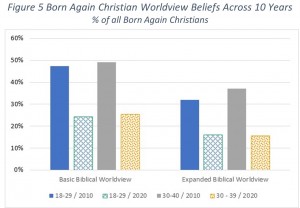
Figure 5 Born Again Christian Worldview Beliefs Across 10 Years % of all Born Again ChristiansNow let’s compare these 2020 results with the results from our 2010 survey. Figure 5 shows the results across this decade for Born Again Christians looking at the percent who agree with the worldview answers above. As shown, there has been a dramatic drop in both the Basic Biblical Worldview and the Expanded Biblical Worldview.

If we compare the 18–29 result from 2010 with the 30–39 result from 2020 (i.e., the same age cohort 10 years later), we see a drop from 47% to 25% for the Basic Biblical Worldview and from 32% to 16% for the Expanded Biblical Worldview. So, the percentage of Born Again Christians with a Biblical Worldview (of either type) has been cut in half over the last decade. This result is a startling degradation in worldview beliefs of Born Again Christians over just 10 years.

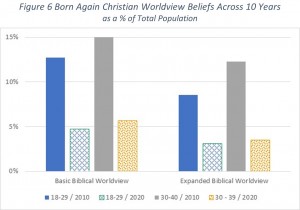
Figure 6 Born Again Christian Worldview Beliefs Across 10 Years as a % of Total PopulationHowever, because the percent of the population who profess to being born again has dropped over the last ten years as well, the situation is even worse. We need to look at the percent of Americans of a particular age range who hold to a Biblical Worldview. Those results are shown in Figure 6. Once again, comparing the 18–29 age group from 2010 with the same age group ten years later now 30–39, we find an even greater drop off. For the Basic Biblical Worldview, we see a drop off from 13% of the population down to 6%. For the Expanded Biblical Worldview, the decline is from 9% down to just over 3% (a drop off of two thirds).

The drop off seen over this ten-year period is more than dramatic and extremely discouraging. In 2010, we had about 10% of the population modeling an active biblical worldview. Although small, 10% of the population means that most people would know one of these committed Christians. At between 6% and 3%, the odds of impacting a significant number of Americans are certainly reduced.

However, we cannot forget that the percent of biblical worldview Christians in the Roman Empire in AD 60 was much less than 1% of the population. Three hundred years later virtually the entire empire was at least nominally Christian. If we will commit ourselves to “proclaiming the excellencies of Him who called us out of darkness into His marvelous light,”{11} God will bring revival to our land.

Second, how do various religious groups stack up against these questions?

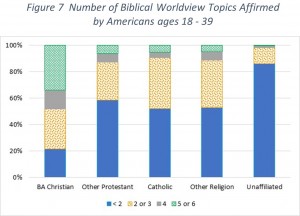
Figure 7 Number of Biblical Worldview Topics Affirmed by Americans ages 18-39Rather than look at the two biblical worldview levels discussed above, we will look at how many of the six biblical worldview questions they answered were consistent with a biblical worldview. In the chart, we look at 18- to 39-year-old individuals grouped by religious affiliation and map what portion answered less than two of the questions biblically, two or three, four, or more than four (i.e., five or six).

You can see that there are three distinct patterns. First, Born Again Christians where almost half of them answered four or more questions from a biblical perspective (the top two sections of each bar). Then, we see Other Protestants, Catholics{12}, and Other Religions{13} chart about the same, with over half answering zero or one and very few answering more than three.

Finally, we see that the Unaffiliated have over 85% who answer zero or one. This result is one of many we have identified over the years, clearly showing that the Unaffiliated are not active Christians who do not want to affiliate with a particular group. Some have suggested this possibility, but the data does not support that hopeful concept.

Third, what do they say about God and His relationship to the world?

People have many different views of God or gods in this life. In this chart, we look at how 18-to 39-year old respondents define God across the different religious affiliations used in the prior chart. Our respondents were asked: Which of the following descriptions comes closest to what you personally believe to be true about God? They were given the following answers to choose from (without the titles).

1. God Rules: God is the all-powerful, all-knowing, perfect creator of the universe who rules the world today.

2. Impersonal Force: God refers to the total realization of personal human potential OR God represents a state of higher consciousness that a person may reach.

3. Deism: God created but is no longer involved with the world today.

4. Many gods: There are many gods, each with their different power and authority.

5. No God: There is no such thing as God.

6. Don’t Know: Don’t know

Once again, the answers fall into three groups. A vast majority of Born Again Christians (~80%) believe in a creator God who is still active in the world today. It is somewhat surprising that over 20% ascribe to a different view of God. The second group consists of Other Protestants who do not claim to be born again, Catholics and Other Religions. These groups are remarkably similar in their responses with around 40% who believe in an active, creator God. So, the remaining 60% have a different view. The third group are the Unaffiliated with less than 10% professing belief in an active, creator God. Over 50% believe in no God or they just don’t know. Overall, only about one third of Americans 55 and under believe in an active, creator God. We must admit that America is not a Judeo-Christian nation as the belief in God is central to Judeo-Christian views. From an evangelistic viewpoint, one needs to be prepared to explain why someone should believe in a creator God. The Probe Ministries website, www.probe.org, is an excellent place to explore the topic.{14}

Summary

This document begins the process of understanding the status and trends of religious beliefs and behaviors in the America of this third decade of the twenty first century. Several findings addressed above are worth highlighting in summary.

• Unaffiliated Americans continue their growth toward one half of the population which began before the turn of this century. The current number of young adults (under the age of 40) who are unaffiliated ranges between one third and one half of our population.

• The percentage of young adult Americans who claim to be Born Again Protestants has declined slightly among the youngest group (18–29) but has remained fairly constant during this century.

• Other Protestants and Catholics have seen marked declines during this century. The percentage of young adult Other Protestants has dropped by one half (from about one quarter of the population to about one eighth) since 1988.

• Born Again Christians are the only group to have a significant number of adherents who profess to having a Basic Biblical Worldview. This worldview is measured by the answers to four very basic questions at the heart of Christian doctrine. Even among this group, only about one in four (25%) of them hold to a Basic Biblical Worldview.

• Over the last ten years, the number of young adult (18–39) Born Again Christians with a Basic Biblical Worldview has dropped by two thirds from almost 15% of the population down to about 5%. This is a remarkable and devastating drop in one decade.

• Just under one half of Born Again Christians agree with more than three of the six worldview questions. Amongst other Christian groups and the population as a whole less than one in ten do so.

• Overall, only about one third of Americans 55 and under believe in an active, creator God.

In our next release, we will look at how American young adults

• react to the doctrine of Jesus Christ,

• believe that Jesus is the only path to heaven, and

• have a classic view of tolerance.

In the meantime, be in prayer about what you can do in your sphere of influence to stem the trends listed above.

Notes

1. For a detailed analysis of the outcomes of our 2010 survey and other surveys from that decade, go to our book Cultural Captives: The Beliefs and Behavior of American Young Adults.
2. The 717 respondents equated to 747 equivalent people when weighted to adjust for differences between those surveyed and the distribution of gender, ethnicity, ages, and location as given by the United States Census Bureau.
3. Our 2010 survey was facilitated by the Barna Group and I would presume they commonly use these two questions in other surveys to identify born again Christians.
4. We have looked at religious affiliation from Pew Research, GSS, PALS, Barna Group and others.
5. General Social Survey data was downloaded from the Association of Religion Data Archives, www.TheARDA.com, and were collected by the National Opinion Research Center.
6. Note that the Other Religions category includes Christian cults (e.g. Mormon, Jehovah’s Witnesses), Jews, and other world religions.
7. In future releases, we will also see that the Unaffiliated are very unlikely to hold to basic Christian beliefs.
8. U.S. Religious Landscape Survey 2007, U.S. Religious Landscape Survey 2014, Religious Knowledge Survey 2019 Pew Forum on Religion & Public Life (a project of The Pew Research Center). The Pew Research Center bears no responsibility for the analyses or interpretations of the data presented here. The data were downloaded from the Association of Religion Data Archives, www.TheARDA.com, and were collected by the Pew Research Center.
9. Other answers to select from: God created but is no longer involved with the world today; God refers to the total realization of personal human potential; there are many gods, each with their different power and authority; God represents a state of higher consciousness that a person may reach; there is no such thing as God; and don’t know.
10. Born Again Christians include Catholics who answered the born again questions to allow comparison with the 2010 survey but in the Catholic category we include all Catholics including those who are born again.
11. 1 Peter 2:9
12. Catholics here include about 20% who profess to be born again. That subset is included in both the BA Christian column and the Catholic column in Figure 7 and Figure 8.
13. One of the reasons that Other Religions include some that answer more than three worldview questions is that Mormons and other Christian cults are included in that category.
14. Articles on our website addressing this topic include Evidence for God’s Existence, There is a God, Does God Exist: A Christian Argument from Non-biblical Sources, The Impotence of Darwinism, Darwinism: A Teetering House of Cards, and many others.

©2021 Probe Ministries


A Christian Worldview Appraisal of Gun Control and the Second Amendment

Steve Cable examines the Second Amendment from a biblical perspective.

In today’s America, the Second Amendment invokes intense arguments regarding its meaning and application. Events like the Newton school, the Aurora movie theater, and the Tucson shopping center shootings bring sorrow to our minds and prayers to our lips. Some say the way to prevent these tragedies is to remove the right for individuals to own and carry firearms. Others argue that firearms carried by responsible individuals could have prevented much, if not all, the carnage of these mass shootings.

download-podcastAny discussion of the Second Amendment should begin by making sure we are familiar with the wording and the original meaning of this part of our Bill of Rights. The Second Amendment states: “A well-regulated Militia, being necessary to the security of a free State, the right of the people to keep and bear Arms, shall not be infringed.” Although we can reasonably assume the authors of the Bill of Rights and the people of that day felt that this was an unambiguous statement, it is not the case today.

Some believe that the phrase “the right of the people to keep and bear Arms” creates an individual constitutional right. This view is referred to as the “individual right theory,”{1} that legislative bodies are precluded from prohibiting firearm possession. Others argue that the phrase “a well-regulated Militia” means that it was only intended to restrict Congress from legislating away a state’s right of self-defense. This view is called the “collective rights theory.”{2}

In all likelihood, the authors intentionally combined these two thoughts. The states could not muster a militia of their people unless the people were allowed to keep arms. This view is supported by people involved in crafting and/or approving the Bill of Rights. Samuel Adams wrote, “The said Constitution be never construed to authorize Congress to . . . prevent the people of the United States, who are peaceable citizens, from keeping their own arms.”{3} Similarly, Noah Webster wrote, “Before a standing army can rule, the people must be disarmed; as they are in almost every kingdom in Europe. The supreme power in American cannot enforce unjust laws by the sword; because the whole body of the people are armed, and constitute a force superior to any band of regular troops that can be on any pretense, raised in the United States.”{4}

Does a Christian worldview provide guidance for our views on the Second Amendment?  The Bible does not talk about guns, but does it provide instruction on this issue?  In 1 Peter, we learn that governments bear the sword to implement justice. Under our Constitution, we, the people, are ultimately the ones who bear the sword to ensure justice.

The Second Amendment: Why Was It Added?

As discussed above, those responsible for the Second Amendment intended to ensure individuals could bear firearms legally. What concerns led to this original amendment to our constitution?

To understand, we should review the context for the introduction of the Bill of Rights. When the Constitution was sent to the states for ratification in 1787, two groups formed around adding a bill of rights to the Constitution, the Federalists and the Anti-Federalists. The Federalists supported the Constitution as written, believing that any attempt to list certain rights as remaining with individuals or states would be interpreted as making other rights subject to the federal government. The Anti-Federalists believed it was important to clearly state key fundamental rights over which the federal government would have no jurisdiction. Neither group was arguing against any of the Bill of Rights, but rather whether it was more effective to be silent or to list them explicitly.

The Federalists, who had the majority of delegates to the convention, were wrong in assuming that most people would agree with their hands-off approach. This situation led to many of the states ratifying the Constitution with the stipulation that a bill of rights be added. The right to bear arms was a common component of these stipulations. As James Madison wrote in the Federalist Papers, “The advantage of being armed, which the Americans possess over the people of almost every other nation . . . forms a barrier against the enterprises of ambition  . . . The several kingdoms of Europe . . . are afraid to trust the people with arms.”{5}

When the first Congress met, James Madison presented a bill of rights before the members of the House. The first Congress converted these into twelve amendments which were sent back to the states for ratification in September of 1789. The language which would become the Second Amendment was essentially unchanged from that offered by Madison. On March 1, 1792, Thomas Jefferson announced the ratification of the United States Bill of Rights.

In Romans, Paul wrote, “But if you do what is evil, be afraid; for (governing authorities) do not bear the sword for nothing; for it is a minister of God, an avenger who brings wrath on the one who practices evil.”{6} However, if government officials hold all power, those who would control us will seek that power by taking over the government. In our constitutional system, the people are the ultimate governing authorities and thus are given the right to bear arms to protect the nation against those who would take over for the practice of evil.

The Second Amendment: How Is It Applied Today?

As noted previously, two different thoughts arose in interpreting the Second Amendment, namely the “individual rights theory” and the “collective rights theory.” Which view is supported by the Supreme Court?

In the most recent ruling of 2008, the court ruled the amendment confers an individual right to possess a firearm for traditionally lawful purposes such as self-defense. It also determined that the clause concerning a well-regulated militia does not limit the part which clearly states an individual’s right to keep and bear arms. Thus, the Court affirmed the “individual rights theory” of interpretation.

Remember, the framers of the Second Amendment were aware that guns held by individuals could be used for criminal activity. They felt that protecting individual liberty was more important than trying to create a perfectly safe environment. However, it should not be interpreted that everyone should have equal access to firearms. The Court has supported laws which 1) restrict those with mental problems or a criminal background in acquiring guns and 2) limit general access to specific types of weapons for mass destruction.

The difficult question is, when does the government cross the line into the realm of interfering with a person’s rights? First, what is meant by arms; does it include tanks, RPGs, etc.?  Second, what could legally preclude a person’s right to bear arms? What type of personality or personality disorder makes it dangerous to others for you to carry a gun?

On the first question, the answer is not defined by what is needed for hunting or protection from thieves. From the perspective of the Founding Fathers, it needs to be weapons such that if a sufficient number of people possess them, the government is unable through the force of an army to impose any unconstitutional burdens upon the people. The Court’s position is that rifles and handguns are sufficient and that the government has the right to control other types of weapons.

The second question is equally difficult: how does one determine who is sane enough to have the right to bear arms? The Court has allowed this to be defined in terms of mental deficiencies, mental problems and a criminal background.

In 1 Timothy 2:1-2, we are told to pray for those in authority, that we may lead a quiet and peaceful life with all godliness and dignity. Our Constitution indicates that we are to take up arms as necessary to protect a government supporting godliness and dignity. It is reasonable to preclude those without a sane concept of a quiet and peaceful life from accessing firearms, which would always be a small minority of the populace.

The Second Amendment: Should It Be Ignored?

To this point, we have laid out the history and the status of our right to bear arms. We have three possible responses: 1) accept and obey this law, 2) ignore it as counter to God’s greater law, or 3) work to repeal the law. Let us first consider the question, “Is this a law that we should ignore?”

As spelled out in Romans 13 and 1 Peter 2, Christians are to uphold the laws of our land. Although no specific governmental system is promoted in the New Testament, we appreciate a system that protects our ability to worship God consistent with 1 Timothy 2:1-2. We support protecting the individual religious freedom offered by this country. At the same time, we want to limit robbery, murder and mayhem. How do these potentially conflicting desires relate to our view of the Second Amendment?

Remember, its underlying purpose is to ensure that our freedoms as individuals and as states are never trampled on by the federal government or others. The framers of the Constitution were worried about the tendency of large governments to attempt to consolidate their power at the expense of freedom. As Christians, we should desire to live in a society where we are free to worship God and share our faith with others.

In 1 Timothy 2:1-4, we see that we should pray for such a society because “This is good, and it is pleasing in the sight of God our Savior, who desires all people to be saved and to come to the knowledge of the truth.”  As citizens of this nation, the Second Amendment makes it clear that we have a responsibility to protect our rights from those who would attempt to abuse their position, to maintain our freedoms including our freedom to live godly lives and share Christ freely.

In 2 Peter 2:13-14, we are to submit “for the Lord’s sake to every human institution,” whether to a king or his representatives. Within our structure of government, we submit to our Constitution and its principles. The Second Amendment calls for us (if needed) to be armed and ready as individuals to participate in a state militia or, in the absence of a militia, to act as individuals to protect our liberty. In 2008, the Supreme Court ruled that this also confers an individual right to possess a firearm for traditionally lawful purposes.

Clearly, the right to bear arms as defined in our Constitution and explained by Supreme Court rulings is not counter to biblical teaching. Therefore, we are to act in accordance with this amendment to our Constitution. Whether we should try to repeal this law is discussed below.

The Second Amendment: Should It Be Repealed?

If the Second Amendment creates more harm than good, we can support repealing it. The main argument for this position is that guns are used by some to harm the innocent. If guns are freely available to the citizenry, does the harm done outweigh the value envisioned by the Second Amendment?

Many innocent people have been killed by deranged individuals and criminals with guns; at the same time, we cannot remember a time when American citizens were called to the streets to protect our Constitution. Have we reached a point where the nature of today’s weapons and our society make the Second Amendment a detriment?

One group argues that if private ownership was illegal and strictly enforced, it would severely limit gun violence. An opposing view believes the problem is actually worsened by the lack of gun ownership by the public. If more law abiding citizens were armed and prepared to respond, the number of people killed would drop due to the deterrent effect.

What is the problem with repealing the Second Amendment? To have no guns among the citizenry, the government must be very proactive in removing guns from society as a whole. Guns must be removed from those not inclined to obey— a very difficult task as evidenced by the prevalence of alcohol during Prohibition. If accomplished, the government must assume unprecedented powers which may be fine as long as the Constitutional is not usurped. But if a future government decides to do so, there will be nothing to stop it.

Swords were used to kill people in Jesus’ day. Did Jesus rail against the presence of swords and demand that no one but soldiers should carry them? No, in fact, he told His disciples that he who had no sword should buy one because of the troubled days ahead.{7} Peter was carrying his sword in the garden when Jesus was arrested.{8} While Jesus kept Peter from interfering with His arrest, Jesus did not use that situation to initiate a “sword control” campaign.

Perhaps a more sensible way to control gun violence would be to encourage law-abiding citizens to carry weapons, particularly in public areas. This approach creates a deterrent against the insane, the criminal, and a future government gone amok.

According to Isaiah 2:4 and Micah 4:3, in the last days, swords will be beaten into plowshares and nations will no longer lift up the sword against other nations. We are clearly not in those last days now. Keeping the Second Amendment in place highlights our commitment to a government “of the people, by the people and for the people,” while we wait for Christ’s bodily return.

Notes

1. Second Amendment, Legal Information Institute, Cornell University Law School, www.law.cornell.edu/wex/second_amendment
2. Ibid.
3. Philip Mulivor, Proclaiming Liberty: What Patriots and Heroes Really Said about the Right to Keep and Bear Arms, Brightman Press, New York, 2011 quoting Samuel Adams, Amendment introduced on 6 Feb. 1788 in the Massachusetts ratifying convention, qtd. In Debates and Proceeding in the Cnvention of the Commonwealth of Massachusetts, Held in the Year 1788
4. Ibid., Noah Webster, “An Examination of the Leading Principles of the Federal Constitution.” Pamphlets on the Constitution of the United States Published During Its Discussion by the People 1787-1788.
5. Ibid., James Madison, “Paper 46,” The Federalist Papers.
6. Romans 13:4
7. Luke 22:35-38
8. John 18:10

©2015 Probe Ministries


Social Media

Kerby Anderson assesses how social media’s influence is changing our brains and the way we think. He also provides an overview of censorship within social media.

The influence of social media in our society has increased dramatically in the last decade. This leads to two very important questions. First, how are the various forms of social media and these digital devices affecting us? Second, should we respond to the documented examples of censorship on these social media platforms?

Social Media Influence

More than a decade ago, social scientists and social commentators expressed concern about how the Internet in general and social media in particular was influencing us. Nicholas Carr raised this question in an Atlantic article entitled “Is Google Making Us Stupid?” He observed that “Over the past few years I’ve had an uncomfortable sense that someone, or something, has been tinkering with my brain, remapping the neural circuitry, reprogramming the memory.” He believed this came from using the Internet and searching the web with Google.

He later went on to write a book with the arresting title, The Shallows: What the Internet Is Doing to Our Brains. He surveyed brain research that helped to explain why we don’t read as much and why it is so hard to concentrate. The Internet and social media are retraining our brains. He says, “Once I was a scuba diver in the sea of words. Now I zip along the surface like a guy on a Jet Ski.”

A developmental psychologist at Tufts University put it this way. “We are not only what we read. We are how we read.” The style of reading on the Internet puts “efficiency” and “immediacy” above other factors. Put simply, it has changed the way we read and acquire information.

You might say that would only be true for the younger generation. Older people are set in their ways. The Internet could not possibly change the way the brains of older people download information. Not true. The 100 billion neurons inside our skulls can break connections and form others. A neuroscientist at George Mason University says: “The brain has the ability to reprogram itself on the fly, altering the way it functions.”

The proliferation of social media has also begun to shorten our time of concentration. Steven Kotler made this case in his Psychology Today blog, “How Twitter Makes You Stupid.” He once asked the author of the best-selling book why he called it the “8 Minute Meditation.” The author told him that eight minutes was the length of time of an average segment of television. He reasoned that “most of us already know exactly how to pay attention for eight minutes.”

Steven Kotler argues that Twitter was reducing the time of concentration to 140 words (back when that was the word limit). He showed how Twitter was constantly tuning “the brain to reading and comprehending information 140 characters at a time.” He concluded that “[I]f you take a Twitter-addicted teen and give them a reading comprehension test, their comprehension levels will plunge once they pass the 140 word mark.”

Not only is there a problem with concentration; there is a problem with distraction. A study at the University of Illinois found that if an interruption takes place at a natural breakpoint, then the mental disruption is less. If it came at a less opportune time, the user experienced the “where was I?” brain lock.

Another problem is what is called “continuous partial attention.” People who use mobile devices often use their devices while they should be paying attention to something else. Psychologists tell us that we really aren’t multitasking, but rather engage in rapid-fire switching of attention among tasks. It is inevitable they are going to miss key information if part of their focus is on their digital devices.

There is also the concern that social media and digital devices are reducing our creativity. Turning on a digital device and checking social media when you are “doing nothing” replaces what we used to do in the days before these devices were invented. Back then, we called it “daydreaming.” That is when the brain often connects unrelated facts and thoughts. You have probably had some of your most creative ideas while shaving, putting on makeup, or driving. That is when your brain can be creative. Checking e-mail and social media sites reduces daydreaming.

These new media platforms present a challenge to us as Christians. As we use these new forms of media, we should always be aware of their influence on us. They can easily conform us to the world (Romans 12:2). Therefore, we should make sure that we are not taken captive (Colossians 2:8) by the false philosophies of the world.

Christians should strive to apply the principle set forth in Philippians 4:8. “Finally, brothers, whatever is true, whatever is honorable, whatever is just, whatever is pure, whatever is lovely, whatever is commendable, if there is any excellence, if there is anything worthy of praise, think about these things.”

A wise Christian will use discernment when approaching the various social media platforms. They provide lots of information and connect us with people around the world. But we should also guard against the worldly influence that is also promoted on many of these platforms.

Social Media Censorship

Big Tech companies have been censoring content for many years. Many years ago, the National Religious Broadcasters began monitoring censorship on these social media platforms through their John Milton Project for Religious Free Speech. Even back then, their report concluded that “The free speech liberty of citizens who use the Internet is nearing a crisis point.”

A recent Senate hearing provided lots of additional examples. Senator Marsha Blackburn asked why her pro-life ad was pulled during the 2018 campaign because Twitter deemed it “inflammatory.” It is worth noting that she did receive an apology from the executive who added that they made a “mistake on your ad.” Senator Ted Cruz pointed to a Susan B. Anthony List ad that was banned. It had a picture of Mother Teresa with her quote: “Abortion is profoundly anti-woman.” At the top of the poster in the committee room was the word: CENSORED.

A number of commentators (Laura Loomer, Milo Yiannopoulos, Alex Jones) have been banned from Facebook and Instagram. Steven Crowder’s YouTube channel has been demonetized. Nearly two-dozen PragerU videos have been slapped with a restricted label on YouTube. The list goes on and on.

Big tech does control much of the media world. Google controls 90% of worldwide search, 75% of smartphone operating systems, 67% of desktop browser, and 37% of digital advertising. Add to this other platforms like Twitter, Instagram, and YouTube that also have a profound influence. At the Senate hearing, Ted Cruz noted that these big tech companies “are larger and more powerful than Standard Oil was when it was broken up” and “larger and more powerful than AT&T when it was broken up.” But does that mean government should get involved?

Those who are advocating government intervention make the case that “platform access is a civil right.” The argument is that private companies are actually violating the civil rights of Americans in the same way that preventing someone to speak in a public park would be a violation. They argue that the big tech companies are a monopoly. And they call for federal and state regulation of these social media platforms arguing that the Supreme Court has argued in the past that government cannot restrict your access to the public square.

The problem with that argument is two-fold. First, these big tech companies are private companies not the government. Facebook, Twitter and YouTube platforms are private property and not the public square. We may not always like what they do, but they are privately owned technology companies and not the federal government, which is governed by the First Amendment.

Second, these companies are protected by a section of the 1996 Communications Decency Act that keeps them from being exposed to potentially crippling liability for something posted on their platform. Some politicians have called for changing that legal protection, but Congress seems unlikely to do anything like that in the near future.

Many conservatives are wary of having the government get involved in patrolling social media platforms. They remind us of the 1949 FCC Fairness Doctrine. This regulation was supposed to provide an opportunity for media outlets to provide content that was fair, honest, and balanced. Talk radio and other forms of media exploded once the Fairness Doctrine was removed. In most cases, government regulation of the media hurt conservative voices more than helped them.

Even if government were to regulate content on social media platforms, it is worth mentioning that the major tech companies would probably have lots of influence. Facebook and Mark Zuckerberg would have a place at the table as government drafted various media regulations. It is likely that company and many others might even help craft regulations that would protect them from future competitors. We have seen this picture before in other instances when government intervened.

Some have even suggested that we close our social media accounts. If you don’t like the way the New York Times or the Washington Post reports stories or provides commentary from people on your side, you don’t have to subscribe to those newspapers. If you don’t like how MSNBC or Fox News covers stories, you don’t have to tune to that TV network. Media outlets are already choosing what to print or broadcast. Social media platforms are no different.

Sam Sweeney has this advice: “Delete your Facebook, yesterday. Don’t get your news from Twitter. The issues of free speech on social media will no longer matter to you. They don’t matter to me. I’ve made a decision not to subjugate myself to the whims of our new overloads.”

I think most of us want to keep our social media accounts because of the benefit we receive. But I also realize that in light of what we have discussed in this article, many will decide to follow his advice and drop one or more of these social media accounts. We leave that decision to you.

Additional Resources

Kerby Anderson, Arts, Media, and Culture (Cambridge, OH: Christian House Publishing, 2016).

Nicholas Carr, “Is Google Making Us Stupid?” Atlantic, July/August 2008.

David French, “Social-Media Censorship is the Product of Culture and Commerce,” National Review, 6 June 2019.

Stephen Kotler, “How Twitter Makes Your Stupid,” Psychology Today, 15 May 2009.

Jessica Melugin, “Conservative who want Facebook, other social media regulated should think twice,” Foxnews.com, 11 June 2019.

Sam Sweeney, “Close Your Social-Media Accounts,” National Review, 10 June 2019.

©2019 Kerby Anderson


Are Surveys Fake News?

Probe dessert 3/7/19 about surveys and fake news
On March 7, 2019, Probe’s Senior VP Steve Cable gave a one-hour presentation drawing on his decades of statistical research and insight to probe deeply into the trustworthiness of news containing references to surveys. In this message he shows why we should remain skeptical of what surveys purportedly indicate. Sometimes the actual results are directly opposite of what is claimed.

You can download the mp3 audio recording here.


“Gosnell”: The Doctor Who Snuffed Out Babies and His Silencing Accomplices

“Were you guys at the ‘Gosnell’ showing?” asked the older gentleman at the urinal next to me. “Have you ever been in a theater where nobody speaks as they leave the movie?” Two very unusual events had just occurred: the reaction he mentioned and men talking at the toilet! A men’s room discussion ensued, focusing on the heaviness of the topic: abortion and baby killing.

Despite unseasonable cold and rain, my wife and I had sat with a few others in the local theater late on a weeknight. It was the last chance to see a film that’s been just as shut down as the discussion of its topic: killing of babies born alive by an abortionist so unprincipled that he was foresworn by fellow abortionists and pro-abortion advocates. The perpetrator: Dr. Kermit Gosnell. The film bears his name. It is also subtitled, maybe exaggeratedly, “The Trial of America’s Biggest Serial Killer.” But who cares if a few others killed more humans than he did over 30 years’ time? Gosnell is deservedly serving three life sentences for first degree murder for offing who knows how many newborns as a “service” to poor women.

As we exited the theater, I had nearly commented about the palpable silence, but realized the gravity of the moment and stopped myself. Perhaps it would take a while to process the newly resurrected horror. The alternate thought occurred to me that, even with a likely self-selecting audience of pro-lifers, silence is what got us to the cultural situation we are in regarding abortion. Would anyone even comment?

The “right to choose” has now been superseded by a debate about personhood of fetuses and babies. Christians often remain silent. Many believe fetal sonogram pictures have dealt a blow to the euphemisms. Turns out, it’s a picture that sealed Gosnell’s doom.

The story tells itself, so the film simply needed to be believable. The superbly cast “Gosnell” pulls it off, with characters as diverse as inner-city young women employed by the mad doctor to a suburbanite prosecutor and mother of five to the queerly eccentric, self-justified Gosnell himself. (The lead actor is the actual Gosnell’s doppelganger!) A well-played Emo blogger may have made the difference in prosecuting the deranged doctor, while the mainstream press was absent without leave. Cable TV-level cursing lends a less religious, more real-to-life tone, but it seemed a bit overdone.

“Gosnell’s” biggest strength, unfortunately, is the unraveling of a chamber of horrors haunted by the abortionist’s classical piano playing and taste for exotic flowers. It is surreal. This cat- and exotic turtle-loving, soft dictator’s demise began as a drug case. In a classic storyline, the DEA (Drug Enforcement Agency) and FBI encroach on a local police investigation, forcing the investigation down the cul-de-sac of a mere drug bust. As a law unto himself, Gosnell had become a dealer. No one was prepared for the baby body bags and slime of Gosnell’s “clinic.” That is, the headlines and court case were stranger than fiction—and more disturbing than most. Frankly, the pre-Halloween release seems appropriate. Still, the obvious moral implications and the inevitable appeal to conscience provides a critical reality check for all time, something that cuts through the slogans and euphemisms surrounding abortion.

That tension between the practice no one talks about and the inherent law of right and wrong within human hearts at times splits the screen. The pro-abortion prosecutor subtly rethinks her position as she cuddles her new baby. The most telling scene is the courtroom practice session with the defense lawyer, brilliantly played by Nick Searcy. Here, Gosnell unequivocally states that he has no respect for laws about training healthcare workers up to code. More chillingly, he declares that his diagnosis of fetal-and live-birth babies’ viability is the definitive opinion. In other words, the doctor totally violated the classical “do no harm” doctrine of medicine as aided and abetted by authorities, wantonly violated laws designed to protect women, and played God with babies’ lives even beyond the allowance of Roe-liberalized abortion laws. But truth has a way of emerging. And history repeats itself in a way.

How so? The up-to-the-minute story, which smells as fishy as Gosnell’s clinic and the cover-up-by-negligence that kept him in grim business for a third of a century, is a tale of viewpoint discrimination. The little-known fight to stanch this movie’s release and cancel showings parallels the way that authorities ignored—by decree—the egregious crimes of Gosnell. This week, headlines like “‘Gosnell’ Filmmakers: Theaters Dropping Movie, Preventing People From Buying Tickets” emerged on Christian news web sites—and nowhere else, apparently. “John Sullivan, the film’s producer and marketing director, said, ‘The fact that we’ve been dropped from theaters where the movie is the number 6 or number 9 movie is just something you don’t see. ‘It’s hard not to believe it isn’t about the content of the movie’.”{1} Despite an excellent opening run, Facebook ticket-buyers report refunds from AMC outlets without explanation and in explicable screening cancellations.

It still seems as if there’s a conspiracy to shut down knowledge of the facts. The spirit of the grand jury-convening judge who demanded the case not be about abortion lives on. Recently, NPR played the same card, avoiding the hot button term “abortion.” The Daily Beast reports that “National Public Radio’s own past reporting called Kermit Gosnell an ‘abortion doctor.’ But when the makers of a new film [“Gosnell”] wanted to pay to use the phrase on air, no dice.” According to actual events, which comprise most of the screenplay, health officials had direct orders from the governor’s office not to follow up on complaints about the clinic.

Gosnell’s “hellhole” of an abortion mill defied imagination. It was a nasty nest of cat filth and biohazards. Turns out, lots of that biological “waste” were the bodies of infants killed both in the womb past legal dates, whom the butcher-doctor “snipped” in the neck after they were delivered. “As liberal commentator Kirsten Powers wrote at USA Today back in 2013, ‘Infant beheadings. Severed baby feet in jars. A child screaming after it was delivered alive during an abortion procedure. Haven’t heard about these sickening accusations? It’s not your fault.’ Powers continued, ‘Since the murder trial of Pennsylvania abortion doctor Kermit Gosnell began . . . there has been precious little coverage of the case that should be on every news show and front page.’” Years later, the crickets can still be heard. Gosnell’s gruesome methods boggled the mind of jurors and moviegoers. Still, the trial was not allowed to “be a case about abortion.” Nor the film. Yeah, right.

So, the docudrama about a “prolific serial killer” seems to be merely another extension of the strange silence induced by a biased system and a duped public. On a radio interview, the producer said he had to raise funds himself, as with other such independent conservative films. He has faced astonishing resistance at every turn in the four-year process of creating and releasing “Gosnell.” Studios supposedly balk because of controversy, but conservatives know that there is more viewpoint discrimination than anything at work. One would almost think that there are tweaked consciences being defended.

In a monumental scene, the prosecutor shows the gruesome picture of a late-term born-alive baby boy who had been executed by Gosnell. Courtroom fact-finding, arguments, and persuasive appeals gave way to the impact of a picture, worth many more than a thousand words. May the light of day shine on the awful picture of death-dealing in and out of the womb in the court of public opinion and individual hearts and minds. “Gosnell” provides a revealing and compelling picture that will hopefully live on despite the spotty and embattled theater releases.

Note

1. The Christian Post, posted Oct. 22, 2018, accessed Oct. 25, 2018. www.christianpost.com/news/gosnell-filmmakers-theaters-dropping-movie-preventing-people-from-buying-tickets-228090.

©2018 Probe Ministries


Politicized Culture

Kerby Anderson examines the politicized nature of American culture, offering the Bible’s antidote of a call to civility.

Social Media’s Role in Politicizing Issues

I think most of us lament how just about everything in our culture has become politicized. We can attribute that to the fact that we live in a nation that is divided. The clash of worldviews is more apparent than ever before.

download-podcastIn this article I want to talk about the politicized nature of our culture. First I would like to look at how technology has accentuated this problem. In a recent column, Daniel Foster points the finger to social media. The title of his column is “Everything All the Time.”{1}

His perspective is simple. “It is no longer the case that technologies of communication merely accelerate the public discourse, they now ensure that every possible public discourse happens simultaneously.” In other words, we don’t hear these comments one after another. We hear every comment all at the same time.

We have always had conflicts and differences of opinion in this republic. But these seem to have intensified because of the means of our communication. We could work through our differences “at a pace consistent with
social cohesion.” Now we “get a no-holds-barred battle royale in which all things are always at stake.”

Football and the national anthem provide a good example. We were told that Colin Kaepernick did not have a job in the NFL because he was either: (a) a terrible quarterback, or (b) was being blackballed by the NFL owners.
Foster argues that the truth was obviously in between: he is a middling NFL talent who might have the job if he didn’t come with so much baggage.

Of course, the discussion quickly moved beyond him to many of the other NFL players that decided to kneel during the national anthem. Either they were presented as saints or traitors. Soon the protests became something else: a referendum on America. Lost in all of that was the reason for the actions of the football players.

The tackle for the Pittsburg Steelers (Alejandro Villanueva) decided to stand for the national anthem with his hand on his heart. As an ex-Army Ranger, he could do nothing less. Yet, he was made a hero by many and criticized by others.

He wasn’t trying to make a statement, and I don’t think he was trying to defy his coach and teammates. He was merely trying to do what he thought was right. He was distressed with how he was being portrayed in the media by both people who approved of his actions and by those who disapproved. He was merely trying to do what he thought was right before playing the game of football.

In this world of new media, everyone’s opinion is available simultaneously. And the most strident opinions are often given more attention because they are the more extreme. There is little time to digest them and evaluate them because they are coming fast and furious.

Politicizing Sport and Education

An NFL player kneeling during the national anthem isn’t the only place where we see a politicized culture.

For example, the controversy over the NFL players seemed to be dying down until President Donald Trump intensified the debate with his speeches and tweets. But politics in sports began long before he became president.

ESPN has been losing viewers, in part, because it has become much more political. Sports journalist Clay Travis put it this way: “Middle America wants to pop a beer and listen to sports talk, they don’t want to be lectured about why Caitlyn Jenner is a hero, Michael Sam in the new Jackie Robinson of sports, and Colin Kaepernick is the Rosa Parks of football.”

In fact, a recent survey validates his conclusions. “The study aggregated 43 different media markets to see the political leanings of ESPN consumers in those markets.”{2} The study found that Republicans were
fleeing ESPN in droves. In the last year, the ESPN audience became 5 percent less Republican and ESPN 2 actually became 10 percent less Republican. The biggest partisan shift happened on ESPN News, whose audience became 36 percent less Republican.

Last week the editors at the Wall Street Journal explained why we need some areas of our life that are not dominated by political thought. “Healthy democracies have ample room for politics but leave a larger space for civil society and culture that unites more than divides. With the politicization of the National Football League and the national anthem, the Divided States of America are exhibiting a very unhealthy level of polarization and mistrust.”{3}

Politics has also been a part of education, especially higher education, for some time. Political correctness led to attempts to prevent certain professors from gaining tenure and kept certain speakers from even being allowed to speak on campus. Universities may say they believe in free speech, but I think we all know that certain religious views and political views are essentially banned from the academy.

Politics has now become part of the business world. Just like on college campuses, we see that certain social and political views are not allowed in the corporate world. Just ask employees at Google and Mozilla who lost their jobs because one wrote a memo about gender and diversity and the other gave a donation to support traditional marriage. No wonder America is so polarized. Nearly everything in our world has become political.

This politicized political environment has moved into nearly every area of life, including the military.

Politicizing the Military

The military might be one arena that you could assume would not be politicized. Unfortunately, we have seen how even the military has been affected by the political environment we find ourselves in today.

We have some examples during the 2016 presidential campaign. Candidate Trump seemed to question the heroism of Senator John McCain when he said, “I like people that weren’t captured.” Trump also belittled the Khan family who criticized him at the Democratic Convention. His approval ratings dropped significantly due to his critical comments about that Gold Star family.

More recently, we have seen the controversy that erupted when a Gold Star wife and a member of Congress complained about the way President Trump talked on the phone to her about the loss of her son. Before it was over, you had the media, members of Congress, and key figures in the Trump administration making comments and charges about what was supposed to be a desire to console a mother who lost her son.

In a recent column, Ben Shapiro reminds us that when we politicize a sacred space in our culture it is a serious problem.{4} He believes it is serious “because no culture can exist without certain cultural capital—trust—and that trust exists only when there are certain spaces in which we can assume agreement without having to ask.”

When there is shared agreement, there is communication and less friction. If every issue becomes contentious, then the chances for miscommunication increase. Also the cost of transactions increases dramatically.

One of the cultural taboos (until recently) have been the politicization of Gold Star families. Their loved ones have paid the ultimate sacrifice, and they certainly deserve to be left alone to grieve and rebuild their lives. They should not be at the center of politicized statements.

President George W. Bush provides a good example of how to respond. You might remember that he was the target of a Gold Star mother by the name of Cindy Sheehan. Instead of opposing her or reacting to her, he allowed her to make harsh political statements and did not respond.

It is worth remembering she alleged that Bush went to war for oil. She even said that Bush sent her son to die to make his oil friends rich. She even camped out near his home in Crawford, Texas to protest him. He showed character and restraint.

Perhaps there is a lesson for us to learn. In this politicized environment, we need to be peacemakers as people of integrity and civility. We should practice restraint because it is often better to turn the other cheek. Sometimes it is better not to respond or retaliate. After all, that is what is what the Bible tells us to do.

Philosophical and Spiritual Roots of Politicizing

Why has nearly everything in society become politicized? We have talked about the role of social media and other cultural factors. Today I would like to look at the philosophical and spiritual reasons.

What we are seeing in our society can also be seen in Western civilization. It is the loss of civility. The two words share the same etymology. The root word means to be “a member of the household.” Just as there are certain rules that allow family members to live peacefully within a household, so there are rules of civility that allow us to live peacefully within a society. Those rules have collapsed in the 21st century.

How can we summarize the principles of civility? I believe Jesus simply expressed the goal of civility when he taught that “You shall love your neighbor as yourself” (Matthew 22:39). If we truly love our neighbors, then we should be governed by moral standards that express concern for others and limit our own freedom.

Perhaps that is why civility is on the decline. More and more people live for themselves and do not feel they are morally accountable to anyone (even God) for their actions or behavior. We live in a world of selfishness and narcissism and we aren’t about to let anyone limit our freedom to be ourselves.

Civility also acknowledges the value of another person. Politeness and manners are not merely to make social life easier. We are to treat each other with respect and afford them the dignity they deserve as people created in the image of God. It is improper not to treat them with the dignity they deserve.

Again, this may help answer why civility is on the decline and political divisions seem to be growing. An increasing majority in our society no longer believes in moral absolutes. A significant number do not believe in God and therefore do not believe we are created in God’s image. The moral restraints that existed in the past are loosed. As this crisis of morality and theology unfolds, so does barbarism and decadence. Civility is what is lost from society.

If this is so, then the rise of rudeness and incivility cannot be easily altered. Miss Manners and others have written books about how our nation can regain its civility. But if the crisis is greater than a lack of anners (and I believe that it is), its solution must be found in a greater social change than merely teaching manners or character.

Ultimately, a return to civility must flow out of a moral and religious change. And I believe Christians should lead the way by exemplary behavior. In essence, Christians must be the best citizens and the best examples of civility in society.

The Bible’s Antidote

Let’s turn from the loss of civility and the subsequent rise in a politicized culture to what the Bible has to say about this idea of a civil discourse.

At the heart of civility is the biblical command to love your neighbor as yourself. While it is relatively easy to love people who are your friends or people who are nice to you, the real test of Christian love comes when we are with strangers or with people who are not civil to you. When we find ourselves being criticized in social media or face to face, we shouldstill treat these critics with dignity and respect even if they are not civil to us. Even if they are not gracious toward us, we should not repay them with incivility.

Our duty to be civil to others should not depend on whether we like them or agree with their moral or political perspectives. They may be disagreeable, and we are free to disagree with them, but we should do so by giving grace. Often such a gentle response can change a discussion or dialogue. Proverbs 15:1 reminds us that “A gentle answer turns away wrath.”

Civility also demands that we not retaliate. The Apostle Paul teaches in Romans (12:9, 14, 21) we are to “Abhor what is evil; hold fast to what is good.” Paul goes on to say that we should “Bless those who persecute you; bless and do not curse them.” Finally, he concludes, “Do not be overcome by evil, but overcome evil with good.”

Civility also requires humility. A civil person acknowledges that he or she does not possess all wisdom and knowledge. Therefore, one should listen to others and consider the possibility that they might be right and that
he is wrong. Philippians 2:3 says, “Do nothing from selfishness or empty conceit, but with humility of mind let each of you regard one another as more important than himself.”

Civility also requires that we watch what we say. The Bible clearly warns us of the danger of the tongue in James 3:5-8. We should watch what we say and what we write.

We should work to cleanse our language of harsh, critical, and condemning words. We should rid ourselves of nasty and vulgar language. Ephesians 4:29 says, “Let no unwholesome word proceed from your mouth, but only such a word as is good for edification according to the need of the moment, that it may give grace to those who hear.”

In summary, we should be a positive example as we engage the world. We should do so with courage, compassion, character, and civility.

Notes

1. Daniel Foster, “Everything All the Time,” National Review, 16 October 2017,
www.nationalreview.com/magazine/2017-10-15-2050/everything-all-time.
2. “Shocking Study Reveals Just How Liberal ESPN Has Become,” The Daily Caller, 24 May, 2017, dailycaller.com/2017/05/24/shocking-study-reveals-just-how-more-liberal-espn-has-become/
3. “The Politicization of Everything,” Wall Street Journal, 24 September 2017,
www.wsj.com/articles/the-politicization-of-everything-1506291118.
4. Ben Shapiro, “Gold Star Families Are Sacrosanct,” National Review, 24 October 2017, www.nationalreview.com/article/453028/honoring-gold-star-families-protecting-innocents-some-things-must-remain-sacred

©2018 Probe Ministries


Gay Men to Lead Boy Scouts: Gates’ Failure to Render Genuine Leadership

This week the Boy Scouts of America have announced they will welcome transgendered youth into the program. This culture-following trend began when the BSA allowed gay scouts, then gay leaders. This shows a serious leadership gap, according to Eagle Scout, former Scout employee, and volunteer Byron Barlowe.

Boy Scouts will now be subject to gay adult leadership if BSA (Boy Scouts of America) president Robert Gates’ advice is taken. Gates, who once held our military’s top position as Secretary of Defense, declared the inevitability of ending the ban on openly gay Scout leaders while addressing the BSA national annual meeting in Atlanta Thursday, May 21, 2015.

Does anyone really doubt that Gates’ position will be made official, especially given recent advances for gay rights at the states’ level, with the Girl Scouts, in Ireland’s national referendum vote three days later and most likely via the United States Supreme Court this June? I wager it’ll be only a few months before it’s official BSA policy.

The question for Mr. Gates: How does bowing to the rapidly changing poll numbers on this issue constitute leadership? Don’t heroes often have to stand alone? Even if Gates holds convictions that would dictate openness in his personal dealings, his stated premise for lifting the long-time ban on gay Scout leaders that stands to affect tens of thousands of youth is flawed: that the proverbial train has left the station and the organization needs to cover its rear guard, to go with the inevitable flow of gay rights, to kowtow to pressure from within and without. Pure pragmatism on parade. And entirely inappropriate and unrespectable.

Brave New World vs. “A Scout is Brave”

Part of the Scout Law every Boy Scout for 105 years has memorized and recited reads, “A Scout is trustworthy . . . brave . . . reverent. . . .” But the BSA has done a 180-degree flip on the topic of homosexuality, having won a Supreme Court case against a gay membership push as recently as 2000. The Opinion of the Court in Dale v. Boy Scouts of America, written by Chief Justice Rehnquist, reads, “The Boy Scouts asserts that it ‘teach[es] that homosexual conduct is not morally straight’” in its defense of denying avowed homosexual and gay activist James Dale leadership privileges with a Scout troop.

Oh, what a difference fifteen years makes when one bases decisions on the swiveling wind vane of a degrading culture.

To his credit, Dr. Gates called for individual chartering organizations—representing 70 percent of Boy Scout Troops and Cub Packs—to decide for themselves how to implement such a policy. Yet, in the same speech, Gates cites the refusal of a New York Council to abide by current BSA policy in hiring gay leaders as a realistic reason to change the national policy. Which is it? Gay men get the right to lead, or troops and packs get to say no? We see where that is going in the courts and in culture with Christian photographers, bakers and T-shirt makers: inescapable pressure to succumb.

Live Up to High Standards of Scouting

I’m holding President Gates to a high standard here. Sure, he’s been pressured by his own big business (read: big donor) board members like Randall Stephenson of AT&T and James Turley of Ernst & Young to eradicate the BSA’s longstanding policies against gay participation at every level. Though it may not compare to high stakes, national level non-profit boardroom politics, I lost my job as a BSA District Executive by holding to the principles of Scouting (and my biblical faith). When asked to misrepresent the number of Cub Scout Packs in local schools at a BSA Council in North Carolina, I refused. Threats didn’t move me despite my 23-year-old, first-job fears. Call me naïve. Then explain that to a boy. It would be refreshing to see Mr. Gates stand up to power himself.

Even if I agreed with gay rights claims concerning the private youth training organization, I’d object to the hypocrisy of its leader. Gates’ recent declaration, as with the BSA’s 2013 decision to enroll openly gay Scouts, is modeling another dereliction of duty. Yet “duty to God,” others and self has always formed the three-legged stool of values on which Scouting stood. God is not confused on this issue, nor was the Scouting program for a full century.

If This Goes, Scouting Will Forever Be Altered

I write “values on which Scouting stood” in past tense advisedly. As I was quoted via the Los Angeles Times syndicate while demonstrating against the policy change to allow openly gay Scouts in 2013, this is the end of Scouting as we have known it. Another prediction: A sharp decrease in numbers following that decision will be surpassed if the BSA allows admittedly gay leaders. As an Eagle Scout, father of an Eagle Scout, former volunteer Scouting leader and BSA local executive, I can no longer support in any way the Boy Scouts of America. I’ll support other youth programs.

This conviction grieves me, but borrowing from the Christian reformer Martin Luther, here I stand and I can do no other. No, this episode does not rise to the level of religious reformation; however, the gravity of such social slides will change the cultural landscape for as long as our Republic stands. The gay advocacy heavyweight Human Rights Campaign is right when it celebrates Gates’ announcement as a huge victory in its drive for full acceptance of homosexuals across the culture, given that the BSA is “one of America’s most storied institutions.”

As SecDef, Gates ended the ambiguous “Don’t ask, don’t tell” doctrine, a decision that opened doors for openly gay service men and women to serve freely despite fears of sexual chaos. Our former CIA Director and, again, Secretary of Defense Gates now holds the top leadership post among a younger group of Americans. On this issue he has led neither members of the armed forces nor impressionable and sexually vulnerable adolescent Scouts.

Once again, Gates’ ethics reek of pure pragmatism: “We must deal with the world as it is, not as we might wish it to be. The status quo in our movement’s membership standards cannot be sustained,” he said to the assembled Scouting leaders.

Never mind high ideals. The wind has blown, the ship has sailed and we must get on board or be left behind (or at least sued heavily). Oh, such bravery.

Posted May 2015 | Updated Jan 2017
© 2015 Probe Ministries


The Technological Simulacra: On the Edge of Reality and Illusion

Dr. Lawrence Terlizzese says that our addiction to technology is heading toward the opposite of the life we want.

What Saccharine is to Sugar, or
The Technological Simulacra: On the Edge of Reality and Illusion

“Anyone wishing to save humanity today must first of all save the word.”{1} – Jacques Ellul

Simulacra

Aerosmith sings a familiar tune:

“There’s something wrong with the world today,
I don’t know what it is,
there’s something wrong with our eyes,
we’re seeing things in a different way
and God knows it ain’t [isn’t] his;
there’s melt down in the sky. We’re living on the edge.”
{2}

download-podcast What saccharine is to sugar, so the technological simulacra is to nature or reality—a technological replacement, purporting itself to be better than the original, more real than reality, sweeter than sugar: hypersugar.

This article without footnotesSimulacra, (Simulacrum, Latin, pl., likeness, image, to simulate): or simulation, the term, was adapted by French social philosopher Jean Baudrillard (1929-2007) to express his critical interpretation of the technological transformation of reality into hyperreality. Baudrillard’s social critique provided the premise for the movie The Matrix (1999). However, he was made famous for declaring that the Gulf War never happened; TV wars are not a reflection of reality but projections (recreations) of the TV medium.{3}

Simulacra reduces reality to its lowest point or one-dimension and then recreates reality through attributing the highest qualities to it, like snapshots from family vacation. When primitive people refuse to have their picture taken because they are afraid that the camera steals their souls, they are resisting simulacra. The camera snaps a picture and recreates the image on paper or a digital medium; it then goes to a photo album or a profile page. Video highlights amount to the same thing in moving images; from three dimensions, the camera reduces its object to soulless one-dimensional fabrication.{4}

Simulacra does not end with the apparent benign pleasures of family vacation and media, although media represents its most recent stage.{5} Simulacra includes the entire technological environment or complex, its infrastructure, which acts as a false “second nature”{6} superimposed over the natural world, replacing it with a hyperreal one, marvelously illustrated in the movie Terminator 2: Judgment Day (1991). As liquid metal conforms itself to everything it touches, it destroys the original.{7}

Humanity gradually replaces itself through recreation of human nature by technological enhancements, making the human race more adaptable to machine existence, ultimately for the purpose of space exploration. Transhumanists believe that through the advancements in genetic engineering, neuropharmaceuticals (experimental drugs), bionics, and artificial intelligence it will redesign the human condition in order to achieve immortality. “Humanity+,” as Transhumanists say, will usher humanity into a higher state of being, a technological stairway to heaven, “glorification,” “divinization” or “ascendency”in theological terms.{8}

God made man in his own image and now mankind remakes himself in the image of his greatest creation (image), the computer. If God’s perfection is represented by the number seven and man’s imperfection by the number six, then the Cyborg will be a five according to the descending order of being; the creature is never equal or greater than the creator but always a little lower.{9}

Glorious Reduction!{10}

www.probe.org/machinehead-from-1984-to-the-brave-new-world-order-and-beyond/

Hyperreality

An old tape recording commercial used to say, “Is it real or is it Memorex?” By championing the superiority of recording to live performance the commercial creates hyperreality, a reproduction of an original that appears more real than reality, a replacement for reality with a reconstructed one, purported to be better than the original.

Disneyland serves as an excellent example by creating a copy of reality remade in order to substitute for reality; it confuses reality with an illusion that appears real, “more real than real.”{11} Disney anesthetizes the imagination, numbing it against reality, leaving spectators with a false or fake impression. Main Street plays off an idealized past. The technological reconstruction leads us to believe that the illusion “can give us more reality than nature can.”{12}

Hyperreality reflects a media dominated society where “signs and symbols” no longer reflect reality but are manipulated by their users to mean whatever. Signs recreate reality to achieve the opposite effect (metastasis){13}; for example, in Dallas I must travel west on Mockingbird Lane in order to go to East Mockingbird Lane. Or, Facebook invites social participation when no actual face to face conversation takes place.{14}

Hyperreality creates a false perception of reality, the glorification of reduction that confuses fantasy for reality, a proxy reality that imitates the lives of movie and TV characters for real life. When reel life in media becomes real life outside media we have entered the high definition, misty region—the Netherlands of concrete imagination—hyperreality!{15}

Hyperreality goes beyond escapism or simply “just entertainment.” If that was all there was to it, there would be no deception or confusion, at best a trivial waste of time and money. Hyperreality is getting lost in the pleasures of escapism and confusing the fantasy world for the real one, believing that fantasy is real or even better than reality. Hyperreality results in the total inversion of society through technological sleight of hand, a cunning trick, a sorcerer’s illusion transforming the world into a negative of itself, into its opposite, then calling it progress.

Hyperreality plays a trick on the mind, a self-induced hypnotism on a mass scale, duping us by our technological recreation into accepting a false reality as truth. Like Cypher from the movie The Matrix who chose the easy and pleasant simulated reality over the harsh conditions of the “desert of the real” in humanity’s fictional war against the computer, he chose to believe a lie instead of the truth.{16}

The Devil is a Liar

A lie plays a trick on the mind, skillfully crafted to deceive through partial omission or concealment of the truth. The lie is the devil’s (devil means liar) only weapon, always made from a position of inferiority and weakness (Revelation 20:3, 8). A lie never stands on its own terms as equal to truth; it does not exist apart from twisting (recreating) truth. A lie never contradicts the truth by standing in opposition to it.

A lie is not a negative (no) or a positive (yes), but obscures one or the other. It adds by revealing what is not there—it subtracts by concealing what is there. A lie appears to be what is not and hides what it really is. “Satan disguises himself as an angel of light” (2 Corinthians 11:14).

A lie does not negate (contradict) or affirm truth. Negation (No) establishes affirmation (Yes). Biblically speaking, the no comes before the yes—the cross then the resurrection; law first, grace second. The Law is no to sin (disobedience); the Gospel is yes to faith (obedience). Truth is always a synthesis or combination between God’s no in judgment on sin and His yes in grace through faith in Jesus Christ. “For the Law was given through Moses; grace and truth were realized through Jesus Christ” (John 1:17). Law without grace is legalism; grace without law is license.{17}

www.probe.org/law-and-grace-combating-the-american-heresy-of-pelagianism/

The devil’s lie adds doubt to the promise of God; “Indeed, has God said, ‘you shall not eat from any tree of the garden’?”(Genesis 3:1 NASB) It hides the promise of certain death; “You surely will not die” (Genesis 3:4). The serpent twists knowledge into doubt by turning God’s imperative, “Don’t eat!” into a satanic question “Don’t eat?”{18}

But it is Eve who recreates the lie in her own imagination. “When the woman saw that the tree was good for food, and that it was a delight to the eyes, and that the tree was desirable to make one wise, she took from its fruit and ate; and she gave also to her husband with her, and he ate” (Genesis 3:6).{19}

Sight incites desire. We want what we see (temptation). Eve was tempted by “the lust of the eyes” (1 John 2:16) after seeing the fruit, then believed the false promise that it would make her wise. “She sees; she no longer hears a word to know what is good, bad or true.”{20} Eve fell victim to her own idolatrous faith in hyperreality that departed from the simple trust in God’s word.{21}

The Void Machine

Media (television, cell phone, internet, telecommunications) is a void machine.{22} In the presence of a traditional social milieu, such as family, church or school, it will destroy its host, and then reconstruct it in its own hyperreal image (Simulacra). Telecommunication technology is a Trojan Horse for all traditional institutions that accept it as pivotal to their “progress,” except prison or jail.{23}. The purpose of all institutions is the promotion of values or social norms, impossible through the online medium.

Media at first appears beneficial, but this technology transforms the institution and user into a glorified version of itself. The personal computer, for example, imparts values not consistent with the mission of church or school, which is to bring people together in mutual support around a common goal or belief for learning and spiritual growth (community). This is done primarily through making friends and forming meaningful relationships, quite simply by people talking to each other. Values and social norms are only as good as the people we learn them from. Values must be embodied in order to be transmitted to the next generation.{24}

Talking as the major form of personal communication is disappearing. Professor of Communications John L. Locke noted that “Intimate talking, the social call of humans, is on the endangered species list.”{25} People prefer to text, or phone.{26} Regrettably, educational institutions such as high schools and universities are rapidly losing their relevance as traditional socializing agents where young people would find a potential partner through like interests or learn a worldview from a mentor. What may be gained in convenience, accessibility or data acquisition for the online student is lost in terms of the social bonds necessary for personal ownership of knowledge, discipline and character development.{27}

An electronic community is not a traditional community of persons who meet face to face, in person, in the flesh where they establish personal presence. Modern communication technologies positively destroy human presence. What philosopher Martin Heidegger called Dasein, “being there,” (embodiment or incarnation) is absent.{28} As Woody Allen put it, “90 percent of life is showing up.”{29} The presence of absence marks the use of all electronic communication technology. Ellul argued, “The simple fact that I carry a camera [cell phone] prevents me from grasping everything in an overall perception.”{30} The camera like the cell phone preoccupies its users, creating distance between himself and friends. The cellphone robs the soul from its users, who must exchange personal presence for absence; the body is there tapping away, but not the soul! The cell phone user has become a void!{31}

The Power of Negative Thinking

According to popular American motivational speakers, the key to unlimited worldly wealth, success and happiness is in the power of positive thinking that unleashes our full potential; however, according to obscure French social critics the key to a meaningful life, lived in freedom, hope and individual dignity is in the power of negative thinking that brings limits, boundaries, direction and purpose.

Negativity gives birth to freedom, expanding our spiritual horizons with possibilities and wise choices, which grounds faith, hope and love in absolute truth, giving us self-definition greater than our circumstances, greater than reality of the senses. To freely choose in love one’s own path, identity and destiny is the essence of individual dignity.

According to French social critics Jacques Ellul and Herbert Marcuse, freedom is only established in negation that provides limits and boundaries, which tells us who we are. Technological hyperreality removes all natural and traditional limits in the recreation of humanity in the image of the cyborg. The transhuman transformation promises limitless potential at the expense of individual freedom, personal identity and ultimately human dignity and survival.

www.probe.org/into-the-void-the-coming-transhuman-transformation/

All limitless behavior ends in self-destruction. Human extinction looms over the technological future, like the Sword of Damocles, threatening humanity’s attempt to refit itself for immortality in a grand explosion (nuclear war), a slow poisoning (ecocide) or suicidal regressive technological replacement. Stephen Hawking noted recently that technological progress threatens humanity’s survival with nuclear war, global warming, artificial intelligence and genetic engineering over the course of the next 100 years. Hawking stated, “We are not going to stop making progress, or reverse it, so we must [recognize] the dangers and control them.”{32}

In asserting “NO!” to unlimited technological advance and establishing personal and communal limits to our use of all technology, especially the cell phone, computer and TV, we free ourselves from the technological necessity darkening our future through paralyzing the will to resist.{33}

After we “JUST SAY NO!”{34} to our technological addictions, for instance, after a sabbatical fast on Sunday when the whole family turns off their electronic devices, and get reacquainted, a new birth of freedom will open before us teeming with possibilities. We will face unmediated reality in ourselves and family with a renewed hope that by changing our personal worlds for one day simply by pushing the off button on media technology we can change the future. Through a weekly media fast (negation) we will grow faith in the power of self-control by proving that we can live more abundant lives without what we once feared absolute necessity, inevitable and irresistible. “All things are possible with God” (Mark 10: 27). When we exchange our fear of idols for faith in the Living God the impossible becomes possible and our unlimited potential is released that will change the world forever!{35}

I see trees of green, red roses, too,
I see them bloom, for me and you
And I think to myself
What a wonderful world.

I see skies of blue, and clouds of white,
The bright blessed day, the dark sacred night
And I think to myself
What a wonderful world.

The colors of the rainbow, so pretty in the sky,
Are also on the faces of people going by.
I see friends shaking hands, sayin’, “How do you do?”
They’re really sayin’, “I love you.”

I hear babies cryin’. I watch them grow.
They’ll learn much more than I’ll ever know
And I think to myself
What a wonderful world.{36}

“[I]f man does not pull himself together and assert himself . . . then things will go the way I describe [cyborg condition].” – Jacques Ellul{37}

Notes

1. Jacques Ellul, The Humiliation of the Word (Grand Rapids: Eerdmans, 1985), vii.

2. Aerosmith, Eat the Rich, “Livin’ on the Edge,” Sony, 1993.

3. The same is true of the game last night—I caught the highlights on ESPN—no difference really—it never happened! The Presidential debates, my Facebook page, 911, televangelism, the online (electric) church: all reproductions, all exist at the level of Santa Claus in a dreamy, surreal world not really real: hyperreal, really!

4. French social critic Herbert Marcuse (1898-1979) described dimensional reduction in human nature through the process of “mimesis” very similar to Baudrillard’s conception of simulacra (technological simulation) and Ellul’s la technique (technological order). Mimesis eradicates all protest and opposition to the prevailing technological normalcy and silences all conscientious objections to the obvious or self-evident benefits (taken for granted) and blessings of technological progress. Like a frontal lobotomy when a section of the brain is removed that leaves all necessary automatic biological functions but removes the capacity to higher critical thinking, effectively silencing all differences, removing unique personality, individuality, and private space. The person is reduced to one dimension without the critical higher thought process or skills. Mimesis or mimicry transcends the adjustment phase to new technology known as Future Shock and brings the population into a direct and immediate relationship with the technological environment comparable to prehistoric and primitive cultures in their relationship to their natural milieus, climates and habitats. Mimesis replaces the traditional social environment with a technological one, an imitation or mimicry (simulacra). Mimesis removes the ability to feel alienation. Through reduction of the individual to a cell (atomization) in the social body, one never feels out of place, discomfort or disease, etc., because there is no longer any sense of individuality or difference. Anesthetizing the soul kills the pain of maladjustment to modernity leaving all feelings alike; joy is indistinguishable from hate. What do people feel after a lobotomy? They feel nothing, comfortably numb describes postmodern sentimentality.

Mimesis reduces the population to impulsive consumers. Material goods tie us to the system. “People recognize themselves in their commodities; they find their soul in their automobile, hi-fi set, split-level home, kitchen equipment. The very mechanism which ties the individual to his society has changed and social control is anchored in the new needs it has produced” (Herbert Marcuse, One-Dimensional Man: Studies in Advanced Industrial Society [Boston: Beacon Press, 1964], 9). People are in love with their technology. Consumer objects express passion and spirituality; “For example, cars are not simply neutral transportation objects but beloved expressions of soul.” Their self-image is locked in the kind of cars they drive, houses they live in: “From teen dreaming about a hot set of wheels to the self-imagined sophisticate, it is image that dictates our purchase . . . Most of us can’t imagine why anyone would buy a Hummer except to flaunt his financial ability to conspicuously consume . . . . Anyone who doubts the role of image needs only drive a rust bucket” (Lee Worth Bailey, The Enchantments of Technology [Chicago: University of Illinois Press, 2005], 7). “Image is everything!” Modern technological materialism has become the antithesis of the Christian way of life. Jesus said, “A man’s life does not consist in the abundance of his possessions” (Luke 12:15).

5. Orders of Simulacra:

Renaissance: Copies of Original

Industrial: Mass Production of Original

Hyperreality: Recreation of Original

Metastasis: Reverse effects of the hyperreal stage of simulacra proliferate, comparable to the spread of cancerous tissue. “Metastasis: the transfer of disease from one organ or part to another not directly connected with it” (Benjamin F. Miller and Claire Brackman Keane Encyclopedia and Dictionary of Medicine and Nursing [Philadelphia: Saunders, 1972]). Hyperreality “more real than real” purports to be a technological improvement on nature and “the signs and symbols,” (language) and institutions of traditional society, “better than real;” however, despite the apparent success of the hyperreal stage to deliver on its promise of improvement or “progress,” opposite results threaten social stability. Disneyland gets boring. Media technology isolates people rather than bringing them together. Social media turns out to be anti-social. The automobile extends the commute to work. The computer increases the average work load and illiteracy, reduces jobs, depersonalizes individuals, kills privacy, creates universal surveillance, makes pornography and depictions of violence readily accessible to children. The cell phone is actually an excellent bomb detonating device. The computer atrophies human intelligence, logic, and thinking (creative and problem solving skills); through societal dependence on the computer people have forgotten how to think for themselves, and solve problems in any other way. The computer is not a simple tool used to organize knowledge, making it readily accessible, but as the centralizing technology through the digitalization process it recreates the world in its own image. Instead of happiness, the technological order is producing mass neurosis evident in the increase in depression, anxiety, attention deficit disorder, anorexia, bulimia, suicide and the mass inability to differentiate between reality and illusion.

Metastasis in the Orders of Simulacra according to Baudrillard also reflects Jacques Ellul’s critical technological analysis in his assertion of the law of diminishing returns (law of reverse effects), The Technological Bluff (Grand Rapids: Eerdmans, 1990). Once the threshold of reversal in technological progress is reached, a saturation point, beyond which any further advance is completely unnecessary (and thus further progress despite mass optimism) will produce reverse or opposite effects than intended. The technological threshold is reached when new technology is imposed on the population which was unnecessary prior to its invention. When necessity for a new technology appears after its invention the threshold of beneficial effects inverts and harmful consequences, side effects—intended or not—rapidly multiply. There is no use or felt needs for much of the technology developed in the 20th century; TV, computer, jet engine, rockets, atom bomb, cell phone, innumerable widgets and gadgets, so use is found and need artificially created. People have no felt need for a technology that does not yet exist. When useless technology is developed for its own sake (knowledge for knowledge’s sake), rather than liberation it displaces the good of mankind to the glory of God as its object or telos and becomes an end in itself. The general population never asks for new technology; rather, technology is developed according to the technological imperative—whatever can be done should be done. Its beneficial use is unquestionably assumed and its use promoted through mass advertising and commercials (technological propaganda), and in short order a new necessity is added to the litany of technological requirements. As the list of “must haves” and “can’t live without” grows in order to keep pace with the tempo of modern life, users voluntarily surrender their freedom for self-imposed technological necessity, blissfully unaware of any potential side-effects or untoward consequences.

The technological condition may be compared to generational slavery. Those born into servitude accept it as normal. The “happy slave” remains so through refusal to recognize his condition as “slave.” He embraces the world as he finds it with all his material needs and appetites satiated. There is no reason to protest, compounded by the fact that he has no ability to do so. A slave will always remain a slave until he recognizes that he is a slave. And without an intellectual horizon to lift him above his condition as a real possibility he will forever remain a slave. The first step to freedom for the slave is to recognize his condition of slavery and the possibility of a different way of life through self-determination, but that is impossible without a degree of abstract analysis and a measure of critical reason. Comparatively, technological determinism imposes its frightful inescapable necessity as a natural order without a meaningful future beyond the present way of life. In stripping society of critical ability to reason and negate that order from a metaphysical view, humanity has lost its only absolute reference point outside its own limited existence and above its concrete situation from which to criticize technology and bring it under ethical control and moral limitation. God is greater than any technological idol made by human hands and provides an immovable ground from which humanity can reassert control, but mankind’s Creator, Savior and Helper does him no good if he does not believe in his power or worse confuses it with the status quo, so that the apocalyptic power of God’s confrontational judgment that leveled Babel (Genesis 11), Egypt (Exodus), Jerusalem and Rome is convoluted through blessing the technological utopia as New Atlantis.

The idolization of technology follows in the wake of modern science and rationalism but has a dehumanizing effect rather than amelioration. New technology brings new necessity and demands rather than freedom that exacts its price from humanity and nature, resulting in a much more complicated and dangerous world. The Apostle Paul stated that if we have food and shelter we should be content (1 Timothy 6:8). The accumulation of material things beyond meeting basic needs becomes a new burden, an added necessity not there before, resulting in bondage not freedom. People are owned by their possessions, must work harder for their technology and have been reduced to cogs in the wheel of progress rather than individuals with inherent value made in the image of God. From electricity, to phones, appliances to automobiles to computers, cell phones, ad infinitum, ad nauseam each new technology begins with the promises of convenience and improving modern life by making it faster, then through habitual use it becomes necessary, eventually addictive. From the basic material needs of food and shelter modern life has added dishwashers, microwave ovens, vacuum cleaners, TVs, cars, computers and most recently the cell phone as necessary for life in modern times. The devaluation of human life pays for the technology that is developed for the sake of expanding the frontiers of knowledge and exploration rather than creating the condition of freedom. Human freedom is lost with each new artificial technical necessity, resulting in an increasingly nihilistic society; where power increases, choice is lost, resulting in increased meaninglessness. Nihilistic sentiment develops along with technological power; “We know that power always destroys values and meaning . . . Where power augments indefinitely there is less and less meaning” (Jacques Ellul, Perspectives on Our Age [New York: Seabury, 1981], 45). Technological necessity proliferates along with technological power over nature, reducing the scope of available choices, options or way of life that differs from those ensnared in the modern mechanized mainstream. What possibilities for a decent way of life are open to those who own neither car nor home, do not use a cell phone or computer, or possess at least a college degree? How successful will any corporate organization, church, school or business be if it does not use modern communication technology, radio, TV, computer or advertising techniques (propaganda) to promote its cause or product? As the world conforms itself to technological necessity, “you must get a cell phone and use a computer or risk getting left behind,” it loses touch with the reality outside these devices, which is reduced and recreated online. For example, the traditional “church service” where believers join together in the unity of faith around the communion table as community and family becomes the embarrassing forgery of a lone spectator in front of a one dimensional monitor.

6. Paul Tillich, The Spiritual Situation in Our Technical Society (Macon, GA: University Press, 1988), 7. “Tillich describes the creation of a ‘second nature’ that results from science’s attempt to control nature. Second nature in turn subjects man to the same domination he wishes to exert over nature, making himself subject to the very thing he had created to liberate him” (Lawrence J. Terlizzese, Trajectory of the 21st Century: Essays on Theology and Technology [Eugene, OR: Resource Publications, 2009, 155]).

7. Baudrillard’s description of Simulacra is reminiscence of Herbert Marcuse’s depiction of “Mimesis” in One-Dimensional Man. Mimesis: the total identification of the individual with technological environment that mimics, apes or imitates historical social conditions, for example the city replaces nature, the automobile replaces the horse and carriage, TV replaces the family hearth, social media substitutes for personal relationships. Muk-bang replaces family members at the dinner table, traditional institutions that requires a personal presence, school and church, are rapidly transferring to the online medium. Likewise Jacques Ellul in The Technological Society describes technological advancement or “la technique” as creating a new environment, one that overlays both the natural and historical social environments with an urban/industrial/digital one.

8. Braden Allenby and Daniel Sarewitz, The Techno-Human Condition (Cambridge, MA: MIT Press, 2011), 1-13; Humans Need Not Apply, CGP Grey, 2014. The Transhuman Transformation is the ultimate in works salvation that lifts humanity to the next stage in evolutionary development through technological immortality or digitalized godhood that replaces all his physical corruptions with artificial replacements in the simulated heaven of a computer server. The computer does not dominate the will of humanity, enforcing universal peace through fear of annihilation as in the movie Colossus: The Forbin Project (1970), but assimilates humanity digitally and recreates it in its own image or highest ideal. The robots are not taking over, rather humanity is surrendering its will and decisions to the computer in tired resignation of life which has become too difficult by its own design.

9. “O LORD . . . What is man that you are mindful of him or the son of man that you visit him? For you have made him a little lower than the angels and crowned him with glory and honor” (Psalm 8:4, 5). “Angels,” Elohim (God) in Psalm 8:5 refers to the divine visitation (theophany) mentioned in verse 4, the Angel of The LORD, i.e., Genesis 18; 19; 22:15; 32:24-32; Exodus 12:12, 13. Humanity was made highest in God’s created order, below the creator and above the angelic host in the chain of being; “Don’t you know you will judge angels?” (1 Corinthians 6:3). Angels are “ministering spirits sent to minister to the heirs of salvation” (Hebrews 1:14).

10. We are not saying one cannot reduce a complicated argument, book, movie etc., to its main points in outline form. We are saying that reduction does not replace the original, as somehow “better.” A well-done outline does not alleviate the audience’s responsibility to discover for itself, to pick up and read, but will inspire the audience to do so. Reading Calvin’s Institutes, or Augustine’s City of God or Thomas’ Summa Theologica in PowerPoint or Cliff Notes is comparable to watching the Super Bowl in highlights instead of in its entirety from kickoff.

The proliferation of the digital camera as appendage to the cell phone has created the absurd phenomenon of reduction of reduction in the class room. As the PowerPoint slide has allowed professors to reduce all learning to three pertinent bullet points per slide, so students have followed their cue in picturing the text (taking a picture of the slide). Instead of suffering the laborious and tedious task of jotting down a simple outline in a note book, a helpful mnemonic practice, they take a picture of it, reducing the slide to digital acknowledgement and temporary storage before deletion, in order to make room for the pictures of tomorrow night’s Harry Potter costume gala. Education isn’t what it used to be, it just isn’t!

11. Jean Baudrillard, Simulacra and Simulation, 166 ff.

12. Umberto Eco, Travels in Hyperreality (New York: HBJ, 1986), 43.

13. The projections of visual media may have their origins in “the desert of the real” as Baudrillard puts it, but what the spectator sees on his screen, monitor or photograph should not be confused with “reality,” but recreated reality mediated through an electronic medium. Marshall McLuhan’s famous maxim for media analysis, “The medium is the message,” undergirds this critical understanding of media technology. Any fan of live entertainment or sports knows immediately that TV broadcast of a live venue is an entirely different event than being there live behind home plate or on the fifty yard line. Preference for the surreal, sterilized, cartoonish, Apollonian images on TV and in film, rather than seeing the actual blots, blemishes and facial scars of people, perspiring athletes or hearing the crack of the bat is not the central moral issue, which does not come down to preferences, which are already conditioned by excessive media exposure at an early age. The failure to distinguish between reality and hyperreality constitutes the greatest dangers of the technological simulacra. When the general audience mistakes or confuses the hyperreal for reality, it allows itself to be deceived. When it believes what it sees on TV to be the literal unbiased truth, when in fact TV broadcasts a highly opinionated reconstructed version designed to transport its audience to a dream-like existence, the audience loses touch with reality and becomes immune to moral conscience, guilt and remorse for its actions—for example, war, ecological destruction, racism, etc. Group deception and delusion is rooted in personal inability to distinguish fact and fantasy, reality and illusion creating a strange self-hypnotic mass psychosis, easily persuaded by the predominate image projected into its thinking. “Brainwashing” or “mind control” are not the best choice of words, yet the terms still resonate for many people in describing the immediate effects of visual media on the audience. Electronic media bypass the rational process and speaks directly to the emotional or subconscious. Media effects the shaping of behavior through mass appeal of image, a reproduction of reality framed in drama and grounded in the erotic (sex appeal), moving the mass to do something (doing is being), buy, give, join, fight, etc., without the ballast of critical reflection that will spare a people from rushing headlong into disaster. The irrational nature of the emotional appeal was the cause for Plato’s expulsion of artists, musicians and dramatists from his fictional utopia The Republic. By allowing irrational appeal free reign, the public loses the appeal to critical reason as the measure of truth and the people become prone to deception and mass manipulation by a tyrant. Likewise Jesus urges all to pause in rational reflection, “to count the cost” like a king going to war or building a tower, before deciding to follow him (Luke 14:25-33).

The failure to discern the difference between reality and illusion in mass and social media is due to the intoxicating effects of hyperreality and the loss of critical reason in the public’s media consumption. Electronic media numbs awareness to reality and allows escape to fantasy, as the universal soma (perfect drug from Huxley’s fictional tale Brave New World). The condition of intoxication or “drunkardness” is one of self-induced madness, so the self-hypnotic condition of electronic media creates a similar neurosis. Karl Marx criticized religion as “the opiate of the people,” accurate for the masses living in the industrial conditions of the 19th century, but obsolete as a description of the masses since the invention of television, which has replaced religion as the opiate of the people.

When image dominates a societal mindset and learning, emotional (sex) appeal moves the population in mass conformity or group behavior that ousts critical reason in herd mentality, subject to the whims of the image makers, propagandists, clergy, advertisers, etc. Ellul noted two orders of thinking determined by the means of learning: image and language. Image learning presents knowledge as a totality, each image is a world, complete and ready-made, certain of its own truthfulness, imparting its information instantly so long as we occupy the same space as the image. “The image conveys to me information belonging to the category of evidence, which convinces me without any prior criticism” (Ellul, The Humiliation of the Word, 36). The image impresses itself on the character of the learner through unconscious acceptance that does not follow the logical sequence of language from start to finish, beginning to end but produces a haphazard collage of contradicting light totalities that appeal immediately to the moment (instant gratification). Image based learning produces a monolithic mentality or stereotypical thinking and prescribed behavior. Critical reason is never allowed to assert differences; extremes are normalized so that everything is accepted. This is very apparent in the current PC orthodoxy widely accepted in the Millennial generation, the first generation raised on the computer, that stupidly pontificates that any assertion of difference between sexes, races, religion, etc., etc., amounts to “hate-crime.” For example, the gay lifestyle is no longer an acceptable alternative to monogamy but now has legal sanction as part of the mainstream establishment, despite its irrational and unnatural character. Islam is accepted as a religion of peace and compatible with Western democracies, yet no proof is ever offered to support this claim from the history of Islam. And the universal inanity of technological neutrality that provides the false sense of individual control over technological use, rapidly degenerates to technological necessity and inevitability of technological progress in actual daily behavior. Technology cannot be both neutral in its character under control of human choices and necessary or not under control of human choices, but autonomous (developing according to its own inner logic) at the same time; yet this inherent contradiction is completely ignored by all advocates of unlimited technological progress, Transhumanists, Futurists or simply all those who feel invested in the latest innovation: intellectuals, preachers, writers, professors, technogeeks, technognostics and technophiles. The smartest people in society appear completely oblivious to the contradiction of believing that technology is neutral in its essence yet necessary in application, rationalizing its rapid acceleration, not because they are bad people but because their thinking is dominated by the image of unlimited progress and human perfectibility projected onto them from the computer, rather than a rational way of thinking growing out of the book and lecture. Computerization of all human life creates the cardinal value of speed for its own sake (faster is better), which necessarily leads to nonlinear or irrational (emotional) learning through images because it is easy, instant, and unconscious, producing stereotypical categories and behavior. The word expressed in speech and writing produces opposition to image domination of the computer because it is slower, linear and critical.

The second order of thinking Ellul says comes from language or the spoken and written word which must follow an arduous task of connecting letters, words, sentences and thoughts to each other through the process of speaking, reading and writing which follows the contours of logical sequence in step by step growth in knowledge and reason. Language learning does not begin with the self-asserting certainty of the totalitarian image, but develops progressively from “the unknown to uncertain and then from the uncertain to the known.” (Ellul, The Humiliation of the Word, 36); dialectically including doubt, objection, protest or difference in the attainment of knowledge. Language is rational, self-aware or conscious, certain of what it knows but never exhaustive in its claim to absolute total knowledge, therefore it remains critical or open to differences of opinion and further learning; there is always something new to learn, discover and explore. Language allows for personal identity through individual choices that are free but never absolute or final beyond correction or criticism. In the total world imposed by the image, knowledge is absolute with nothing new possible, therefore it must be accepted uncritically.

Because language is rational it also produces the highest standards in ethics and morality-rooted individual values and beliefs. Rationalism always produces the greatest moralism. In the ancient world the rational school of philosophy (Stoicism) based on their belief in logos (universal reason) was also the most ethical in their practice of universal peace, and equality. In world religions Buddhism stands as the most rational in its beliefs of simple universal truths leading to practical moral behavior (Four Noble Truths: life is suffering, suffering is caused by selfish desire, suffering is alleviated by limiting selfish desire, curb selfish desire through the practical application of the Eightfold Path). Modern Rationalism culminating in the 19th century was also one of the profoundest in moral character in all strata of society, education, politics, economics and religion. The ethic of love rooted in the Fatherhood of God and Brotherhood of Man was considered the essence of Christianity in the 19th century (Harnack, What is Christianity?). The Jewish rabbinical approach to learning through language is legendary for its rationalism and strict legalism as well as its Islamic counterpart in the Muslim devotion to the Koran, Sharia Law and iconoclasm.

In the second order of language, ethics are grounded in personal choices as a product of rational criticism, which allows for meaningful differences of opinion and the free creation of values. In the first order of image learning, all views are standard and all behavior an expression of group conformity. “The image tends . . . to produce conformity, to make us join a collective tendency” (Ellul, The Humiliation of the Word, 35). Thus the two orders of thinking are opposed to each other. The first order in totalitarian fashion is in the process of eradicating the second order through purging critical reason from the mindset of the population like a mass spiritual lobotomy that removes part of the brain that contains the higher function of reason and abstract thought process. The image overwhelms the word through reduction and then removal and remaps the collective mind to think accordingly, freedom of thought is left open as possibility only because most people cannot think for themselves but are programed through media saturation. Note the drift in social media from glorified email responses on Facebook to the forced shrinkage of the word to 120 characters on Twitter, to finally pictures only on Tumblr, and Instagram. The second order in critical toleration of the image does not want to eradicate it, but put image in its place, not as an expression of truth or reality but a simple illustration in service of the word and higher critical function of human nature through which humanity creates its self-definition, limits and significance. The second order of language thinking does not separate rational discourse in philosophy from a dramatic presentation in literature, or the arts, film or TV, etc. The Twentieth Century French Existentialists demonstrated the compatibility of rational discourse through abstract prose and exposition and the concrete embodiment of their ideas in dramatic forms such as plays, novels and movie illustrations. Jean Paul Sartre, Albert Camus, Gabriel Marcel wrote the most penetrating philosophical analysis of the modern condition of alienation as well as the greatest poetic description of modern despair and hope, for example, compare Sartre’s tome Being and Nothingness with his play “No Exit” or Camus’ essay on The Myth of Sisyphus to his novel The Stranger. Theologian Paul Tillich argued likewise that art serves as the spiritual barometer of culture. Through rational analysis of art, literature and drama the church will gain a better read on the spiritual climate of the society it hopes to evangelize and better tailor its message of the gospel to the concrete situation expressed through peoples felt needs. Even Jacques Ellul the leading social critic of visual media and advocate of word over image adopted a similar method of point and counter point as the existentialists by pairing the most penetrating sociological analysis of technology, raising the question how to limit autonomous technique and answering it with an allegorical interpretative method of the biblical text under the respectable umbrella of Barthian theology through his ethic of limits or nonpower. Compare The Technological Society to his biblical exposition of Genesis in The Meaning of the City.

14. On Facebook, friends can number into the thousands. New friends are just a click away; you don’t even have to know them or even meet them to be friends. Aristotle said that friends are the people we eat with every day. Simple enough to grasp, but what does an ancient Greek philosopher know compared to the moguls of social media?

15. Baudrillard and Eco validated Gasset’s thesis in Revolt of the Masses that science and technology sows the seeds of its own demise by elevating the mass of humanity through its values of discovery, invention and discipline, yet the mass revolt against those values that brought them to dominance. This is the same basic thesis that argues we are the victims of our own success as applied to capitalism and the accumulation of wealth. One generation works to achieve a level of wealth that the next generation inherits with all the benefits of wealth but none of the sacrifice of the previous generation. Therefore it squanders it not knowing the value of wealth not having to work for it and being raised in privilege.

Gay Marriage is another recent example of simulacra. The hyperreal replaces the real with a copy made in our own image. Contemporary society is under a spell, thinking it can remake the institution of marriage founded in the Bible between one man and one woman (Genesis 2 and Matthew 19) to include its opposite or whatever the courts deem acceptable; eventually the courts will accept the union of people and their pets. Already the Disney Corporation has changed the name of The Family Channel to Free Form, an ominous precursor to the dissolution of meaning to the sacred word family in American popular culture and its reprobate legal system.

16. Reality and Truth are not coequal or synonymous terms, but signify different metaphysical orders. Ellul noted that the unity of reality and truth expresses “the unity of being” (Ellul, Humiliation of the Word, 96), or the right relationship between the Creator and his creation. Truth belongs to God’s essence alone, as the One Eternal Absolute. Reality expresses the multifaceted finite human concrete situation. When our reality aligns with God’s truth we experience the peace of redemption that passes understanding, harmonious being. Reality is the realm of sight that leads us away from the truth of the invisible God who cannot be seen and is found only through the word (speech, talk, conversation, discourse, lecture, song). The visible is the realm of false idols incarnated as very real visible powers (gods): Money, the State, and Technology (Ellul, The Humiliation of the Word, 94, 95). The order of reality is the order of human life which Nietzsche argued may include error. “Life no argument—We have fixed up a world for ourselves in which we can live-assuming bodies, lines, planes, causes and effects, motion and rest, form and content: without these articles of faith, nobody now would endure life. But that does not mean that they have been proved. Life is no argument; the conditions of life could include error.” (Friedrich Nietzsche, The Gay Science (New York: Vintage, 1974), 177 [121]). Iconoclasm then becomes the mission of the church as it proclaims the gospel and demolishes spiritual strong holds which is the battle for the mind “destroying speculations . . . raised up against the knowledge of God” (2 Corinthians 10:3-6); “iconoclasm is always essential to the degree that other gods and other representations are manifested . . . Today reality triumphs, has swept everything away and monopolizes all our energy and projects. The image is everywhere, but now we bestow dignity, authenticity and spiritual truth on it. We enclose within the image everything that belongs to the order of truth” (Ellul, The Humiliation of the Word, 94, 95).

17. In terms of an ethic of technology biblical truth translates as limit before use or law before license. For example, When adults set time limits on media use for their children anywhere from twenty minutes to an hour of screen time be it TV, computer or cell phone, they are practicing an ethic of technology.

Social critic Jacques Ellul stated; “The ‘yes’ makes no sense unless there is also the ‘no’ . . . the no comes first, death before resurrection. If the ‘No!’ is not lived in its reality the yes is a nice pleasantry, a comfort one adds to one’s material comfort, and as Barth has conclusively shown the No is included in the gospel” Quoted in Lawrence J. Terlizzese, Hope in the Thought of Jacques Ellul (Cascade: Eugene, OR, 2005), 127; Jacques Ellul, False Presence of the Kingdom, 25.

18. Original Divine Command: “From any tree of the Garden you may eat freely, but from the tree of the knowledge of good and evil you shall not eat, for in the day that you eat from it you shall surely die” (Genesis 2:16, 17 NASB).

Satanic Recreation of the original command: “Indeed, has God said, ‘You shall not eat from any tree of the garden’”(Genesis 3:1 NASB).

Imperative turns into question through a simple shift in voice emphasis, “Don’t eat!” to “Don’t eat?”, inciting disobedience instead of obedience as its effect, confusing the knowledge of good and evil.

19. The hyperreal replaces the real with a copy made in our own image. A copy is never greater than the original and to believe that a glorified reduction, a snap shot somehow surpasses the original shows just how far along the popular delusion has advanced. Simulacra is portent to antichrist: “The one whose coming is in accord with the activity of Satan, with all power and signs and false wonders, and with all the deception of wickedness for those who perish, because they did not receive the love of the truth so as to be saved. For this reason God will send upon them a deluding influence so that they will believe what is false in order that they all may be judged who did not believe the truth, but took pleasure in wickedness”(2 Thessalonians 2:9-12). Mass media qualifies as “a deluding influence”: remaking the image of God in the image of an image. “Language is unobtrusive in that it never asserts itself on its own. When it [mass media] uses a loudspeaker and crushes others with its powerful equipment, when the television set speaks, the word is no longer involved, since no dialogue is possible. What we have in these cases is machines that use language as a way of asserting themselves. Their power is magnified, but language is reduced to a useless series of sounds which inspires only reflexes and animal instincts” (Jacques Ellul, The Humiliation of the Word, 23).

The first commandment teaches that “You shall not make any graven images . . . you shall not bow down to them nor worship them (Exodus 20:4, 5). The construction of image is always a reduction from an original and imperfectly copies what it claims to represent; presenting a false image of God, an idol. The idol transforms its worshipers into its own image. All those who worship idols become like them (Psalms 115).

By worshiping the creature humanity dehumanizes itself by bowing down to the created order lower than itself. The prohibition against worshiping idols is meant to spare God’s people from corrupting God’s glory by reducing the invisible Creator to the visible creation and enslaving themselves to the works of their own hands. Idolatry exchanges “the glory of the incorruptible God for an image in the form of corruptible man . . .” (Romans 1:23). The idol is the construction of man, representing his ideal of God (image) in his own image, which in turn recreates man as slave in the image of the idol. Here we see perfectly in the biblical model of idolatry, the same Transhumanists enterprise of constructing an ideal image (cyborg) in the image (mankind) of an image (the computer), leading not to human ascendance or godhood but dehumanization or slavery by placing humanity lower than its own creation (the cyborg condition). Man builds an idol he thinks represents God which in truth is a reduction of the glory of God into the image of the creature and lowers himself through worship of the false image of God making himself a slave to a thing that appears real but really does not exist outside of humanity’s faith in its own self-projection.

The first commandment prohibits “graven images” the invisible God cannot be seen in the works of human hands (Acts 17). All images of God are an affront to his holiness and danger to his children. Idols reduce God to the false image which then further reduces worshipers.

Iconoclasm is the central liberation mission of the church in its declaration of the gospel.

“No one can see God and live” (Exodus 33:20). “Images are incapable of expressing anything about God. In daily life as well, the word remains the expression God Chooses. Images are in a completely different domain—the domain that is not God and can never become God on any grounds” (Ellul, The Humiliation of the Word, 91).

20. Ellul, The Humiliation of the Word, 96.

21. God’s revelation comes only through the spoken word received by faith never through sight, which must remain subservient to the oral, spoken invisible message. “Faith comes from hearing and hearing by the word of Christ” (Romans 10:17). “We look not at the things that are seen, but at the things that are not seen; for the things that are seen are temporal, but the things that are not seen are eternal” (2 Corinthians 4:18). “We walk by faith, not by sight (2 Corinthians 5:7). “Faith is the assurance of things hoped for, conviction of things not seen . . . By faith we understand . . . Without faith it is impossible to please God” (Hebrews 11). “The righteousness of God is revealed from faith to faith, as it is written; ‘The righteous live by faith’” (Romans 1:17). “Set your mind on things above [the invisible Christ, “the way, the truth and the life”], not on the things that are on earth [the visible, material, tangible, concrete reality of the present world].” “Fixing our eyes on Jesus the author and perfecter of faith” (Hebrews 12:2). The aural, auditory sense or put simply the ear is the organ of perception and faith never the eyes. Sight brings only doubt; despite popular opinion seeing is not believing, but unbelief. The desire to see the truth is rooted in doubt and unbelief; “Unless I see . . .” doubting Thomas said, “. . . I will not believe” (John 20:25). “Blessed are they who have not seen and yet believe” (John 20:29). “Sight played an enormous role in the Fall and caused all of humanity and language to swing to its side. Under these circumstances, it is understandable that the Bible so often relates sight to sin. Sight is seen as the source of sin, and the eye becomes the link between reality and the flesh. The eye is seen as the focusing lens of the body (but only of the body). The Bible speaks of the lust of the eye and of the eye as the source and means of coveting. Now we know that covetousness is the crux of the whole affair, since sin always depends on it. “You shall not covet” (Ex. 20: 17) is the last of the commandments because it summarizes everything—all the other sins” (Ellul, The Humiliation of the Word, 100, 101). Because Eve looked upon the fruit, she lusted after wisdom, the knowledge of good and evil, a possession she desired but did not work for or earn that did not belong to her. “Eve coveted equality with God . . . She coveted autonomy of decision” (Ellul, The Humiliation of the Word, 101). Lust is born from sight of the material possession. The Tenth Commandment lists a prohibition of desire on what does not belong to us but is rightfully our neighbor’s: his wife, house, domesticated animals and servants, all must first be seen before desired. Today we call these possessions status symbols, spouse, house, cars, money, etc., etc., all the objects of consumer desire that dominate our visual horizon through advertising, commercials and the all-pervasive world of image, which fills us with materialistic greed.

22. Technological convergence brings TV, computer, cell phone, video game (telecommunications) together as one medium. Professor of Philosophy Andy Clark notes that the cell phone is the gateway to the cyborg condition: “The cell phone is, indeed, a prime, if entry-level cyborg technology” (Andy Clark, Natural-Born Cyborgs: Minds, Technologies, and the Future of Human Intelligence [New York: Oxford University Press, 2003], 27). The cell phone has evolved from a clumsy mobile phone into a sleek microcomputer that puts the full resources of the internet at the fingertips of the user.

The computer medium heralds the absolute closing of the human mind and cultural diversity by subverting all ends to its means it creates the condition necessary for total domination of the human spirit. All total systems subvert ends to means in their revolutionary beginning, such as the Napoleonic empire, fascism and communism. “By any means necessary,” or “for the good of the cause” becomes the motto of the radical on the road to totalitarian paradise (Serfdom). The computer coopts all nontechnical areas; in the form of “technical aid and support” subverting their ends by overbearing means. As the absolute single point of convergence for all humanity the computer fixes its own organizational categories on every person, discipline (field) or organization that uses it. The passage of admission to digital utopia is technical conformity (surrender). All nontech people and fields must soon learn the ways of the computer, if they expect to survive in the new universal cyber regime (the technological order). Liberal Arts, for instance no longer exists as a separate track or discipline in a dialectical counter balance to Science. Beholden to the computer for success it has sold its spiritual birth right as moral conscience through cultural critic or prophet to the rational establishment. By way of apt analogy, in the past when churches received State support through official recognition as the established religion they became in effect the court prophets, chaplain’s to the king. They “sold out” to the powers that be, forfeiting their divisive voice. Dissent is never allowed in any total system by definition, otherwise it would not be total. Those who profit from the system are not in a position to disagree with its direction without mortal endangerment. The old maxim “never bite the hand that feeds you” was rigorously applied by the official religions in the past. Likewise, rarely is a critical voice heard today through the prodigious production of liberal arts in media, except for science fiction film. The old dichotomy of art and technology embodied in the Intellectual verses the City model has resolved itself in the computer. Chilton Williamson, Jr. noted the subtle reeducation the older generation of writers must endure in order to practice their craft using the computer. “Writing ought to be, technically speaking, among the simplest and natural of human actions. The computer makes it one of the most complex and unnatural ones. It is nothing less than a crime against humanity, and against art, that a writer should be required to learn how to master a machine of any kind whatsoever in order to write a single sentence. But no writer today can succeed in his craft if he does not learn to become a more or less skillful machine operator first.” (“Digital Enthusiasm” in Chronicles [June 2014, 38.6], 33). The end or goal of writing (to be read by others) has been subverted by means of the computer (Subversion: to corrupt an alien system for different ends from within, for example; primitive Christianity was subverted by the political forces of the later Roman Empire, creating Christendom). Computer subversion of humanity has been repeated simultaneously with writing since the digital revolution in the 1990’s.

By giving children at the earliest age possible a computer to play with and master, turning work into play, the technological oligarchy has guaranteed that they will grow to become computer technicians in some degree and has successfully circumvented the nasty reeducation process necessary to all revolutions in the past. As the product of the digital revolution the Millennial generation has inherited the onerous responsibility of being the first generation raised on the computer as their defining characteristic. They are the first non-national generation, identifiable by digital acuity, video game addiction and the cell phone, rather than by race, gender or creed. The world that they create will ultimately prove their humanity or not.

One machine that can do everything controls everyone, even now as I write an unsolicited advertisement appears on my computer screen telling me that “Technical support is designed to monitor your system for issues.” Positively Orwellian! No greater insidious subtlety to seduce the human spirit than the emerging global technological order has appeared since the Tower of Babel!

All total systems are inherently corrupt and eventually self-destruct.

23. Philosopher Michael Foucault builds on Jeremy Bentham’s purposed panoptic system theory by arguing that Bentham’s proposed universal prison surveillance system that kept prisoners under constant watch has been extended to contemporary society through media saturation. Law Professor Jerry Rosen argues that through social media society has entered a condition he describes as “Omniopticon” where we are all watching each other (The Naked Crowd); Ellul, The Humiliation of the Word, 152; Reg Whitaker The End of Privacy: How Total Surveillance Is Becoming a Reality (New York: New Press, 1999).

24. Hyperreal communities, churches, schools, dating sites do not allow for individual charisma, personal persona, flamboyancy, speech impediments, warts, blemishes, ugliness, beauty, intelligence, everything thing that makes an individual unique disappears behind the brilliance of a cartoon reality.

The modern socialization process once reserved for family, church and community in traditional society has been usurped by media and the State. Socialization is the rather sensitive and all important process through which values are imprinted on youth. Socialization is everything! Society receives its understanding of right and wrong, good and evil in a word normalcy through socialization. In the mission of the church socialization is equal to evangelism. If the church successfully evangelizes a society, converting everyone to the Christian faith, it must then pass those values to the next generation, if it fails to do so it must then start the whole evangelization process over. Regrettably, the American church is learning this lesson the hard way, after surrendering the socialization process of Christian youth to media, and public schools. The most media saturated and technologically adapt generation in human history is rapidly becoming the most nihilistic since late antiquity.

Media transmits collective values directly to the social body by passing the individual consciousness. Mass media transmits its own values of consumption and materialism that traditional family, church and community as social agents cannot compete with according to social critic Herbert Marcuse. Media transmits the values of “efficiency, dream, and romance.” “With this education, the family can no longer compete.” The father’s authority is the first traditional value to fall.(Herbert Marcuse, Eros and Civilization: A Philosophical Inquiry to Freud (New York: Vintage 1955, 88).

25. John L. Locke, The De-Voicing of Society: Why We Don’t Talk to Each Other Anymore (New York: Simon & Schuster, 1998), 19.

26. The only reason people give as to why they use media technology is because of its convenience, it is easier to send an email or text than write a letter and use a postage stamp. However, ease of use and convenience shows lack of understanding as well as accountability. “I use it because it is easy” is hardly a thought-out moral defense for one’s action! And here is where the trap lies for all of us. The history of technology demonstrates that convenient and pervasive use over time slowly turns into necessity. What was once done because it was so easy to do, eventually must be done. TV, computer and most recently the cell phone, these technologies never appeared as necessities but convenience, but now they are irresistible necessities. Convenience turns into necessity because it was so easy to send a text, or email, we have forgotten how to communicate in any other way, or refuse to relearn those old ways. Convenience dulls the spirit and numbs the mind, producing stupidity and apathy by removing all other practices from our intellectual horizon. Beware of anything thing that looks so easy, it is nothing more than a hook to necessity. The old saying, “If it sounds too good to be true it probably is,” applies to technology as well. “Whatever appears to make your life easier right now in the long run may make it more difficult.” Convenience turns into habit, habit turns into need, need turns into addiction.

27. The friendships forged in traditional institutions create the social support network for an individual throughout his professional career. As an online professor I did not know how to write a letter of recommendation for a student I have never met in person. Education has become so dominated by technical learning, all students in essence are studying to be engineers in their field whether teachers, medical practitioners, social workers etc.; they are taught efficient methods as administrators or managers of large groups of people.

28. Martin Heidegger, Being and Time (San Francisco: Harper and Row, 1962).

29. Quoted in Locke, The De-Voicing of Society, 43.

30. Ellul, The Humiliation of the Word, 122. “Even more, it [the camera] keeps me from proceeding to cultural assimilation, because these two steps can be taken only in a state of availability and lack of preoccupation with other matters – a state of “being there.” (Ibid).

31. In line with Baudrillard thesis on the orders of simulacra, popular cell phone use, namely texting, demonstrates regressive effects of the latter stage of simulacra: metastasis or reversal of effects. It is quite common to see people texting and even preferring texting to any other mode of communication, especially phone calling, when it is obviously easier to call and talk than it is to text, time wise and in terms of context and amount of content necessary for successful conversation, yet texting is preferred because of its impersonal nature; people prefer the harder task of texting because it is impersonal, however, impersonal communication is less effective to the point of communication.

32. Radio Times (January 2016). Hawking said bluntly, “I think the development of full artificial intelligence could spell the end of the human race.” Quoted in “Rise of the Machines” in the Dallas Morning News Sunday, February 14, 2016, 1P. Recognizing and controlling the dangers of progress is a call for limits and boundaries to technological acceleration possible only through negation.

33. The fear of living without the necessity that controls us reveals the modern condition of technological determinism. In confronting determinism we must appeal to “the individual’s sense of responsibility . . . the first act of freedom, is to become aware of the necessity” (Ellul, The Technological Society, xxxiii).

Necessity (whatever we fear we cannot live without) is always a limitation placed on human nature, such as the basic biological needs to eat and sleep. Necessity limits freedom and therefore power and ability. Death is also a necessity, without which new life and growth cannot take place. However, death is the last enemy, which is defeated finally in the resurrection of the saints (1 Corinthians 15:50-58). To believe as Transhumanists do that death can be overcome through technological enhancement can only result in abomination. Professor of Computer Science Matthew Dickerson prophetically asks, what if the Transhuman “transformation is based on something that is not true? What will we be transformed into?” (The Mind and the Machine: What it Means to be Human and Why it Matters, Grand Rapids, MI: Brazos Press, 2011), xiv.

34. A campaign to “JUST SAY NO!” to further technological advance that threatens human existence, such as artificial intelligence, must be a collective effort for the entire human race, but begins with our own personal individual choices in limiting technological use, i.e. TV, computer, cell phone, and automobiles, and set boundaries to consumption on all consumer products. Resist the digitalization of traditional life through technological transfer of community to the online medium. Despite the convenience of a total online education it is unconscionable and detrimental if online students never encounter a real college classroom, talk face to face with a professor and argue in group discussion with peers. Likewise, the church cannot remain the Body of Christ by shunting its responsibilities to parishioners, new members and seekers by declaring online and televised services equal to a live one. “Do not forsake the assembly of yourselves together” (Hebrews 10:25) prohibits a total digitalization of Christian worship and community. Christ said, “Where two or three have gathered in my name, I am there in the midst of them” (Matthew 18:20). The bodily presence necessary for community conveyed in these passages must not be allegorized by techno-gnostics who equate physical isolation in front of an electric screen to be “just as good” as being there.

35. We are enslaved to what we fear we cannot live without whether it be money, sex or technology. The rich young ruler did not follow Christ because he could not imagine life without his wealth, the security, comfort and power it bestowed was greater than the promise of eternal life through Jesus Christ. “Children, how hard it is for those who trust in riches to enter the kingdom of God” (Mark 10:24). The disciples were in shock at Jesus’ utter intolerance to devotion to anything other than God: “You cannot serve God and money [technology, power]” (Matthew 6:24). Knowing their own attachment to wealth, they despaired, “Who then can be saved?” (Mark 10:26). It appears impossible to give up what we fear we cannot live without. “What shall we eat? What shall we drink? What shall we wear?” (Matthew 6:25); the perennial anxiety and pursuit of the faithless and fearful enslaved to material (bodily) necessity; “Is not life more than food and the body more than clothing [enhancement]?” (Matthew 6:25). “For after all these things the Gentiles [unregenerate] seek” (Matthew 6:32). “But Lord Jesus, we cannot live without cell phones and computers, any more than we can live without money! Get real, be reasonable—Lord you are asking the impossible of mortal sinners.” And Jesus agrees, “With people it is impossible, but not with God; for all things are possible with God” (Mark 10:27).

36. Louis Armstrong – What A Wonderful World Lyrics | MetroLyrics

37. Ellul, The Technological Society, xxxi.

©2016 Probe Ministries


Trends in American Religious Beliefs: An Update

Steve Cable examines the newest data reflecting Americans’ religious beliefs. It’s not encouraging.

Are Nones Still Increasing Toward a Majority?

One dismaying trend in my book, Cultural Captives, was the significant growth of people indicating their religion was atheist, agnostic, or nothing at all, referred to collectively as the nones. In 2008, the percentage of emerging adults (18- to 29-year-olds) who self-identified as nones was one fourth of the population, a tremendous increase almost two and a half times higher than recorded in 1990.

Now, let’s look at some updated data on emerging adults. In 2014, the General Social Survey{1} showed the percentage of nones was now up to one third of the population. The Pew Religious Landscape{2} survey of over 35,000 Americans tallied 35% identifying as nones.

When we consider everyone who does not identify as either Protestant or Catholic (i.e., adding in other religions such as Islam and Hinduism), the percentage of emerging adults who do not identify as Christians increases to 43% of the population in both surveys.

If this growth continues at the rate it has been on since 1990, we will see over half of American emerging adults who do not self-identify as Christians by 2020. Becoming, at least numerically, a post-Christian culture.

Some distinguished scholars have suggested that a large percentage of “nones” are actually Christians who just have an aversion to identifying with a particular religious tradition. Using the GSS from 2014, we can probe this assertion using three investigative avenues:

How many of the “nones” in this survey say they actually attend a church at least once a month? The
answer: less than 7% of them.

How many of these “nones” say they believe in a God, believe that the Bible is the inspired word of God,
and believe that there is life after death? The answer: about 12% of them.

3. How many of these “nones” attend a church and have the three beliefs listed above? The answer:
about one out of every one hundred emerging adults not identifying as a practicing Christian.

What about the “nothing at all” respondents, who are not atheists or agnostics? Perhaps, they simply do not want to identify with a specific Christian tradition. Since the majority of nones fall into this “nothing at all” category, if all the positive answers to the three questions above were given by “nothing at alls,” their percentages would still be very small.

Clearly, the vast majority of nones and “nothing at alls” have broken away from organized religion and basic Christian doctrine. Most are not, as some scholars suggest, young believers keeping their identity options open.

American has long been non-evangelical in thinking, but is now becoming post-Christian as well.

Role of Pluralism and Born-Agains in Our Emerging Adult Population

Pluralists believe there are many ways to eternal life, e.g. Christianity and Islam. Our 2010 book, Cultural Captives, looked at pluralism among American emerging adults (18 – 29), finding nearly 90% of non-evangelicals and 70% of evangelicals were pluralists. So, the vast majority of young Americans believed in multiple ways to heaven.

Is that position changing in this decade? We analyzed two newer survey, Portraits of American Life Survey 2012{3} and Faith Matters 2011{4}. In the first, if a person disagreed strongly with the following, we categorized them as not pluralistic:

  1. It doesn’t much matter what I believe so long as I am a good person.
  2. The founder of Islam, Muhammad, was the holy prophet of God.

In the second, if a person agreed strongly that “one religion is true and others are not,” they are not pluralistic.

For non-evangelical, emerging adults, the number of pluralists grew to 92%. For evangelicals, the number grew to 76%. For those over thirty the number of evangelical pluralists drops to two out of three; still a disturbing majority of those called to evangelize their fellow citizens.

Under the threat of death, Peter told the Jewish leaders, “This Jesus . . . has become the cornerstone. And there is salvation in no one else, for there is no other name under heaven given among men by which we must be saved.”{5}

God sent His Son because there was no other way to provide redemption. Many evangelicals seem to think this great sacrifice is one of many ways to reconciliation. But Jesus said, “No one comes to the Father except through me.”{6}

Not only are Protestants more pluralistic, at the same time there are fewer Protestants. From 1976 to 2008, emerging adults identifying as born-again Protestants only dropped from 28% to 25% of the population. Today only 20% are born-again Protestants while 43% are non-Christian.

Protestants who do not consider themselves to be born-again have dropped further, from around one quarter in 1990 down to around 14% now.

We are heading to a day when over half of emerging adults will be non-Christians and less that one fourth will identify as Protestants. And, the majority of those Protestants will take a pluralistic view, ignoring the call to evangelize—a major change in the religious make up of our country.

Biblical Worldview Beliefs Considered from A Newer Survey

In our book, Cultural Captives, we reported that about one in three evangelical emerging adults and about one in ten non-evangelical emerging adults held a biblical worldview.

Today, we consider a newer survey of over 2,600 people called Faith Matters 2011.{7}
The questions used to define a biblical worldview were on: 1) belief in God, 2) belief in life after death, 3)
the path to salvation, 4) inspiration of the Bible, 5) the existence of hell, and 6) how to determine right and wrong.

Let’s begin by looking at how many have a biblical worldview on all of the questions above except for the correct path to salvation. About half of evangelical emerging adults (those 18 – 29) take a biblical view versus about 15% of non-evangelicals.

Adding the question about the path to salvation moves evangelical emerging adults from 50% down to about 5%. The question causing this massive reduction is: “Some people believe that the path to salvation comes through our actions or deeds and others believe that the path to salvation lies in our beliefs or faith. Which comes closer to your views?” The vast majority of evangelicals responding were unwilling to say that salvation is by faith alone even though the Bible clearly states this is the case. Many of them responded with both, even though it was not one of the options given.

However, the reason may not be that evangelicals feel that they need to do some good works to become acceptable for heaven. Instead, they want to leave room for a pluralistic view that surmises that others, not really knowing of Jesus’ sacrifice, may get by on their righteous activities. Supporting this premise, the Faith Matters survey shows that about 80% of evangelicals believe that there are more ways to heaven other than faith in Jesus Christ.

Another survey the 2012 Portraits in American Life Survey (PALS){8} also included questions similar to the biblical worldview questions above but did not ask how one obtained eternal life. About one in three evangelical{9} believers under the age of 30 professed a biblical worldview on those questions.

These new surveys clearly demonstrate a biblical worldview is not rebounding among emerging adults

How Confident are Americans in Those Running Organized Religion?

What do the people of America feel about organized religion? Have those feelings changed since 1976? We can explore these questions using data from the General Social Survey (GSS) which asked this question across the decades from 1976 up to 2014:

As far as the people running organized religion are concerned, would you say you have a great deal of confidence, only some confidence, or hardly any confidence at all in them?

Not surprisingly, the surveys show our confidence in these religious leaders has degraded over time. Let’s begin by looking at how these results play out for different age groups.

Across all age groups, the number with “a great deal of confidence” in the leaders of organized religion dropped significantly from 1976 to 2014. The greatest drop from 30% down to 15% was among emerging adults at the time of the survey.

At the same time, those having “hardly any confidence” grew significantly. Both emerging adults and those 45 and over increased the number taking this negative position by about 35% since 1976. For emerging adults, this was an increase from 20% in 1976 to 27% in 2014.

Now let’s look at how these results play out across different faith communities, specifically Protestants who claim to be born again, Mainline Protestants, Catholics, Other Religions and Nones (i.e. atheists, agnostics and nothing at all).

Once again consider those who said they had “a great deal of confidence” in the leaders of organized religion. All Christian groups show a significant downward trend in their confidence in faith leaders. Not surprisingly, the Nones fell by well over 60%, probably reflecting the general negative trend. If the mainstream population has problems with their religious leaders, the AAN’s are more than happy to jump on the bandwagon, expressing disdain toward those leaders. Mainline Protestants experienced the largest drop among any Christian religious group, dropping almost half from 32% down to 18% across the period.

Do we see a similar uptick across all religions in the percentage of respondents having “hardly any confidence” in the leaders of organized religion? Actually, we do not. We had significant decreases among born-again Protestants and those of other non-Christian religions. At the same time, we saw increases among Mainline Protestants and Catholics and a very significant increase among the AAN’s.

The trends shown here leads one to ask, Can religion have a positive impact on our society when four out of five people do not express a great deal of confidence in its leaders? Make it a point to contribute to our society by promoting a positive view of the religious leaders in your church and denomination.

The Hispanic Religious Landscape

Since 1980, our Hispanic population has grown from 6.5% to 17.4%, almost tripling their percentage of our total population.

Many assume the Hispanic population would be primarily Catholic from the 1980’s to today. Looking at General Social Surveys from 1976 through 2014, we can see what the actual situation is. Not surprisingly, in 1976 approximately 80% of Hispanics in American self-identified as Catholics. But, the 1980’s saw a downward trend in this number, so that through the 1990’s up until 2006, approximately 68% of Hispanics identified as Catholics. From 2006 to 2014, this percentage has dropped significantly down to about 55%.

At the same time, the percentage of Hispanics identifying as “nones,” i.e., one having no religious affiliation, has grown from about 6% in the 1990’s to 16% in 2014 (and to a high of 22% for emerging adult, Hispanics) according to GSS data.

The median age of Hispanics is America is much lower than that of other ethnicities. Many Hispanics in American are emerging adults between the ages of 18 and 29. How do their beliefs stack up? The GSS data shows that about 45% of Hispanic emerging adults indicate a Catholic affiliation while the Pew survey shows only 35%. Both surveys show that significantly less than half of emerging adult Hispanics are Catholic. So have they become mainline, evangelical, “nones” or some Eastern religion?

Both surveys show a significant increase in the percentage of Hispanic “nones” for emerging adults compared to those over 30. As with other ethnic groups, Hispanic emerging adults are much more likely to select a religious affiliation of “none” than are older adults. According to extensive data in the Pew Research survey, among emerging adults, the 31% of Hispanics who identify as “nones” is coming very close to surpassing the 35% who identify as Catholic.

A majority of Hispanics still identify at Catholics. How closely are they associated with their local Catholic church through regular attendance? Among emerging adult Hispanics affiliated with a Catholic church, about two out of three state that they attend church once a month or less. So, the vast majority are not frequent attenders, but are still more likely to attend than their white counterparts. Among emerging adult whites affiliated with a Catholic church, about four out of five state that they attend church once a month or less.

Soon more Hispanics will be “nones,” evangelicals and mainline Protestants than are Catholic, portending dramatic shifts in the worldview of American Hispanics.

The religious makeup of young Americans is changing dramatically in the early part of this century. We need to proclaim the good news of Christ to our emerging generation.

Notes

1. General Social Survey 2014, National Opinion Research Center, 2014, The data were downloaded from the Association of Religion Data Archives, www.TheARDA.com, and were collected by Tom W. Smith.
2. Pew Research Center, May 12, 2015, “America’s Changing Religious Landscape”, page 11, source: 2014 Pew Religious Landscape Study.
3. Emerson, Michael O., and David Sikkink. Portraits of American Life Study, 2nd Wave 2012.
4. Data downloaded from the Association of Religion Data Archives, www.TheARDA.com, and were collected on behalf of Harvard University and the University of Notre Dame, principal investigators: Robert Putnam, Thomas Sander, and David E. Campbell.
5. Acts 4:11-12.
6. John 14:6.
7. Data downloaded from the Association of Religion Data Archives, www.TheARDA.com, and were collected on behalf of Harvard University and the University of Notre Dame, principal investigators: Robert Putnam, Thomas Sander, and David E. Campbell.
8. Emerson, Michael O., and David Sikkink. Portraits of American Life Study, 2nd Wave, 2012.
9. Evangelical includes those who associate with a Historically Black Protestant Church as well as those who associate with an evangelical church.

©2016 Probe Ministries