Steve Cable explores Probe’s 2020 survey, examining the participants’ religious practices, sense of purpose for living, and views on tolerance vs. acceptance.
In our first two reports, we looked primarily at religious affiliations and core religious beliefs. In this report, we examine the level of religious activity of different religious groups and how they relate to people with different religious beliefs.
Some of the key results for Americans ages 18 through 39 on religious practices are as follows:
• Only about a fourth of Born Again Christians prayed multiple times per day and a similar number said they read their Bible daily.
• Only about one in five Born Again Christians give 10% or more of their income to their church and other charities.
• Only about one in twenty Born Again Christians reported a consistent religious life where they attended church at least twice a month, considered their faith as strongly important in their daily life, prayed multiple times per day, and read their Bible daily.
• Less than one in five Born Again Christians reported a nominal religious involvement where they attend church at least once a month, considered their faith as important in their daily life, prayed at least once a day, and read their Bible at least weekly, and gave at least 5% to their church and other charities.
• From 2010 to 2020, the percent of Born Again Christians who reported attending church at least twice a month, considered their faith as strongly important and read their Bible daily dropped by one half from 40% down to 20%.
• When asked about their ultimate purpose for living, slightly more than half of Born Again Christians selected a purpose which included serving God which was a significant drop from the two thirds who selected a similar purpose in 2010.
Some of the key results for Americans ages 18 through 39 on tolerance of other religions are:
• Only about one quarter (27%) of them disagree with the statement “. . . it is important to let people know that I affirm as true (at least for them) their religious beliefs and practices.”
• At the same time, almost two thirds (65%) agree that tolerance is best defined as “Treating with respect people with ideas or actions that you believe to be wrong or misguided.”
• This is another topic where we see somewhat conflicting results. Apparently, many Born Again Christian young adults think that you cannot believe someone is “wrong or misguided” when it comes to religion. Or they believe that “Treating with respect” means “affirming as true (at least for them)”.
Level of Religious Activities
We will begin by looking at two different levels of religious activity: a Nominal Level and a Committed Level as shown in Table 1 below.
Table 1 Defining Levels of Religious Activity
|
Religious Activity
|
Nominal Level
|
Committed Level
|
|
How often do you attend religious services, not including special events such as a wedding
or funeral?
|
Monthly
|
Twice a month or more
|
|
My religious faith has a significant impact on my daily life
|
Agree
|
Agree strongly
|
|
How often do you pray outside of a formal religious service?
|
Daily
|
Multiple per day
|
|
How often do you read or study your Holy Book in a small group setting or by yourself
|
Weekly
|
Daily or more
|
|
How much do you give to religious organizations and charities each year?
|
5% to 10% of
income
|
At least 10% of income
|
I think most would agree that someone doing the activities listed at the level required for the Committed Level is serious about their faith. They consider it important enough to make it a priority in their thoughts, time and finances. One can find specific instructions or examples in scripture for the importance of the first four activities listed above in the Committed Level column. Giving at least 10% of your income is not a clear direction in the New Testament, but it is a good metric for assessing someone’s commitment. The nominal level probably represents someone who considers their faith as important but not important enough to involve a significant amount of time and money.
Committed Level of Religious Activity
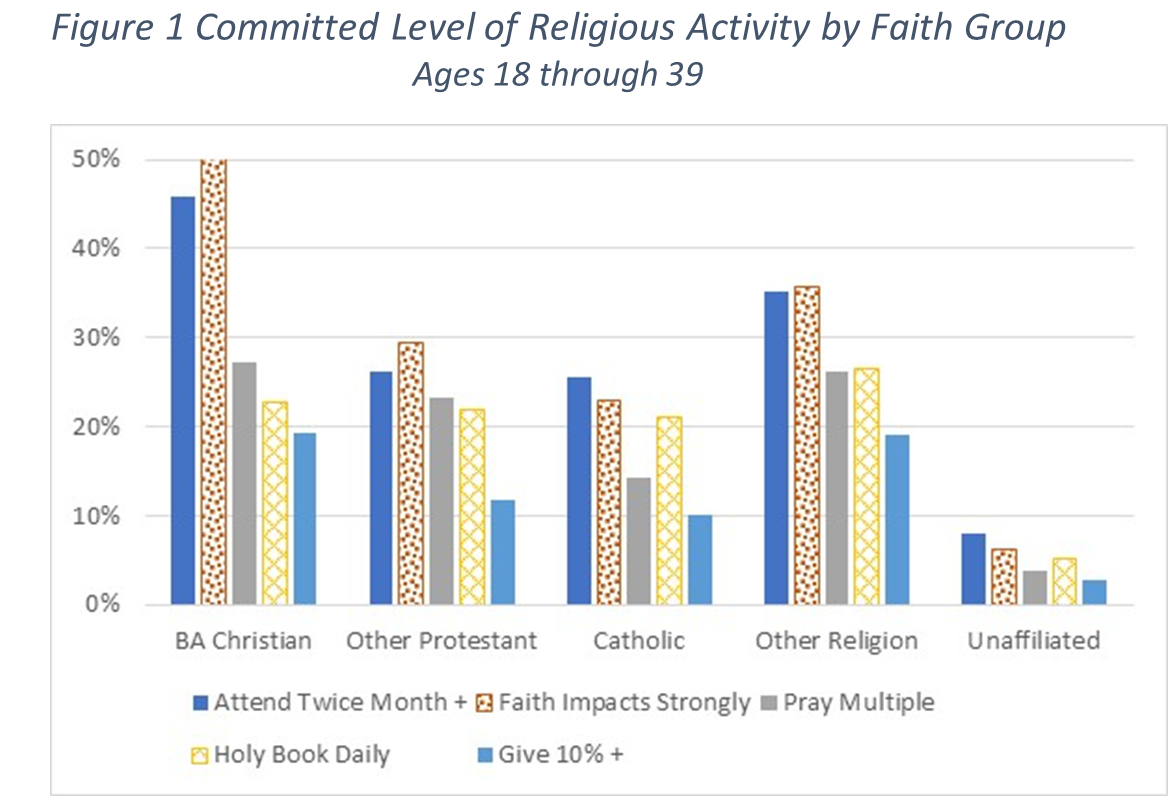
Those ages 18 through 39 who practice their religion at a committed level are shown in Figure 1 at right. We have roughly ordered these items from highest probability of adherence to lowest.
As shown in the figure, Born Again Christians lead the way in frequent church attendance and for strongly considering their faith significant. For the next two, prayer and reading your holy book, all four of the religious groups were similar. Finally, for the giving metric, Born Again Christians show about 20% at that level of giving while Other Protestants and Catholics are about half of that level, or 10%.
It is distressing that three of the five metrics show only about one in four of Born Again Christians who practice them. Even the most commonly practiced religious behaviors show fewer than half of Born Again Christians active at those levels.
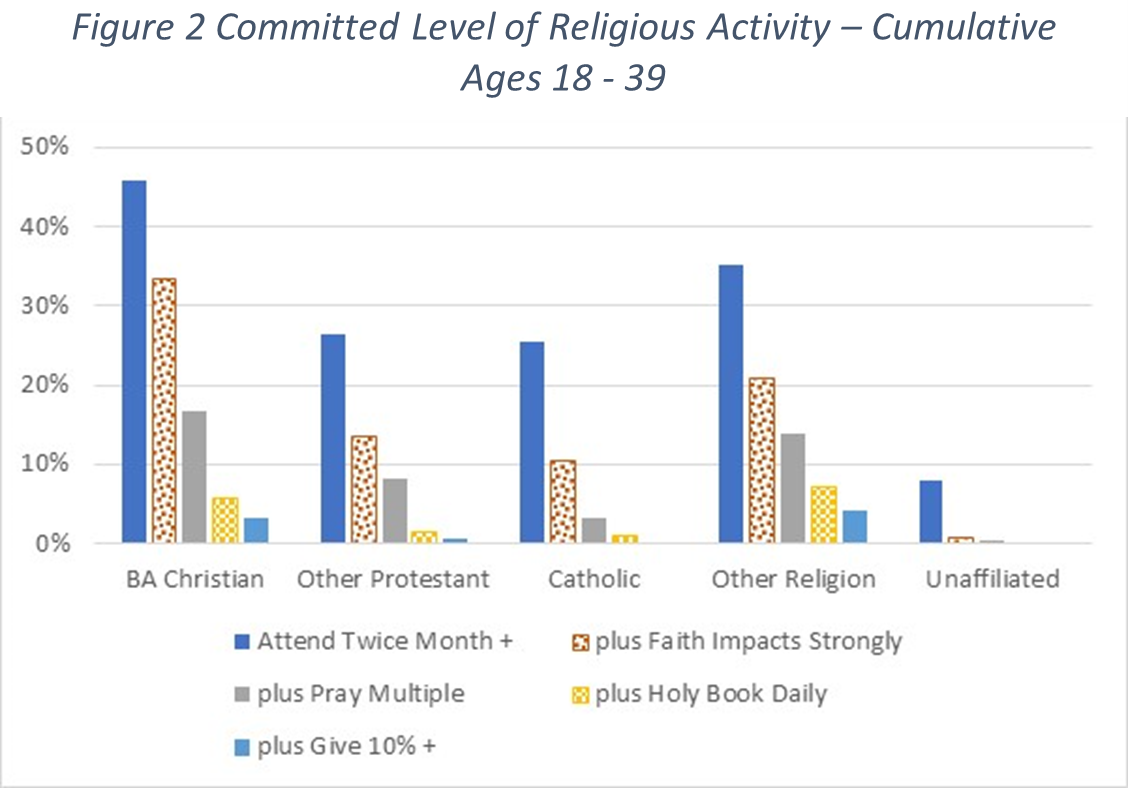
And when we combine all of these metrics together (as shown in Figure 2) to identify people who show a strong commitment to their religious faith, we find around 3% (1 out of 33) Born Again Christians saying they perform all five activities. In fact, people of Other Religions have about 4% performing all five metrics. However, for all practical purposes, there is not difference between 3% and 4%. Both numbers represent a tiny portion of the faith group.
Note that if we exclude the question on giving, the percentage of Born Again Christians increases from 3% to 5%. Clearly, money is not the primary issue driving down the number of consistently active believers.
Also note that the entire Unaffiliated group reports less than 8% on each of these practices and less than 1% who claim to do even two of
these practices.
These survey results clearly show that a scant few Americans of any religious persuasion take the time to be actively involved in practices
to help them grow in their faith.
 Nominal or Committed Levels of Religious Activity
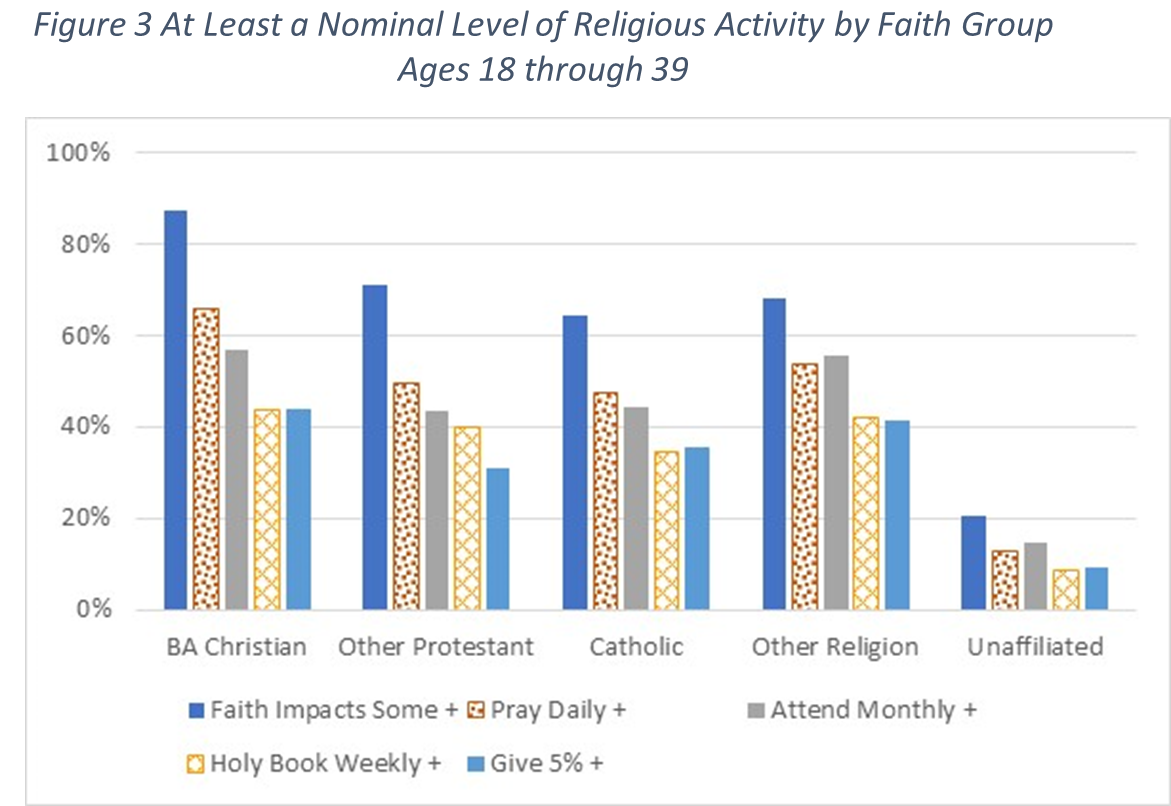
Now let’s look at those with at least a Nominal level of religious practice (i.e., those who select the nominal level or the committed
level). As shown in the figure, this is a much lower bar with all religious faiths hovering over 60% on those who agree/strongly agree that their faith has a significant impact on their daily lives and around half on those who pray at least daily. The other three activities range between 30% and 50%.
We should not forget that the pastors of these religious groups should be (and probably are) ashamed of these numbers. Particularly so when we consider the percentage of each group that practices all five of these relatively easy levels of commitment. The numbers (not shown on the graph) for those who practice all five are 16% of Born Again Christians, 13% of Other Religions, 9% of Other Protestants and 7% of Catholics. I must believe that pastors of those who answered the two Born Again questions would expect those congregants to be greater than 80% rather than hovering around 15%.
It is interesting that when we combine five different metrics, each of which is greater than 40% for Born Again Christians, that it drops down to 16%. Note both the metrics for reading the Bible at least weekly and giving at least 5% of your income to charities come in at Almost half (44%). When we combine the two metrics to see how many Born Again Christians affirm that they engage in both of these activities, the number drops to about one in four (26%).
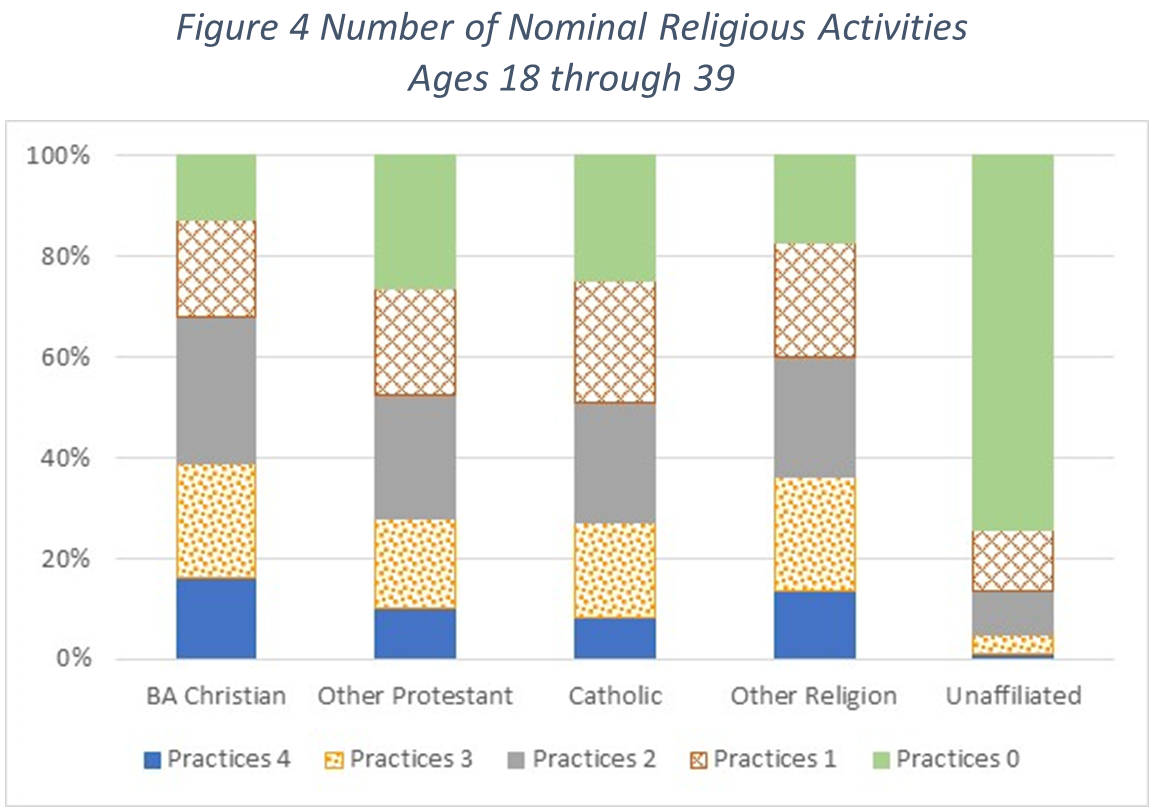
So let’s look and see how many said they did all the activities, three of the activities, two of the activities, etc. Almost 40% of Born Again Christians did at least three of the activities. Only 5% of the Unaffiliated could say the same. In fact, over 75% of the Unaffiliated did none of these activities.
It is worth noting that Other Protestants and Catholics do not lag far behind Born Again Christians in the percentage doing at least three
of the activities. This difference is a significant contrast to the Basic Biblical Worldview questions and the “who is Jesus” questions where these other religious groups lagged far behind Born Again Christians.
If I were to say to a Born Again believer, “to consistently grow in your faith and represent the good news of Christ to the world, I recommend that you pray to God daily, attend church at least one a month, read your Bible at least one a week, and give at least 5% of your income to religious charities including your church.” I would not expect to get much blowback. After all, it takes less than one hour a week and no real financial hardship. Of course, what I really say is we should all try to live at a Committed level. Not because it is necessary for salvation, rather this level of activity will help us live a life honoring God and making a difference beyond the temporal into eternity.
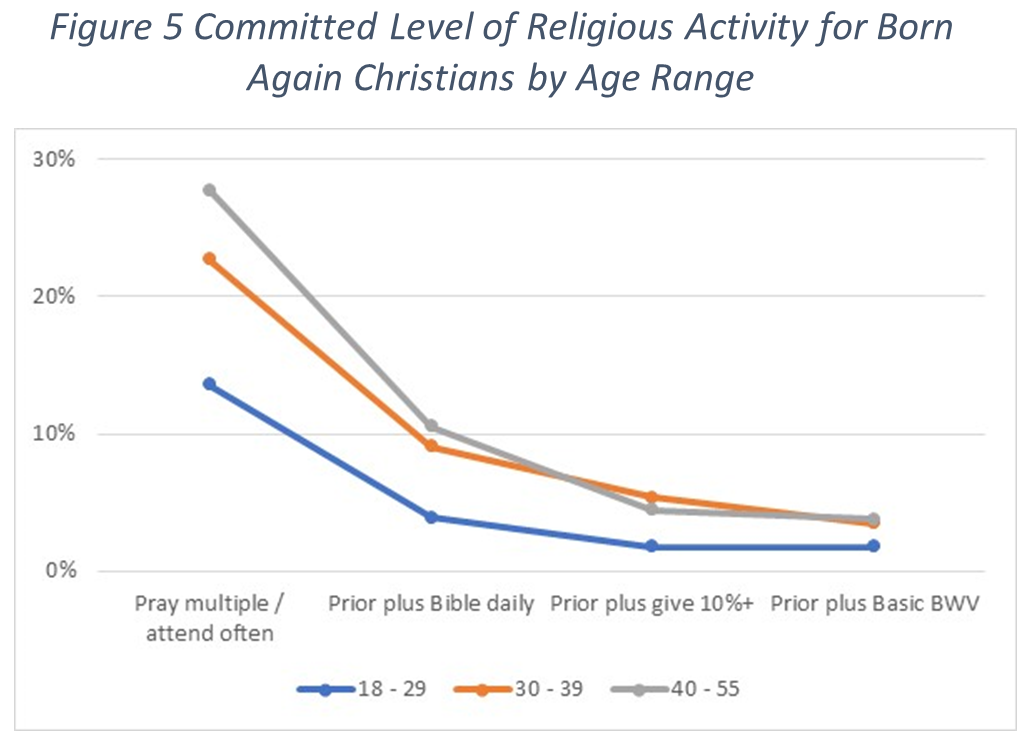
Variations by Age among Born Again Christians
How do these religious activities vary by age among Born Again Christians? The results are plotted in the graph on the right for a
Committed Level of Activity. As shown, the percentage of the youngest adults is significantly less than for the two older groups. However, as the graph moves to the right adding more aspects to the cumulative total, the difference becomes small. In general, the youngest adults are less likely to practice key components of an active faith, but regardless of age the numbers are small.
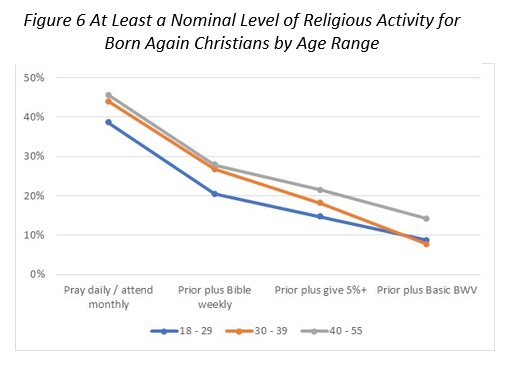
The results are shown on the left for a Nominal or Committed Level of Activity. We have more Born Again Christians who participate across these levels. The lines still trail down sharply as we move to the right, adding more practices to the cumulative total. The fact that only one out of five Born Again Christians ages 18 through 29 pray daily, attend church at least monthly, and read the Bible at least weekly presents a major challenge to our young adult ministries. I would suggest that these activities are essential to a consistently grow sanctification in our lives.
Religious Practice from 2010 to 2020
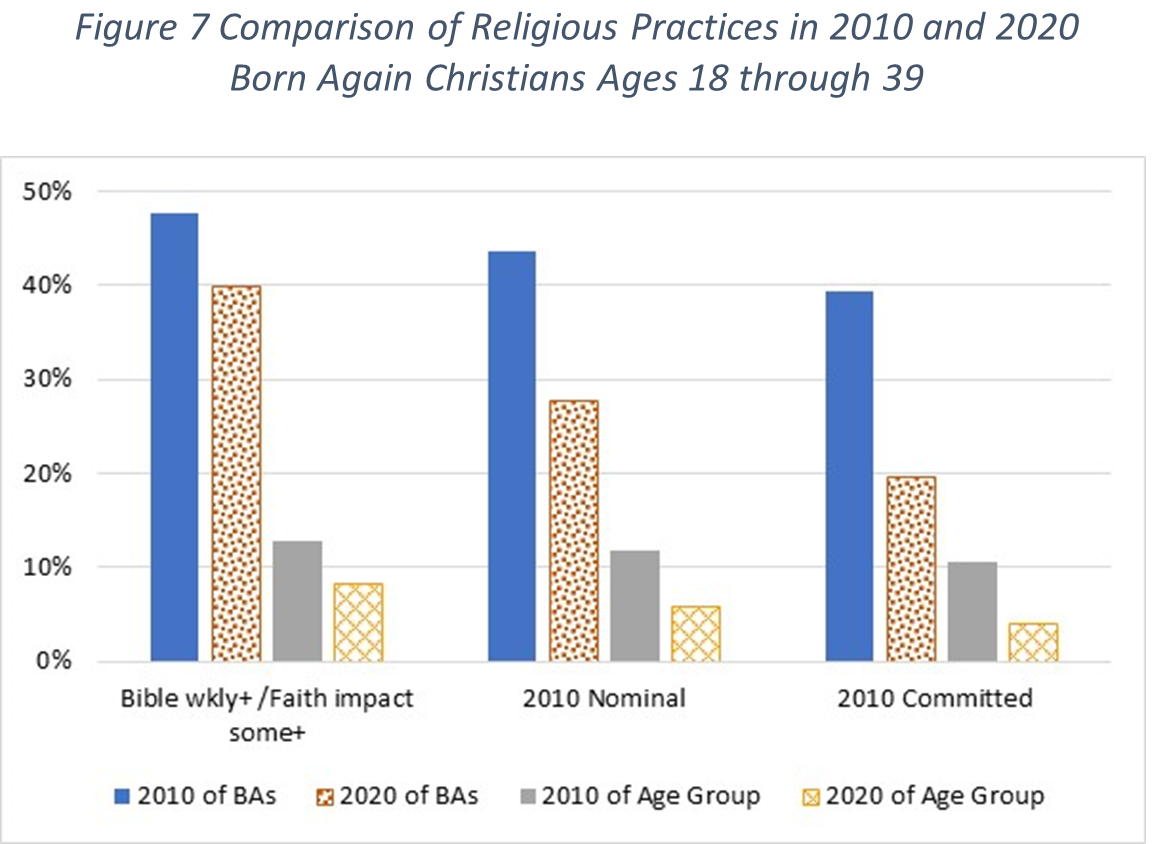
How has the commitment to religious practices fared over the last 10 years or so? Our survey from 2010 asked the same questions regarding attendance, Bible reading, and the importance of faith. The questions on prayer and giving were different. However, we can get some good comparison data looking at the three common questions.
In the figure at right we use two terms, 2010 Nominal and 2010 Committed, which are defined below. The 2010 Nominal attend monthly plus, read the Bible weekly plus, and agree that their faith is significant in their daily lives. The 2010 Committed attend more than monthly, read the Bible weekly plus, and strongly agree that their faith is significant in their daily lives.
The first category shown does not include church attendance. One unknown with the attendance question taken during the Covid-19 pandemic is that some respondents may have replied taking the pandemic into consideration and while other respondents considered normal times. We see a slightly greater drop-off between the first category and the 2010 Nominal category which could be associated with this issue. However, the difference is not large enough to impact the overall conclusions.
What we see is that the drop-off in the 2010 Nominal category is from 44% to 28% and the drop-off in the 2010 Committed category is down one half from 40% to 20%. These numbers reflect an astounding drop in the importance that Born Again Christians place on these simple religious activities.
Combining Worldview and Church Attendance (a key metric from our earlier book{1})
In our prior study of Born-Again Christians, one of the key divisions we used in looking at religious practices, religious beliefs and cultural practices was a combination of Biblical Worldview and Church Attendance. We found that those Born-Again Christians with a Biblical Worldview and regular church attendance (twice a month or more), were much more likely to demonstrate biblical religious practices, beliefs, and cultural practices. So, we wanted to compare those results with the findings from our new survey.
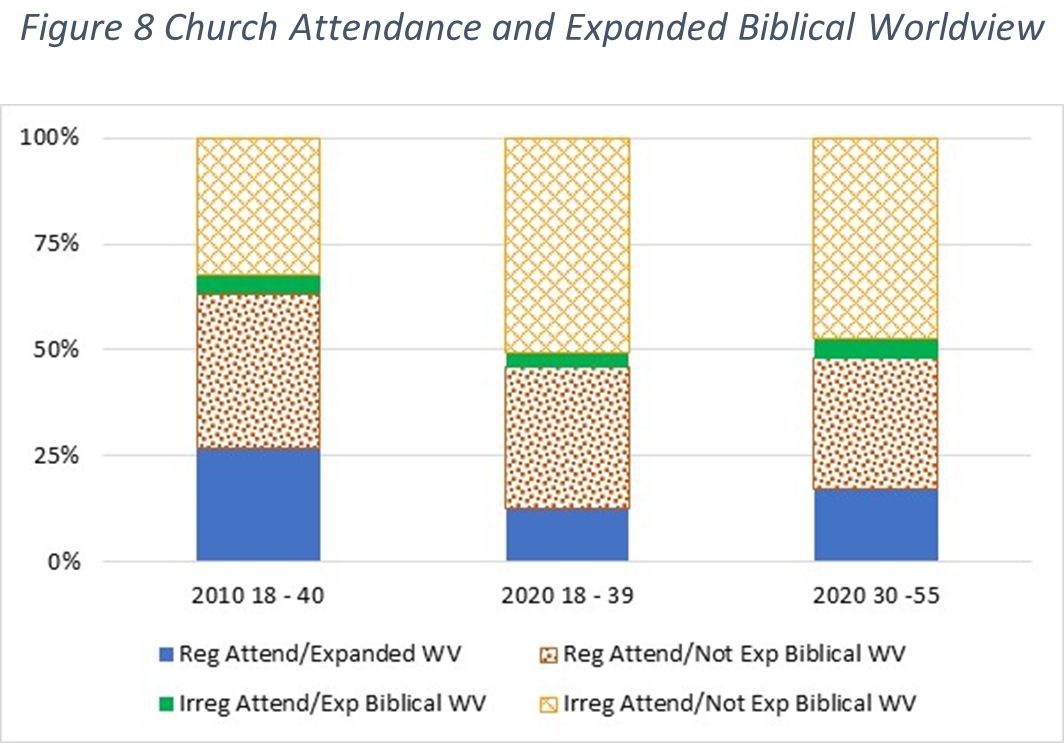 The figure on the left compares the findings from 2010 with those from 2020 using the more stringent Expanded Biblical Worldview. The values shown are the percent of Born-Again Christians (so all columns add up to 100% even though the percentage of Born Again Christians is less in 2020). Two age ranges are used in 2020; the first one is basically the same age range used in 2010 (18 – 39) and the second age range (30 – 55) is very close to the age range of the 2010 survey aged by the ten years that have gone by.
Looking at those with regular attendance and an Expanded Biblical Worldview we see a significant reduction among 18- to 29-year-olds in 2020 (27% down to 13%) with a lesser reduction among 30- to 55-year-olds down to 17%. The percentage of regular attenders without an Expanded Biblical Worldview has remained relatively constant. But of course, that does not mean that the people who stopped attending were those with an Expanded Biblical Worldview. It could be that many without it stopped attending while some decided that they did not believe all of the positions in the worldview but kept attending on a regular basis.
The area showing a startling high level of growth are those attending monthly or less who do not hold to an Expanded Biblical Worldview. This is the square that ten years ago we wanted to drive down to a smaller number. Instead, it has grown by about 18% (from 32% to 50%).
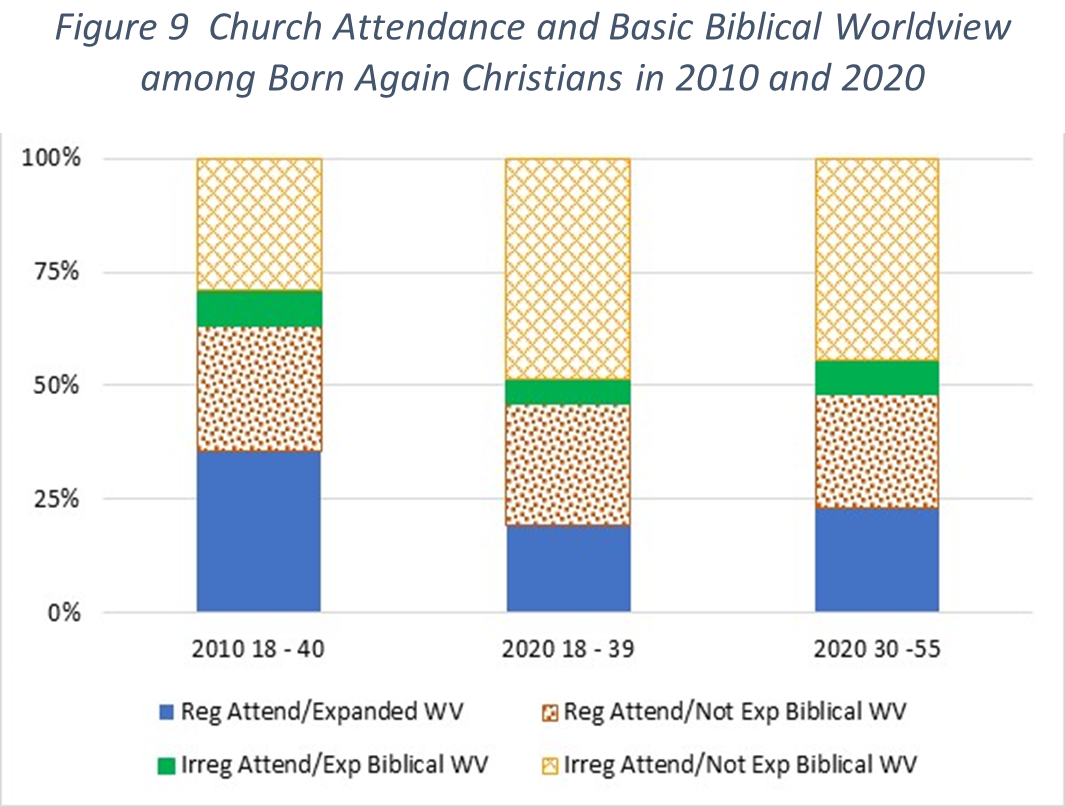 Now let’s examine the same chart using a Basic Biblical Worldview. We see nearly the same features as discussed above. A significant drop is shown in those with regular attendance and a Basic Biblical Worldview coupled with a significant increase in those with irregular attendance and no Basic Biblical Worldview.
Ultimate Purpose for Living
We wanted to explore what American young adults thought they were living their lives for. So we asked, “Which statement comes closest to
describing your ultimate primary purpose for living?” The choices to select from were:
1. To be a good person and make others happy.
2. To serve God by living a life which proclaims Christ’s grace.
3. To make it through each day with integrity.
4. To live at peace with all.
5. To enjoy the best life has to offer, e.g. success, money, travel.
6. To love my family and raise loving, productive children.
Most of these answers sound like good purposes for life. But only one of them extends into eternity and recognizes our Creator and his “desire for all people to be saved and to come to the knowledge of the truth.”{2} The answers to this question help identify those who are living their life as eternal beings rather than as temporal beings.
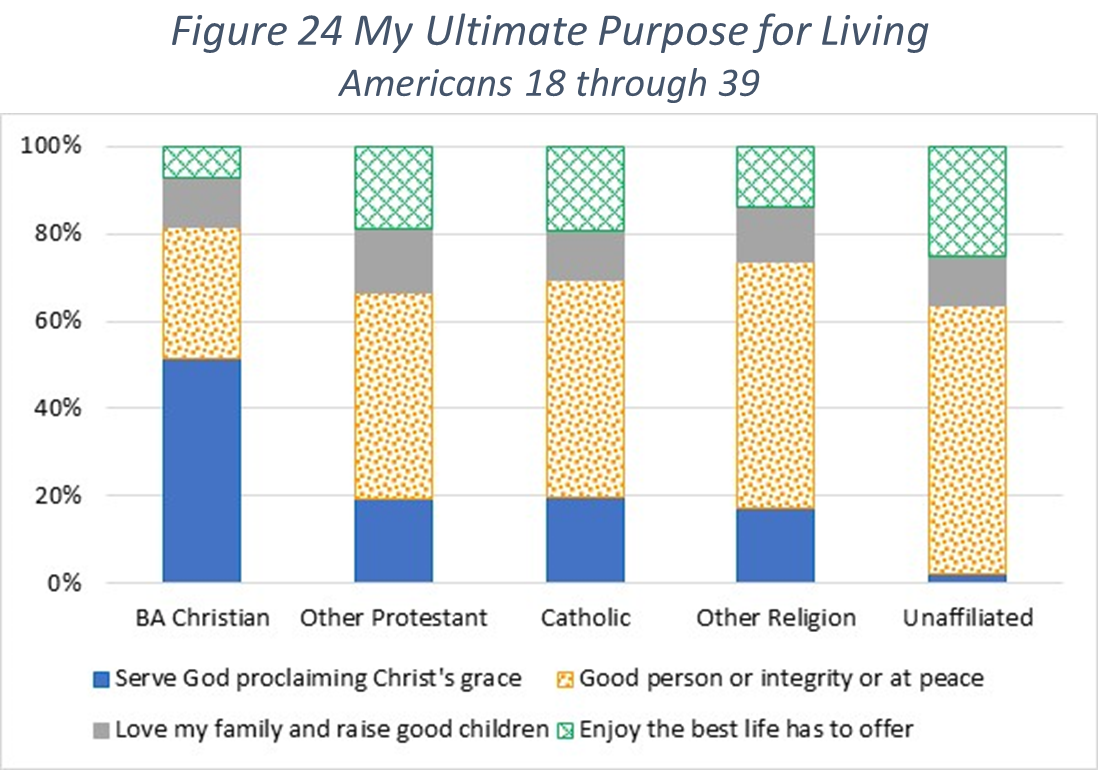 The results are charted in the graph to the left. As shown, just over half of Born Again Christians profess an eternal perspective. This means almost half do not, with most of those selecting a purpose that focuses on good behaviors in their personal life.
Every other religious group has very few that selected an eternal perspective as their ultimate purpose for living. Around forty to fifty percent of the other groups selects a purpose reflecting good behaviors.
It is interesting that only a small percentage of each group selected the family focused purpose for living. I would like to know if that would have been a larger number say fifty years ago.
Finally, note this is another question that highlights the stark difference between the Unaffiliated and Born Again Protestants. We see that 57% of Born Again Protestants selected the eternal answer while only 2% of the Unaffiliated did the same. This result is a clear indicator that the Unaffiliated do not include a lot of Christians who do not want to affiliate with a particular Christian group.
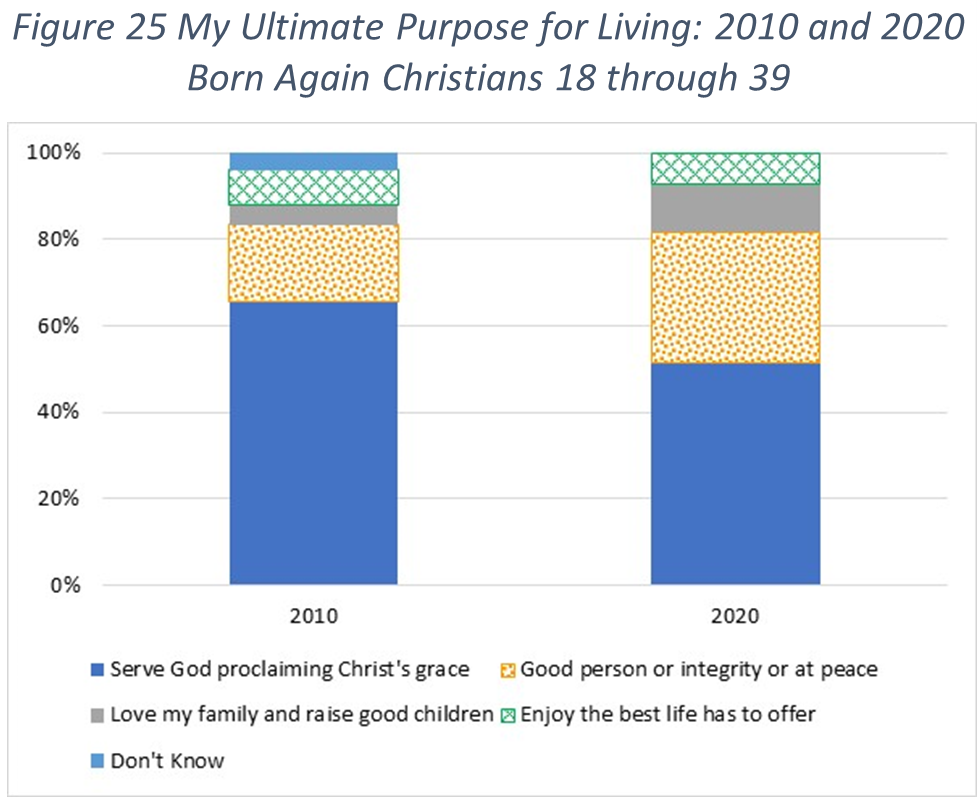
For Born Again Christians, we can compare data from our 2010 survey with the 2020 survey as shown in the figure. The 2010 survey had the
same question as the 2020 survey, but it had more answers to choose from. For example, there were three answers that had an eternal perspective: to serve God and live out His will for my life, to lead others to salvation in Jesus Christ, to praise and glorify God. These three answers were grouped together to align with the 2020 answer: To serve God by living a life which proclaims Christ’s grace.
As you can see the percentage of Born Again Christians who included God in their ultimate purpose for living dropped from 66% in 2010 to 51% in 2020, a significant drop. It appears that in 2020 people who did not name God in their answer opted to pick an admirable answer focused on themselves.
Relationship to a Basic Biblical Worldview
Consider the question of how many Born Again Christians accept a Basic Biblical Worldview and an eternal perspective on their ultimate purpose. We find that 88% of those with a Basic Biblical Worldview selected an ultimate purpose proclaiming God’s grace. Conversely, 43% of those selecting an ultimate purpose proclaiming God’s grace affirmed a Basic Biblical Worldview for their life (as compared with 25% for Born Again Christians as a whole). Thus, we find a fairly strong correlation between a biblical worldview and an eternal ultimate purpose for life.
Acceptance or Tolerance
Some of the key findings on this topic summarized at the beginning of this report are repeated below prior to going into the details.
Looking at Born Again Christians ages 18 through 39, we find:
• Only about one quarter (27%) of them disagree with the statement “. . . it is important to let people know that I affirm as true (at least for them) their religious beliefs and practices.”
• At the same time, almost two thirds (65%) agree that tolerance is best defined as “Treating with respect people with ideas or actions that you believe to be wrong or misguided.”
• This is another topic where we see somewhat conflicting results. Apparently, many Born Again Christian young adults think that you cannot believe someone is “wrong or misguided” when it comes to religion. Or they believe that “Treating with respect” means “affirming as true (at least for them)”.
According to the Collins Dictionary, “Tolerance is the quality of allowing other people to say and do what they like, even if you do not agree with or approve of it.”{3} In today’s culture, we find two conflicting understandings of the meaning of tolerance. One, following the idea of the dictionary meaning is, “treating with respect people with ideas or actions that you believe to be wrong or misguided.” The second one influenced by postmodern philosophy and popularized by the secular media, is “valuing human beings equally and affirming their ideas as right for them.” The second definition basically assumes that there are no absolute truths in our existence and therefore we have no basis to disagree with what someone else believes.
Which of these definitions holds sway among our population today?
To explore this question, we asked two different questions dealing with how to treat those who have a different religious viewpoint. The first question we asked on this topic is “What does Tolerance mean to you?” The respondents chose from four possible answers:
1. Treating with respect people with ideas or actions that you believe to be wrong or misguided.
2. Not questioning another person’s moral decisions.
3. Valuing human beings equally and affirming their ideas as right for them.
4. Don’t know.
This question gives us information on how people interpret the word, not whether they apply tolerance in their dealings with others.
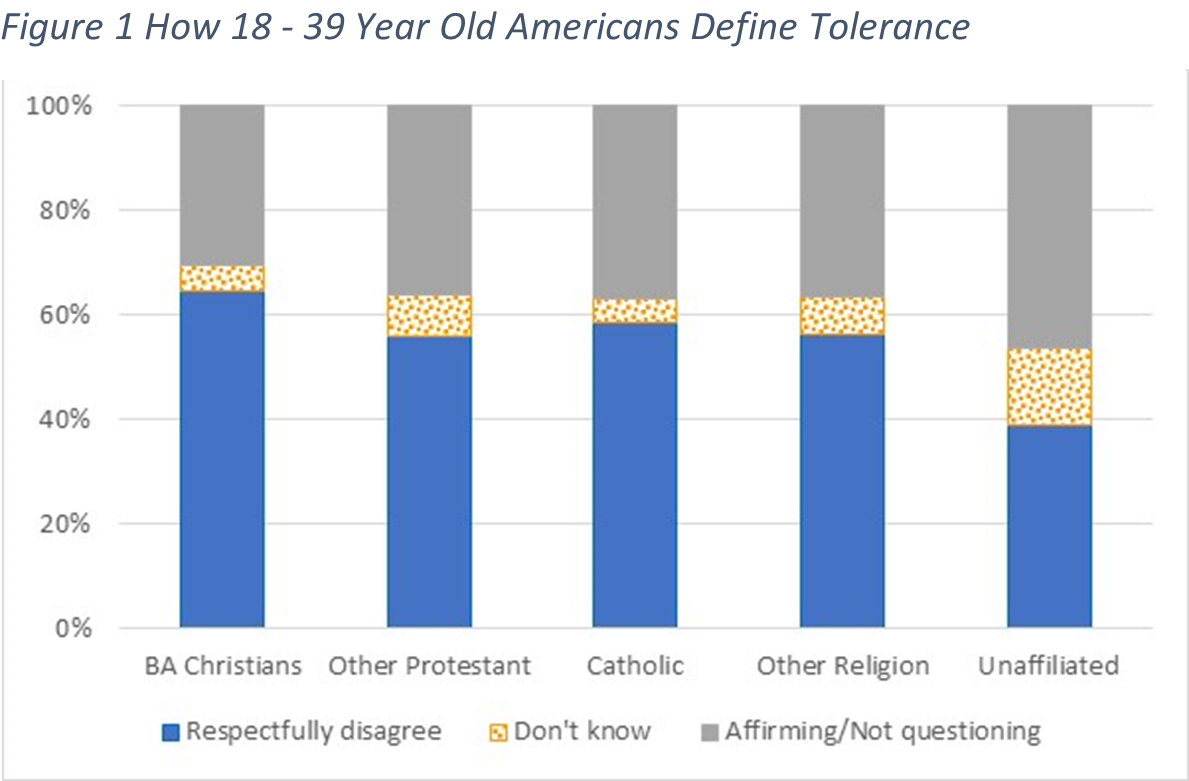
In figure 1, we see how the definitions are distributed. Almost two thirds (65%) of young adult, Born Again Christians selected a classic definition of tolerance. As shown, over 50% of the other religious groups also selected a classic definition. But as one can see from the graph, a significant number of young adult Americans were selecting a different definition with the portions ranging from one third to almost one half of each religious group. So, it appears that a majority of the population is hanging onto the classic definition, but definitions which question the reality of absolute truths have a strong following.
Now let’s look at how people apply tolerance in the area of religious beliefs. Are they quick to say, “I will respect you and your beliefs even though I believe them to be wrong”? Or are they going to follow the trend saying, “They may well be true for you.”
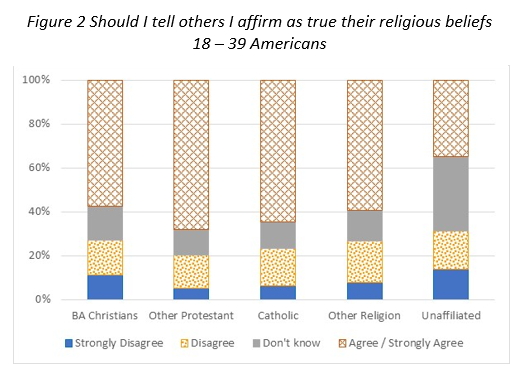
To find out, we asked another question: “When discussing religious matters, I feel that it is important to let people know that I affirm as true (at least for them) their religious beliefs and practices,” with the answer ranging from Agree Strongly to Disagree Strongly. As an evangelical Christian, I would answer that I Disagree Strongly with that statement. I want them to know that I respect them as a person, but I believe I have been shown the absolutely true answer as to how man can be reconciled to our creator God. But somehow, when asked in this manner, Born Again Christians just don’t seem to get the importance of disagreeing as shown in Figure 1.
As shown in the figure, only about one in four (27%) Born Again Christians disagree with the statement. This level tracks closely with the rest of the population. If one is agreeing with the statement, one is
either saying in religion what’s not true for me can be true for you, or there are multiple religions that are the truth, or we should lie to others about the absolute truth of Christianity when discussing religion with them. All three of those options are clearly countered by the Bible which tells us that Jesus Christ is the source of absolute truth, that there is only one way to heaven, and that lying about the truth is against the nature of God.
The disconnect between the definition of tolerance and applying tolerance in our interactions with other religions is striking. As noted in the initial summary, apparently many Born Again Christian young adults think that you cannot believe someone is “wrong or misguided” when it comes to religion. Or they believe that “Treating with respect” means “affirming as true (at least for them).” We don’t have data to distinguish between these two options, but I suspect that both of them contribute to the current reluctance to lift up Jesus as God’s one true answer to the fundamental problem of mankind.
Notes
1. Stephen Cable, Cultural Captives: The Beliefs and Behaviors of American Young Adults, 2012
2. 1 Timothy 2:4
3. Collins English Dictionary, Tolerance definition and meaning | Collins English Dictionary (collinsdictionary.com)
©2021 Probe Ministries
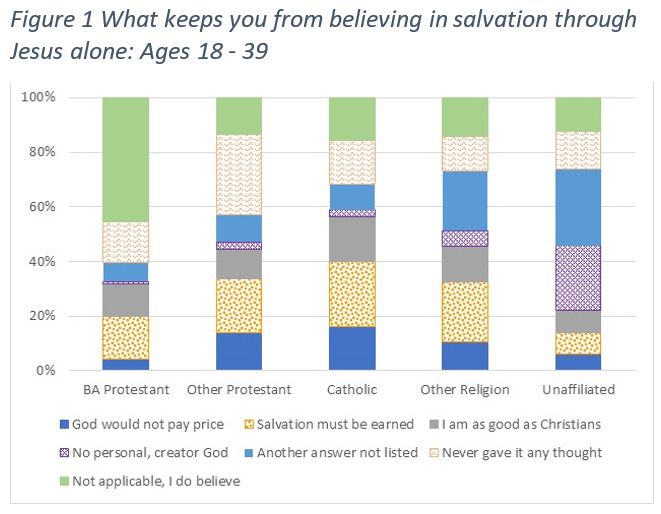
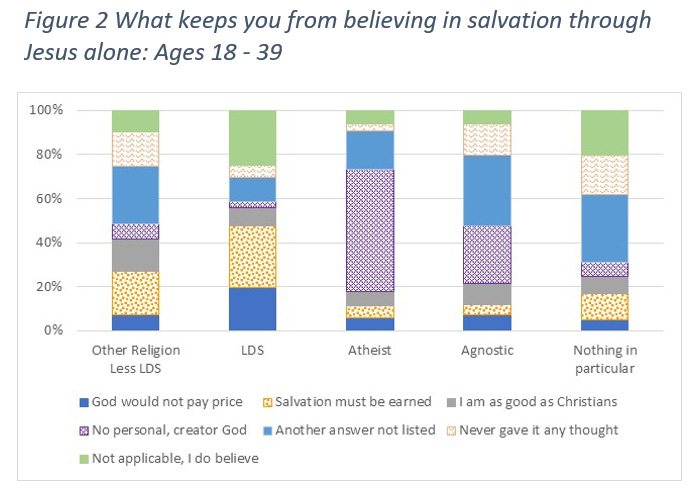 To get a better understanding of what drives these results, we dove further into the makeup of each of these two groups. The results are shown in Figure 2.{2} We divided Other Religions into the Latter Day Saints (Mormons) and all other non-Christian religions. We divided the Unaffiliated into Atheist, Agnostic and Nothing in Particular. As shown, the LDS respondents are much more likely than other religions to select “salvation must be earned,” “I do believe,” and “God would not pay the price.” Almost one quarter of the LDS selected “I do believe” which explains how the Other Religion category showed about 15% with that answer. So we see that a strong majority of LDS people believe that they must do something more than believing in Christ to achieve salvation. At the same time, a significant minority believe in salvation through faith in Christ alone.
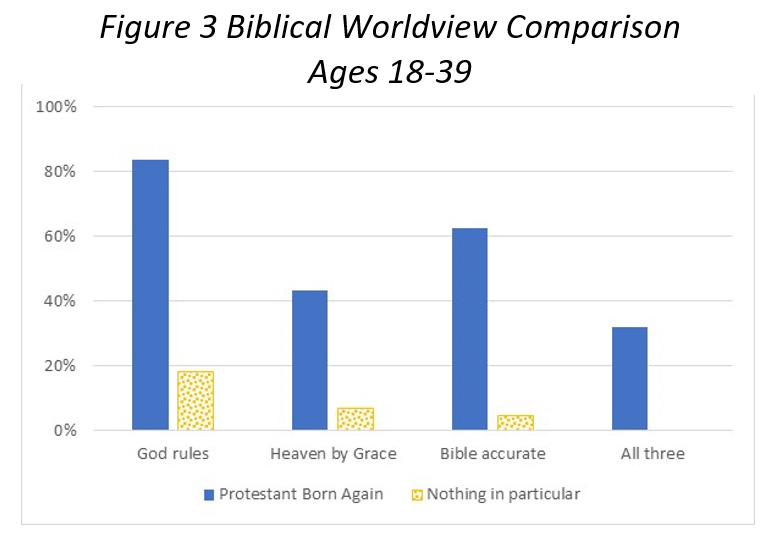 Let’s compare the results for Born-again Protestants and those who claimed to be Nothing in Particular. As shown in Figure 3, for each of the questions those agreeing with a biblical worldview among the Nothing in Particulars is a small fraction of those among Born-again Protestants. When we combine the three questions together, we see one out of three Born-again Protestants vs. no NIPs. Certainly, some of these NIPs came from an evangelical background, but none of them interviewed in our survey ascribe to a basic evangelical worldview as adults. As noted in our first report, one in three orn-again Protestants is a disappointing percentage ascribing to these biblical worldview questions, but it is certainly dramatically better than the Nothing in Particular group.
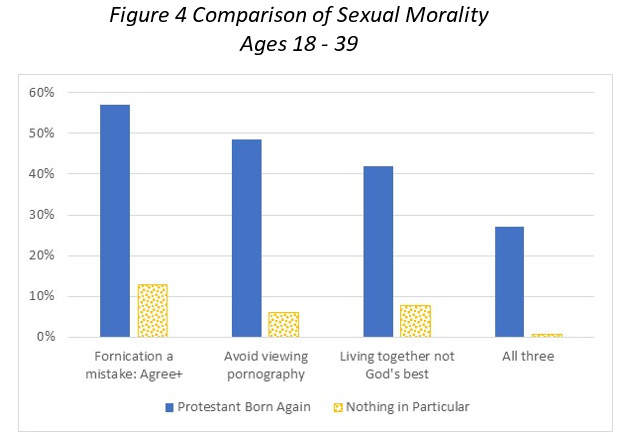 The results from our survey are shown in Figure 4. Once again, we see a large difference between these two groups. Clearly, the NIPs do not ascribe to a biblical view on sexual morality. The majority of Born-again Protestants do not ascribe to those beliefs either, but a significant minority of them do.
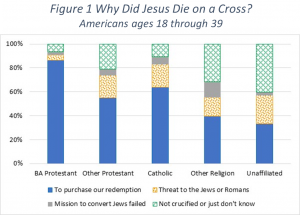 The responses for ages 18 through 39 are shown in Figure 1. As shown, Born Again Protestants have a far greater percentage, over 85%, stating that Jesus was crucified to purchase our redemption. One would suspect that all Protestant and Catholic leaders would want their people to know that Jesus’ death on the cross was for their redemption. Yet, less than two thirds of each group selected that answer. Note that the answer to this question did not say that salvation was through grace alone. So even those with a works-based gospel should still select that answer.
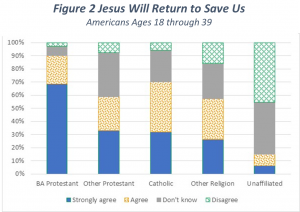 The results for this question follow a similar pattern to those for the first question above with a little less surety shown among Christians. As shown, just over two thirds of Born Again Protestants strongly agree that Jesus will return to save. Meaning that almost one third of them are not absolutely sure of Jesus’ return.
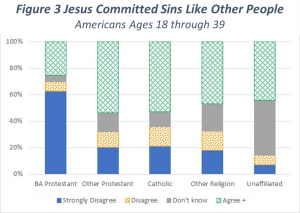 Young adult American beliefs about this statement follow a similar pattern as the first two questions. Once again, about one third of Born Again Protestants either Don’t Know or Agree with this statement. Having this large a number of Born Again Protestants who don’t accept a primary belief of Biblical Christianity is disappointing.
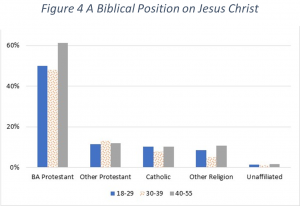 What happens when we look at how many Born Again Protestants take a biblically consistent view on all three of these questions? Consider the results shown in Figure 4. First, we see that young adult Born Again Protestants drop from about two thirds for the individual questions down to about one half when looking at all three questions. It appears that about one half of those categorized as Born Again Protestants are trusting Jesus to save them but do not have a good understanding of biblical teaching on Jesus.
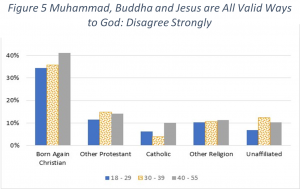 First let’s look at just question number one across the various religious groups, looking for the answer Disagree strongly as shown in Figure 5
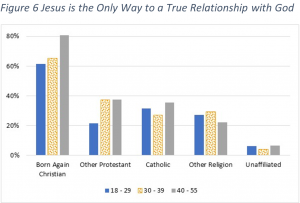 Instead, we asked this second question in a slightly different way but with the same intent: “I believe that the only way to a true relationship with God is through Jesus Christ.” We thought that this question would be
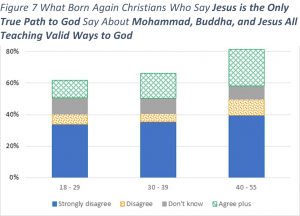 However, the survey respondents show us that one does not have to give answers which logically support one another. Even if some of the respondents misread the statement, the difference between the two is great enough that it is safe to assume that the results are not primarily attributable to misreading.
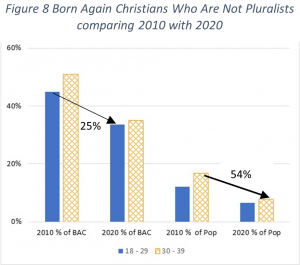 How have the statistics on Born Again Christians and pluralism changed from 2010 to 2020? As shown in the figure, we see a significant drop in the percent of BACs who are not pluralists. Those age 18 to 29 drop by 25% (from 45% to 34% of all BACs) and those age 30 to 39 drop by 31% (from 51% to 35% of all BACs).
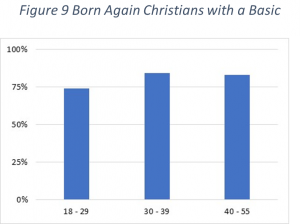 What about that smaller subset of people who have a Basic Biblical Worldview? Do a majority of them also have a pluralistic worldview? The answer is no. As shown, between 75% and 85% of them are not pluralists.