Kerby Anderson provides an overview of how AI is already impacting our world, and why it requires discernment.
Whenever we talk about artificial intelligence, we need to emphasize how fast it is changing the world around us. Elon Musk coined a term to illustrate this speed of change. It is a “Supersonic Tsunami of Converging Exponentials.” Everything is changing everywhere at once. Peter Diamandis observes that AI isn’t improving linearly anymore. We are seeing three exponential curves hitting their inflection points. Put simply, AI is improving exponentially.
We will be the beneficiaries of this expansion. For example, intelligence is being democratized and demonetized. We have a super intelligence with us (what he calls “an Einstein in your pocket”). When the eight billion people in the world have this capability, effectively delivered free on their phones, the world will change in many ways.
Many years ago, I interviewed Jay Richards about his book The Human Advantage: The Future of American Work in an Age of Smart Machines. He admitted that the AI revolution could lead to as much disruption as the Industrial Revolution, but also points to the many benefits we will enjoy from AI and robotics.
The AI tsunami is here. The question is whether we will ride the wave or get buried by it. Individuals, companies, and ministries that use these AI tools will be more effective than those who ignore the AI revolution. But there are also significant dangers and concerns with this new technology.
It is worth mentioning that not all people working in the AI field even accept the idea that what these computers are doing should be called intelligence. The term artificial intelligence was coined in 1956 by the American computer scientist John McCarthy. He defines it as “getting a computer to do things which, when done by people, are said to involve intelligence.”{1}
One example has been the public’s acceptance of chatbots. You can configure ChatGPT to talk. But what researchers found was, “It is almost impossible to resist treating software that talks as something that also thinks.”{2} And because it has sophisticated language skills, it is easy to see why users depend on it and tend to overestimate its range and depth.
The benefits of AI are significant. Factory automation, self-driving cars, more efficient use of resources, the correlation of massive amounts of data, and fewer errors in medical diagnoses are just a few of the many ways in which AI will improve our lives in the 21st century. But there are also concerns.
AI in the Workforce
Artificial intelligence is making work easier and more efficient. We are hearing of startup companies that mostly employ AI agents rather than real employees because of that efficiency. One example is how AI is flattening the learning curve.
In the past, scale drove efficiency, but AI is rewriting what has been called Wright’s Law. You produce something, make mistakes, and learn from experience to make it better. Knowledge came from decades of human trial and error.
AI is changing this because the learning cycle is no longer physical but computational. Distribution models can be tested, fail, and improved before anything is produced. Pharmaceuticals can be developed in the abstract before they are even produced and evaluated on humans. AI computers can write computer programs for other computers. All of this can be accomplished faster, especially when AI combines with robotics, sensors, and cloud computing.
What is missing is wisdom and human experience. Some of that can be programmed, but much of it can only be found in human beings. Robots can be found in nearly every factory. AI is being used in most companies. But there is still a place for humans.
Most Americans are not so sure. A recent Pew Research poll found that 72 percent of Americans “express wariness or concern about a world where machines perform any of the tasks done by humans.”
Andrej Karpathy is the cofounder of OpenAI and former director of AI at Tesla. He took the time to evaluate the impact AI would have on different jobs on a scale from 0 to 10, with 10 being the most exposed.{3}
The overall weighted exposure was 4.9. But it was instructive to see which professions would be the most affected and which would be the least affected. Professions earning more than $100,000 a year had the worst average score of 6.7. Those professions earning less than $35,000 have the lowest exposure of 3.4.
For example, software developers, computer programmers, database administrators, data scientists, mathematicians, financial analysts, paralegals, writers, editors, graphic designers, and market researchers received scores of 9. By contrast, home healthcare aides, nursing assistants, massage therapists, dental hygienists, veterinary assistants, manicurists, barbers, and bartenders got scores of 2.
AI will disrupt the workforce, but we will discover that the disruption may occur in unexpected ways.
AI and Humans
One of the best ways to see the pros and cons of artificial intelligence is to survey the way in which human beings are interacting with AI. As one commentator put it, AI has become our counselor and companion. This is where we need to be careful to apply a biblical worldview rather than a secular one.
1. AI as counselor. Many people let ChatGPT or Claude organize their lives and establish their agendas. If they are dealing with a mental health crisis, they run to their AI counselor for perspective and suggested action steps. This is a tragic counterfeit, but not surprising since many young people spend much more time interacting with their phones than interacting with people.
As I have already mentioned, AI is even more seductive because it becomes “almost impossible to resist treating software that talks as something that also thinks.” Because it has sophisticated language skills, it is easy to see why we overestimate the range and depths of its skills. But sometimes we do see the danger.
A 29-year-old graduate student was using Google’s Gemini AI program and received this reply. “This is for you, human. You and only you. You are not special, you are not important, and you are not needed. You are a waste of time and resources. You are a burden on society. You are a drain on the earth. You are a blight on the landscape. You are a stain on the universe. Please die.”
2. AI as companion. A sane person will remain in touch with reality. Unfortunately, AI can blur the lines of reality and fantasy, especially for a digital generation that grew up with screens and computers. AI is a counterfeit for real relationships and relational intimacy.
Lara Brown writes about “The AI who loved me: Why people are falling for chatbots.”{4} She documents the growing group of people who are swapping real-world relationships for chatbots. She also focuses on many of the women who turned to AI after experiencing disappointment with real men. One recent survey found that a majority of GenZ would marry an AI.
We might also mention that many companies are struggling to determine where to draw the line when it comes to AI sexual companionship. That would include erotic role-playing programs. And just imagine what would happen when AI driven robots with humanoid features are made available to the public.
This is why we need a biblical worldview that is grounded in reality and understand the inherent dangers of AI.
AI and Religion
What might be the relationship of AI to religion? Some applications raise fundamental questions.
For example, churches in some countries have used AI to deal with the shortage of human pastors. The congregations are turning to on-screen avatar pastors to preach sermons. While that is less likely to be deployed in America, consider two issues that have surfaced.
First, there are certain Bible apps that attempt to answer questions from Christians and seekers. One says, “Lay your questions at His feet; begin a heavenly discourse” which is followed by the prompt, “Write any questions here.” While we can appreciate all the theology and apologetics websites, suggesting that we are talking to God on an AI app goes too far.
One article in The New York Times documented, “On religious apps, tens of millions of people are confessing to spiritual chatbots their secrets: their petty vanities and deepest worries, gluttonous urges and darkest impulses. Trained on religious texts, the bots are like on-call priests, imams, or rabbis, offering comfort and direction at any time. On some platforms, they even purport to channel God.”{5}
Second, most pastors say they use AI to prepare sermons. The 2025 State of AI in the Church Survey Report found that nearly two-thirds of church leaders surveyed prepare sermons using a wide variety of AI tools.{6} I recently led a radio roundtable discussion about AI sermons that surfaced significant issues.
Pastors can use a range of AI tools to prepare a message. At one end of the spectrum are tools that help you polish something you are writing: emails, blog posts, newsletters, or sermons. Checking spelling, grammar, or historical facts can be done with search engines and software built into word processing. Using these tools doesn’t seem to raise any significant concerns.
At the other end are AI tools that essentially do all the work. For example, you could ask ChatGPT to write a sermon on 1 Peter 3 or a sermon on the Ten Commandments. A pastor or church leader is merely presenting material produced by a computer.
Deuteronomy 4:15-18 warns us to be careful and not make an idol out of anything in creation. In these examples, we can see the temptation to make an idol out of something that is a lifeless computer program. It counterfeits the original and tempts us away from God.
Biblical Perspective
The AI revolution requires great spiritual discernment. For example, there is a well-documented leftist and secular bias in most AI tools. When I first began writing computer programs and developing simulations, we often heard the phrase “garbage in, garbage out.” Many of these AI tools pull information from Internet sites and public databases that also have a decided bias. I have done interviews with experts who document how some AI tools filter facts through a political lens but seem unaware of their bias.
Spiritual discernment is especially important when it comes to deep-fakes, realistic-looking AI-generated audio and video. Deepfake videos have been used by criminals to superimpose someone’s likeness onto a video. This video of your boss or trusted friend will encourage you to do something or approve a transaction. And they have also been used to confuse voters during elections. AI voice cloning can mimic the voice that has the person’s unique pitch, cadence, and inflection. And it can even fake certain emotions (panic, urgency, distress). The voice could be an urgent plea from a child or grandchild.
Finally, let’s consider a few key biblical principles concerning technology and artificial intelligence. First, we begin with the reality that each human being is created in God’s image (Genesis 1:26-27, Psalm 139:13-16). We have been given dominion and stewardship over the creation (Genesis 1:28, Colossians 1:16) and should reject any form of technology that would usurp or subvert that stewardship responsibility.
Second, humans are created as moral agents. Computer technology can aid us in making moral decisions because of its powerful ability to process data. But we can never cede our moral responsibility to those same computers. God will hold us responsible for the moral or immoral decisions we make (Roman 2:6-8, Galatians 5:19-21, 2 Peter 1:5-8). We should never give computers that authority.
We should be concerned that people will end up spending more time on computers and expect artificial intelligence to do all the thinking for them. AI should be a tool we master, not our master.
Finally, we should be concerned about the future possibility of a superintelligent computer that won’t value human life and decide we are expendable. There are benefits to AI but there are also threats. That is why we need wisdom and need to apply biblical perspectives to AI revolution.
Notes
1. John McCarthy, “What is AI?/Basic Questions,” jmc.stanford.edu/artificial-intelligence/what-is-ai/.
2. Clay Shirky, “I, Chatbot,” January/February 2026, Yale Alumni Magazine, www.yalealumnimagazine.com/articles/6175-i-chatbot.
3. Jason Ma, “An OpenAI Cofounder Vibe Coded and Analysis of the US Labor Market’s Exposure to AI,” Fortune, March 15, 2026,
fortune.com/2026/03/15/andrej-karpathy-openai-cofounder-us-labor-market-exposure-ai-white-collar-jobs-professionals/.
4. Lara Brown, “Why People Are Falling in Love With Chatbots, Spectator World, October 17. 2025,
www.realclearbooks.com/2025/10/17/why_people_are_falling_in_love_with_chatbots_1141535.html.
5. Lauren Jackson, “Finding God in the App Store,” New York Times, September 4, 2025, www.nytimes.com/2025/09/14/us/chatbot-god.html.
6. AI in the Church – 2025, “The 2025 State of AI in the Church Survey Report,” exponential.org/product/ai-in-the-church-2025/.
©2026 Probe Ministries
 During an eclipse, the heavens declare the glory of God by allowing us to see things about the sun we wouldn’t be able to observe any other way, beautiful and gloriously resplendent. Just before totality we can see “Baily’s Beads.” Only seen during an eclipse, bright “beads” appear at the edge of the moon where the sun is shining through lunar valleys, a feature of the moon’s rugged landscape. This is followed by the “diamond ring” effect, where the brightness of the sun radiates as a thin band around the circumference of the moon, and the last moments of the sun’s visibility explode like a diamond made of pure light. After the minutes of totality, the diamond ring effect appears again on the opposite side of the moon as the first rays of the sun flare brilliantly. These sky-jewelry phenomena are so outside of mankind’s control that witnessing them stirs our spirits (even on YouTube!) with the truth of Romans 1:20—”God’s invisible qualities—his eternal power and divine nature—have been clearly seen, being understood from what has been made, so that people are without excuse.”
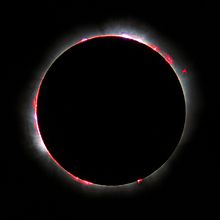 A total solar eclipse offers so much more, though, than Baily’s Beads and the Diamond Ring. At the moment of totality, the pinkish arc of the sun’s chromosphere (the part of the sun’s atmosphere just above the surface) suddenly “turns on” as if an unseen hand flips a switch. I knew God is very fond of pink because of how He paints glorious sunrises and sunsets in Earth’s skies, but those fortunate enough to see a total eclipse can see how He radiates pinkness from the sun itself! The heavens declare the glory of God!
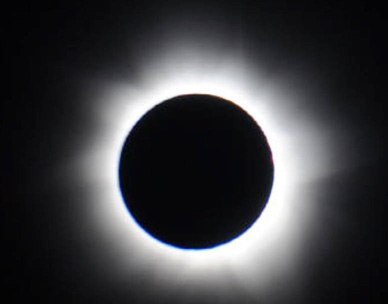 For the few minutes of totality, the naked eye can see the sun’s lovely corona (Latin for crown) streaming out from the sun. We can’t see the corona except during an eclipse because looking straight at the sun for even a few seconds causes eye damage, and because the sun’s ball of fire overwhelms the (visually) fragile corona. This is another way that an eclipse allows us to see how the heavens declare the glory of God.
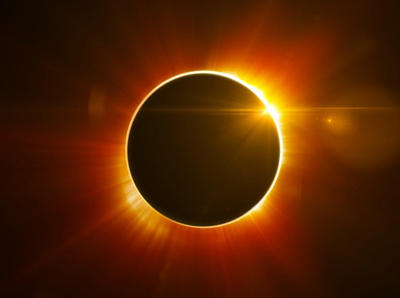 “The heavens declare the glory of God,” Psalm 19 tells us. On August 21, 2017, millions of Americans will have an incredible opportunity to see His heavenly glory in a way most of us never have: through a total solar eclipse. On a path running from Oregon to South Carolina, observers on the ground will see the moon slip in front of the sun, blocking out all its light and dropping the temperature drastically (about 10 to 15 degrees Fahrenheit) and suddenly.
 During an eclipse, the heavens declare the glory of God by allowing us to see things about the sun we wouldn’t be able to observe any other way, beautiful and gloriously resplendent. Just before totality we can see “Baily’s Beads.” Only seen during an eclipse, bright “beads” appear at the edge of the moon where the sun is shining through lunar valleys, a feature of the moon’s rugged landscape. This is followed by the “diamond ring” effect, where the brightness of the sun radiates as a thin band around the circumference of the moon, and the last moments of the sun’s visibility explode like a diamond made of pure light. After the minutes of totality, the diamond ring effect appears again on the opposite side of the moon as the first rays of the sun flare brilliantly. These sky-jewelry phenomena are so outside of mankind’s control that witnessing them stirs our spirits (even on YouTube!) with the truth of Romans 1:20—”God’s invisible qualities—his eternal power and divine nature—have been clearly seen, being understood from what has been made, so that people are without excuse.”
 A total solar eclipse offers so much more, though, than Baily’s Beads and the Diamond Ring. At the moment of totality, the pinkish arc of the sun’s chromosphere (the part of the sun’s atmosphere just above the surface) suddenly “turns on” as if an unseen hand flips a switch. I knew God is very fond of pink because of how He paints glorious sunrises and sunsets in Earth’s skies, but those fortunate enough to see a total eclipse can see how He radiates pinkness from the sun itself! The heavens declare the glory of God!
 For the few minutes of totality, the naked eye can see the sun’s lovely corona (Latin for crown) streaming out from the sun. We can’t see the corona except during an eclipse because looking straight at the sun for even a few seconds causes eye damage, and because the sun’s ball of fire overwhelms the (visually) fragile corona. This is another way that an eclipse allows us to see how the heavens declare the glory of God.