“You Mislead People About Jesus and Allah”

Hi—I’m a Muslim from UK. I visited your site and found you to be a misleading person who is blinded by faith most probably passed down the family. You say that Jesus is god then that means that you don’t believe in one god but you believe in two gods, Jesus and his father (god forgive). And if Jesus was god why were the Romans able to overpower him, how can the god who created everything be overpowered by a few measley people?

I hope you do your research thoroughly in the future and look at and review religion with the same eye you look at yours, and if not look at your own religion with the same critical eye you look at others. Please don’t forget your initial duty is the search for truth not the enforcement of your own religion. Please don’t lie in order to achieve a genuine good purpose or you are opposing your own fundamental beliefs.

Hope allah guides to the correct path. Please search for the truth the real truth.

Thank you for writing. I want to honor you for your deep respect and love for God, which is very evident in what you write. I understand why you want to defend your perspective on God.

However, God has revealed certain things about Himself to us that Islam does not accept, but that does not mean they are not true. I share your belief in one God, not two Gods. The idea that God could have three persons and still only be one God is so outrageous it HAS to be a divine idea—how could mere mortals think it up?!

Let me try to explain. Do you believe in water, and steam, and ice? I bet you do. They are all comprised of the H2O molecule. Do you believe in three different H2Os? I bet you don’t. You probably believe in one H2O molecule that takes three different forms. This isn’t a perfect analogy to God, but it’s closer than anything else I can imagine.

The Bible teaches that Jesus is God, the Father is God, and the Holy Spirit is God, but they are not each other and they are not three separate Gods. I have no idea how this can be true, but it’s what the Bible teaches and it is what Jesus said. Jesus was 100% God, but left heaven to become 100% God AND 100% man at the same time. He wrapped Himself in human flesh and became one of us. The purpose for this was to die for our sins because we cannot possibly overcome the penalty for our sin and make ourselves perfect—and God requires that people be perfect to enter heaven.

The Romans did not overpower Him: He allowed them to take Him because that was the divine plan from before creation. There is a huge difference. Even when He was on the cross, He said that if He wanted, He could call a legion of angels to come take Him off but that wasn’t the plan, so He didn’t.

I assure you I have done my research. I tell you, most respectfully, that it is Islam that has gotten off the path of truth. Muhammad listened to Christians and to Jews but chose to believe only what he wanted to believe about Jesus and about what the Bible says. The Bible says that Jesus is fully God and fully man, but Islam says that is a lie. Jesus said He would die for our sins and then come back to life in three days—and He did. He is alive today. Where is Muhammad? He is dead. Jesus is far more than just a prophet; He is actually God.

I pray that God will allow you to see that this is true. Why don’t you ask Him? Ask the one true God if it’s true that Jesus is God. If you have the courage, I challenge you to read the story of a faithful Muslim who discovered this truth about Jesus: www.answering-islam.org/Testimonies/athanasios.html

God bless you, and lead you into all truth.

Sue Bohlin
Probe Ministries


“You’re Mistaken About Islam”

Hi there Sue,

I was sent a copy of your article A Short Look at Six World Religions. Having studied most of them in school years ago, and then in seminary, I had a pretty good knowledge of things, but as with many things, I haven’t really thought about the Hindus or the Buddhists for some 30 years! While you read this note, keep in mind that I am a born-again Christian, who lives in Spain, works in Spain and Morocco and is professionally dedicated to translating texts (English/Spanish and a long list of etc.) so I do know a bit about languages.

I found the Moslem part interesting, but I do disagree about a thing or two. One must consider two things before getting into Islam….its founder married a rich widow, so by the time he was 20, he was married, and had no need to work (unlike us and the rest of humanity at that time), so he dedicated his time to meditation and searching….for God I would imagine. He entered into contact with Judaism, and with the early years of Christianity. Therefore, when you start looking at the Koran and the Moslem faith, there are many, many things that are taken out of Judaism….no pork, no shellfish, and a long list of etc, etc. When you see them praying, they use a string of beads just like a rosary! And there are also many, many aspects that are from the early Christian faith. (Remember that the first Christians were much more Jewish in their thinking that most of us could ever be!)

As I said at the beginning, my work is 100% dedication to translation and there is a clear translation problem with Allah/God when it comes to Islam. The word God for us who speak English is fine, but if you speak Spanish, the word is Dios, and if you speak Arabic, it is Allah (when written in English format, and if it is in the Spanish format, it is Al). Saying that the Moslems do not believe in the same God as us Christians do is totally mistaken. The whole problem stems from a translation error. In Spain, most of the “modern” Moslems, when they say their prayers in Spanish, the use the word “Dios”, and not the word “Al.” Today, when it comes to translating, it is considered correct to not translate proper nouns in a text, therefore, when the Koran was translated into English, you translated everything, and the Arabic word Allah was made to sound English and therefore considered to be another god. (To give you another example….I live in Seville in southern Spain, but here in Seville, the name of the city is Sevilla, and most people want the city to be called Sevilla, and not Seville. Does this mean that Seville is one city and Sevilla is another? No, of course not) This is the same problem with God and Allah. How many born again Christian use the word Jehovah to describe the God of Abraham? Does that mean they are two different Gods? Of course not. Is the God of the Old Testament different from the God of the New? One again, of course not!

If you consider for a moment that Allah is not Yav nor God, then you are pulling the rug out from under the feet of the many missionaries who have spend years trying to take Christianity to the Moslems.

After being raised in the US in an active, church-going Christian family, and having lived abroad for 30 years, I have discovered that the western version of Christianity has become altered over the centuries to adapt to cultural implications of various nations. Our beliefs have incorporated heathen beliefs and customs, which are accepted, but are about as far from the truth as can possible be! (sorry about so many examples) We exchange presents at Christmas, and have a tree and the like, including Santa Claus, who was a saint. Where did it all come from?? First of all, Christ was not born on December 25. Based on the Bible description, and knowing weather conditions in the Mediterranean, I am sure that it was more like March or April, and according to my studies, historically, the Wiseman visited Christ about July, so really, the best time of the year to have Christmas would be July, but change the business world on that point! Then, we have a tree….that all comes from the pre-Christian beliefs in northern Europe and England…the druids used to think that the (oak) trees died in winter because the gods left, so they decorated them to get the gods to come back….and they did, in Spring! Over the years, pine trees were decorated, and then people started bringing them into their houses, and the like. If you get down to the bottom line, then if you want to really celebrate Christ’s birthday, then we’ll have to throw out the heathen tree! The celebration in December 25….it is only 4 days later than the celebration of the coming of winter, a heathen practice in Stonage (UK). Personally, I would rather celebrate Christmas and gift giving in July, with no strings attacked, but then business is business!!

Thank you so much for taking the time to send such a thoughtful and educational letter! You have obviously gained a great deal of perspective in your time in Europe, and I appreciate all the things you’ve shared with me.

I would like to address your comment “Saying that the Moslems do not believe in the same God as us Christians do is totally mistaken.” If you re-read my reasons for this statement, they have nothing to do with the word for God in English and Arabic, and everything to do with the character of Allah and of the God of the Bible. Because the article was written as a time-constrained radio transcript (aimed at a Christian audience), I was limited in what I could say. A strong case can certainly be made for the perspective that Muslims and Christians differ in our understanding of how God is revealed in the Bible and the Qur’an. I suppose it’s something like the old story of the three blind men encountering different parts of an elephant: one felt its tail and said the animal was like a rope, the second felt its trunk and said it was like a tree, and the third felt its hide and said it was like a house. I do believe that because the Bible is inspired and the Qur’an is not, we can trust what the Bible says and must see the Qur’an as a man-made book that, as you point out, borrows from both Judaism and Christianity. Thus, one view of God is correct and the other, while containing some truth about God, is incomplete and incorrect.

You mention the work of Christians trying to evangelize Muslims (an amazing task!). I see a parallel between their calling and Paul’s sermon at the Areopagus, where he invoked the unknown god the Greeks worshipped and suggested that he could identify that unknown god for them, taking them from what they already knew to unfamiliar theological territory.

It’s always hard, when we’re trying to fit a large subject into a short amount of time, to strike the right balance between simplicity and accuracy. To be honest, my statement about Allah not being the same as the God of the Bible was directed at the well-meaning people who mistakenly believe “we all worship the same God with different names: God, Allah, Brahman, Buddha. . .” Certainly, Islam and Christianity have many points of similarity, particularly in terms of the fact they are both monotheistic, but there are too many Christians who don’t understand the huge and significant differences.

I really appreciated your comments about the cultural aspects of Christianity. I think it’s a challenge to Christians in every culture, in every time in history: to stick to Biblical Christianity and leave out what is cultural. As Paul wrote in 1 Cor. 4:6, “Do not go beyond what is written.” A lot of people equate American (or Western) Christianity with Biblical Christianity, and they’re not the same! You gave the excellent example of how we celebrate Christmas, by using imported pagan symbols and dates. I have also seen a difference in the way many American Christians view the use of alcohol compared to European Christians, and when one culture’s taboos are imposed on another, misunderstandings occur and opportunities for bridge-building can be lost.

Thanks for sharing your thoughts with me.

Sue Bohlin
Probe Ministries


“Is Islam a Religion of Peace or of Violence?”

I’m hearing people (like the president) say that Islam is actually a religion of peace. Others are warning us that the terrorists who attacked the U.S. on 9/11 represent the true Islam of anger and violence. Which is it? And why would they want to attack us anyway?

To get a better grasp on this apparent contradiction I had a very enlightening conversation with a missionary to Muslims for many years who also has a Ph.D. in Islamics. He provided perspective I have never heard:

We have to back up to 610 A.D. and look at the big picture of Muhammad and the Qur’an.

Muhammad was frustrated at the heathen polytheism of the Arabian culture, and wanted people to return to the one true God, the God of the Bible. In fact, he called Jews and Christians “the people of the Book.” In the beginning, he said he was preaching the same message, just in a different language. And if people had doubts about what he was saying, they should check with the people of the Book.

The Qur’an, which is a compilation of the teachings of Muhammad after his death, is not in chronological order. When Islamic scholars rearrange the chapters, or suras, into chronological order, they are comprised of the Mecca (early, middle and late) suras, the city where Muhammad started out, and the Medina suras, where he ended up. Something very important happened in between those two sections. As Muhammad rose in prominence and influence, accumulating followers, some of them wanted to verify that he was actually a prophet of God. He said, “Go check with the Jewish tribes.” So they did. . . and the Jews said, “No, Muhammad is not a prophet of God.” This made him very angry, and it changed the way he thought about Jews. The anti-semitism of Islam began here. The hostility, violence, controlling nature, and forceful missionary zeal of Islam (“accept Islam or suffer”) developed in Muhammad’s later teachings.

So there are two very different aspects to Islam. Earlier suras are more about peace. Later suras are more about violence. In addition, where Muslims are in the minority (such as North America and Europe), they tend to follow the earlier Mecca suras. Where they are in the majority (such as the middle East, Afghanistan, Pakistan, etc.), they tend to follow the later Medina suras.

Add to this the fact that in the culture of Islam, people learn differently. We are taught to think critically, to analyze and compare and contrast literature. Muslims are taught NOT to think critically, only to memorize the Qur’an and parrot back what they are taught about Islam. So it is not surprising to learn that some Muslims say that Islam is a religion of peace, since that is their perception and experience, and other Muslims say that Islam is a religion of conquering and judgment, since that is their perception and experience.

The Qur’an contradicts itself from the early Mecca suras to the Medina suras. This is different from the progressive revelation we find in the Bible, where God reveals more and more information as history unfolds, and He reveals what had earlier been mysteries. This makes sense in view of the fact that the Qur’an is a human invention and the Bible is divinely inspired.

I also asked the missionary why Osama bin Laden wanted to attack us. He suggested three reasons:

• A personal grudge against the U.S. for pressuring Sudan and Saudi Arabia (bin Laden’s home country) to kick him out.

• A resentment of America that he shares with many Muslims for exporting our immoral standards and examples to the world through TV, movies and music. They object to the way sexual immorality and impurity, women’s provocative dress, pornography, drug and alcohol abuse, and homosexuality are presented as normal, desirable lifestyles. (And I have to say this is a completely legitimate complaint, although their way of showing frustration and displeasure is completely unacceptable!)

• The whole Palestinian-Israeli land fight. In the Arab mindset, the sons of Ishmael (Abraham’s son) had the rights to the promised land, and they held it for thousands of years. Then when Israel (sons of Isaac, Abraham’s other son) came and took it away from them, that was heinously unfair, but the U.S. backed and supported Israel. What looks like righting a wrong to Israel is “wronging a right” to the Palestinians. This is an impossible situation that cannot be solved until the Lord Jesus returns and HE makes all things right.

One final comment which Pat asked me to be sure and stress: it is just as illogical to judge all Muslims as terrorists as it is for the rest of the world to condemn all American Christians as Timothy McVeighs.

This is a very complex situation and won’t be solved easily or quickly. It shows the importance of worldview and the truth that ideas have consequences.

Sue Bohlin
Probe Ministries


“You Have Many Inaccuracies in Your Article on Islam”

Dear Rick Rood,

I stumbled upon your “What is Islam” article and read it thoroughly. I would like to know how you got that information because it is inaccurate. I would just like to point them out to you so that you may correct them.

“He called on the many factions of the Arab peoples to unite under the worship of Allah, the chief god of the Arab pantheon of deities.”

Correction: Allah is not the chief god of the Arabs pantheon of dieties. Allah means “God” in Arabic. You are confusing the reader by associating Allah with other Arab deities as for example Zeus is the chief god in the Romans.

“At this point we should discuss the current status of Islam. In doing so, it’s important to realize that Islam is not a monolithic system.”

Correction: Islam is a pure monotheistic religion. The message of Islam is that ‘There is no God, but God.” How is it not? Please elaborate.

“The Koran mentions numerous names of Allah, and these names are found frequently on the lips of devout Muslims who believe them to have a nearly magical power.”

Correction: Muslims do not believe that Allah’s names hold magical powers. There are 99 names which is mentioned in the Quran (not Koran), for example: The Most Merciful, The Protector, The Creator, The All-Knowing, The Loving. These names identify the characteristics of God.

“Though Muhammed himself said that he was a sinner, nonetheless there are many Muslims throughout the world who appear to come close to worshiping him.”

Correction: Prophet Muhammad (peace be upon him) always recognized that he was a human being. He was a human, and he made mistakes just like the other prophets who are human beings. It is very judgmental for you to add that Muslims appear to come close worshipping him when that is not the case at all. Muslims only worship God, and only God.

“Those who conclude that Islam is a fatalistic religion have good reason for doing so.”

Why is that?

“But it also contains many elements of prescribed activity that are of pagan origin.”

What kinds? For example?

“A sixth pillar, that of jihad, is often added. (The term means “exertion” or “struggle” in behalf of God.) Jihad is the means by which those who are outside the household of Islam are brought into its fold. Jihad may be by persuasion, or it may be by force or “holy war.” The fact that any Muslim who dies in a holy war is assured his place in paradise provides strong incentive for participation!”

You got the part right about how the Jihad means “struggle,” but you got the rest of it completely false. It is a struggle to attain nearness to God, by struggling to overcome your bad desires, and to stick to Islam under difficult circumstances, such as when facing persecution and other problems.

There are MANY other mistakes that you have written about Islam. Not to mention that it sounds very bigoted. Please fix your mistakes. Thanks!

Thanks for your letter. Rick Rood is no longer with Probe Ministries. However, I’m afraid that you may have misunderstood certain aspects of Rick’s article. Please allow me to try to briefly clarify.

“He called on the many factions of the Arab peoples to unite under the worship of Allah, the chief god of the Arab pantheon of deities.” Correction: Allah is not the chief god of the Arabs pantheon of dieties. Allah means “God” in Arabic. You are confusing the reader by associating Allah with other Arab deities as for example Zeus is the chief god in the Romans.

Any good history of the Arab peoples that documents the religious climate immediately preceding the time of Muhammad will confirm that there was indeed a pantheon of deities. Muhammad instituted monotheism in place of a prior Arabic polytheism.

“At this point we should discuss the current status of Islam. In doing so, it’s important to realize that Islam is not a monolithic system. ” Correction: Islam is a pure monthestic religion. The message of Islam is that ‘There is no God, but God.” How is it not? Please elaborate.

Mr. Rood uses the term “monolithic” – not “monotheistic.” I believe that you simply misread him at this point. Islam is certainly monotheistic. He documents what he means by it not being monolithic in his article.

“The Koran mentions numerous names of Allah, and these names are found frequently on the lips of devout Muslims who believe them to have a nearly magical power.” Correction: Muslims do not believe that Allah’s names hold magical powers. There are 99 names which is mentioned in the Quran (not Koran), for example: The Most Merciful, The Protector, The Creator, The All-Knowing, The Loving. These names identify the characteristics of God.

Your third point is well-taken, provided we are speaking of theologically educated Muslims. However, many Muslims hold to what some scholars call “folk Islam”. This sort of Islam, often influenced by animism, does often regard these names as having magical power. Similar aberrant beliefs can be found in Judaism, Christianity, and most other world religions. Finally, sometimes Sufi mysticism can tend in this direction as well.

“Though Muhammed himself said that he was a sinner, nonetheless there are many Muslims throughout the world who appear to come close to worshiping him.” Correction: Prophet Muhammad (peace be upon him) always recognized that he was a human being. He was a human, and he made mistakes just like the other prophets who are human beings. It is very judgmental for you to add that Muslims appear to come close worshipping him when that is not the case at all. Muslims only worship God, and only God.

Again, your point is well-taken, provided we are speaking of theologically educated Muslims. However, as I mentioned above, some Muslims would come awfully close to worshiping Muhammad, just as some Roman Catholics come awfully close to worshiping the virgin Mary, even though church doctrine does not include Mary worship. I’m not saying this is what orthodox Islam teaches, it’s simply what sometimes happens in practice.

“Those who conclude that Islam is a fatalistic religion have good reason for doing so.” Why is that?

Do you not believe that all things are dictated by the sovereign will of Allah? Does anything happen that is not willed by God? If you reject this doctrine, I think you would be taking a minority view within Islam.

“But it also contains many elements of prescribed activity that are of pagan origin.” What kinds? For example?

Casting stones at a stone pillar representing Satan. This was done by Arab pagans prior to the time of Muhammad.

“A sixth pillar, that of jihad, is often added. (The term means “exertion” or “struggle” in behalf of God.) Jihad is the means by which those who are outside the household of Islam are brought into its fold. Jihad may be by persuasion, or it may be by force or “holy war.” The fact that any Muslim who dies in a holy war is assured his place in paradise provides strong incentive for participation!” You got the part right about how the Jihad means “struggle,” but you got the rest of it completely false. It is a struggle to attain nearness to God, by struggling to overcome your bad desires, and to stick to Islam under difficult circumstances, such as when facing persecution and other problems.

As for Jihad, it has historically been understood by most Muslims (and still is today) as Holy War. It can be interpreted, as you say, to mean striving in the cause of Allah to live a pure and righteous life. But many passages in the Quran resist this interpretation (e.g. Suras 4:74-75; 9:5, 14, 29; 47:4; 61:4; etc.).

The New Encyclopedia of Islam (Altamira Press, rev. ed. 2001) documents many of these points.

Shalom,

Michael Gleghorn


Islam and the Sword

Don Closson provides a consideration of the role that violence has played in both historical and contemporary Islam.

On September 11, 2001 Americans found themselves confronted by an enemy they knew little about. We had suddenly lost more lives to a sneak attack than had been lost in the attack on Pearl Harbor and yet few understood the reasons for the hatred that prompted the destruction of the World Trade Center towers and part of the Pentagon. Even in the days that followed, Americans were getting mixed signals from the media and from national politicians. One voice focused on the peaceful nature of Islam, going so far as to argue that Osama bin Laden could not be a faithful Muslim and commit the acts attributed to him. Others warned that bin Laden has a considerable following in the Muslim world and that even if he was removed as a potential threat many would step in to replace him with equal or greater fervor.

Some argued that fundamentalist Muslims are no different than fundamentalist believers of any religion. The problem is not Islam, but religious belief of any type when taken too seriously. This view holds that all forms of religious belief, Christian, Jewish, or Islamic can promote terrorism. Robert Wright, a visiting scholar at the University of Pennsylvania writes that:

If Osama Bin Laden were a Christian, and he still wanted to destroy the World Trade Center, he would cite Jesus’ rampage against the money-changers. If he didn’t want to destroy the World Trade Center, he could stress the Sermon on the Mount.{1}

His view is that terrorism can be justified by any religion when people are economically depressed. He adds “there is no timeless, immutable essence of Islam, rooted in the Quran, that condemns it to a medieval morality.”{2}

This claim points to the question: Is there something inherent in Islam that makes it more likely to resort to violence than other world religions like Christianity or Buddhism? While it is important to admit that all religions and ideologies have adherents that are willing to use violence to achieve what they believe are justified ends, it does not follow that all religions and ideologies teach equally the legitimacy of violent means.

People have committed horrible atrocities in the name of Jesus Christ, from the inquisitions to the slaying of abortionists. However, it is my position that it is not possible to justify these actions from the teachings of Christ Himself. Nowhere in the New Testament does Jesus teach that one should kill for the sake of the Gospel, the Kingdom of God, or to defend the honor of Jesus Himself.

What about Islam? My contention is that Islam’s founder Muhammad, and the Qur’an, its holy book, condone violence as a legitimate tool for furthering Allah’s goals. And that those who use violence in the name of Allah are following a tradition that began with the very birth of Islam.

Muhammad

As mentioned earlier, there are followers in most of the world’s belief systems that justify the use of violence to achieve their religious or political goals. However, this says more about the sinfulness of humanity than it does about the belief system itself. It is important to look past the individual behavior of a few followers to the message and actions of the founder of each system and his or her closest disciples. In the case of Islam, this means Muhammad and the leadership of Islam after Muhammad’s death.

One cannot overstate the centrality of Muhammad’s example within the religion of Islam. One of the greatest Muslim theologians, al- Ghazzali, writes of Muhammad:

Know that the key to happiness is to follow the sunna [Muhammad’s actions] and to imitate the Messenger of God in all his coming and going, his movement and rest, in his way of eating, his attitude, his sleep and his talk . . . God has said: “What the messenger has brought—accept it, and what he has prohibited—refrain from it!” (59:7). That means, you have to sit while putting on trousers, and to stand when winding a turban, and to begin with the right foot when putting on shoes.{3}

Although considered only human, one Muslim writer describes Muhammad as “[T]he best model for man in piety and perfection. He is a living proof of what man can be and of what he can accomplish in the realm of excellence and virtue. . . .”{4} So it is important to note that Muhammad believed that violence is a natural part of Islam. Many passages of the Quran, which came from Muhammad’s lips support violence. Followers are told to “fight and slay the Pagans wherever ye find them (9:5),” and to “Fight those who believe not in God, nor the Last Day.” (9:29) Muhammad also promises paradise for those who die in battle for Allah, “Those who left their homes . . . or fought or been slain,—Verily, I will blot out from them their iniquities, and admit them into Gardens with rivers flowing beneath;—A reward from the Presence of God.” (3:195; cf. 2:244; 4:95)

While living in Medina, having escaped from persecution in Mecca, Muhammad supported himself and his group of followers by raiding Meccan caravans. His fame grew after a stunning defeat of a large, well-defended caravan at Badr. Muhammad was also willing to have assassinated those who merely ridiculed his prophetic claims. The list of those killed included Jews, old men and women, slaves, and a mother of five children who was killed while she slept.{5} Also, in order to violate a long-standing ban against warfare during a sacred month, he claimed a new revelation that gave him permission to kill his enemies.{6}

Violent expediency seems to have been the guiding rule of Muhammad’s ethics.

Early Islam

Muhammad’s life as a prophet was a precarious one. After fleeing Mecca and establishing himself in Medina, Muhammad was constantly being tested militarily by those who considered him a religious and political threat. Although at an initial disadvantage, Muhammad wore down his opponents by raiding their caravans, seizing valuable property, taking hostages and disrupting the all-important economic trade Mecca enjoyed with the surrounding area.{7} The turning point for Muhammad and his followers seems to have come in what is known as the Battle of the Ditch or the Siege of Medina. A large Meccan force failed to take the city and destroy the new religion. Suspecting that a local Jewish tribe had plotted with the Meccans to destroy him, Muhammad had all the men of the tribe killed and the women and children sold into slavery.{8} In A.D. 630 Muhammad returned to Mecca with a large force and took it with little bloodshed. He rewarded many of its leaders financially for surrendering and within a short period of time a large number of the surrounding tribes came over to this new and powerful religious and political movement.

Muhammad continued building his following by using a combination of material enticements, his religious message, and force when necessary. With the fall of Mecca, many other tribes realized Muhammad’s position as the most powerful political leader in western Arabia and sent representatives to negotiate agreements with him.

Muhammad’s death in 632, just two years after his triumphant return to Mecca, thrust an important decision on the community of believers. Should they choose one person to lead in Muhammad’s place or do they separate into many communities. The decision was made to pick Abu Bakr, the Prophet’s father-in-law and early supporter to assume the role of caliph or successor to Muhammad. Immediately, many who had submitted to Muhammad refused to do so to Abu Bakr. Several tribes wanted political independence, some sought to break religiously as well. The result is known as the Apostasy wars. At the end of two years of fighting to put down both religious and political threats, Abu Bakr had extended his control to include the entire Arabian Peninsula. Islam was now in position to extend its influence beyond Arabia with a large standing army of believers.

Violence and warfare seems to have dominated early Islam. Two of the first four caliphs were assassinated by internal rivals, and within the first fifty years of its existence Islam experienced two bloody civil wars. Rival tribal loyalties within and the religious struggle or jihad against the Byzantine and Sasanian Empires made the first century of Islam a bloody one.

Jihad

Historian Paul Johnson writes,

[T]he history of Islam has essentially been a history of conquest and re-conquest. The 7th-century “breakout” of Islam from Arabia was followed by the rapid conquest of North Africa, the invasion and virtual conquest of Spain, and a thrust into France that carried the crescent to the gates of Paris.{9}

From the beginning, Muslims “saw their mission as jihad, or militant effort to combat evil and to spread Muhammad’s message of monotheism and righteousness far and wide.”{10} Although many Muslims in America have argued that jihad primarily refers to a struggle or striving for personal righteousness, Bernard Lewis, professor of Near Eastern Studies at Princeton University writes that, “The more common interpretation, and that of the overwhelming majority of the classical jurists and commentators, presents jihad as armed struggle for Islam against infidels and apostates.”{11}

Although highly regulated by Islamic law, the call for every able- bodied Muslim to defend Islam began with Muhammad and has continued with the fatwas of Osama bin Laden in 1996 and 1998. Bin Laden argues that his attacks on American civilians and military personnel conform to Islamic law because America is acting as an imperialistic aggressor against Islam. He has three specific complaints: America has placed infidel troops on holy soil in Saudi Arabia; America has caused the death of over a million Iraqi children since Desert Storm; and American support for the evil Zionist nation of Israel.

Regarding the history of jihad in Islam, an ex-chief justice of Saudi Arabia has written “[A]t first ‘the fighting’ was forbidden, then it was permitted and after that it was made obligatory, . . .” Muslims are to fight against those who oppress Islam and who worship others along with Allah.{12} He adds that even though fighting is disliked by the human soul, Allah has made ready an immense reward beyond imagination for those who obey. He also quotes Islamic tradition, which says, “Paradise has one hundred grades which Allah has reserved for the Mujahidin who fight in His Cause.”{13}

Numerous passages in the Qur’an refer to Allah’s use of violence. A surah titled “The Spoils of War” states, “O Prophet! Rouse the Believers to the fight. If there are twenty amongst you . . . they will vanquish two hundred: if a hundred, they will vanquish a thousand of the Unbelievers: for these are a people without understanding.”{14} Another says, “O ye who believe! When ye meet the Unbelievers in hostile array, never turn your backs to them. . . .”{15} It adds that those who do will find themselves in hell, a significant incentive to fight on.

Muslims and Modernity

Islam was born in the midst of persecution and eventually conquest. Muhammad was adept at both religious and military leadership, but what about modern Islam? Do all Muslims see jihad in the light of conquest and warfare?

While it is probably safe to say that American born Muslims apply the teachings of Muhammad and Islamic traditions differently than Saudi or Iranian Muslims. The use of violence in the propagation of Islam enjoys wide support. Part of the reason is that the concept of separation of church and state is alien to Islam. Muhammad Iqbal, architect of Pakistan’s split from Hindu India, wrote, “The truth is that Islam is not a church. It is a state conceived as a contractual organism. . . .”{16} Responding to the inability of Islam to accommodate the modern world, an Algerian Islamic activist points to the example of Muhammad:

The Prophet himself did not opt to live far away from the camp of men. He did not say to youth: “Sell what you have and follow me. . . .” At Medina, he was not content merely to be the preacher of the new faith: he became also the leader of the new city, where he organized the religious, social and economic life. . . . Later, carrying arms, he put himself at the head of his troops.{17}

The powerful combination within Islam of immediate paradise for those who die while fighting for Allah and the unity of political, religious, and economic structures, helps us to understand the source of suicide bombers and children who dream of becoming one. Young Palestinians are lining up by the hundreds in the West Bank and Gaza Strip to volunteer for suicide missions. Eyad Sarraj, the director of the Gaza Community Mental Health Project, detects a widespread zeal. “If they are turned down they become depressed. They feel they have been deprived of the ultimate award of dying for God.”{18} Palestinian support for suicide bombers is now at 70 to 80 percent.

Islam and Christianity both require its followers to sacrifice and turn from the world and self. Yet while Islam equates political conquest with the furtherance of Allah’s reign, Jesus taught that we render unto Caesar what is Caesar’s and unto God what is God’s. Christianity recognizes that the advancement of God’s kingdom is not necessarily a political one. The New Testament did not advocate the overthrow of the Roman Empire. Muslims are given the example of Muhammad’s personal sacrifice in battle so that Allah’s enemies might be defeated. Christians are given the example of Christ who gave His life as a sacrifice, so that even His enemies might believe and have eternal life.

Notes

1. Robert Wright, www.msnbc.com/news, 10/30/2001.
2. Ibid.
3. Norman L. Geisler & Abdul Saleeb, Answering Islam: The Crescent in the Light of the Cross, (Grand Rapids, MI: Baker Book House, 1993), p 82.
4. Ibid., 84.
5. Ibid., 175.
6. The Quran states, “They ask thee Concerning fighting in the Prohibited Month. Say: ‘Fighting therein is a grave (offense)’; But graver is it In the sight of God To prevent access to the path of God.” (2:217)
7. John Esposito, The Oxford History of Islam, (Oxford University Press, 1999), p 10.
8. Geisler & Saleeb, p 79.
9. Paul Johnson, National Review, October 15, 2001.
10. John Esposito, The Oxford History of Islam, p 13.
11. Bernard Lewis, “Jihad vs. Crusade,” The Wall Street Journal, September 27, 2001.
12. Sheikh Abdullah Bin Muhammad Bin Humaid, “Jihad in the Qur’an and Sunnah,” http://islamworld.net/jihad.html, p 4.
13. Ibid., p 8.
14. Qur’an 8:65.
15. Qur’an 8:15-16.
16. Kenneth Cragg & Marston Speight, Islam From Within, (Wadsworth Inc., 1980), p 213
17. Ibid., p 228.
18. Eric Silver, “Bomber quit intelligence service to join Hamas two days before
attack,” Independent Digital (UK) Ltd, 03 December 2001, www.independent.co.uk.

©2002 Probe Ministries.


The Crusades

The Crusades were more complex than the simple and unfair invasion of Muslim lands by Christians often portrayed in history books. There is cruelty and conquering on both sides.

Spanish flag This article is also available in Spanish.

At the Council of Clermont in 1095 Pope Urban II called upon Christians in Europe to respond to an urgent plea for help from Byzantine Christians in the East. Muslims were threatening to conquer this remnant of the Roman Empire for Allah. The threat was real; most of the Middle East, including the Holy Land where Christ had walked, had already been vanquished. Thus began the era of the Crusades, taken from the Latin word crux or cross. Committed to saving Christianity, the Crusaders left family and jobs to take up the cause. Depending on how one counts (either by the number of actual crusading armies or by the duration of the conflict), there were six Crusades between 1095 and 1270. But the crusading spirit would continue on for centuries, until Islam was no longer a menace to Europe.

There is a genuine difficulty for us to view the Crusades through anything but the eyes of a 21st century American. The notion of defending Christianity or the birthplace of Christ via military action is difficult to imagine or to support from Scripture, but perhaps a bit easier since the events of September 11th.

So when Christians today think about the Crusades, it may be with remorse or embarrassment. Church leaders, including the Pope, have recently made the news by apologizing to Muslims, and everyone else, for the events surrounding the Crusades. In the minds of many, the Crusades were an ill-advised fiasco that didn’t accomplish the goals of permanently reclaiming Jerusalem and the Holy Lands.

Are history books correct when they portray the Crusades as an invasion of Muslim territories by marauding Europeans whose primary motive was to plunder new lands? What is often left out of the text is that most of the Islamic Empire had been Christian and had been militarily conquered by the followers of the Prophet Muhammad in the 7th and 8th centuries.

Islam had suddenly risen out of nowhere to become a threat to all of Christian Europe, and although it had shown some restraint in its treatment of conquered Christians, it had exhibited remarkable cruelty as well. At minimum, Islam enforced economic and religious discrimination against those it controlled, making Jews and Christians second-class citizens. In some cases, Muslim leaders went further. An event that may have sparked the initial Crusade in 1095 was the destruction of the Holy Sepulchre by the Fatimid caliph al-Hakim.{1} In fact, many Christians at the time considered al-Hakim to be the Antichrist.

We want black and white answers to troubling questions, but the Crusades present us with a complex collection of events, motivations, and results that make simple answers difficult to find. In this article we’ll consider the origins and impact of this centuries-long struggle between the followers of Muhammad and the followers of Christ.

The Causes

Historian Paul Johnson writes that the terrorist attacks of September 11th can be seen as an extension of the centuries-long struggle between the Islamic East and the Christian West. Johnson writes,

The Crusades, far from being an outrageous prototype of Western imperialism, as is taught in most of our schools, were a mere episode in a struggle that has lasted 1,400 years, and were one of the few occasions when Christians took the offensive to regain the “occupied territories” of the Holy Land.{2}

Islam had exploded on the map by conquering territories that had been primarily Christian. The cities of Antioch, Alexandria, and Carthage had been the centers of Christian thought and theological inquiry for centuries before being taken by Muslim armies in their jihad to spread Islam worldwide. Starting in 1095 and continuing for over four hundred years, the crusading spirit that pervaded much of Europe can be seen as an act of cultural self-preservation, much as Americans now see the war against the Taliban in Afghanistan.

One motivation for the Crusade in 1095 was the request for help made by the Byzantine Emperor Alexius I. Much of the Byzantine Empire had been conquered by the Seljuk Turks and Constantinople, the greatest Christian city in the world, was also being threatened. Pope Urban knew that the sacrifices involved with the call to fight the Turks needed more than just coming to the rescue of Eastern Christendom. To motivate his followers he added a new goal to free Jerusalem and the birthplace of Christ.

At the personal level, the Pope added the possibility of remission of sins. Since the idea of a pilgrim’s vow was widespread in medieval Europe, crusaders, noblemen and peasant alike, vowed to reach the Holy Sepulcher in return for the church’s pardon for sins they had committed. The church also promised to protect properties left behind by noblemen during travels east.

The Pope might launch a Crusade, but he had little control over it once it began. The Crusaders promised God, not the Pope to complete the task. Once on its way, the Crusading army was held together by “feudal obligations, family ties, friendship, or fear.”{3}

Unlike Islam, Christianity had not yet developed the notion of a holy war. In the fifth century Augustine described what constituted a just war but excluded the practice of battle for the purpose of religious conversion or to destroy heretical religious ideas. Leaders of nations might decide to go to war for just reasons, but war was not to be a tool of the church.{4} Unfortunately, using Augustine’s just war language, Popes and Crusaders saw themselves as warriors for Christ rather than as a people seeking justice in the face of an encroaching enemy threat.

The Events

The history books our children read typically emphasize the atrocities committed by Crusaders and the tolerance of the Muslims. It is true that the Crusaders slaughtered Jews and Muslims in the sacking of Jerusalem and later laid siege to the Christian city of Constantinople. Records indicate that Crusaders were even fighting among themselves as they fought Muslims. But a closer examination of the Crusades shows the real story is more complex than the public’s perception or what is found in history books. The fact is that both Muslims and Christians committed considerable carnage and internal warfare and political struggles often divided both sides.

Muslims could be, and frequently were, barbaric in their treatment of Christians and Jews. One example is how the Turks dealt with German and French prisoners captured early in the First Crusade prior to the sacking of Jerusalem. Those who renounced Christ and converted to Islam were sent to the East; the rest were slaughtered. Even Saladin, the re-conqueror of Jerusalem was not always merciful. After defeating a large Latin army on July 3, 1187, he ordered the mass execution of all Hospitallers and Templars left alive, and he personally beheaded the nobleman Reynald of Chatillon. Saladin’s secretary noted that:

He ordered that they should be beheaded, choosing to have them dead rather than in prison. With him was a whole band of scholars and Sufis . . . [and] each begged to be allowed to kill one of them, and drew his sword and rolled back his sleeve. Saladin, his face joyful, was sitting on his dais; the unbelievers showed black despair.{5}

In fact, Saladin had planned to massacre all of the Christians in Jerusalem after taking it back from the Crusaders, but when the commander of the Jerusalem garrison threatened to destroy the city and kill all of the Muslims inside the walls, Saladin allowed them to buy their freedom or be sold into slavery instead.{6}

The treachery shown by the Crusaders against other Christians is a reflection of the times. At the height of the crusading spirit in Europe, Frederick Barbarossa assembled a large force of Germans for what is now known as the third Crusade. To ease his way, he negotiated treaties for safe passage through Europe and Anatolia, even getting permission from Muslim Turks to pass unhampered. On the other hand, the Christian Emperor of Byzantium, Isaac II, secretly agreed with Saladin to harass Frederick’s crusaders through his territory. When it was deemed helpful, both Muslim and Christian made pacts with anyone who might further their own cause. At one point the sultan of Egypt offered to help the Crusaders in their struggle with the Muslim Turks, and the Turks failed to come to the rescue of the Shi’ite Fatimid Muslims who controlled Palestine.

Human treachery and sinfulness was evident on both sides of the conflict.

The Results

On May 29, 1453 the city of Constantinople fell to the Ottoman sultan Mehmed II. With it the 2,206-year-old Roman Empire came to an end and the greatest Christian church in the world, the Hagia Sophia, was turned into a mosque. Some argue that this disaster was a direct result of the Crusaders’ misguided efforts, and that anything positive they might have accomplished was fleeting.

Looking back at the Crusades, we are inclined to think of them as a burst of short-lived, failed efforts by misguided Europeans. Actually, the crusading spirit lasted for hundreds of years and the Latin kingdom that was established in 1098, during the first Crusade, endured for almost 200 years. Jerusalem remained in European hands for eighty-eight years, a period greater than the survival of many modern nations.

Given the fact that the Latin kingdom and Jerusalem eventually fell back into Muslim hands, did the Crusaders accomplish anything significant? It can be argued that the movement of large European armies into Muslim held territories slowed down the advance of Islam westward. The presence of a Latin kingdom in Palestine acted as a buffer zone between the Byzantine Empire and Muslim powers and also motivated Muslim leaders to focus their attention on defense rather than offense at least for a period of time.

Psychologically, the Crusades resulted in a culture of chivalry based on both legendary and factual exploits of European rulers. The crusading kings Richard the Lionheart and Louis IX were admired even by their enemies as men of integrity and valor. Both saw themselves as acting on God’s behalf in their quest to free Jerusalem from Muslim oppression. For centuries, European rulers looked to the Crusader kings as models of how to integrate Christianity and the obligations of knighthood.

Unfortunately, valor and the ability to conduct warfare took precedent over all other qualities, perhaps because it was a holdover from Frankish pagan roots and the worship of Odin the warrior god. These Germanic people may have converted to Christianity, but they still had a place in their hearts for the gallant warrior’s paradise, Valhalla.{7} As one scholar writes:

But the descendants of those worshippers of Odin still had the love of a warrior god in their blood, a god of warriors whose ultimate symbol was war.{8}

The Crusades temporarily protected some Christians from having to live under Muslim rule as second-class citizens. Called the dhimmi, this legal code enforced the superiority of Muslims and humiliated all who refused to give up other religious beliefs.

It is also argued that the crusading spirit is what eventually sent the Europeans off to the New World. The voyage of Columbus just happens to coincide with the removal of Muslim rule from Spain. The exploration of the New World eventually encouraged an economic explosion that the Muslim world could not match.

Summary

Muslims still point to the Crusades as an example of injustice perpetrated by the West on Islam. An interesting question might be, “Had the situation been reversed, would Muslims have felt justified in going to war against Christians?” In other words, would the rules in the Qur’an and the Hadith (the holy books of Islam) warrant a conflict similar to what the Crusaders conducted?

You have probably heard the term jihad, or struggle, discussed in the news. The word denotes different kinds of striving within the Muslim faith. At one level, it speaks of personal striving for righteousness. However, there are numerous uses of the term within Islam where it explicitly refers to warfare.

First, the Qur’an permits fighting to defend individual Muslims and the religion of Islam from attack.{9} In fact, all able bodied Muslims are commanded to assist in defending the community of believers. Muslims are also given permission to remove treacherous people from power, even if they have previously agreed to a treaty with them.{10}

Muslims are encouraged to use armed struggle for the general purpose of spreading the message of Islam.{11} The Qur’an specifically says, “Fighting is a grave offense, but graver is it in the sight of Allah to prevent access to the path of Allah, to deny Him, to prevent access to the Sacred Mosque. . . .”{12} Warfare is also justified for the purpose of purging a people from the bondage of idolatry or the association of anything with God. This gives the Muslim a theological reason to go to war against Christians, since the Qur’an teaches that the doctrine of the Trinity is a form of idolatry. Had the situation been reversed, the religion of Islam provides multiple rationalizations for the actions of the Crusaders.

But is there a Christian justification for the Crusades? The only example of a Christian fighting in the New Testament is the apostle Peter when he drew his sword to protect Jesus from the Roman soldiers. Jesus told him to put the sword away. Then He said, “Do you think I cannot call on my Father, and He will at once put at my disposal more than twelve legions of angels?” The kingdom that Jesus had established would not be built on the blood of the unbeliever, but on the shed blood of the Lamb of God.

The Crusader’s actions should be defended using Augustine’s “just war” language rather than a holy war vocabulary. Although they did not always live up to the dictates of “just war” ideals, such as the immunity of noncombatants, the Crusades were a last resort defensive war that sought peace for its people who had been under constant assault for many years.

If one of the functions of a God-ordained government is to restrain evil and promote justice, then it follows that rulers of nations where Christians dwell may need to conduct a just war in order to protect their people from invasion.

Notes

1. John Esposito, ed. The Oxford History of Islam, (Oxford University Press, 1999), 335.
2. Paul Johnson, National Review,
http://www.nationalreview.com/15oct01/johnson101501.shtml.
3. Thomas F. Madden, A Concise History of the Crusades, (Rowman &
Littlefield Publishers, Inc, 1999), 10.
4. Ibid., 2.
5. Ibid., 78.
6. Ibid., 80.
7. Zoe Oldenbourg, The Crusades, (New York: Pantheon Books, 1966), 33.
8. Ibid, 32.
9. Qur’an 2:190, 193.
10. Ibid, 8:58.
11. Ibid, 2:217 (also see www.irshad.org/islam/iiie/iiie_18.htm published by The
Institute of Islamic Information & Education, P.O. Box 41129, Chicago, IL 60641-0129).
12. Qur’an 2:217.

©2002 Probe Ministries.


Probe Staff Responds to the Terrorist Attack on America

Words are difficult to form when seeking to respond to the tragic events of September 11, 2001 in New York City and Washington D.C. Evil of the most despicable sort has truly visited our shores. But amidst the numbing horror of watching the unbelievable scenes on television and the disgusting displays of celebration from some in Palestine, an emotion lacking in my heart was anger.

I am confident that every attempt at finding those who helped mastermind this complex act of terrorism will be made. They must be brought to justice and I support every legal effort to do so. However, I understand that those who brought these tragic events about justify it on the basis of faulty assumptions, a different worldview. This scheme was brought about by not necessarily a sick mind but a deceived and confused mind. They may even believe, if they turn out to be Islamic fundamentalists, that they will have gained a greater reward in the next life for killing huge numbers of “infidels” (unbelievers). This points out all too powerfully that in order to engage our increasingly global culture for Christ, we need to understand not only what we believe and why, but also the worldview of those around us. Not only are our evangelistic efforts imperiled, but our very lives are threatened if we fail to do so.

Unbridled anger is also unproductive. It can lead to making mistakes in a rush to find someone to blame. To seek vengeance as opposed to justice is to abandon a Christian worldview. Paul admonishes us to never pay back evil for evil to anyone. He further reminds us that vengeance belongs to God and to feed our enemy, therefore overcoming evil with good (Romans 12:17-21). Paul further reminds us in the next chapter that the government carries the God-given responsibility for justice, “for it does not bear the sword for nothing, for it is a minister of God, an avenger who brings wrath upon the one who practices evil” (Rom. 13:4b).

Let us pray, and donate our blood and money for the families of those who have been murdered, the injured, those still missing but alive, the rescue workers and medical personnel, and especially pray for those in our government responsible for investigating and ultimately apprehending those who planned these acts of terrorism that adjectives simply can’t adequately embrace.

Sue Bohlin:

Several observations have struck me and stuck with me as I’ve watched, listened, assimilated and prayed over the disaster.

1. Many people are experiencing fear that they find difficult to shake. The antidote to fear is to know the presence of the Lord, and I think we need to continually invite Him and the sense of His presence into our hearts, our minds, and our feelings. I think it’s essential to remind ourselves that a loving God is in control, and to communicate this to our children.

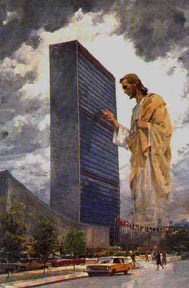
Jesus at UN2. As I was meditating on the inevitable question that so many people would ask: “Where was God in the midst of this disaster?” I realized that Jesus was on the hijacked planes, He was in the World Trade Center offices, and He was at the Pentagon. I remembered the painting of the Lord Jesus knocking at the door of the U.N. building. In my mind’s eye, I could easily see Him standing before the twin towers of the World Trade Center, and then I “saw” Him turned around, facing the planes on their deadly missions, and realized they had to fly through Jesus, and through His heart, to get to the buildings. The terrorists inflicted fresh pain on the Lord just as they devastated the American people.

3. In hearing people’s anguished voices on talk radio, and reading their impassioned posts on the internet, and seeing their pained faces in real life, I sensed a strong desire for justice. Many expressed outrage at the unfairness and the evil of this despicable act. And I thought, as a culture we can talk about everybody having the right to their own truth and the universal validity of everyone’s experience, but a tragedy like this shows what a hollow and deceptive philosophy that is. Where did the strong sense of right and wrong, of good and evil, come from if not from the fact that “God has planted eternity in the hearts of man” (Eccl. 3:11)? Within moments of hearing about the terrorist attacks, I started praying that people (including the media) would talk about this as an act of evil, making the moral judgment that calling something evil is. . . and was so glad to hear Peter Jennings use that word moments later. President Bush wisely and I am sure deliberately used the word “evil” several times in his message the night of the attacks.

4. Several friends have remarked that they don’t feel safe anymore; they feel like they’re in a war zone and their world could blow up at any time. What a poignant reminder that in actuality, we live in a spiritual war zone. We are in more danger of the enemy’s flaming darts and philosophical scud missiles, every single day of our lives, than we are of hijacked planes slamming into buildings. We need to stay vigilant and trust in God all the time. Which reminds me. . . God is good. All the time. All the time, God is good.

Michael Gleghorn:

As the prophet Jeremiah surveyed the destruction of Jerusalem he wept, pouring out his grief in the poignant poetry of the Old Testament book of Lamentations. The ruthless honesty with which he attempts to reconcile his profound sense of loss with the sovereign will of a holy God is, ironically, both heartbreaking and refreshing. He offers no trite phrases, no easy answers. Indeed, he freely confesses, “My strength has perished, and so has my hope from the Lord” (3:18).

Yet in the midst of his despair and the desolation of his city a light begins to dawn, a ray of hope breaks through the darkness and gloom and he writes his now famous words:

“This I recall to my mind, therefore I have hope. The Lord’s lovingkindnesses indeed never cease, for His compassions never fail. They are new every morning; great is Thy faithfulness. ‘The Lord is my portion,’ says my soul, ‘therefore I have hope in Him’” (3:21-24).

Though we may not fully understand why God would allow Tuesday’s tragic events we can, like Jeremiah, still look to Him in hope. Even in the midst of our pain and confusion, we can humbly remember His faithfulness, compassion and loyal love.

Pat Zukeran:

Yesterday’s attack challenges each person’s beliefs and convictions. It brought the reality home to all of us, that life is fragile and eternity is only one step away. At times like these we really begin to search and question our beliefs. It is at these times we see if our belief system really addresses life’s greatest questions and if it provide the answers.

Yesterday we saw that only the Christian worldview stood the test. Never have we heard so many people turning to God for strength, for answers and for healing. This shows the natural reaction of man to turn to God in times like these. Each man and woman has the knowledge of God imbedded in his or her heart. As Romans 1:18 states, all men and women have knowledge of God but suppress this truth to justify living independently of Him. However, in times like this, we see this knowledge that man suppresses, rise up and come to the forefront of his thoughts. We can only question this act of terror, seek comfort, and hope only in relation to God Whose nature is revealed in the Bible. No other worldview can address an issue like this and make any sense of it, or bring a message of any hope.

The naturalist believes there is no God and that we are just accidents of time and chance. Therefore, there really is no ultimate reason or purpose behind our existence in the vast universe. Naturalists must realize that, in their belief system, thousands of their loved ones have died for no reason and we will never see them again forever and ever. Those who were burned alive or jumped to their deaths from the burning buildings, firemen who rushed in to the World Trade Center to rescue their fellow citizens, died a meaningless death and are now extinct forever. What hope, what meaning is there in the naturalist worldview? Where are the atheists and humanists proclaiming their message of eternal extinction? They are all silent.

Pantheists will state that evil and sin are really an illusion. How then do we respond to this event? The pantheist’s understanding of reality and human nature cannot make sense of this act.

To the Postmodernists who believe all truth is relative and decided by each individual, can those who truly believe this say this was an evil act? Those who flew this suicide mission and their supporters say no. So do we have the right to condemn them? Relativists, I am sure, are rethinking their position. Americans are angered and seeking justice to be executed on the perpetrators. This is the only right response, to seek justice, and that can only be done if there is a universal basis for right and wrong. Otherwise, if we hold to the relativist’s position, we should tolerate this act as a one group freely expressing their ideas. Fortunately for Christians, we can respond properly for there are absolutes of right and wrong declared to us from God’s word. Only on this basis can we seek a basis for executing justice.

Only the Christian worldview can bring an understanding, meaning, and hope to this tragedy. The Christian worldview correctly diagnosis human nature, that man is created in the image of God but sinful and separated from God. Therefore, he falls prey to false beliefs and is capable of doing great evil. Only Christianity gives the message of hope that God is in control and will execute justice and one day overcome all evil. Only Christianity can give hope that those in Christ will live eternally in the presence of God. Life is fragile, but there is a life beyond the grave where justice is restored, peace is forever, and love will be experienced in its greatest way. Finally, seeking justice is the right response, for God’s word states, “You shall not murder.” Human life is sacred, and we are angered and in sorrow for beings made in the image of God are all valuable to Him and He weeps when they are destroyed by the evil we enact on fellow image bearers. This event only makes sense in reference to God.

That is why many are turning to Him now. Now is the time for Christians to expose false ideas and proclaim truth throughout our country and the world.

Second, it challenges us to see that religious values have consequences. What would motivate men to go on suicide missions and kill thousands of people? It is the Islamic belief that if a man dies in a Jihad, he will spend eternity in heaven sitting on couches, drinking wine, and enjoying the sensual pleasures of the heavenly maidens of whom he can take as many as he desires. This false religion, begun in violence, has devastating consequences of which we have now become aware. I can only conclude this is an evil force that has captured the hearts and minds of young men and led them to commit some of the worst acts of evil in the name of their false God. We Christians must pray and seek to win those lost Muslims to a saving knowledge of Jesus Christ.

Jimmy Williams:

A recent bestdeller by Tom Brokaw is entitled The Greatest Generation. The people to whom he referred (and honored) were those who faced the horrors of World War II. They met their challenge with resolve and personal sacrifice, overcoming their enemies and helping to create a new “beginning” for planet Earth. Why were they “great?” What kind of environment could forge such men and women?

The fathers and mothers of this “great” generation entered the 20th century optimistically. The light bulb. The automobile. The airplane. But then came World War I. It was called The “Great War.” And so it was. Never had the world seen such carnage on the battlefield. An estimated ten million died and twenty million were injured.

Quickly following came the “Great Depression.” Times were hard in America, and the economy didn’t really recover until the demands of war with Germany and Japan jump-started American industry. 400,000 Americans died in this war. Every home in America had been touched by death and injury to their friends and loved ones.

When it was over, this was a cleansed and grateful generation. No theory here. They had experienced and affirmed anew what they deemed REALLY important. The spirit, bravery, and sacrifice of their lives spilled over upon their children, the first post-war generation (baby boomers).

Life was good, and getting better. Unfortunately, it didn’t last twenty years. The turbulent Sixties followed. Assassinations. Flower Children. Vietnam. Ingratitude. “Me First.” Personal peace and affluence. Security. Unbridled freedom and non-stop entertainment of some kind.

While in church this first Sunday after September 11, I was struck by the awesome power of the words in the hymns we sang: “God of Our Fathers,” “A Mighty Fortress is Our God,” and “How Firm a Foundation.” They just flew off the page at me! It made me realize that the people who wrote these great hymns were probably much closer to living every day in a world of “uncertainty” and danger which Americans have just now rediscovered in the reality of our current shock, grief, and even fear.

Perhaps this tragic event is an opportunity for all Americans to be cleansed and purged and purified to such an extent that we might be among those who one day could come to be honored as another “greatest” Generation.

A “legacy of faith” has been prevalent throughout the history of our country which has periodically refashioned and refreshed the nation, giving it a strong religious flavor, not unnoticed by foreign observers. English novelist and poet G.K. Chesterton remarked in 1922 that the United States is “a nation with the soul of a church.” May it be so again in these days.


©2001 Probe Ministries.


Conversation with a Muslim and a Christian

An e-mail conversation between a Christian (Don Closson) and an earnest Muslim revealed the mindset and attitudes of a follower of Allah.

Spanish flag This article is also available in Spanish.

It is always easier to deal with religious belief systems in the abstract. Cataloguing what a particular religion believes concerning the nature of God, human nature, salvation, and morality is usually a straightforward affair. Actually dialoguing with someone who holds to these beliefs can be far more interesting and challenging. So, although I possessed a general knowledge of what Islam teaches, I found that only by carrying on a long-term discussion with a Muslim did I gain a sense of the mindset and attitudes of a follower of Allah. A door was opened for me to experience some of the passion and zeal to be found in the Muslim evangelist. The discussion occurred via email, which muted some of the emotions that often accompany religious exchanges, but they still came through with considerable intensity.

The opportunity to carry on a discussion with a Muslim apologist arose when a campus minister asked if I would help respond to charges against the claims of Christianity being made by an Islamic leader at his school. I agreed, and soon realized that a number of others, both Muslim and Christian would be listening in on our discussion. Once introduced to my Muslim counterpart, let’s call him Ali, the interchange began quickly. I wish that I could report that at the end of our discussion Ali placed his faith in Christ. In fact, I don’t think that I made much of an impact at all on his thinking. Ali, as with all of us, chooses what to accept as evidence. He refused to even attempt to see any of the issues we discussed from a Christian perspective. All I can do is pray that God might use our discussion down the road sometime, if God chooses to soften Ali’s heart.

Over a six month period our discussion primarily focused on the person of Christ. Ali would ask questions and I would attempt to give an answer. I quickly realized that Ali’s tactics and intentions were different from mine. He often used ridicule and intimidation in his responses and would pick and choose what to discuss and what to ignore, deciding when to move on to another topic in order to avoid really considering the material at hand. I have never considered myself a debater, I would much rather have a discussion with people who are really interested in the topic and graciously exchange viewpoints. If I were to enter another dialogue like the one with Ali, I would have to realize that I cannot assume that everyone thinks the way I do regarding dialogue across religious worldviews. The Bible tells us to be ready to give the reason for the hope that we have in Christ, and to do so with gentleness and respect. Don’t assume the other person will follow the same rules.

Next we will look at the issue of the person of Jesus Christ from a Muslim perspective and begin to consider how one might make a biblical response.

Christological Mathematics

Since I had never spoken to a Muslim regarding the claims of Christianity, I was looking forward to the kinds of questions that might be raised. I was not surprised that the first issue that came up was the nature of Jesus Christ, since this really is the heart of the matter. Muslims believe that Jesus was a prophet, perhaps even a unique prophet, but not in any sense God. Ali got the conversation going by declaring that there was no place in the Bible that says that Jesus is both 100 percent God and 100 percent man. Along with this initial challenge Ali pointed out that he was very sensitive to proper interpretation and would be looking for incidents of verse twisting in order to make a passage say something that it actually doesn’t.

I sent Ali a 2500 word essay that I had written earlier that contained multiple arguments for the deity of Christ and numerous biblical examples of Jesus saying and doing things that only make sense if He were indeed equal with God the Father. My response included indications of Christ’s self-perception as God, as well as statements made by His disciples portraying their belief in His deity. I assumed that Christ’s humanity was not the real issue. So I did not see a need to defend it. Ali’s response was interesting. He noted that Muslims do indeed believe that Jesus was born of a virgin and performed many miracles, with the help of God. But then he stated, “From your response I think we both agree that the Bible does not claim that Jesus is both 100% God and 100% man.” He later added, “If you don’t have any verses to give us then let’s move on to the next point.”

At first I thought that Ali had not gotten my entire essay. How could he have missed my point? He reassured me that he had gotten it and then declared that since there is no verse that states the 100 percent deity and 100 percent humanity of Christ, we can go on. What I eventually realized was that he was demanding a single verse that actually declared a mathematical set of percentages for the mixture of deity and humanity in Christ. I was a bit surprised to say the least. When I asked for confirmation, he said that that was indeed what he was looking for.

Most people know that the verse numbers in the Bible were added at a later date for convenience sake. After reminding Ali of passages like Philippians 2:6-7 and the first chapter of John, I asked him why it was necessary to find this complex truth in one verse. He ignored my question and responded by claiming victory that indeed, the Bible does not claim in one verse that Jesus is 100 percent God and 100 percent man, and he declared that we would now move on to the next point.

I must admit that I was a bit baffled, but not ready to concede the issue.

The Importance of Context

Ali’s debating tactics might be called the “slash and burn” technique: never admit to using a weak argument and make good use of sarcasm to intimidate your opponent. He also likes to claim victory in the middle of an exchange of ideas and then declare that we are moving on to the next issue. However, before I moved on to his next question I tried once more to answer his first. All that got me was the charge that I was avoiding his second point. He wrote,

You see Don, what you have done in your last email is you completely avoided this verse, and then you went looking in the Bible for other verses in which you think Jesus claimed to be God and gave them to us thinking that it would some how make us “forget” about John 5:30.

What about John 5:30? Jesus says; “By myself I can do nothing; I judge only as I hear, and my judgment is just, for I seek not to please myself but Him who sent me.” Ali claims that the verse shows that Jesus is inferior and helpless, that in fact He can do nothing. The key to this passage, as always, is in the context. I pointed out to Ali that in John 5:19-23 Jesus says that “He can do only what He sees His Father doing, because whatever the Father does the Son also does.” Jesus raises the dead, has been given all judgment, and is to be given the same honor that the Father is given. Ali replied, “Great, this is what a messenger does, this doesn’t make him god.”

I pointed out to him that a messenger communicates on behalf of someone else. He does not claim to do what someone else does. Muhammad claimed to be a messenger of Allah, not to do what Allah does. In fact, Jesus didn’t claim to show the way as a messenger might, but He claimed that He was the way, the truth, and the life (John 14:6). In fact, the same chapter says that the Jews recognized that Jesus was claiming equality with God the Father and tried all the harder to kill him (John 5:18). Ali might disagree with this claim, that Jesus is God, but that is exactly the argument that is being made by this chapter and the rest of the book of John.

Ali pulls verses from their context and refuses to deal with the entire passage. When given evidence from the chapter that contradicts his views, he changes the meanings of words and ridicules what he finds to be unreasonable. Next we will look at Ali’s rejection of the Trinity.

The Trinity

It is not surprising that Ali does not understand nor acknowledge the Trinitarian relationship between Jesus and the Father. Surah 4 verse 171 in the Qur’an calls on people of the book, Christians, not to commit excesses in their religion. It claims that Jesus was just a messenger of Allah and His Word, which was given to Mary. It literally tells Christians to “say not Trinity” for Allah is one. It is possible that Muhammad believed that the Trinity consisted of Jesus, the Father, and Mary. He rejected Jesus as the Son of God because he pictured Jesus as a physical offspring from a union of God the Father and Mary. This would commit the ultimate sin in the eyes of Islam, equating a physical thing with God the Creator (shirk). Ali writes, “To say that Jesus is God or Son of God is not only a mockery of Godhood, but blasphemy of the lowest order and an insult to the intelligence of men.”

As a result, Ali alternates between denying that the Bible teaches that Jesus is God and ridiculing as illogical the notion the Jesus can be both God and man. He refuses to acknowledge the notion of the Trinity, even when it is the best way to bring together difficult passages. When enough evidence is given that the Bible does teach that Jesus is both God and man, admittedly a difficult concept, Muslims reject the Bible as having been corrupted. They really have no other choice since the Qur’an specifically rejects the Trinity. It literally comes down to either rejecting their prophet Muhammad or accepting the validity and message of the Bible.

An interesting side note to this discussion is that Ali’s position is very similar to believers of other religious groups who respect Jesus but reject Christianity. Jehovah’s Witnesses claim that the Bible was corrupted following the passing of the apostles, and that they now have its correct interpretation, as do Mormons and the Baha’is, an offshoot of Islam. Mormons claim that their prophet Joseph Smith received their view of Jesus, found in the Book of Mormon, from the angel Moroni. Muhammad claimed to have received the Qur’an from the angel Gabriel. It is obvious that all of these revelations cannot be true as they each give us a very different Jesus. Paul has something to say about these different gospels. He writes to the church in Galatia:

I am astonished that you are so quickly deserting the one who called you by the grace of Christ and are turning to a different gospel–which is really no gospel at all. Evidently some people are throwing you into confusion and are trying to pervert the gospel of Christ. But even if we or an angel from heaven should preach a gospel other than the one we preached to you, let him be eternally condemned! (Galatians 1:6-8)

A Difficult Decision

As I mentioned earlier, the outcome of the six-month interchange was neither a conversion, nor even a congenial agree-to-disagree ending. In fact, I ended the dialogue after realizing that continuing the exchange could profit little and that my time might be better spent elsewhere. I must add that this was not an easy decision to make. I wondered whether I had given up too easily or had somehow not communicated adequately the hope that I have in Christ.

However, any hesitation to end the conversation was erased when I received a reply to my note to terminate the exchange. Ali told me that I could not quit. That in fact, he would announce on various web sites that both I and Probe Ministries had nothing to say regarding the reliability of the Bible if I did not respond to his challenges. This confirmed to me that Ali was simply using me to gain access to a larger audience in order to get out his message. He had no interest in a real discussion where ideas are considered and a minimal amount of graciousness exists.

I went back to the Scriptures to see how Jesus handled such people and what He taught His followers to do when they encountered ears that would not hear. In the synoptic Gospels, Jesus told his apostles that, “[I]f any place will not welcome you or listen to you, shake the dust off your feet when you leave, as a testimony against them.” The meaning communicated was that those who reject the gospel must now answer for themselves. When the gospel is taught, it brings both judgment and salvation.

In Matthew 7:6 Jesus tells the apostles, “Do not give dogs what is sacred; do not throw your pearls to pigs. If you do, they may trample them under their feet, and then turn and tear you to pieces.” Dogs and pigs do not signify any specific race or ethnic group. Jesus is teaching that those who have treated the gospel with scorn and clearly rejected the salvation it offers and have been hardened by their contempt are to be avoided.

When Paul and Timothy were opposed by the Jews, who became abusive, the book of Acts (18:5) records, “[H]e shook out his clothes in protest and said to them, ‘Your blood be on your own heads! I am clear of my responsibility.’”

I get little pleasure from reading these passages. I wanted to change Ali’s mind. However, when I told Ali that I was praying for him, he replied, “Don’t preach to me, prove it to me.” Given that he had ignored much evidence already, it told me that his ears were closed. However, I will continue to pray that God will soften Ali’s heart and that one day he might have ears to hear the Gospel.

©2001 Probe Ministries.


A Short Look at Six World Religions – Understand the Beliefs of Non-Christians

An overview of Islam, Hinduism, Buddhism, Judaism, Mormonism and Jehovah’s Witnesses from a conservative Christian perspective.

Islam

There are three monotheistic religions in the world, religions that teach that there is only one God: Christianity, Judaism, and Islam.

The term “Islam” means “submission” to the will of God, and the person who submits is called a “Muslim.”

The founder of Islam is Muhammad, who was born in 570 A.D. At age 40 he claimed to begin receiving revelations from a spirit being he believed was the angel Gabriel. These later were recorded and became the Qur’an, Islam’s holy book.

There are Six Articles of Faith that all Muslims hold to. The first is that “there is no God but Allah.” The second Article of Faith is belief in a hierarchy of angels, of which the archangel Gabriel is the highest. Each Muslim is assigned two angels, one to record his good deeds and the other to record the bad deeds. At the bottom of the angelic hierarchy are the jinn, from which we get the word “genie.” They are a Muslim version of demons.

The third Article of Faith is belief in 104 holy books, with the Koran as the final revelation. The fourth is belief in the prophets. According to the Qur’an, God has sent a prophet to every nation to preach the message that there is only one God. 124,000 prophets have been sent, most of them unknown but some of them biblical characters, including Jesus. Muhammed, though, is the prophet for all times, the “Seal of the Prophets.”

The fifth Article of Faith is belief in predestination. All things, both good and evil, are the direct result of the will of Allah. Islam is a very fatalistic religion.

The sixth Article of Faith is the day of judgment. Those whose good deeds outweigh their bad will be rewarded with Paradise; those whose bad deeds outweigh their good will be judged to hell. Islam is a religion of human works. The Bible tells us, though, that we can never earn God’s acceptance on the basis of our deeds.

There are Five Pillars of Islam, obligations every Muslim must keep. The first is reciting the creed, “There is no God but Allah, and Mohammed is his messenger.” The second is prayer: 17 cycles of prayer, spread out over five times of prayer each day. They must wash in a prescribed manner before they kneel down and face toward Mecca.

The third pillar is almsgiving, 2.5% of one’s income for the poor. The fourth pillar is fasting during the lunar month of Ramadan. Muslims must forego food, water and sex during daylight hours. The fifth pillar is making the pilgrimage to Mecca at least once in their lives.

Sometimes you will hear people say that Allah is another name for the God of the Bible. Is it the same? “Allah” is the Arabic name for God, and Arab Christians use the name Allah to describe the God of the Bible. Mohammed taught that there is one true God who is the same God that Jews and Christians (“the People of the Book”) worship. He began Islam on the foundation of the God of the Bible. We can say that in principle, we worship the same God. Islam began on the foundation of belief in the one true God to combat the pagan polytheism of the area. However, Mohammed departed from this foundation, and we differ in our understanding of how God has fully revealed Himself. In the Qur’an, Allah is a distant spiritual being, but Yahweh is a Father to His children. Allah does not love wrongdoers, but God demonstrates His love for us in that while we were still sinners, Christ died for us. Allah has predetermined everything about life; the God of the Bible invites us to share our hearts with Him.

Hinduism

Hinduism may seem like an alien religion of people on the other side of the world, but it has infiltrated our culture in all sorts of ways. You’re probably familiar with most of the basic Hindu concepts without even realizing it. Have you seen the Star Wars movies? They are filled with Hindu ideas. Ever watch Dharma and Greg on TV? “Dharma” is an important Hindu term for moral duty. 30% of Americans believe in reincarnation, which is a Hindu concept. Transcendental Meditation is thinly disguised Hinduism. George Harrison’s song “My Sweet Lord” invokes a Hindu chant. New Age philosophy is Hinduism wrapped in Western garb.

Hinduism is tremendously diverse. It encompasses those who believe in one reality, Brahman, as well as those who believe in many gods–as many as 330 million! Some Hindus believe the universe is real; most believe it is illusion, or maya. (This world view isn’t consistent with reality. You won’t find Hindus meditating on railroad tracks, for instance.) Some believe Brahman and the universe are one; others see them as two distinct realities.

Despite the diversity within Hinduism, there are five major beliefs of this religion. The first is that ultimate reality, called Brahman, is an impersonal oneness. In The Empire Strikes Back, Yoda tells Luke that everything–the tree, the rock, etc.–is all part of “The Force.” This is monism: the belief that all is one. Nothing is distinct and separate from anything else.

Another Hindu belief is that just as the air in an open jar is identical to the air around the jar, we extend from and are one with Brahman. All is one, all is god–and that means that we are god. In her book and movie “Out on a Limb,” Shirley MacLaine relates a time when she stood on a beach, embracing this concept and declaring, “I am god! I am god!” It’s a very Hindu concept.

Humanity’s primary problem, according to Hinduism, is that we have forgotten we are divine. The consequence is that we are subject to the Law of Karma, another important Hindu belief. This is the moral equivalent to the natural law of cause and effect. You always reap what you sow. There is no grace, there is no forgiveness, there is never any escape from consequences. It’s a very heavy burden to carry. Not only that, but Hinduism says that the consequences of our choices, both bad karma and good karma, follow us from lifetime to lifetime. This is another Hindu concept: samsara, the ever-revolving wheel of life, death, and rebirth, also known as reincarnation. A person’s karma determines the kind of body–whether human, animal, or insect–into which he or she is incarnated in the next lifetime.

The final major Hindu concept is liberation from the wheel of birth, death, and rebirth. One can only get off the reincarnation merry-go-round by realizing that the idea of the individual self is an illusion, and only the oneness of Brahman is real. There is no heaven, though–only losing one’s identity in the universal oneness.

Praise God that through the Lord Jesus, Christianity offers hope, forgiveness, grace, and a personal relationship with a personal God in heaven. Jesus means there’s a point to life.

Buddhism

Buddhism does not believe in a personal God. It does not have worship, prayer, or praise of a divine being. It offers no redemption, no forgiveness, no hope of heaven, and no final judgment. Buddhism is more of a moral philosophy, an ethical way of life.

In his essay “De Futilitate,” C.S. Lewis called Buddhism “a heresy of Hinduism.” Buddhism was founded by a Hindu, Siddhartha Gautama, during the sixth century B.C. After being profoundly impacted by seeing four kinds of suffering in one day, Siddhartha committed himself to finding the source of suffering and how to eliminate it. One day he sat down under a fig tree and vowed not to rise again until he had attained enlightenment. After some time, he did so and became the Buddha, which means “enlightened one.” He started teaching the “The Four Noble Truths,” the most basic of Buddhist teachings.

The First Noble Truth is that life consists of suffering. The Second Noble Truth is that we suffer because we desire those things that are impermanent. This is absolutely central to Buddhism: the belief that desire is the cause of all suffering.

The Third Noble Truth is that the way to liberate oneself from suffering is by eliminating all desire. (Unfortunately, it’s a self-defeating premise: if you set a goal to eliminate desire, then you desire to eliminate desire.) The Fourth Noble Truth is that desire can be eliminated by following the Eight-Fold path.

In the Eight-Fold Path, the first two steps are foundational to all the others. Step one is Right Understanding, where one sees the universe as impermanent and illusory and believes that the individual does not actually exist. If you ever hear someone say, “The world is an illusion, and so am I. I don’t really exist,” they’re probably exploring Buddhism. (You might want to pinch them and see what they do.) Right Thought means renouncing all attachment to the desires and thoughts of oneself, even as he recognizes that the self doesn’t exist.

Other parts of the Eight-Fold path are Right Speech, Right Action, Right Livelihood, Right Effort, Right Awareness, and Right Meditation. Ethical conduct is very important in Buddhism. There are commands to refrain from the taking of any life (that includes ants and roaches in your house), stealing, immorality, lying, and drinking.

The Eight-Fold Path is a set of steps that describe not only a good life but one which will move the follower toward Nirvana, the goal of Buddhism. Nirvana is not heaven; it is a state of extinction, where one’s essence–which does not actually exist in the first place–is extinguished like a candle flame, marking the end of desire and thus the end of suffering.

One of the important concepts in Buddhism is samsara, a cycle of birth, death and rebirth. It differs from the Hindu concept of reincarnation in that Buddhism teaches there is no self to continue from one life to the next. Another important concept is karma, the belief that you reap what you sow, and your karma follows you through the cycles of samsara. Note the inherent inconsistency here: there is no self to continue from one life to the next, but one’s karma does?!

Buddhism says there are many paths to the top of the mountain, so there are many ways to God. Jesus says, “I am the way, the truth, and the life. No one comes to the Father but through Me.”

Judaism

Both Christianity and Judaism have their roots in Old Testament faith. But Christianity is really a sister, rather than a daughter, to Judaism, which is the religion developed by rabbis from 200 B.C. on.

When the Temple was destroyed in 70 A.D., that spelled the end of sacrifices and the priesthood. Instead of being guided by prophets, priests and kings, the Jewish people turned to rabbis as their authorities on matters of laws and practice.

There was basically one kind of Judaism until the eighteenth century when the Age of Enlightenment swept through Europe. That’s when the three major branches of Judaism arose.

That one basic kind of Judaism is what is now called “Orthodox Judaism.” It has a strong emphasis on tradition and strict observance of the Law of Moses.

Reform Judaism began in Germany at the time of the Enlightenment. Reform Judaism is the humanistic branch. In fact, there are many Reform Jews who don’t believe in God at all. For them, Judaism is a way of life and culture with a connection to one’s ancestors that is about legacy, not faith.

The middle-ground branch, seeking to find moderate ground between the two extremes of the Orthodox and Reform branches, is Conservative Judaism.

If there is any religious principle that Judaism explicitly affirms and teaches, it is the unity of God. You may have heard of the Shema, found in Deuteronomy 6:4¾“Hear O Israel, the Lord our God, the Lord is One.” This one all-important principle is the reason so many Jewish people have a hard time understanding Christianity, which they see as a religion of three gods, not one God in three Persons.

The Old Testament is the Scripture of Judaism. Many Jews, though, do not consider the Old Testament to be the Word of God or inspired, although they do give it respect as a part of Jewish tradition and history.

There are some lifestyle practices that set people apart as distinctively Jewish. Traditional Jews, usually Orthodox but including some from other branches, observe the Sabbath. This means abstaining from work, driving, and lighting a fire from Friday night to Saturday night. Orthodox Jews also keep kosher, which means keeping the Old Testament dietary laws. The most well known is the prohibition against mixing meat and milk at the same meal, although many people are also aware that most Jewish people do not eat pork or shellfish.

It is difficult for Jewish people to place their faith in Jesus as Messiah because it is not considered a Jewish thing to do. In fact, they see “Jewish Christian” as an oxymoron. For many, being Jewish equals “Not Christian.” But there’s another big reason it is so hard for Jewish people to come to faith in Christ. They don’t see a need for “salvation,” because there is nothing to be saved from. If there is a God, then Jewish people already have a special relationship with Him as His chosen people. Jesus is superfluous for Jews.

If you know someone who is Jewish, pray that God will cause the scales to fall from the eyes of their heart and they will see the truth: that there’s nothing more Jewish or more godly than submitting in faith to one who was, and is, the very Son of God, and who proved His love for them by dying in their place on the cross.

Mormonism and Jehovah’s Witnesses

Have you ever answered your door to find a couple of nicely-dressed people asking to talk to you about spiritual things? Chances are they were either Mormons or Jehovah’s Witnesses. Since both groups send many missionaries not only into American homes but to foreign countries, it makes sense to cover them in a discussion of world religions.

Many people think of Mormons and Jehovah’s Witnesses as Christians in slightly different denominations, but this is not the case. To put it bluntly, both religions teach another gospel and another Jesus. They are cults, not Christian denominations.

Mormonism was founded by Joseph Smith, a teenage boy in New York. He claimed that he was visited by first God the Father and the Son, and then by the angel Moroni, who gave him golden plates, which he translated into the Book of Mormon. He said that Christianity had been corrupted since the death of the last apostle, and God appointed him to restore the truth. But Joseph Smith provided nine different versions of these events, which set the tone for the rest of his teachings.

Deuteronomy 18:22 gives God’s standards for His prophets: 100% accuracy. Joseph Smith wrote a lot of prophecies, many of which never came true. He was a false prophet, and the religion he founded is not from God.

Mormonism is not Christian because it denies some of the essential doctrines of Christianity, including the deity of Christ and salvation by grace. Furthermore, Mormon doctrine contradicts the Christian teaching that there is only one God, and it undermines the authority and reliability of the Bible.

Jehovah’s Witnesses was founded by Charles Taze Russell, another false prophet. His Watchtower Bible and Tract Society has produced a prodigious amount of literature. It has prophesied the return of Christ in 1914, 1925, and 1975. Again, by God’s standards, the representatives of the Watchtower Society are false prophets.

Jehovah’s Witnesses deny the basics of the Christian faith. They deny the Trinity. They believe there is one singular God, Jehovah. Jesus is actually the created being Michael the Archangel, and who became flesh at the incarnation. The Holy Spirit is not God but an active force much like electricity or fire. They deny the bodily resurrection of Christ. Like Mormons, they deny the existence of hell and eternal punishment.

Both of these religions teach salvation by works, not God’s grace. And they teach that salvation is only found in their organizations.

What do you do if they come to your door? First, don’t do anything without sending up a prayer of dependence on God. If you are not well-grounded in your own beliefs, unless you know not only what you believe but why it’s true, then you should probably politely refuse to talk to them, and work on your own understanding of your faith. Both Mormons and Jehovah’s Witnesses are very successful at drawing in church-goers who can’t recognize false teaching because they don’t know what’s true.

If you do know the Bible and what you believe, then prayerfully and humbly answer their questions and comments by showing them what the Bible says. And pray that God’s Spirit will show them the truth. He is grieved that people for whom Jesus died are so deceived.

©2000 Probe Ministries.


The Religion of Baha’i – What Does a Baha’i Believe

Lou Whitworth looks at the principles and claim of the Baha’i faith from a biblical perspective. Then, he compares the beliefs of Baha’i with the teaching of Christianity so we can understand the significant differences between the two. He shows that Baha’i really offers nothing to our lives while Christianity offers an eternal relationship with our Creator God.

The Origin of Baha’i

The roots of the Baha’i faith go back to a nineteenth-century religion called “Babism.” Babism, which broke off from the Shiite form of Islam, was founded in 1844 in Persia (now known as Iran). The founder, a young businessman who assumed the title “Bab” (which means “the Gate” or door to spiritual truth), began to proclaim a new religious system that took a marked departure from his Islamic roots. For example, he stated that the religious prophets were divine “manifestations” of God himself. He then proclaimed himself a prophet or manifestation of God greater than Muhammad, and claimed that he was sent by God “to replace Muhammad’s religion and laws with his own.”(1) He also saw himself as a “forerunner” to an even greater manifestation destined to emerge later. This person would be “the World Teacher who would appear to unite mankind and usher in a new era of peace.”(2)

The Bab’s message fell on responsive ears, and soon he developed a strong following. In fact, the growth of this movement, called the Babis, so alarmed orthodox Muslim leaders that the Bab was arrested. The bulk of his ministry occurred during this six-year prison sentence. The years between 1848 and 1850 were marked by bloody clashes between the Babis and the Persian government. In 1850 the government, in an attempt to eradicate the movement, executed the Bab by firing squad and launched a widespread persecution of his followers. The persecution reached its height in 1852 when the government massacred approximately 20,000 Babis. In spite of this horrible persecution, Babism continued to spread.

Before his death, the Bab had chosen a young disciple to be his successor. The young man, Subh-I-Ezel, was not cut out for leadership and many of his responsibilities were performed by his older half-brother, Mirza Husayn Ali.(3) In 1863, the older half- brother, also a disciple of the Bab, declared himself the World Teacher. In other words, he claimed to be the fulfillment of the Bab’s prediction of a coming World Teacher who would unite the world and bring peace. He then assumed the name “Baha’u’llah” which means “the glory of God.”

Most of the Babis accepted Baha’u’llah as the World Teacher (and became “Baha’is”). Some, however, remained loyal to the younger brother. Violent skirmishes occurred between the two factions, and the two leaders accused each other of attempted poisoning.(4) The government sent Subh-I-Ezel, the younger brother, to prison in Cyprus, and the older to prison at Akka (now in Israel).(5) The younger man’s following withered away, but Baha’u’llah’s following grew in numbers and intensity. This is largely because his disciples, the Baha’is, recorded everything he said over one hundred books and tablets in all, and thus were able to keep spreading the word.(6)

Baha’u’llah spent many years in prison and/or exile, but because of all the recorded teachings his movement continued to grow. He lived to the ripe old age of 75 and died in 1892. His oldest son Abdu’l- Baha was given sole authority to interpret his teachings. He was considered to be infallible in his interpretation of Baha’u’llah’s works, and he proved quite successful in spreading the faith outside of the Muslim world.(7)

Major Beliefs in Baha’i

Progressive Revelation Baha’i theology holds to the idea of progressive revelation. In their system there are different manifestations of God during different periods of time. For example, in the Baha’i religion, Abraham was a manifestation of God, but he was followed by Krishna, who was followed by Moses, then by Zoroaster, Buddha, Christ, Muhammad, the Bab, and finally by Baha’u’llah. Each manifestation allegedly builds on the previous ones and brings new information and insight to man. Thus God’s message to man is progressively revealed and enhanced over time through different prophets. Though each manifestation is considered legitimate and appropriate for its time, in some sense the latter always overrules the former. Baha’is teach that Baha’u’llah is the manifestation to humanity for this time. In accordance with this principle, one of the leading Baha’i teachers said that, “The fundamental principle which constitutes the bedrock of Baha’i belief [is] the principle that religious truth is not absolute but relative, that Divine Revelation is orderly, continuous and progressive and not spasmodic or final.”(8)

Oneness and Unity The Baha’i faith teaches the oneness of God, the oneness of all religions, and the oneness of mankind. The emphasis on oneness is not window dressing; it is a core concept of the system. Unity is sought, taught, and preached today and is the goal for tomorrow. The mission of Baha’i life is to bring to fruition the unity of all mankind in a divine civilization based on the teachings of Baha’u’llah.

Laws and Obligations Every Baha’i should observe the following laws or obligations:


  1. Pray every day.
  2. Observe the Baha’i Fast from sunrise to sunset each day from March 2 through 21.
  3. Consider work as worship.
  4. Teach the Cause of God.
  5. Avoid alcoholic drinks and drugs.
  6. Observe Baha’i marriage.
  7. Obey the government and not participate in politics.
  8. Avoid backbiting and gossip.
  9. Observe Baha’i Holy Days.
  10. Contribute to the Baha’i Fund.(9)


The Twelve Principles Baha’i philosophy can be summed up in this statement: “The earth is but one country and mankind its citizens.” Behind this maxim are the twelve principles of Baha’i thought:(10)


  1. Oneness of God.
  2. Oneness of Religion.
  3. Oneness of Mankind.
  4. Elimination of prejudice of all kinds.
  5. Individual search after truth.
  6. Universal auxiliary language.
  7. Equality of men and women.
  8. Universal education.
  9. Harmony of science and religion.
  10. Elimination of extremes of wealth and poverty.
  11. World government.
  12. Protection of cultural diversity.(11)


Extravagant Claims Baha’u’llah made some claims about himself that are breathtaking in their boldness. “He claimed to be the fulfillment not only of all Christian prophecies, but of many Jewish, Hindu, Buddhist, Zoroastrian and Muslim prophecies as well. In glory, stature and importance, Baha’u’llah eclipsed Jesus and all other Manifestations. He denied being Almighty God Himself, but taught that he, like all other manifestations, was the only source of divine guidance in his cycle.”(12)

Dawning of Peace Baha’is believe that “Mankind is currently headed toward a socio- economic cataclysm. Out of this tragedy a golden age’ will dawn, and Baha’is will be the only ones prepared to rule in this *new world order*. [Emphasis added.] War shall cease,’ said Baha’u’llah,and all men shall live as brothers.’”(13)

Contrasts Between Baha’i and Christianity

God and the Trinity In response to the Christian doctrine of one God in three persons, Father, Son, and Holy Spirit, the Baha’i faith answers a resounding negative. The Baha’i’s emphasis on unity (oneness of mankind, oneness of religion, etc.) is true here too. The concept of the Trinity is inconsistent and repugnant to their theology. They attribute the Christian belief in this doctrine to misinterpretation of the Bible. They view God as one person in much the same way as Judaism and Islam.

Jesus Christ To followers of Baha’i, Jesus is one of the great prophets. His manifestation of God superseded the manifestation of Buddha which had superseded the manifestations of Zoroaster, Moses, Krishna, and Abraham, respectively. But then Jesus and His message was superseded; first by Muhammad, then by The Bab, and finally by Baha’u’llah. The idea of Jesus as the unique Son of God, both God and man, is rejected in Baha’i. To them, Jesus is just one of nine manifestations, each of which came to bring more spiritual light to the world. What each one taught was true for his time until he was superseded by a greater manifestation.

The Holy Spirit For Christians the Holy Spirit is the third person of the Triune Godhead, the revealer of truth, who inspired the Scriptures, and empowers believers for Christian service and evangelism. He is also involved in the work of convicting, regenerating, indwelling, baptizing, and sealing believers. Baha’is believe that Christ’s promise of another Comforter refers not to the coming of the Holy Spirit, but to the coming of Baha’u’llah (John 14:16).

The Resurrection of Christ In Christianity the central fact is the Resurrection of Christ. Baha’is, however, do not believe in the bodily resurrection of Christ, though they do believe in a future resurrection of all human beings. They do believe that Jesus conquered death spiritually.

Atonement for Sin The Bible teaches that Jesus Christ’s death on the cross paid the penalty for sin for all who will believe on (or place their trust in) Christ. Christ bore on His body the penalty of our sin. Forgiveness is a free gift to those who believe; good works are an evidence of the inner faith. In Baha’i, on the other hand, one arrives at what we would call “salvation” by practicing the “principles laid down by Baha’u’llah and by making every effort through prayer and personal sacrifice to live in accord with the character of the divine being.”(14) Even then Baha’is must hope for God’s mercy without which “no one would escape the divine judgment.”(15)

Heaven and Hell The Bible teaches that there will be a final judgment, that heaven will be the future reward of those who have trusted Christ, and that hell will the future home of those who have rejected Christ. Baha’i teaches that there will be a resurrection and a time of divine judgment. There is also an abode of the righteous, the paradise of God, but there is no concept of eternal flames or hell as taught in the Bible. Those who do not attain to the paradise apparently have the opportunity to progress spiritually until they are worthy of acceptance.

Baha’i’s Organization and Goals

The Organizational Structure of Baha’i

Local Worship Centers In cities large enough to have at least nine adult members of the Baha’i faith, a “Spiritual Assembly” can be formed to hold official meetings and worship services. Worship services (usually held in homes) normally consist of singing and reading from the works of Baha’u’llah or Abdul Baha. In many countries the Baha’is build a National House of Worship. America has one in Wilmette, Illinois.

The Baha’i World Headquarters is located in Haifa, Israel, on the side of Mt. Carmel. A major building and landscaping program has resulted in a beautiful headquarters for the organization. It serves as a working headquarters as well as a tourist attraction and a very brilliant public relations center in which to expose the religion in a beautiful setting and win friends for the faith. One of those beautiful buildings is the Universal House of Justice, from which the whole ministry is run by an elected nine-person committee elected to five-year terms. Notable among the other buildings are the International Archives and the International Baha’i Library. All this construction on Mt. Carmel seems less strange when you remember that Baha’is believe that this site is to be the center of a coming one-world government and that one day presidents and kings from around the world will come to this site in search of world peace. Also these structures are effective in attracting new members.

The Goals of the Baha’i Religion

World Unity Some who have studied Baha’i closely are concerned by its organizational structure and its goals of world unity. For example, how is this unity to be achieved? Also, what would happen to those who refused to conform? Some of the statements from its leaders about expecting people to give up personal and national rights are unsettling, to put it mildly. A modern religious movement with global aspirations, but very small in size is not intimidating to anyone. But, let that organization grow and set in place various institutions with power to police and enforce its vision, and the picture changes dramatically. At that point, the possibility for abuse of dissidents is dramatically increased. For this reason, Baha’i bears close watching. Some have commented that the goals of political and religious unity and of universal submission to the Baha’i leadership sound similar to the oppressive false world church system that will exist in the Last Days. (For more information, see the Book of Revelation.)

One World “When Baha’is talk about the unity of mankind, or about one world, the Kingdom of God, they do not mean a mere mood or ethos of togetherness. They mean an international political empire of which the Baha’i Faith would be the state religion.”(16) In fact, Baha’is intend to institute “a Baha’i world Super-State, a commonwealth in which all the peoples of the world would be subject to a single global authority. All nations would waive their national sovereignty and cede key rights to the Baha’i world Super-state.”(17)

After the historian Arnold Toynbee examined the Baha’i faith, he came to believe that it could be the future world religion. Others have expressed similar thoughts. Though Baha’i seems small and innocuous at present, if it grows in size and influence to the point that it could succeed in its aims of unifying the world under its own terms, it could be a sinister force.

Weaknesses in the Religion of Baha’i

An Impersonal and Unknowable God In Baha’i, God is impersonal and unknowable. In Christianity, God is the believer’s Father. Jesus spoke of God using a familiar, intimate term, “Abba,” which means, “Daddy.” The Muslim and the Baha’i know nothing of this intimacy.

No Assurance of Salvation In Baha’i, it is impossible to know whether or not you are spared from judgment and will go to the Paradise of God. Christians can know that we are forgiven and going to heaven (1 John 5:11 13). This knowledge is based not on our merit but on the mercy of God to all who will trust Christ as their sin-bearer. Apart from biblical Christianity which focuses on Christ’s death, burial, and resurrection in payment for our sins, no religion, no philosophy, no program on earth has really dealt with man’s sin problem. To the Baha’i, the Christian believer’s claim of assurance of salvation is presumptuous. But this is a typical reaction of all non-Christian religions and cults because they all teach a program of works with no assurance of salvation.

Is the Baha’i God fickle and changeable?–Why are many “manifestations of God” necessary? According to the Bible, God never changes (He is the same yesterday, today, and tomorrow, Heb. 13:8), and human nature doesn’t change or evolve. The Baha’i faith, however, holds that the manifestations were given because of different needs in different times of human history. It also teaches that after enough time has passed mankind has learned sufficiently from one cycle and needs to grow and be stretched by a new “manifestation of God.”

Was Baha’u’llah an opportunist or a manifestation of God? How is it believable that the manifestation of Baha’u’llah followed that of the Bab by less than twenty years? Could mankind have grown, progressed, and mastered his teachings so rapidly? Hardly. For one thing, few outside of Middle East had even heard of the Bab and his new religion. Furthermore, the Bab himself had predicted that the next manifestations after him would be many years (1,511 and 2,001 years) in the future.(18) Note that he mentioned two manifestations. No wonder many of the Babis were surprised and rejected Baha’u’llah’s claim.

There are many facts that we could cover, but this information in this essay is sufficient to show the open-minded person that the religion of Baha’i has some real credibility problems. There are, however, many noble-minded, sweet people in this cult who deserve to hear the truth in love and gentleness so they can be free from the grip of this false religion.

In a chapter on Baha’i from his book The Kingdom of the Cults, Walter Martin summarized in sad and melancholy fashion the emptiness of the Baha’i faith:

There was no virgin born Son, there was only a Persian student; there was no miraculous ministry, there was only the loneliness of exile; there was no power over demons, there were only demons of Islam; there was no redeeming Saviour, there was only a dying old man; there was no risen Saviour, there was only Abdul Baha; there was no Holy Spirit, there was only the memory of the prophet; there was no ascended High Priest, there was only the works of the flesh; and there was no coming King, there was only the promise of a new era.(19)

Notes

1. John Boykin, “The Baha’i Faith,” in Ronald Enroth, et al., A Guide to Cults and New Religions (Downers Grove, Ill.:InterVarsity, 1983), 26.

2. Edmond C. Gruss, “Baha’i,” Cults and the Occult (Phillipsburg, N.J.: P & R Publishing, 1974, 3d ed., rev. and enl., 1994), 146-47.

3. Boykin, 26.

4. Ibid., 27.

5. Ibid.

6. Ibid.

7. Ibid.

8. Boykin, 28.

9. Official Baha’i booklet, “The Baha’i Faith” (Wilmette, Ill.: Baha’i Publishing Trust, 1981).

10. Larson, 147.

11. “The Baha’i Faith.”

12. Boykin, 29.

13. Larson, 147, emphasis mine.

14. Walter Martin, Kingdom of the Cults (Minneapolis, Minn.: Bethany Fellowship, 1965), 256.

15. John Boykin, 30.

16. Ibid., 30 31.

17. Ibid., 31.

18. William Miller, citied in Gruss, 148.

19. Martin, 257.


©1997 Probe Ministries.