The Value of Suffering: A Christian Perspective

Sue Bohlin looks at suffering from a Christian perspective.  Applying a biblical worldview to this difficult subject results in a distinctly different approach to suffering than our natural inclination of blame and self pity.

Spanish flag This article is also available in Spanish.

There is no such thing as pointless pain in the life of the child of God. How this has encouraged and strengthened me in the valleys of suffering and pain! In this essay I’ll be discussing the value of suffering, an unhappy non-negotiable of life in a fallen world.

Suffering Prepares Us to Be the Bride of Christ

download-podcastAmong the many reasons God allows us to suffer, this is my personal favorite: it prepares us to be the radiant bride of Christ. The Lord Jesus has a big job to do, changing His ragamuffin church into a glorious bride worthy of the Lamb. Ephesians 5:26-27 tells us He is making us holy by washing us with the Word—presenting us to Himself as a radiant church, without stain or wrinkle or any other blemish. Suffering develops holiness in unholy people. But getting there is painful in the Lord’s “laundry room.” When you use bleach to get rid of stains, it’s a harsh process. Getting rid of wrinkles is even more painful: ironing means a combination of heat plus pressure. Ouch! No wonder suffering hurts!

But developing holiness in us is a worthwhile, extremely important goal for the Holy One who is our divine Bridegroom. We learn in Hebrews 12:10 that we are enabled to share in His holiness through the discipline of enduring hardship. More ouch! Fortunately, the same book assures us that discipline is a sign of God’s love (Heb. 12:6). Oswald Chambers reminds us that “God has one destined end for mankind—holiness. His one aim is the production of saints.”{1}

It’s also important for all wives, but most especially the future wife of the Son of God, to have a submissive heart. Suffering makes us more determined to obey God; it teaches us to be submissive. The psalmist learned this lesson as he wrote in Psalm 119:67: “Before I was afflicted I went astray, but now I obey your word. It was good for me to be afflicted so that I might learn your decrees.”

The Lord Jesus has His work cut out for Him in purifying us for Himself (Titus 2:14). Let’s face it, left to ourselves we are a dirty, messy, fleshly people, and we desperately need to be made pure. As hurtful as it is, suffering can purify us if we submit to the One who has a loving plan for the pain.

Jesus wants not just a pure bride, but a mature one as well—and suffering produces growth and maturity in us. James 1:2-4 reminds us that trials produce perseverance, which makes us mature and complete. And Romans 5:3-4 tells us that we can actually rejoice in our sufferings, because, again, they produce perseverance, which produces character, which produces hope. The Lord is creating for Himself a bride with sterling character, but it’s not much fun getting there. I like something else Oswald Chambers wrote: “Sorrow burns up a great amount of shallowness.”{2}

We usually don’t have much trouble understanding that our Divine Bridegroom loves us; but we can easily forget how much He longs for us to love Him back. Suffering scoops us out, making our hearts bigger so that we can hold more love for Him. It’s all part of a well-planned courtship. He does know what He’s doing . . . we just need to trust Him.

Suffering Allows Us to Minister Comfort to Others Who Suffer

One of the most rewarding reasons that suffering has value is experienced by those who can say with conviction, “I know how you feel. I’ve been in your shoes.” Suffering prepares us to minister comfort to others who suffer.

Feeling isolated is one of the hardest parts of suffering. It can feel like you’re all alone in your pain, and that makes it so much worse. The comfort of those who have known that same pain is inexpressible. It feels like a warm blanket being draped around your soul. But in order for someone to say those powerful words—”I know just how you feel because I’ve been there”—that person had to walk through the same difficult valley first.

Ray and I lost our first baby when she was born too prematurely to survive. It was the most horrible suffering we’ve ever known. But losing Becky has enabled me to weep with those who weep with the comforting tears of one who has experienced that deep and awful loss. It’s a wound that—by God’s grace—has never fully healed so that I can truly empathize with others out of the very real pain I still feel. Talking about my loss puts me in touch with the unhealed part of the grief and loss that will always hurt until I see my daughter again in heaven. One of the most incredibly comforting things we can ever experience is someone else’s tears for us. So when I say to a mother or father who has also lost a child, “I hurt with you, because I’ve lost a precious one too,” my tears bring warmth and comfort in a way that someone who has never known that pain cannot offer.

One of the most powerful words of comfort I received when we were grieving our baby’s loss was from a friend who said, “Your pain may not be about just you. It may well be about other people, preparing you to minister comfort and hope to someone in your future who will need what you can give them because of what you’re going through right now. And if you are faithful to cling to God now, I promise He will use you greatly to comfort others later.” That perspective was like a sweet balm to my soul, because it showed me that my suffering was not pointless.

There’s another aspect of bringing comfort to those in pain. Those who have suffered tend not to judge others experiencing similar suffering. Not being judged is a great comfort to those who hurt. When you’re in pain, your world narrows down to mere survival, and it’s easy for others to judge you for not “following the rules” that should only apply to those whose lives aren’t being swallowed by the pain monster.

Suffering often develops compassion and mercy in us. Those who suffer tend to have tender hearts toward others who are in pain. We can comfort others with the comfort that we have received from God (2 Cor. 1:4) because we have experienced the reality of the Holy Spirit being there for us, walking alongside us in our pain. Then we can turn around and walk alongside others in their pain, showing the compassion that our own suffering has produced in us.

Suffering Develops Humble Dependence on God

Marine Corps recruiter Randy Norfleet survived the Oklahoma City bombing despite losing 40 percent of his blood and needing 250 stitches to close his wounds. He never lost consciousness in the ambulance because he was too busy praying prayers of thanksgiving for his survival. When doctors said he would probably lose the sight in his right eye, Mr. Norfleet said, “Losing an eye is a small thing. Whatever brings you closer to God is a blessing. Through all this I’ve been brought closer to God. I’ve become more dependent on Him and less on myself.”{3}

Suffering is excellent at teaching us humble dependence on God, the only appropriate response to our Creator. Ever since the fall of Adam, we keep forgetting that God created us to depend on Him and not on ourselves. We keep wanting to go our own way, pretending that we are God. Suffering is powerfully able to get us back on track.

Sometimes we hurt so much we can’t pray. We are forced to depend on the intercession of the Holy Spirit and the saints, needing them to go before the throne of God on our behalf. Instead of seeing that inability to pray as a personal failure, we can rejoice that our perception of being totally needy corresponds to the truth that we really are that needy. 2 Corinthians 1:9 tells us that hardships and sufferings happen “so that we might not rely on ourselves but on God, who raises the dead.”

Suffering brings a “one day at a time-ness” to our survival. We get to the point of saying, “Lord, I can only make it through today if You help me . . . if You take me through today . . . or the next hour . . . or the next few minutes.” One of my dearest friends shared with me the prayer from a heart burning with emotional pain: “Papa, I know I can make it through the next fifteen minutes if You hold me and walk me through it.” Suffering has taught my friend the lesson of total, humble dependence on God.

As painful as it is, suffering strips away the distractions of life. It forces us to face the fact that we are powerless to change other people and most situations. The fear that accompanies suffering drives us to the Father like a little kid burying his face in his daddy’s leg. Recognizing our own powerlessness is actually the key to experience real power because we have to acknowledge our dependence on God before His power can flow from His heart into our lives.

The disciples experienced two different storms out on the lake. The Lord’s purpose in both storms was to train them to stop relying on their physical eyes and use their spiritual eyes. He wanted them to grow in trust and dependence on the Father. He allows us to experience storms in our lives for the same purpose: to learn to depend on God.

I love this paraphrase of Romans 8:28: “The Lord may not have planned that this should overtake me, but He has most certainly permitted it. Therefore, though it were an attack of an enemy, by the time it reaches me, it has the Lord’s permission, and therefore all is well. He will make it work together with all life’s experiences for good.”

Suffering Displays God’s Strength Through Our Weakness

God never wastes suffering, not a scrap of it. He redeems all of it for His glory and our blessing. The classic Scripture for the concept that suffering displays God’s strength through our weakness is found in 2 Corinthians 12:8-10, where we learn that God’s grace is sufficient for us, for His power is perfected in weakness. Paul said he delighted in weaknesses, hardships, and difficulties “for when I am weak, then I am strong.”

Our culture disdains weakness, but our frailty is a sign of God’s workmanship in us. It gets us closer to what we were created to be—completely dependent on God. Several years ago I realized that instead of despising the fact that polio had left me with a body that was weakened and compromised, susceptible to pain and fatigue, I could choose to rejoice in it. My weakness made me more like a fragile, easily broken window than a solid brick wall. But just as sunlight pours through a window but is blocked by a wall, I discovered that other people could see God’s strength and beauty in me because of the window-like nature of my weakness! Consider how the Lord Jesus was the exact representation of the glory of the Father—I mean, He was all window and no walls! He was completely dependent on the Father, choosing to become weak so that God’s strength could shine through Him. And He was the strongest person the world has ever seen. Not His own strength; He displayed the Father’s strength because of that very weakness.

The reason His strength can shine through us is because we know God better through suffering. One wise man I heard said, “I got theology in seminary, but I learned reality through trials. I got facts in Sunday School, but I learned faith through trusting God in difficult circumstances. I got truth from studying, but I got to know the Savior through suffering.”

Sometimes our suffering isn’t a consequence of our actions or even someone else’s. God is teaching other beings about Himself and His loved ones—us—as He did with Job. The point of Job’s trials was to enable heavenly beings to see God glorified in Job. Sometimes He trusts us with great pain in order to make a point, whether the intended audience is believers, unbelievers, or the spirit realm. Quadriplegic Joni Eareckson Tada, no stranger to great suffering, writes, “Whether a godly attitude shines from a brain-injured college student or from a lonely man relegated to a back bedroom, the response of patience and perseverance counts. God points to the peaceful attitude of suffering people to teach others about Himself. He not only teaches those we rub shoulders with every day, but He instructs the countless millions of angels and demons. The hosts in heaven stand amazed when they observe God sustain hurting people with His peace.”{4}

I once heard Charles Stanley say that nothing attracts the unbeliever like a saint suffering successfully. Joni Tada said, “You were made for one purpose, and that is to make God real to those around you.”{5} The reality of God’s power, His love, and His character are made very, very real to a watching world when we trust Him in our pain.

Suffering Gets Us Ready for Heaven

Pain is inevitable because we live in a fallen world. 1 Thessalonians 3:3 reminds us that we are “destined for trials.” We don’t have a choice whether we will suffer–our choice is to go through it by ourselves or with God.

Suffering teaches us the difference between the important and the transient. It prepares us for heaven by teaching us how unfulfilling life on earth is and helping us develop an eternal perspective. Suffering makes us homesick for heaven.

Deep suffering of the soul is also a taste of hell. After many sleepless nights wracked by various kinds of pain, my friend Jan now knows what she was saved from. Many Christians only know they’re saved without grasping what it is Christ has delivered them from. Jan’s suffering has given her an appreciation of the reality of heaven, and she’s been changed forever.

I have an appreciation of heaven gained from a different experience. As my body weakens from the lifelong impact of polio, to be honest, I have a deep frustration with it that makes me grateful for the perfect, beautiful, completely working resurrection body waiting for me on the other side. My husband once told me that heaven is more real to me than anyone he knows. Suffering has done that for me. Paul explained what happens in 2 Corinthians 4:16-18:

“Though outwardly we are wasting away, yet inwardly we are being renewed day by day. For our light and momentary troubles are achieving for us an eternal glory that far outweighs them all. So we fix our eyes not on what is seen, but on what is unseen, for what is seen is temporary, but what is unseen is eternal.”

One of the effects of suffering is to loosen our grasp on this life, because we shouldn’t be thinking that life in a fallen world is as wonderful as we sometimes think it is. Pastor Dick Bacon once said, “If this life were easy, we’d just love it too much. If God didn’t make it painful, we’d never let go of it.” Suffering reminds us that we live in an abnormal world. Suffering is abnormal–our souls protest, “This isn’t right!” We need to be reminded that we are living in the post-fall “Phase 2.” The perfect Phase 1 of God’s beautiful, suffering-free creation was ruined when Adam and Eve fell. So often, people wonder what kind of cruel God would deliberately make a world so full of pain and suffering. They’ve lost track of history. The world God originally made isn’t the one we experience. Suffering can make us long for the new heaven and the new earth where God will set all things right again.

Sometimes suffering literally prepares us for heaven. Cheryl’s in-laws, both beset by lingering illnesses, couldn’t understand why they couldn’t just die and get it over with. But after three long years of holding on, during a visit from Cheryl’s pastor, the wife trusted Christ on her deathbed and the husband received assurance of his salvation. A week later the wife died, followed in six months by her husband. They had continued to suffer because of God’s mercy and patience, who did not let them go before they were ready for heaven.

Suffering dispels the cloaking mists of inconsequential distractions of this life and puts things in their proper perspective. My friend Pete buried his wife a few years ago after a battle with Lou Gehrig’s disease. One morning I learned that his car had died on the way to church, and I said something about what a bummer it was. Pete just shrugged and said, “This is nothing.” That’s what suffering will do for us. Trials are light and momentary afflictions . . . but God redeems them all.

Notes
1. Oswald Chambers, Our Utmost for His Highest, September 1.
2. Chambers, June 25.
3. National and International Religion Report, Vol. 9:10, May 1, 1995, 1
4. Joni Eareckson Tada, When Is It Right to Die? (Grand Rapids, MI: Zondervan, 1992), 122.
5. Tada, 118.

©2000 Probe Ministries, updated 2018


Bible Literacy Quiz: A Test of Scripture Knowledge

Take this test of basic Bible knowledge to help assess your biblical literacy. This simple quiz examines some of the key doctrines and events of the Bible. It will give you a good feel for your breadth and depth of Scriptural knowledge.

This article is also available in Spanish.

It’s alarming to us at Probe Ministries to see the drop in biblical literacy among Americans. Growing numbers of people don’t know what the Bible says, even the most basic foundational truths and people and facts.

Evangelical pollster George Barna says,

Over the past 20 years we have seen the nation’s theological views slowly become less aligned with the Bible. Americans still revere the Bible and like to think of themselves as Bible-believing people, but the evidence suggests otherwise. Christians have increasingly been adopting spiritual views that come from Islam, Wicca, secular humanism, the eastern religions and other sources.{1}

That’s because we’re not reading and studying the Bible. If we don’t know what God says is truth, it makes us vulnerable to believing a lie.

Take the quiz yourself: click here for a format with the questions and answers separated.

download-podcast
1. Who wrote the first four books of the New Testament?

Matthew, Mark, Luke, and John.

2. Who wrote the first five books of the Old Testament?

Most conservative scholars hold that the Pentateuch was written by Moses.

3. What two Old Testament books are named for women?

Esther and Ruth.

4. What are the Ten Commandments?

1. I am the Lord your God; you shall have no other gods before Me.
2. You shall not make for yourself an idol in the form of anything in heaven above or on the earth beneath or in the waters below.
3. You shall not misuse the name of the Lord your God.
4. Remember the Sabbath day by keeping it holy.
5. Honor your father and your mother.
6. You shall not murder.
7. You shall not commit adultery.
8. You shall not steal.
9. You shall not give false testimony against your neighbor.
10. You shall not covet your neighbor’s house. You shall not covet your neighbor’s wife—or anything that belongs to your neighbor. (Exodus 20:2-17)

5. What is the Greatest Commandment?

“Love the Lord your God with all your heart and with all your soul and with all your mind.” (Matthew 22:37,38)

6. What is the second Greatest Commandment?

“Love your neighbor as yourself.” (Matthew 22:39)

7. What is the Golden Rule?

“Do unto others as you would have them do unto you.” (Matthew 7:12)

8. What is the Great Commission?

“Therefore, go and make disciples of all nations, baptizing them in the name of the Father and of the Son and of the Holy Spirit, and teaching them to obey everything I have commanded you. And surely I will be with you always, to the very end of the age.” (Matthew 28:19,20)

9. What was the test of a prophet, to know that he was truly from God?

He had to be 100% accurate in his prophecies. The penalty for a false prophet was death by stoning. (Deuteronomy 18:20-22)

10. To whom did God give the 10 Commandments?

Moses. (Exodus 20)

11. Which two people did not die?

Genesis 5:24 says that Enoch, who was Noah’s great-grandfather, “walked with God; then he was no more, because God took him away.” The other was the Old Testament prophet Elijah, who was taken up to heaven in a whirlwind with a chariot and horses of fire. (2 Kings 2:11)

12. What is the root of all kinds of evil?

The love of money. (1 Timothy 6:10)

13. What is the beginning of wisdom?

The fear of the Lord. (Psalm 111:10)

14. Who delivered the Sermon on the Mount?

The Lord Jesus. (Matthew 5-7)

15. How did sickness and death enter the world?

Romans 5:12 says that sin entered the world though one man, and death through sin. The fall of man is recorded in Genesis 3, where God’s perfect creation was spoiled by Adam’s sin.

16. Who was the Roman governor who sentenced Christ to death?

Pontius Pilate. (Matthew 27:26)

17. Who are the major prophets?

Isaiah, Jeremiah, Ezekiel, and Daniel.

18. What people group is the Old Testament about?

The Hebrews, who became the nation of Israel. They were descendants of Abraham though Isaac.

19. What happened while the Lord Jesus was in the desert for 40 days?

He was tempted by the devil. (Matthew 4:1) Hebrews 4:15 tells us that He was tempted in every way, just as we are—yet was without sin.

20. How many people were on Noah’s ark?

Eight: Noah and his wife, his three sons Shem, Ham, and Japheth, and their wives. (Genesis 7:13, 1 Peter 2:5)

21. Who was the first murderer?

Cain, who killed his brother Abel. (Genesis 4:8)

22. Which person was afflicted with terrible trials but trusted God through it all?

Job. (See book of Job)

23. Who was Israel’s most well-known and well-loved king?

David. (1 Chronicles 29:28)

24. Who was “the weeping prophet?”

Jeremiah.

25. Who was thrown into the lion’s den?

Daniel. (Daniel 6)

26. Who were the two people in the famous fight with a stone and a sling?

David and Goliath. (1 Samuel 17)

27. What is the book of Acts about?

The early years of the church, as the gospel begins to spread throughout the world.

28. What are epistles?

Letters.

29. On what occasion was the Holy Spirit given to the church?

Pentecost. (Acts 2:1-4)

30. Whom did God command to sacrifice his only son?

Abraham. (Genesis 22:2)

31. What was the Old Testament feast that celebrated God’s saving the firstborn of Israel the night they left Egypt?

Passover. (Exodus 12:27)

32. Who was the Hebrew who became prime minister of Egypt?

Joseph. (Genesis 41:41)

33. Who was the Hebrew woman who became Queen of Persia?

Esther. (Esther 2:17)

34. Who was the pagan woman who became David’s great-grandmother?

Ruth. (Ruth 4:17)

35. Which angel appeared to Mary?

Gabriel. (Luke 1:26)

36. How did the Lord Jesus die?

He gave up His life while being crucified. (John 19:18)

37. What happened to Him three days after He died?

He was raised from the dead. (John 20)

38. What happened to the Lord Jesus 40 days after His resurrection?

He ascended bodily into heaven. (Acts 1:9-11)

39. What should we do when we sin, in order to restore our fellowship with God?

1 John 1:9 tells us, “If we confess our sins, He is faithful and just to forgive us our sins, and to cleanse us from all unrighteousness.”

40. How did the universe and world get here?

Genesis 1:1 tells us, “In the beginning, God created the heavens and the earth.” We are told further in Colossians 1:16 and 17 that the Lord Jesus Christ was the one who did the creating.

41. Where did Satan and the demons come from?

Satan was originally the best and the brightest angel, but he sinned in his pride, wanting to be God. Some of the angels followed him, and these “fallen angels” were cast out of heaven. (Isaiah 14, Ezekiel 28)

42. Who directed the writing of the Bible?

The Holy Spirit. (2 Timothy 3:16, 2 Peter 1:21)

43. Where was the Lord Jesus before He was conceived in Mary?

In heaven. (Philippians 2:6-11, 1 Corinthians 15:49)

44. Who taught in parables?

The Lord Jesus. (Matthew 13:3)

45. What are parables?

A short, simple story with a spiritual point.

46. Which two animals talked with human speech?

The serpent in the Garden of Eden (Genesis 3:3) and Balaam’s donkey (Numbers 22:28).

47. With which woman did David commit adultery?

Bathsheba. (2 Samuel 11)

48. Which one of their sons succeeded David as king?

Solomon. (2 Samuel 12:24)

49. Who was the female judge of Israel?

Deborah. (Judges 4:4)

50. Who was the wisest man in the world?

Solomon. (1 Kings 3:12)

51. Who was the first man?

Adam. (Genesis 2:20)

52. Who was the most humble man on earth?

Moses. (Numbers 12:3)

53. Who was the strongest man on earth?

Samson. (Judges 13-16)

54. Where were the two nations of God’s people taken into captivity?

Israel was taken into Assyria (2 Kings 17:23), and Judah into Babylon (2 Chronicles 36:20).

55. Which cupbearer to a foreign king rebuilt the wall of Jerusalem?

Nehemiah. (Nehemiah 2:5)

56. Who were the two Old Testament prophets who worked miracles?

Elijah and Elisha. (1 Kings 17 – 2 Kings 6)

57. Which Old Testament prophet spent three days in the belly of a great fish?

Jonah. (Jonah 1:17)

58. What is the last book of the Old Testament?

Malachi.

59. For which Israelite commander did the sun stand still?

Joshua. (Joshua 10)

60. Who was the first king of Israel?

Saul. (1 Samuel 13:1)

61. Who built the temple in Israel?

Solomon. (1 Kings 6)

62. Which of the twelve tribes of Israel served as priests?

Levites. (Deuteronomy 10:8)

63. Which city fell after the Israelites marched around it daily for seven days?

Jericho. (Joshua 6:20)

64. What did God give the Israelites to eat in the wilderness?

Manna and quail. (Exodus 16)

65. Which two people walked on water?

Jesus and Peter. (Matthew 14:29)

66. Who was the first martyr?

Stephen. (Acts 7)

67. Who betrayed Jesus to the priests, and for how much?

Judas betrayed Him for 30 pieces of silver, the price of a slave. (Matthew 26:14-15)

68. What is the Lord’s Prayer?

Our Father, who art in heaven, hallowed be thy name. Thy kingdom come, thy will be done on earth as it is in heaven. Give us this day our daily bread, and forgive us our trespasses as we forgive those who trespass against us. And lead us not into temptation, but deliver us from evil. For thine is the kingdom and the power and the glory forever. Amen. (Matthew 6:9-13)

69. Who was the first person to see the risen Lord?

Mary Magdalene. (John 20:16)

70. Which prophet and cousin of the Lord was beheaded?

John the Baptist. (John 14:10)

71. To what country did the young Jesus and His parents escape when Herod was threatening His life?

Egypt. (Matthew 2:13-15)

72. What was Christ’s first miracle?

He turned water into wine at the wedding at Cana. (John 2:11)

73. Which one of the Lord’s personal friends did He raise from the dead?

Lazarus. (John 11)

74. Who was the greatest missionary of the New Testament?

Paul. (see book of Acts)

75. Who was Paul’s first partner?

Barnabas. (Acts 13:2)

76. Whom did an angel release from prison?

Peter. (Acts 12)

77. Which event caused God to splinter human language into many tongues?

The building of the Tower of Babel. (Genesis 11)

78. Which chapter of an Old Testament prophet’s book gives a detailed prophecy of the Messiah’s death by crucifixion?

Isaiah 53.

79. Who wrestled all night with the Lord and was left with a permanent limp?

Jacob. (Genesis 32:22-32)

80. Which two pastors did Paul write letters to?

Timothy and Titus.

81. Who was hailed as a god when he was bitten by a snake but nothing bad happened?

Paul. (Acts 28:5-6)

82. Which two New Testament writers were brothers of the Lord Jesus?

James and Jude. (Matthew 13:55)

83. Which two New Testament books were written by a doctor?

Luke and Acts. (2 Timothy 4:11)

84. Who had a coat of many colors?

Joseph. (Genesis 37:3)

85. In what sin did Aaron lead the Israelites while his brother Moses was up on the mountain talking to God?

They made an idol in the form of a golden calf. (Exodus 32)

86. How many books are there in the entire Bible?

66: 39 in the Old Testament, and 27 in the New Testament.

87. What’s the difference between John the Baptist and the John who wrote several New Testament books?

John the Baptist was a prophet who proclaimed the kingdom of God was near in preparation for his cousin Jesus’ ministry. The John who wrote the gospel of John, the epistles—1, 2 and 3 John—and Revelation, was one of the twelve apostles and one of those closest to the Lord, along with Peter and James. He called himself “the disciple whom Jesus loved.”

88. Who saw the Lord appear to him in a burning bush?

Moses. (Exodus 3)

89. How many sons did Jacob have?

Twelve. They were the ancestors of the twelve tribes of Israel. (Genesis 35:22)

90. Who gave up his birthright for a bowl of stew?

Esau. (Genesis 25:33)

91. Which Psalm starts out, “The Lord is my shepherd, I shall not want?”

Psalm 23.

92. Who disowned the Lord Jesus three times before a cock crowed?

Peter. (Matthew 26:69-75)

93. What did the Lord do just after the Last Supper to demonstrate His love and humility?

He washed the disciples’ feet. (John 13:5)

94. Where is the New Testament “Hall of Faith?”

Hebrews 11.

95. Who appeared with the Lord Jesus in glory on the Mount of Transfiguration?

Elijah and Moses. (Mark 9:4)

96. Who is the second Adam?

The Lord Jesus Christ. (1 Corinthians 15:45-49)

97. Which Old Testament prophet married a prostitute because God told him to?

Hosea. (Hosea 1:2)

98. What are the two sacred ordinances that the Lord commanded us to observe?

Baptism (Matthew 28:19,20) and Communion, or the Lord’s Table (1 Corinthians 11:23-26).

99. What are supernatural enablings that allow a believer to serve the Body of Christ with ease and effectiveness?

Spiritual gifts. (Romans 12:6-8, 1 Corinthians 12, Ephesians 4:8-13, 1 Peter 4:10-11)

100. Whose tomb was Christ buried in?

Joseph of Arimathea. (Matthew 27:57-60)

101. Who wrote the book of Hebrews?

Nobody knows.

102. Which is the “epistle of joy?”

Philippians.

103. What is the book of Revelation about?

The end of the world.

104. Who is the bride of Christ?

The church—that is, all who have trusted Him for salvation. (Ephesians 5:25-27, Revelation 19:7-8)

Note

1. bit.ly/fR8BuA

© 2005 Probe Ministries International


“How Can You Say I Can’t Lose My Salvation?”

I mess up all the time, and God is holy all the time. How can you say I can’t lose my salvation?

I’m so glad you asked!

First— and please hear me say this firmly but gently— it’s not your salvation to lose. It is a free gift from God. Ephesians 2:8-9 teaches, “For by grace you have been saved through faith; and that not of yourselves, it is the gift of God; not as a result of works, so that no one may boast.” You did nothing to earn God’s gift of salvation, and you can do nothing to “ungift” it. As some have said, salvation is 100% God and 0% human effort. All we do is receive it, by faith. And God even gives us the grace to receive it in the first place! As I said, it’s 100% God.

Let me suggest three points that support the position that you can’t lose God’s gift of salvation.

1. God makes some breathtaking, unconditional promises in the Bible that express His heart toward us.

I love most what Jesus said in John 10:27-30—

“My sheep listen to My voice, and I know them, and they follow Me. I give them eternal life, and they will never perish; no one will snatch them from My hand. My Father, who has given them to me, is greater than all, and no one can snatch them from My Father’s hand. The Father and I are one.”

We are doubly safe; we are held securely in the Father’s hand and the Son’s hand. No one, not even ourselves, can snatch us from that place of eternal security.

Then, in both the Old Testament (Joshua 1:5) and the New Testament (Hebrews 13:5), God promises, “I will never leave you or forsake you.”

In 2 Timothy 2:13, we read that “If we are unfaithful (or “unbelieving”), God is faithful.”

We are safe in the Lord’s love, protection, care . . . and salvation.

2. We have been promised everlasting (or eternal) life, not temporary life.

Jesus promised in John 5:24, “Most assuredly, I say to you, he who hears My word and believes in Him who sent Me has everlasting life, and shall not come into judgment, but has passed from death into life.”

And in 1 John 5:13, Jesus’ best friend writes, “I have written these things to you who believe in the name of the Son of God so that you may know that you have eternal life.”

It’s not everlasting or eternal if you could stop it by doing something to lose your salvation!

3. You have been forgiven completely and totally.

When Jesus breathed His last on the cross with the statement, “It is finished/paid in full,” that was about paying the penalty for your sins, my sins, all the sins of all the humans on the planet. And He paid for ALL of them 2000+ years ago—when all your sins were still future. Praise God, you are not powerful enough to undo what Jesus did for you on the cross.

The Father, the Son, and the Holy Spirit worked together to give you the magnificent gift of salvation. It’s a forever gift and you can relax in the Lord’s security.

I hope you find this helpful.

Warmly,
Sue Bohlin

(I am indebted to the online discussion between Dr. Sean McDowell and Dr. Andrew Farley for perspective on this issue.)

Posted Sept. 2025
© 2025 Probe Ministries


Acorns, Oak Trees, and Our Son’s Grave

While visiting their son’s grave, Sue Bohlin meditated on the glory of the ‘2.0 resurrection body’ that we look forward to.

On the one-year anniversary of our son’s death, my husband and I drove out to the DFW National Cemetery to find Curt’s grave.

I have never been one to visit loved ones’ gravesites. I always thought, “Why? They’re not there. They’re not in the ground, they’re in heaven.”

But lately I’ve been thinking differently about our bodies. They are more than just physical cases for who we are inside. We ARE our bodies, as well as our souls. Human beings are a unified creation of the material and the immaterial.

So I stood on the ground, thinking about this, above Curt’s body. A precious body, the body I carried inside mine for nine months, and then carried in my arms until he learned to walk. The body of the boy I loved, and still do. The body of the man who looked so handsome in his Air Force uniform. The body that was placed in a casket to be buried a year ago while we honored him at his memorial service.

As I reminded myself that Curt’s “body 1.0” is precious and dear, I thought back to the great privilege of teaching 1 Corinthians 15 and the “2.0 resurrection bodies” that await us.

acornWhen I taught that day, I held up an acorn from our front yard.
“An acorn is an oak seed,” I said. “It has the same DNA as an oak tree. Is the acorn the same as the oak tree? Yes . . . and no.

“They are stages of the same plant, they’re the same genetically, but of course they are different.

“What happens to an acorn? It gets planted in the ground, it falls apart and dies, then it sprouts new life . . . and eventually it is transformed into an oak tree.”

The buried acorn absorbs moisture from the soil and rain, and the outer husk softens. The bare seed inside is exposed, and things change. Little tendrils shoot out and start to grow down into the soil. The acorn falls apart, and that first stage basically dies, but the oak tree can’t come to life unless the seed dies. But a little acorn can become a HUGE tree!

The acorn can’t even begin to imagine the size and power and majesty and beauty of the oak tree. It can’t fathom becoming something big enough and strong enough for someone to build a treehouse in its branches, where kids can play. Mind blowing!

Our bodies are like the acorn planted in the ground. They get sick, weak, and they die. But that’s not the end, like the acorn falling apart in the ground isn’t the end.

We have the hope of experiencing a new form of physical bodily existence that is as different from our earthly bodies as the oak tree is different from an acorn.

1 Corinthians 15:42-44 says,

What is sown is perishable, what is raised is imperishable. It is sown in dishonor, it is raised in glory; it is sown in weakness, it is raised in power; it is sown a natural body, it is raised a spiritual body. If there is a natural body, there is also a spiritual body.

Our natural body, our “Earth suit,” is subject to aging, disease and death. Like an acorn.

What a contrast with our spiritual body—our “New Earth suit”?—which will be strong, vibrant, and glorious. Like a big, beautiful, glorious oak tree.

I love to meditate on the resurrection body, our spiritual body. We can see from the gospel records what Jesus’ resurrection body was like:

• Jesus’ body still had His wounds.
• It was physical. The disciples could touch Him; in fact He commanded that Thomas reach out and touch His wrist, and put his hand in Jesus’ side where the spear had pierced His chest.
• He could travel effortlessly and instantly, appearing and disappearing at will.
• He was able to pass through walls and doors.
• He could-and did-eat, drink, and talk.
• He handled material things (He wasn’t a ghost or an illusion).
• His resurrected body was more real, of more substance, than ours is.

His resurrected body was the oak tree compared to the acorn.

According to Randy Alcorn’s wonderful book Heaven, Curt is experiencing the intermediate heaven today. It’s unimaginably beautiful and glorious, but it’s not the still-future unification of heaven and earth where we will receive our resurrection bodies—and things will get even better.

Our “oak tree bodies” still lie ahead. And that sure makes me smile.


This blog post originally appeared at Acorns, Oak Trees, and Our Son’s Grave on July 10, 2025.


How Contagious Are You?

When someone shared their cold with Sue Bohlin on a recent cruise, it made her think about how contagious we can be in different ways, for good and for bad.

Halfway through my last cruise, I suddenly became aware of my throat. That’s always my first sign of a cold, so I started popping zinc tablets every few hours to fight back. People share their germs on cruise ships, especially those with thousands of passengers; contagion is just a fact of life. I wasn’t surprised.

Many people are now more aware of social contagion. Just like colds and flu, we can easily “catch” other people’s feelings and behaviors and beliefs.

Like anger. Proverbs 22:24-25 warns us, “Do not make friends with a hot-tempered person, do not associate with one easily angered, or you may learn their ways and get yourself ensnared.”

Like entitlement. The proliferation of short “Karen” videos putting self-centered entitlement on full display seems to have made this obnoxiousness multiply.

While these two rotten character traits have proven to be socially contagious, what is deeply heartbreaking to me is the social contagion of teens (and even younger) identifying as transgender. Adolescence is hard and awkward for just about anyone, but when kids are addicted to social media and never put their phones down, the “trans disease” (for lack of a better term) sweeps through schools and classes and friend groups, picking up steam as it picks off youth struggling with who they are and afraid of who they are supposed to become.

Recently, when reading in 1 Samuel. I was struck by the people of Israel telling the last judge, Samuel, “Give us a king to judge us like all the other nations have.” (8:5)

Well, what do you know? Social contagion in the Old Testament!

I have been especially aware of the power of contagion ever since our family doctor asked me once, “You live with two depressed men (my husband and our son), and depression is contagious. What are you doing to protect yourself?”

I laughed, “As it happens, I just got off a short cruise with my sister. Four solid days of joy and laughter and fun with no depression in sight.” She said, “You need to do that regularly.” (And I do. Which is one reason I am “the cruise queen.”)

I didn’t realize depression could be contagious, but it makes sense. Because a number of negative things can be quite contagious. As my other son, who owns several specialty coffee cafés in San Francisco assures me, critical speech and gossip can be contagious. Some of his baristas had absorbed bad habits from each other and it’s heartbreaking.

Negativity is contagious. Like wearing sunglasses indoors, a negative mindset can manifest in someone’s words and even micro-expressions, coloring the thinking and reactions of those around them.

But you know what?

Gratitude can also be contagious.

Lightheartedness can be contagious.

Courtesy can be contagious.

Complimenting and affirming others can be contagious.

Generosity. Enthusiasm. Vulnerability, Laughter.

Even faith.

Contagion, it seems, can be bad . . . or beautiful.


The Glory of Grace

Sue Bohlin explores God’s marvelous grace as the unending flow of His power, presence and favor in our lives.

I bet you recognize “grace” as a theology word. Many of us are quick to say, “Oh yeah, I know what that is. We’re saved by grace through faith.” Or we know of churches with the word “grace” in their name. But many of us don’t have a real handle on it. Often that’s because we haven’t seen it modeled in our families, our churches, or our communities. We’re too focused on trying to prove ourselves good enough, too busy trying to keep God from getting mad at us.

download-podcast But this misunderstood blessing of grace is hugely important. It’s one of the big things that sets Christianity apart from all other religions! Any other world religion involves performance-based works. Biblical Christianity says, “We’re messed-up broken people before a holy God, and there’s nothing we can do to earn His approval. But He loves us and delights in us despite the fact that we don’t deserve it.” With all other religions, the emphasis is on “do.” Because of grace, in Christianity the emphasis is on “done.”{1}

One of the most powerful elements of grace is simply acceptance. The book of Romans assures us that we are accepted by both the Father (Romans 14:3) and the Son (Romans 15:7). We can do nothing to earn Their acceptance; it’s a gift. The Father says, “I accept you just the way you are, but I love you too much to leave you that way. Come to Me: My arms and My heart are open to you because of what My Son did in His incarnation, crucifixion, resurrection and ascension. I have always loved you, My precious child. I chose you before the foundation of the world, to adopt you into My family.”{2} I love to think of God stamping our foreheads with an invisible tattoo that says, “Accepted in the Beloved” (Ephesians 1:6, KJV).

Pastor Mark Driscoll has an especially great definition of grace. Instead of the one we’ve heard for years, “God’s undeserved favor,” Mark calls it “ill-deserved” favor.{3} But my all-time favorite definition comes from John Ortberg: “Grace is the offer of God’s ceaseless presence and irrational love that cannot be stopped. It’s the flow of God’s power and presence and favor in your life from one moment to the next that enables you to do whatever it is God has for you to do.”{4} I want to focus on God’s power, presence, and favor, as well as giving some real-life examples of what grace looks like.

Power

A little boy was playing in his sandbox one Saturday morning when he discovered a large rock in the middle of it. The boy dug around the rock, managing to dislodge it from the dirt. With a little bit of struggle, he pushed and nudged the rock across the sandbox. But then he found that he couldn’t roll it up and over the little wall. The boy shoved, pushed, and pried, but every time he thought he had made some progress, the rock tipped and then fell back into the sandbox.

All this time the boy’s father watched from his window as the drama unfolded and his son burst into tears of frustration.

As the tears fell, a large shadow fell across the boy and the sandbox. It was the boy’s father. He asked, “Son, why didn’t you use all the strength that you had available?”

The boy sobbed, “But I did, Daddy, I did! I used all the strength that I had!”

The father corrected kindly, “No, son, you didn’t use all the strength you had. You didn’t ask me.” With that, the father reached down, picked up the rock and removed it from the sandbox.

Experiencing God grace means depending on Him to provide the power for our lives, whether it’s dislodging a big ol’ rock in our sandbox or simply making it through the day.

I like to think of the power of God’s grace as electricity that is available twenty-four hours, seven days a week. God’s grace is always available to us at every moment of our life, and because of His goodness and faithfulness, we never have to fear a power shortage of God’s grace.

The key to experiencing the flow of God’s power is what Jesus called abiding, choosing to remain in a state of trustful dependence on God. Jesus said in John 15:5, “I am the vine, you are the branches; he who abides in Me and I in him, he bears much fruit, for apart from Me you can do nothing.”

I love to illustrate this by turning on a shop light that’s plugged into an electrical outlet. When I press the switch, the light goes off, even though the power is still flowing and available. We can shut off the expression of grace, the flow of God’s power, by quenching the Spirit—by actively disobeying God, or by passively ignoring Him. But His power can shine in our lives again as soon as we open ourselves up to Him, asking for His help, intentionally depending on His power and not our own. Grace is the flow of God’s power in our lives.

Presence

One morning, as I swam laps in the health club pool, I was meditating on these three aspects of grace. I said, “Lord, what do You want me to know about Your presence?” At that very second, I “just happened” to see a large sign on the wall right in front of me: “WARNING: NO LIFEGUARD ON DUTY.” I literally laughed out loud, realizing that this was code for “You’re on your own, buddy.” God’s grace means we never have to fear that there’s no lifeguard on duty, that we’re on our own, because He has promised to never leave us or forsake us (Deuteronomy 31:6, Hebrews 13:5). The Lord Jesus’ last promise was, “I am with you always” (Matthew 28:20).

My favorite illustration of grace as God’s presence is the building of the Golden Gate Bridge in San Francisco. Dwight Edwards relates that during its initial stages of construction, “Twenty-three workers fell to their deaths. Finally, halfway through the project, a large net was put in place beneath the bridge. From then on, only ten men actually fell—all caught by the net. Plus, the workers’ productivity was raised by twenty-five percent. Assured that their safety was no longer in question, they pursued their work with far greater freedom and effectiveness than before. This is exactly what God has done for us. Stretched wide beneath us, extending from eternity past to eternity future, is God’s perfect grace, assuring every believer that we can never fall from His favor. No matter how badly we falter or fail, we can never plunge past the grace of God.”{5}

Think of grace as the hand of God ready to catch you when you fall. Because God is good and He is sovereign, that means nothing can happen that He cannot redeem. There is no such thing as an unrecoverable disaster. Even when we sin deliberately and stupidly, we cannot jump beyond the bounds of His grace. Now, His grace usually involves painful discipline, because God disciplines those He loves (Hebrews 12:6), but we cannot out-sin God’s love and grace.

Recently, a friend of mine was anguishing, “Why did God allow me to wreck my marriage and family? I wouldn’t let my children run out into the street and be hit by a car, why did He let me go that far?” As I turned to the Lord for an answer, He whispered, “I’m always protecting My children, but you don’t see the disasters I avert.” Part of God’s grace is the safety of His protecting presence.

Favor

One important element of grace is favor. One dictionary defines favor as “an attitude of approval or liking.”

Five-year-old Matt got up from his nap one day and said, “Guess what, mommy, I just had a dream about Jesus!” The mommy asked, “Well, what did Jesus say to you?” “Nothing.” “Well, what was Jesus doing?” “Nothing.” “Now Matthew, you just said you had a dream about Jesus, he MUST have said or done something!” Matt was quiet for a moment, and then with a wiggle and grin he looked up and said shyly, “He just stood there and liked me.”

When somebody likes you, their eyes light up when they see you. Did you know God’s whole face lights up when He looks at you? The Bible talks about His face shining on us.{6} God doesn’t only love us, He likes us! Experiencing God’s grace means He showers not only love but like on us, and His face reflects His heart of favor toward us.

Every child needs to receive the “3 A’s” of favor from his daddy: attention, affection, and approval. The Father poured out the 3 A’s on the Lord Jesus at His baptism when He said, “You are My beloved Son in whom I am well pleased.”{7} Those words are like gold, and we can receive them into our own hearts as well.

I love the way one daddy blogger expresses grace toward his daughter. He writes,

I love you. I love the way your hair rolls into ringlets and falls into your eyes. I love the way you read yourself books, even though you can’t read. I love the way you dance and twirl around the kitchen. I love the way you wave at cars that pass on our walks. I love the way you scream “Dad” in the middle of the night. I love the way you say “do it again” when we do something fun. I even love the permanent marker custom design you put on my new Mac. But as much as I love you, Jesus loves you more. I sacrifice a lot because I love you, but Jesus sacrificed everything because he loves you. So if somewhere along the way you fail a test or love a boy who does not love you back or have a mastectomy or develop Alzheimer’s or gain some weight or lose a job, you will still hold infinite value because Jesus loves you. No matter what. You are loved exactly as you are. Always.{8}

Oh yeah. That’s the beauty of grace.

What Grace Looks Like

I want to share some examples of what grace looks like, both the way God showers grace on us, and the way people share His grace with others.

God has poured grace on me in a huge way when traveling internationally. Because of a schedule change, I found myself flying back to Dallas from Germany just in time to speak at a weekend women’s retreat. I arrived home from the airport with just enough time to repack my bags and pick up my speaking notes and props. I then drove two hours to the retreat facility, arriving while the women were still singing. I literally got out of the car with my notebook in hand, walked in the door and up to the stage to start speaking. With the time difference, my body felt like it was five o’clock in the morning and I’d been awake for twenty-two hours. But God not only kept me alert, He filled me with His energy, and the women couldn’t tell any difference.

When we’ve received God’s grace, we are able to turn around and give it to others.

Grace means responding with patience when someone forgets they already told you something, or that you told them something, and just going with the flow. Grace means lifting off the burden of needless “shoulds” that weigh people down. One grace-filled speaker invited people to respond in song at the end of her message, saying, “If you’d like to sing, great! Join us! If you need a rest, feel free to just listen.” She removed any pressure to perform. At our church, a couple of pastors managed to deliver a message on giving and stewardship without even a hint of shame, or condemnation, or pressure. That’s what grace looks like.

When my friend’s mother contracted Alzheimer’s, she told her daughter early in the progression of the disease, “If I get to the point where I don’t recognize you, don’t take it personally.” She was expressing grace in being more concerned about her daughter’s hurt than her own loss of memory.

Another friend needed eye surgery to keep her from losing her sight. Her friend Angela, who has been blind for a number of years, told our friend, “Don’t be concerned about talking about your vision to me—I am so over that!” That’s what grace looks like.

One of my favorite stories happened one night to my dear friend who was starting to realize what monsters her abusive parents were. She had always patterned herself after her mother, and suddenly realized she had even chosen the same dishes as her mother’s when they got married. Suddenly she couldn’t abide the thought of keeping them in the house a moment longer. She grabbed a plate out of the cupboard and hurled it to the floor, smashing it to pieces. Her husband heard the noise and came to see what was going on. When she explained the connection between their dishes and her mother, her husband calmly said, “Have at it. Tomorrow morning I’ll take you to get new dishes.” Not only did he clean up the mess when she was done, but all those shards damaged their kitchen floor—and he never once mentioned it. That’s grace.

Notes

1. See, for example, John 15:5; 19:30; Colossians 3:4; Ephesians 2:8-9.
2. Ephesians 1:4-5
3. marshill.com/media/religionsaves/grace
4. This quote came from a sermon preached at Pastor Ortberg’s church, Menlo Park Presbyterian Church in Menlo Park, California, 2003. When I emailed him asking for a specific citation, his answer was, “I have no idea, Sue.”
5. Dwight Edwards, Experiencing Christ Within Workbook: Passionately Embracing God’s Provisions for Supernatural Living (Colorado Springs: Waterbrook Press, 2002), p. 105.
6. Numbers 6:25
7. Matthew 3:17
8. jeffdlawrence.com/2011/12/23/some-thoughts-on-how-to-talk-to-little-girls/

© 2012 Probe Ministries


Your Work Matters to God

Sue Bohlin helps us look at work from a biblical perspective.  If we apply a Christian worldview to our concept of work, it takes on greater significance within the kingdom of God.

Spanish flag This article is also available in Spanish.

Many Christians hold a decidedly unbiblical view of work. Some view it as a curse, or at least as part of the curse of living in a fallen world. Others make a false distinction between what they perceive as the sacred—serving God—and the secular—everything else. And others make it into an idol, expecting it to provide them with their identity and purpose in life as well as being a source of joy and fulfillment that only God can provide.
download-podcast
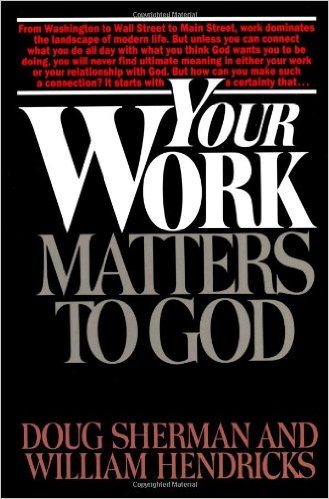
Your Work Matters to GodIn their excellent book Your Work Matters to God,{1} Doug Sherman and William Hendricks expose the wrong ways of thinking about work, and explain how God invests work with intrinsic value and honor. Rick Warren echoes this idea in his blockbuster The Purpose Driven Life when he writes, “Work becomes worship when you dedicate it to God and perform it with an awareness of his presence.”{2}

First, let’s explore some faulty views of work: the secular view, some inappropriate hierarchies that affect how we view work, and work as merely a platform for doing evangelism.

Those who hold a secular view of work believe that life is divided into two disconnected parts. God is in one spiritual dimension and work is in the other real dimension, and the two have nothing to do with each other. God stays in His corner of the universe while I go to work and live my life, and these different realms never interact.

One problem with this secular view is that it sets us up for disappointment. If you leave God out of the picture, you’ll have to get your sense of importance, fulfillment and reward from someplace else: work. Work is the answer to the question, “Who am I, and why am I important?” That is a very shaky foundation—because what happens if you lose your job? You’re suddenly a “nobody,” and you are not important because you are not employed.

The secular view of work tends to make an idol of career. Career becomes the number one priority in your life. Your relationship with God takes a back seat, family takes a back seat, even your relationship with other people takes a back seat to work. Everything gets filtered through the question, “What impact will this have on my career?”

The secular view of work leaves God out of the system. This is particularly unacceptable for Christians, because God calls us to make Him the center of our life.{3} He wants us to have a biblical worldview that weaves Him into every aspect of our lives, including work. He wants to be invited into our work; He wants to be Lord of our work.{4}

Inappropriate Hierarchies: Soul/Body, Temporal/Eternal

In this article, we’re examining some faulty views of work. One comes from believing that the soul matters more than the body. We can wrongly believe that God only cares about our soul, and our bodies don’t really matter. The body is not important, we can think: it is only temporal, and it will fade and die. But if that view were true, then why did God make a physical universe? Why did He put Adam and Eve in the garden to cultivate and keep it? He didn’t charge them with, “Go and make disciples of all nations which aren’t in existence yet, but they will be as soon as you guys go off and start making babies.” No, He said, “Here’s the garden, now cultivate it.” He gave them a job to do that had nothing to do with evangelism or church work. There is something important about our bodies, and God is honored by work that honors and cares for the body—which, after all, is His good creation.

Another wrong way of thinking is to value the eternal over the temporal so much that we believe only eternal things matter. Some people believe that if you work for things that won’t last into eternity—jobs like roofing and party planning and advertising—you’re wasting your time. This wrong thinking needs to be countered by the truth that God created two sides to reality, the temporal and the eternal. The natural universe God made is very real, just as real as the supernatural universe. Asking which one is real and important is like asking which is real, our nine months in our mother’s womb or life after birth? They are both real; they are both necessary. We have to go through one to get to the other.

Those things we do and make on earth DO have value, given the category they were made for: time. It’s okay for things to have simply temporal value, since God chose for us to live in time before we live in eternity. Our work counts in both time and eternity because God is looking for faithfulness now, and the only way to demonstrate faithfulness is within this physical world. Spiritual needs are important, of course, but first physical needs need to be met. Try sharing the gospel with someone who hasn’t eaten in three days! Some needs are temporal, and those needs must be met. So God equips people with abilities to meet the needs of His creation. In meeting the legitimate physical, temporal needs of people, our work serves people, and people have eternal value because God loves us and made us in His image.

The Sacred/Spiritual Dichotomy; Work as a Platform for Evangelism

Another faulty view of work comes from believing that spiritual, sacred things are far more important than physical, secular things. REAL work, people can think, is serving God in full-time Christian service, and then there’s everything else running a very poor second. This can induce us to think either too highly of ourselves or too lowly of ourselves. We can think, “Real work is serving God, and then there’s what others do” (which sets us up for condescension), or “Real work is serving God, and then there’s what I have to do” (which sets us up for false guilt and a sense of “missing it”).

It’s an improper way to view life as divided between the sacred and the secular. ALL of life relates to God and is sacred, whether we’re making a business presentation or changing soiled diapers or leading someone to faith in Christ. It’s unwise to think there are sacred things we do and there are secular things we do. It all depends on what’s going on in our hearts. You can engage in what looks like holy activity like prayer and Bible study with a dark, self-centered, unforgiving spirit. Remember the Pharisees? And on the other hand, you can work at a job in a very secular atmosphere where the conversation is littered with profanity, the work is slipshod, the politics are wearisome, and yet like Daniel or Joseph in the Old Testament you can keep your own conversation pure and your behavior above reproach. You can bring honor and glory to God in a very worldly environment. God does not want us to do holy things, He wants us to be holy people.

A final faulty view of work sees it only as a platform for doing evangelism. If every interaction doesn’t lead to an opportunity to share the gospel, one is a failure. Evangelism should be a priority, true, but not our only priority. Life is broader than evangelism. In Ephesians 1, Paul says three times that God made us, not for evangelism, but to live to the praise of His glory.{5} Instead of concentrating only on evangelism, we need to concentrate on living a life that honors God and loves people. That is far more winsome than all the evangelistic strategies in the world. Besides, if work is only a platform for evangelism, it devalues the work itself, and this view of work is too narrow and unfulfilling.

Next we’ll examine at how God wants us to look at work. You might be quite surprised!

How God Wants Us to See Work

So far, we have discussed faulty views of work, but how does God want us to see it? Here’s a startling thought: we actually work for God Himself! Consider Ephesians 6:5-8, which Paul writes to slaves but which we can apply to employees:

Slaves, obey your earthly masters with respect and fear, and with sincerity of heart, just as you would obey Christ. Obey them not only to win their favor when their eye is on you, but like slaves of Christ, doing the will of God from your heart. Serve wholeheartedly, as if you were serving the Lord, not men, because you know that the Lord will reward everyone for whatever good he does, whether he is slave or free.

It’s helpful to envision that behind every employer stands the Lord Jesus. He sees everything we do, and He appreciates it and will reward us, regardless of the type of work we do. I learned this lesson one day when I was cleaning the grungy bathtub of a family that wouldn’t notice and would never acknowledge or thank me even if they did. I was getting madder by the minute, throwing myself a pity party, when the Lord broke into my thoughts. He quietly said, “I see you. And I appreciate what you’re doing.” Whoa! In an instant, that totally changed everything. Suddenly, I was able to do a menial job—and later on, more important ones—as a labor of love and worship for Jesus. I know He sees and appreciates what I do. It forever changed my view of work.

God also wants us to see that work is His gift to us. It is not a result of the Fall. God gave Adam and Eve the job of cultivating the garden and exercising dominion over the world before sin entered the world. We were created to work, and for work. Work is God’s good gift to us!

Listen to what Solomon wrote:

After looking at the way things are on this earth, here’s what I’ve decided is the best way to live: Take care of yourself, have a good time, and make the most of whatever job you have for as long as God gives you life. And that’s about it. That’s the human lot. Yes, we should make the most of what God gives, both the bounty and the capacity to enjoy it, accepting what’s given and delighting in the work. It’s God’s gift!{6}

Being happy in our work doesn’t depend on the work, it depends on our attitude. To make the most of our job and be happy in our work is a gift God wants to give us!

Why Work is Good

In this article we’re talking about how to think about work correctly. One question needs to be asked, though: Is all work equally valid? Well, no. All legitimate work is an extension of God’s work of maintaining and providing for His creation. Legitimate work is work that contributes to what God wants done in the world and doesn’t contribute to what He doesn’t want done. So non-legitimate work would include jobs that are illegal, such as prostitution, drug dealing, and professional thieves. Then there are jobs that are legal, but still questionable in terms of ethics and morality, such as working in abortion clinics, pornography, and the gambling industry. These jobs are legal, but you have to ask, how are they cooperating with God to benefit His creation?

Work is God’s gift to us. It is His provision in a number of ways. In Your Work Matters to God, the authors suggest five major reasons why work is valuable:

1. Through work we serve people. Most work is part of a huge network of interconnected jobs, industries, goods and services that work together to meet people’s physical needs. Other jobs meet people’s aesthetic and spiritual needs as well.

2. Through work we meet our own needs. Work allows us to exercise the gifts and abilities God gives each person, whether paid or unpaid. God expects adults to provide for themselves and not mooch off others. Scripture says, “If one will not work, neither let him eat!”{7}

3. Through work we meet our family’s needs. God expects the heads of households to provide for their families. He says, “If anyone does not provide for his relatives, and especially for his immediate family, he has denied the faith and is worse than an unbeliever.”{8}

4. Through work we earn money to give to others. In both the Old and New Testaments, God tells us to be generous in meeting the needs of the poor and those who minister to us spiritually. {9}

5. Through work we love God. One of God’s love languages is obedience. When we work, we are obeying His two great commandments to love Him and love our neighbor as we love ourselves.{10} We love God by obeying Him from the heart. We love our neighbor as we serve other people through our work.

We bring glory to God by working industriously, demonstrating what He is like, and serving others by cooperating with God to meet their needs. In serving others, we serve God. And that’s why our work matters to God.

Notes

1. Doug Sherman and William Hendricks, Your Work Matters to God. Colorado Springs: NavPress, 1987.
2. Rick Warren, The Purpose Driven Life. Grand Rapids: Zondervan, 2002. p. 67.
3. Philippians 1:21
4. Romans 12:1, 2
5. Ephesians 1:6, 12, 14
6. Ecclesiastes 5:18-19, The Message.
7. 2 Thess. 3:10
8. 1 Tim. 5:8
9. Leviticus 19:10—Nor shall you glean your vineyard, nor shall you gather the fallen fruit of your vineyard; you shall leave them for the needy and for the stranger. I am the LORD your God. Ephesians 4:28—Let him who steals, steal no longer but rather let him labor performing with his own hands what is good in order that he may have something to share with him who has need. Gal 6:6—The one who is taught the word is to share all good things with the one who teaches him.
10. Matthew 22:37-39

© 2004 Probe Ministries.


Living With an Eternal Perspective

Sue Bohlin considers several ways to develop a way of seeing our earthly life as part of the much bigger picture that extends into eternity.

What Does It Mean To Live With an Eternal Perspective?

Years ago, after spending his whole life on the mission field, a career missionary made his final trip home on a passenger ship. One of the other people on his sailing was a celebrity, and as the ship made its way into the harbor, all those on board beheld a huge throng of well wishers at the pier with signs and instruments to celebrate the famous person’s return.

download-podcast
The missionary stood at the railing, watching wistfully, knowing that not a soul was there for him. He said, “Lord, I’ve served You my whole life. Look at all the recognition and revelry for that famous person, and there’s nobody here for me. It hurts, Lord.”

He heard the still, small voice say, “You’re not home yet, son.”

I love this story that helps me keep in mind the big picture that includes the eternal, unseen realm, and the long picture that extends into the forever that awaits on the other side of death.

The apostle Paul had a firm grasp on what it means to live with an eternal perspective. We can especially see this in 2 Corinthians 4:16-18—

So we do not lose heart. Though our outer self is wasting away, our inner self is being renewed day by day. For this light momentary affliction is preparing for us an eternal weight of glory beyond all comparison, as we look not to the things that are seen but to the things that are unseen. For the things that are seen are transient, but the things that are unseen are eternal.

In these verses, Paul provides three aspects of an eternal perspective that kept him from losing heart, despite living with profound physical persecution and assault such as being hammered with stones, whipped by a cat-o’-nine-tails, beaten with rods, and shipwrecked. He knew what it was to go without sleep, food or drink, sometimes he was cold and naked. The man knew what it was to suffer! (2 Corinthians 11:23-29)

But Paul had a sort of spiritual periscope that allowed him to “see above” into the spirit realm while continuing to “live below” in this physical world. He saw the contrast between our bodies and our souls, how earthly affliction prepares us for glory, and the need to focus on the unseen and eternal rather than the seen and temporary.

Paul’s Eternal Perspective

The apostle Paul showed us in 2 Corinthians 4 that he understood what it was to live with an eternal perspective. He understood that our bodies can be growing older and weaker on the outside, while our spirits are growing stronger, brighter, and more mature on the inside. I get that; as a polio survivor who has also needed both my hips replaced, I am very aware that I keep getting weaker the longer I live in this compromised body. But I also know the beauty and glory of Jesus making me more and more like Himself, day by day, so by His grace I can keep growing in vitality and joy on the inside! I may have diminishing energy in my body, but my spiritual energy capacity keeps getting bigger!

Paul also understood that the hard parts of living in a fallen world, much less living with the pains and trials of persecution, are merely a “light and momentary affliction” compared to what’s waiting on the other side: an eternal weight of glory beyond all comparison. Even horrible pain on earth is still “light and momentary” compared to the infinite length and glory of eternity with Christ. We can see how the Lord Jesus modeled this understanding as He faced the cross, and Hebrews tells us that He “despised its shame” because He was valuing the glory of the joy set before Him (12:2)

And Paul understood that we can shift our focus from the visible and temporary things of this world, to the unseen and eternal things of the spirit realm. We have to work at seeing the unseen and eternal. We do that with the eyes of our hearts (Ephesians 1:18). We do that by training ourselves to view everything through the lens of God’s word.

I’ve been working at developing an eternal perspective for years. For me, it’s about connecting the dots between earthly things and heavenly things.

I look at earthly things and wonder, “How does this connect to the spirit realm? How does this connect to what is unseen and eternal?” For examples, look at my blog posts, such as Glorious Morning Glories [probe.org/glorious-morning-glories/], Back Infections and Heart Infections [probe.org/back-infections-and-heart-infections/], Cruise Ships, Roller Coasters and Attitudes [probe.org/cruise-ships-roller-coasters-and-attitudes/], and Blowing Past Greatness [probe.org/blowing-past-greatness/].

Jesus’ parables are the world’s best examples of using the physical to provide understanding of the eternal. He was always connecting the dots between the things He was surrounded by—different types of soil, lost coins and sheep and sons, a wedding banquet—and explaining how these things related to the Kingdom of Heaven.

One of the most important prayers we can ask is, “Lord, help me see Your hand at work”—and then intentionally looking for it. For years I have kept a “God Sightings” Journal where I recorded evidence of God intervening in my life and the lives of others I have seen. I love to ask my friends and mentees, “Do you any God Sightings to share?” to help them identify the hand of God in their lives.

An Eternal Perspective on Suffering

As we talk about living with an eternal perspective, let’s remember that we live in a permanent battle zone of spiritual warfare. We have an enemy who hates us because He hates God. He and his fellow demons continually attack us with lies and deceptions. Some are personal, but many of them constitute the cultural water we swim in.

When we forget that we live in a culture of anti-God, anti-truth, it’s like going out in our underwear, needlessly exposing ourselves. Living with an eternal perspective means staying vigilant, donning our spiritual armor (Ephesians 6:10-18) and using it to fight back against the lies of the enemy.

Spiritual warfare is HARD. It means suffering. Sometimes physical, most often mental—because spiritual warfare is waged on the battlefield of the mind. But the suffering of spiritual warfare is temporary, because the vast majority of the believer’s life will be spent in heaven where warfare of all kinds will be a distant memory.

But for right now, suffering is still part of life, and developing and maintaining an eternal perspective really helps us remind ourselves of the larger truth. Romans 8:18 says that “our present sufferings are not worth comparing with the glory that will be revealed in us.” Being faithful when we’re suffering means glory in the future.

My friend Holly has battled cancer three times on top of the horribleness of cystic fibrosis. She suffers literally every day of her life. Yet, with a beautiful, godly stubbornness, she reminds herself of what is true: “What if the worst thing happens? Oh wait, it can’t. The worst thing that can possibly happen to anyone is to die apart from Christ and spend eternity in torment. For me, to die means instant joy and relief in the arms of my Savior!”

Like Joni Eareckson Tada, my friend Chris has lived with quadriplegia for almost fifty years. What comes to mind when I think of Chris is two words: “sweet joy.” Because of his eternal perspective, Chris knows his suffering is temporary, and he chooses not to give into self-pity. People are drawn to him like honey because of how he radiates Jesus.

And then there’s me. I’ve lived with a disability my whole life. As a polio survivor, I have walked every step with a very noticeable limp. Living with an eternal perspective means that, by the grace of God, I know I will receive a beautiful, strong, perfectly healthy resurrection body in heaven. My polio days are limited, but my resurrection body days will be unlimited! Meanwhile, I get to see God use my disability for His glory and others’ good in ways I never would have imagined. It really is okay!

Remembering the Long View

Another aspect of living with an eternal perspective is focusing on the reality that our time on earth is short, especially compared to the never-ending life on the other side of death.

One of my favorite questions is to ask, “A hundred years from now, when you are face to face with Jesus in heaven, what do you want to be glad you chose today? Indulging your flesh and doing whatever you think will make you happy right now, or making choices that honor God and bless other people?”

Probably my favorite question remains an essential part of my eternal perspective: passing everything through the grid of the great question, “In the scope of eternity, what does this matter?” [probe.org/in-the-scope-of-eternity/]The frustrations of traffic? Not getting our way? A loved one who does not know Christ? The answer determines what is worth getting upset about, what we should just let go, and where we should be investing time in prayer.

We can remember the long view by pre-deciding now that we will use our earthly days fully, engaged in ministry, as long as God gives us breath.

Years ago, my view of living with an eternal perspective was shaped by the story of a lady who decided to start college in her 70s. When they asked her why she would do such a thing when her life was basically over, she said, “Oh no! It’s not over! I’m preparing for the next part of my life in heaven! The more equipped I can get on earth, the more ready I’ll be for what the Lord has for me on the other side!”

Another lady was homebound because she was so disabled. She got the word out that every afternoon, her home was open for anyone who needed prayer. Some days it was like there was a revolving door, so many coming and going! She had a vibrant ministry in the waning days of her life because she was determined to use her remaining earthly days fully, to the glory of God.

One of my friends is a TSA [Transportation Security Administration, part of the U.S. Government] agent at a major airport. She diligently reminds herself daily that every traveler who comes through the security line is infinitely valuable because they are made in the image of God, and Jesus died for them. She showers kindness on them because they are so important. One of her co-workers, for whom work is just a job where he punches a time clock, once told her, “In twelve months you’ll stop being nice to everyone.” We don’t think so. (Especially since she’s already had this job for several years.) She works at maintaining an eternal perspective, seeing the unseen.

In the time you have now, live well, to the glory of God. Keep reminding yourself that everything we do now has an eternal impact. Our choices, our behaviors, our words, ripple into eternity. Which is why we need to seek to do everything for the glory of God.

Eternal Perspective is What God Sees

As a mom of littles, Nicole Johnson was feeling sorry for herself when she met with a friend who had just returned from Europe. She writes,

“My friend turned to me with a beautifully wrapped package, and said, ‘I brought you this.’ It was a book on the great cathedrals of Europe. I wasn’t exactly sure why she’d given it to me until I read her inscription: ‘With admiration for the greatness of what you are building when no one sees.’

“In the days ahead I would read—no, devour—the book. And I would discover what would become for me, four life-changing truths, after which I could pattern my work:

“1) No one can say who built the great cathedrals—we have no
record of their names.

“2) These builders gave their whole lives for a work they would
never see finished.

“3) They made great sacrifices and expected no credit.

“4) The passion of their building was fueled by their faith that the eyes of God saw everything.

“There’s a story in the book about a rich man who came to visit the cathedral while it was being built, and he saw a workman carving a tiny bird on the inside of a beam. He was puzzled and asked the man, ‘Why are you spending so much time carving that bird into a beam that will be covered by the roof? No one will ever see it.’

“And the workman replied, ‘Because God sees it.’{1}

Living with an eternal perspective as we make choices and invest our time to glorify God is like building a cathedral that we won’t be able to see finished.

It means living with the long view in mind, aware that the things we can see, hear, and feel are temporary, but the spiritual realm is permanent.

An eternal perspective means that the things you do that no one sees but God—the unseen and eternal—they matter!

God tells us in Isaiah that our purpose in life is to glorify Him (43:7). Paul puts a point on this in 1 Corinthians 10:31: “Whether you eat or drink or whatever you do, do it all for the glory of God.”

And that’s the key to living with an eternal perspective.

Notes

1. thejoysofboys.com/monday-motivation-the-invisible-mom/

©2021 Probe Ministries


“What Color Were Adam and Eve?”


Hey Sue, what color were Adam and Eve?

It’s so helpful to have a Ph.D. in molecular and cell biology in the house! Here’s Ray’s answer:

“We can’t know for sure, but here’s my educated guess: They contained all the different skin pigment genes that would end up being distributed to all the various peoples of the world. God would have created them with some level of melanin for skin protection from the sun. They probably would have been not white, not black, probably brownish—like Mediterranean coloring.”

Hope you find this helpful!

Sue Bohlin
Posted March 2025


Four Killer Questions: Power Tools for Great Question-Asking

Sue Bohlin provides helpful information for use in helping sharpen the question-asking skills of fellow believers as well as in evangelism. These “understanding questions” help Christians sharpen their biblical worldview and help unbelievers delve into the inconsistencies of their own worldview.

Download the PodcastDr. Jeff Myers of Bryan College and Summit Ministries shares our passion for helping others develop a biblical worldview. One of the tools he offers in developing critical thinking skills is how to use the right question at the right time.

He suggests four “killer questions” to help anyone think critically.{1} The first question is, What do you mean by that? In other words, define your terms. The second question is, Where do you get your information? The third is, How do you know that’s true?, and the fourth killer question is, What if you’re wrong?

Dr. Myers tells this story:

“A friend took a group of third graders to the Denver Museum of Natural History.

“Before he took them inside, he knelt down on their level and said, ‘Kids, if anybody in this museum tells you anything, I want you to ask them, how do you know that’s true?‘ Giving this question to a third grader is the intellectual equivalent of giving them a surface-to-air missile. These kids walked into the museum; all they knew was, Ask: How do you know that’s true?

“A paleontologist was going to show them how to find a fossil. Apparently they had intentionally buried a fossil down in the soil sample and she said, ‘We’re going to find it.’ Very clever, right? No, not with this crowd. ‘Cause they started asking questions like, ‘Well, how do you know there’s a fossil down in there?’ ‘Well, because we just know there’s a fossil down there.’ ‘Why do you want to find it?’ ‘Well, because we want to study it.’ ‘Why do you want to study it?’ ‘We want to find out how old it is.’ Well, how old do you think it is?’ ‘About 60 million years old.’

“‘Lady, how do you know that is true?’”

“She patronized them. She said, ‘Well, you see, I’m a scientist, I study these things, I just know that.’ They said, ‘Well, how do you know that’s true?’ Anytime she said anything at all they just asked, ‘How do you know that’s true?’ What happened next proves that truth is stranger than fiction. She threw down her tools, glared at these children, and said, ‘Look, children, I don’t know, OK? I just work here!’”{2}

Question #1: What do you mean by that?

The first question is, What do you mean by that? You want to get the other person to define his terms and explain what he is saying. If you don’t make sure you understand what the other person means, you could end up having a conversation using the same words but meaning very different things.

When I was a new believer, I was approached on the street by some people collecting money for a ministry to young people. I asked, naively, “Do you teach about Jesus?” They said, rather tentatively, “Yesss. . . .” I gave them some money and asked for their literature (which was in the reverse order of what I should have done). Only later did I learn that they did indeed teach about Jesus—that He was the brother of Satan! I wish I had had this first killer question back then. I would have asked, “What do you teach about Jesus? Who is He to you?”

Get the other person’s definition. Let’s say you’re talking to a neighbor who says, “I don’t believe there is a God.” Don’t quarrel with him: “Oh yes there is!” “No, there’s not.” Second Timothy 2:24-25 says not to quarrel with anyone. Just start asking questions instead. “What do you mean by ‘God’? What’s your understanding of this God who isn’t there?” Let him define that which does not exist! You may well find out that the god he rejects is a mean, cold, abusive god who looks a lot like his father. In that case, you can assure him that you don’t believe in that god either. The true God is altogether different. If it were me, at this point I wouldn’t pursue the existence of God argument, but rather try to understand where the other person is coming from, showing the compassion and grace of God to someone bearing painful scars on his soul.

Let’s say someone says she is for a woman’s right to choose abortion. You can ask, “What do you mean by ‘woman’? Only adult women? What if the baby is a girl, what about her right to choose? What do you mean by ‘right’? Where does that right come from?” Do you see how asking What do you mean by that? can expose problems in the other person’s perspective?

Question #2: Where do you get your information?

The question Where do you get your information? is particularly important in today’s culture, where we drown in information from a huge array of sources. Information is being pumped at us from TV, radio, music, Websites, email, blogs, billboards, movies, and conversations with people who have no truth filters in place at all. Consider the kind of responses you could get to the question, Where do you get your information?

“I heard it somewhere.” Well, how’s that for reliable? Follow with another killer question, How do you know it’s true?

“Everybody says so.” That may be so, but is it true? If you say something loud enough, often enough, and long enough, people will believe it’s true even if it isn’t. For example, “everybody says” people are born gay. Doesn’t everybody know that by now? That’s what we hear, every day, but where is the science to back up that assertion? Turns out, there is none. Not a shred of proof that there is a gay gene.

Someone else may say, “I read it somewhere.” So ask, in a legitimate newspaper or magazine? Or in a tabloid? Elvis is not alive, and you can’t lose twenty-five pounds in a week. You might have read it somewhere, but there is a word for that kind of writing: fiction.

Did you see it on the internet? That could be a single individual with great graphics abilities pumping out his own totally made-up stuff. Or it could be a trustworthy, legitimate website like Probe.org.

Did you see it on TV? Who said it, and how trustworthy is the source? Was it fact, or opinion? Be aware of the worldview agenda behind the major media outlets. Former CBS reporter Bernard Goldberg exposed the leftist leanings of the media in his book Bias: A CBS Insider Exposes How the Media Distort the News. Most of what you see on TV is what the Bible calls “the world,” and we are to be discerning and skeptical of the values and information it pumps out.

Don’t be fooled by someone sounding confident and self-assured. Many people feel confident without any basis for feeling that way. Ask, Where do you get your information? It’s a great killer question.

Question #3: How do you know that’s true?

The third killer question is, How do you know that’s true? This is probably the most powerful question of them all. It puts the burden of proof on the other person.

Most people aren’t aware of what they assume is true; there’s simply no other way to see the world. They often believe what they believe without asking if it’s true, if it aligns with reality. If you respectfully ask killer questions like How do you know that’s true?, all of a sudden it can begin to occur to folks that what they believe, they believe by faith. But where is their faith placed?

Sometimes, the kindest thing we can do for people is gently shake up their presuppositions and invite them to think.

The reigning philosophy in science today is materialism, the insistence that the physical universe is all that exists. Something is only real if it can be measured and quantified. We need to ask, How do you know there is nothing outside the matter-space-time-energy continuum? How do you know that the instruments of physical measurement are the only ones that matter? How do you know there isn’t something non-physical, which cannot be measured with physical measuring tools? If all you have is a ruler, how do you measure weight? (And if all you have is a ruler, and someone wants to talk about weight, it would be easy to deny there is such a thing as weight, only height and length, a lot like the materialists’ insistence that since we can’t measure the supernatural, it doesn’t exist.)

At the heart of the debate over stem cell research is the question of the personhood of a human embryo. Those who insist that it’s not life until implantation need to be asked, How do you know that’s true? It’s genetically identical to the embryo ten minutes before implantation. How do you know those are only a clump of cells and not a human being?

Postmodern thought says that no one can know truth. This philosophy has permeated just about every college campus. To the professor who asserts, “No one can know truth,” a student should ask, How do you know that’s true? If that sounds slightly crazy to you, good! A teacher who says there is no truth, or that if there is, no one can know it, says it because he or she believes it to be true, or they wouldn’t be saying it!

We get hostile email at Probe informing us of how stupid and biased we are for believing the Bible, since it has been mistranslated and changed over the centuries and it was written by man anyway. When I ask, “How do you know this is true?”, I don’t get answers back. Putting the burden of proof on the other person is quite legitimate. People are often just repeating what they have heard from others. But we have to be ready to offer a defense for the hope that is in us as well.{3} Of course, when we point to the Bible as our source of information, it’s appropriate to ask the killer question, “How do you know that’s true?” Fortunately, there is a huge amount of evidence that today’s Bible is virtually the same as the original manuscripts. And there is strong evidence for its supernatural origins because of things like fulfilled prophecy. Go to the “Reasons to Believe” section of Probe.org for a number of articles on why we can trust that the Bible is really God’s word.

There are a lot of mistaken, deceived people who believe in reincarnation and insist they remember their past lives. Shirley MacLaine claims to have been a Japanese Geisha, a suicide in Atlantis, an orphan raised by elephants, and the seducer of Charlemagne.{4} Here’s where this killer question comes in. If you lose your life memories when you die, how do you know your past lives are real? When you’re born into a new body and your slate is wiped clean, how do you know it’s you?

So many people have embraced a pragmatic, expedient standard of, “Hey, it works for me.” “It works for me to cheat on my taxes, as long as I don’t get caught.” “It works for me to spend hours on porn sites late at night since my wife doesn’t know how to check the computer’s history.” “It works for me to keep God in his corner of the universe while I do my own thing; I’ll get religious later in life.” Well, how do you know it works? You haven’t seen the whole, big picture. You can’t know the future, and you can’t know how tomorrow’s consequences will be reaped from today’s choices.

Let me add a caveat here. The underlying question behind How do you know that’s true? is really, “Why should I believe you?” It can be quite disconcerting to be challenged this way, so be sure to ask with a friendly face and without an edge in your voice.

Question #4: What if you’re wrong?

One benefit of this question is that it helps us not to “sweat the small stuff.” There are a lot of issues where it just doesn’t matter a whole lot if we’re wrong. If you’re agonizing over a restaurant menu, trying to figure out the best entree, what if you’re wrong? It doesn’t matter. You can probably come back another time. If you can’t, because you’re traveling and you’ll never have another chance, is it going to wreck your life? Absolutely not.

Many of our youth (and, sadly, adults as well) believe that having sex is just part of being social. Many of them believe that sex qualifies as recreation, much like going to an amusement park. They need to be challenged: What if you’re wrong? Besides the high probability of contracting a number of sexually transmitted diseases, there is the ongoing heartache of the discovery that “casual” sex isn’t, because of its lasting impact on the heart.

The ultimate question where this matters is, What do you believe about God? What do you do with Jesus’ statement “I am the way, the truth, and the life; no one comes to the Father except by Me”?{5} What if you believe there is no God, or that you can live however you want and God will let you into heaven because you’re not a mass murderer? We need to ask, What if you’re wrong? You will be separated from God forever!

It’s only fair for Christ-followers to ask that of ourselves. What if we’re wrong? What if we’re actually living an illusion that there is a God and a purpose to life? I would say, “You know what? I still lived a great life, full of peace and purpose and fulfillment. Ultimately, if there were no God, it wouldn’t matter—nothing would matter at all!—but I still loved my life. Either way, if I’m right or I’m wrong, I win.”

These four killer questions are powerful to spark meaningful conversation and encourage yourself, and others, to think critically. Use them wisely, be prepared for some interesting conversations . . . and have fun!

Notes

1. Our fellow worldview apologist Bill Jack of Worldview Academy (www.worldview.org) has also popularized these “killer questions,” but they go back all the way to Socrates.
2. “Created Male and Female: Biblical Light for a Sexually Darkened World” conference sponsored by the International Council for Gender Studies, October 10-12, 2003.
3. 1 Peter 3:15.
4. www.fortunecity.com/emachines/e11/86/duncan2.html
5. John 14:6.

© 2007 Probe Ministries